American Guerrilla Marketing
Nationwide Service
Media planning, media buying, billboard advertising, & guerrilla marketing
Case Study:
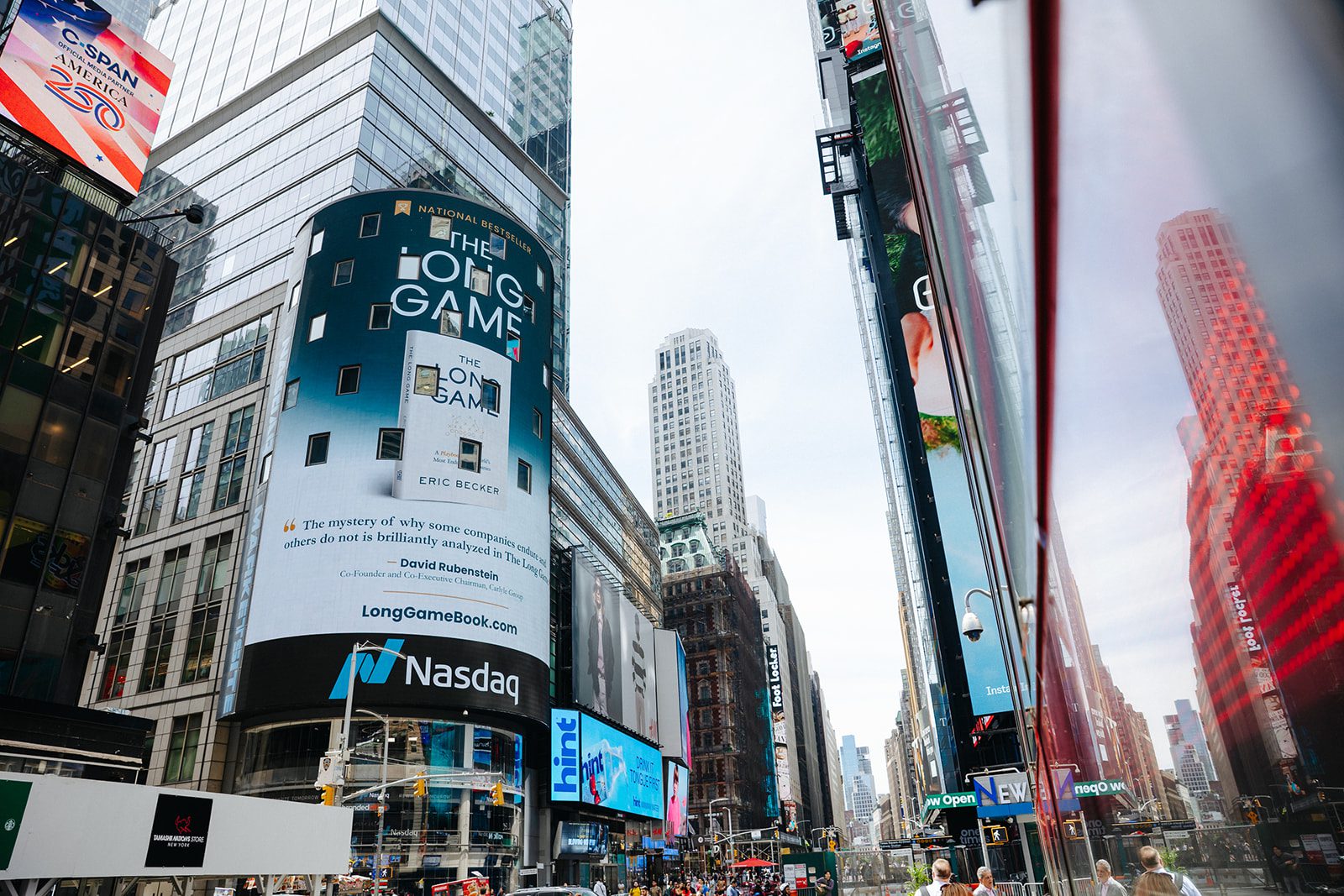
The Long Game By Eric Becker: Nasdaq Times Square Billboard Campaign

Eric Becker is Founder and Co-Chairman of Cresset, a multi-family office with more than 65 billion dollars in assets under management. With co-founder Avy Stein, he has been involved in starting, investing in, and growing over 150 businesses. The Long Game: A Playbook of the World’s Most Enduring Companies is the book that came out of that work, published by Simon & Schuster.
The question the book asks is a good one. Millions of companies struggle to survive a single year. A rare few last a century. What do those companies know, and can a business today be built to last that long on purpose rather than by accident?
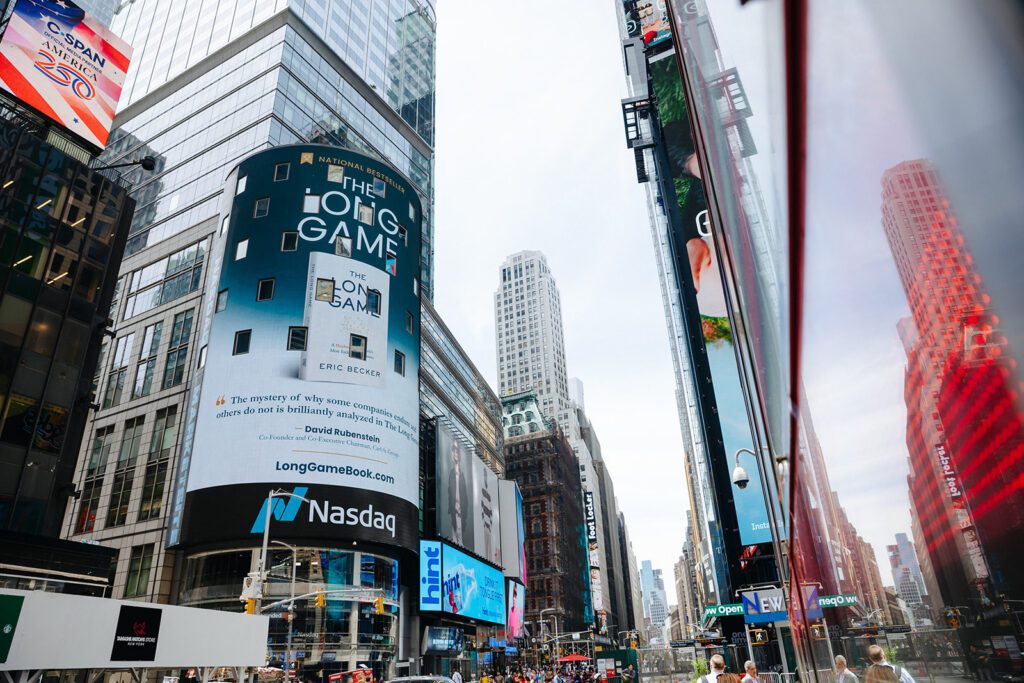
American Guerrilla Marketing booked the Nasdaq Tower in Times Square for that book. The fit is almost too neat. The Nasdaq Tower is the screen the financial world uses to mark companies that made it, the backdrop for listings, openings, and milestones. Putting a book about hundred year companies on the most recognizable business screen on earth is an argument, not an ad.
For an author whose audience is founders, operators, and institutional investors, that placement says something a banner ad cannot. It signals the book belongs in the same conversation as the companies on the screen around it.
What A Nasdaq Tower Buy Actually Includes
The Nasdaq Tower sits at 4 Times Square and is one of the most photographed screens in the world. Buying it is a media placement rather than a production job, which means the mechanics are different from a street campaign.
This buy ran a 15 second spot for a full day, from midnight to 11:59 PM on May 26, at 2.5 minutes of airtime per hour. Across 24 hours that works out to roughly an hour of total screen time, and at 15 seconds per play it comes to around 240 plays over the day. Creative was delivered at 2336 pixels high by 1846 pixels wide, a portrait orientation that reflects the tower’s vertical shape.
Two things about that structure are worth understanding before booking. First, the screen is owned by the venue, not the agency placing the buy, and the slot is only confirmed once payment clears and the venue approves the creative. Creative approval is a real gate, not a formality. Second, a full day flight is sold as a day, so the campaign exists on one calendar date. Everything that happens after that date depends on what was captured while it was live.
That is the part most buyers get wrong, and it is the part this campaign got right.
The Photography Was The Real Deliverable
Here is the honest version of Times Square billboard marketing, and it is not what most vendors selling it will tell you. A single day on a screen in Times Square does not sell books on its own. The people walking through Times Square on a Tuesday are tourists, commuters, and workers, and almost none of them are the institutional investors and founders who buy a book about hundred year companies.
The value is the photograph. A professional shot of an author’s book on the Nasdaq Tower is an asset with a long life. It runs on LinkedIn, where the audience for a business book actually lives. It goes in the author’s media kit, on the book’s website, into speaking proposals, press outreach, and podcast pitches. It becomes the image that introduces the author for years.
So the campaign was built around capture from the start. Professional photography was shot on site while the creative was live, and those images were delivered to the client and repurposed across digital channels. The billboard was the event. The photography is the asset the event produced.
A brand moment like this is bought to be documented. Treat the shoot as the deliverable and the screen time as the means, and the economics make sense. Buy the day and hope someone grabs a phone photo, and they do not.
Campaign Photos




Ready To Put Your Artist Or Brand On The Streets Of America's Top Markets?
Award Winning Personalized Service
You will get thoughtful, devoted, and individualized attention from our experienced, qualified, and professional personnel. Being one of the most illustrious agencies in Brooklyn, New York, American Guerrilla Marketing has been awarded the Best of Brooklyn title.
Nationwide
Industry City, Brooklyn, New York 11232
American Guerrilla Marketing
Hours
Mon - Fri: 9 AM - 5 PM
Sat & Sun: Closed
Automate your campaign with AGM’s Request for Proposal Builder.
Automate your campaign with AGM’s Request for Proposal Builder. Simply answer a few quick questions about your campaign goals, markets, and timeline, and the system will generate a tailored presentation with recommended strategies, quantities, and pricing. Click the RFP Builder to instantly receive your customized proposal.
Shooting A Times Square Billboard Properly
Photographing a screen in Times Square is harder than it looks. The square is bright at all hours and lit by competing screens that throw colored light across everything. Getting a clean frame means knowing where to stand, when the creative cycles, and how to expose for an illuminated display against a dark sky without blowing out the screen or losing the street.
Timing is the main constraint. The spot plays on a rotation, so the photographer has a 15 second window each time it comes up. Knowing the rotation and being in position before it hits is the difference between a usable frame and a near miss. A 2.5 minute per hour schedule gives repeated chances across the day, which is one practical argument for a full day flight over a shorter one.
The brief should cover the range an author will actually use. Tight frames of the screen itself for crops and thumbnails. Wide frames showing the tower in its Times Square context, because the context is what communicates the scale. Vertical compositions for social. Where the author is present, frames of the author with the screen, which are the images that carry the most weight in a media kit.
Why Business Authors Use Out of Home Differently
Most book advertising is built to drive a purchase. A Nasdaq Tower placement is built to establish standing, which is a different objective and should be measured differently.
For a nonfiction business author, the book is often the front of a larger operation. It supports a firm, a speaking calendar, board relationships, and a reputation. A photograph of the book on the Nasdaq Tower works on all of those at once. It is credibility in a single image, and it travels. The same photograph that sits on LinkedIn also appears in the speaker packet, the press kit, and the pitch deck.
Judging a placement like this by direct book sales in the following week misses what it does. The right question is how many conversations, introductions, and bookings the resulting asset supports over the following year.
The audience fit also matters. The Nasdaq Tower carries financial and business association that general Times Square inventory does not. For a book about enduring companies, written by the founder of a multi-family office, that association is the point. A different screen a block away would reach the same pedestrians and say something entirely different.
What To Prepare Before Booking
Creative specs come first. This placement required a 15 second spot at 2336 by 1846 pixels, which is portrait. Creative designed in landscape does not adapt, and a book cover is already a portrait object, so the format is friendlier to publishing than most digital out of home.
Venue approval sits between the booking and the flight. The placement is contingent on the venue approving the creative, so artwork should be finished and submitted with time to absorb a revision. A date confirmed before the creative clears is not actually confirmed.
The photographer should be booked at the same time as the media. Finding a Times Square photographer after the flight date is locked, during a week when the creative is also being finalized, is how campaigns end up with phone snapshots of the most expensive thing in the marketing plan.
Plan the use of the images before the shoot happens. Knowing that the photographs are going to a book site, a LinkedIn campaign, a media kit, and a speaker packet changes the shot list. It is a different brief from shoot the billboard.
Work With American Guerrilla Marketing
AGM places Times Square and Nasdaq Tower billboards, runs wheatpaste poster campaigns, LED billboard trucks, and brand ambassador teams in New York City and nationwide. Book launches, author brand moments, product launches, and corporate announcements. Media placement, creative specs, photography, and reporting.
Planning a book launch or an author brand moment? Email us at [email protected] or call (646) 776-2770.
Frequently Asked Questions
Yes. Digital screens in Times Square, including the Nasdaq Tower, sell flights by the day with a set amount of airtime per hour. This campaign ran a 15 second spot for a full day at 2.5 minutes per hour, which comes to roughly an hour of total screen time. Creative must meet the venue’s spec and be approved by the venue before the flight runs.
Not directly, and anyone promising otherwise is overselling it. Times Square pedestrians are mostly tourists and commuters, who are not the buyers for a business book. The return comes from the photography. A professional image of the book on the Nasdaq Tower gets used on LinkedIn, in media kits, in speaking proposals, and in press outreach for years. Buy the placement for the asset it produces, not for walk-by conversions.
This placement called for a 15 second spot delivered at 2336 pixels high by 1846 pixels wide, a portrait format matching the tower’s vertical shape. Specs vary by screen and by vendor, so confirm the exact dimensions and duration before design begins. Build the creative to the real spec from the start, because a landscape design cannot be cropped into a portrait screen without losing the composition.
On this buy, 2.5 minutes per hour across a full 24 hour day, from 12:00 AM to 11:59 PM. At 15 seconds per play that is approximately 240 plays over the day. Packages differ, so the two numbers to confirm are minutes per hour and the length of the flight, since together they determine total screen time.
Association. The Nasdaq Tower carries financial and business meaning that general Times Square inventory does not, because it is the screen used to mark listings and corporate milestones. For a business book, a finance author, or a company announcement, that context does part of the communication. For a consumer product, a different screen may reach the same people more cheaply with no loss.
Always, and book them at the same time as the media. The flight is one day. If nobody captures it properly, the campaign leaves nothing behind. A professional shoot produces tight crops, wide contextual frames, vertical social compositions, and author portraits with the screen, which is the material that keeps working long after the flight ends.
LinkedIn first for a business book, because that is where the readership is. Then the book’s website, the author’s media kit, press and podcast outreach, speaking proposals, and publisher communications. Plan those uses before the shoot so the shot list covers the crops and orientations each destination needs.