
July 24, 2026
Yard Sign Marketing Campaigns: Political, Real Estate, and Event Formats That Work
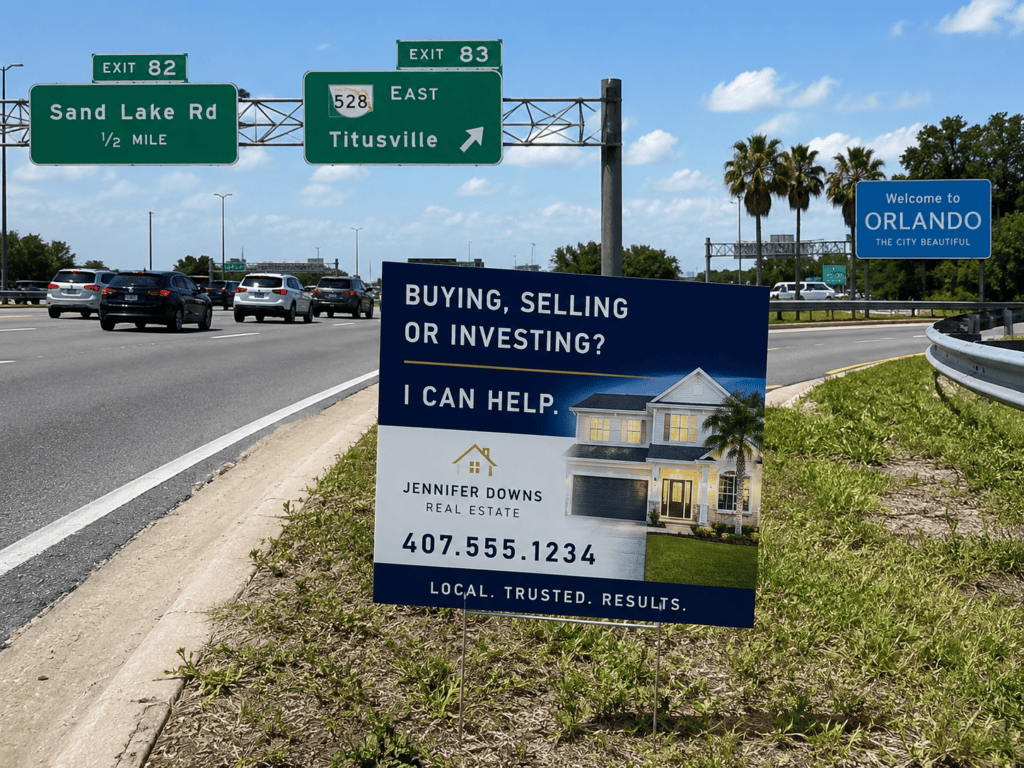
Yard signs are one of the most underestimated formats in outdoor marketing. The format looks simple — a corrugated plastic rectangle on a wire stake — but effective yard sign campaigns require the same strategic thinking that any outdoor format demands: the right message, the right placement, the right density, and the right audience environment. When all of those elements align, yard sign campaigns can generate local awareness at a cost-per-impression that sophisticated OOH formats can’t match.
When they don’t align, you get what most marketers think of when they imagine yard sign campaigns: scattered, low-visibility signs that generate no meaningful awareness and disappear into the visual noise of the suburban environment within a week. The difference between those outcomes is understanding what yard signs actually do well, and deploying them accordingly.
This guide covers yard sign marketing from the ground up — design principles, legal placement frameworks, format variations, the specific use cases where the format excels, and how to run yard sign programs at scale across multiple neighborhoods or markets. Our team at American Guerrilla Marketing coordinates outdoor marketing campaigns including yard sign programs across 50+ U.S. markets from our base in Industry City, Brooklyn.
What Yard Signs Actually Do Well
Before planning a yard sign campaign, understand what the format can and cannot achieve. Yard signs are fundamentally a high-frequency local awareness tool. They work through repetition: a driver who passes through the same neighborhood sees the same signs on the same properties day after day, building awareness through repeated exposure. This frequency within a defined geographic area is the format’s core strength.
What yard signs cannot do effectively: reach audiences outside the immediate geographic area where signs are placed, communicate complex messages, drive direct response without a supporting digital or call infrastructure, or generate awareness through a single placement. The format requires density and duration to produce results. A few signs scattered across a wide geography is not a campaign; it’s sign placement.
Yard Signs as Local Saturation Tools
The most effective yard sign programs treat the format as a neighborhood saturation tool. The goal is to create the experience, for residents and commuters passing through the target area, that the brand or message is everywhere in their immediate environment. This requires enough signs, concentrated tightly enough, to be visible from multiple positions during a typical neighborhood transit — whether driving, cycling, or walking. In most suburban environments, 100-300 signs within a one-to-two-mile radius achieves this saturation effect.
Political Campaign Applications
Political campaigns are the most established users of yard sign programs, and for good reason. The format’s characteristics — local saturation, social proof through visible neighborhood support, low cost per sign — align well with political campaign objectives at the local and regional level.
Social Proof as the Primary Mechanism
Yard signs in political contexts function as much as social proof as they do as direct communication. Seeing a candidate’s signs on multiple properties in your neighborhood communicates that your neighbors support this candidate — a form of peer validation that other advertising formats cannot replicate. The number of signs visible in a neighborhood is a signal about the level of community support, not just the candidate’s advertising budget. This social proof mechanism is particularly powerful in local races where voters know and are influenced by their neighbors’ choices.
Geographic Targeting for Political Programs
Effective political yard sign programs target placement by precinct-level voter analysis, not just general territory coverage. Concentrating signs in precincts with high target-voter density and lower sign saturation from opponents creates the visibility and social proof effect with maximum efficiency. Random geographic distribution of available signs produces far weaker results than a precinct-targeted deployment that concentrates signs where they generate the most relevant visibility.
Door-to-Door Placement Programs
Political yard sign programs combine well with canvassing operations: a canvasser who has a productive conversation with a voter can leave a sign with that voter at the same visit, converting the conversation into a visible signal of support that will be seen by the voter’s neighbors for the remaining weeks of the campaign. This integration of direct voter contact with sign placement is more efficient than separate sign placement operations and produces higher sign density in the highest-engagement precincts.
Real Estate Yard Sign Marketing
Real estate is the other dominant yard sign application, and the format’s characteristics make it nearly indispensable for property marketing at the local level. A listing sign on the property itself is the most basic application, but sophisticated real estate marketers extend the yard sign program beyond the listing property to create neighborhood awareness of the listing and the agent’s activity in the market.
Directional Sign Programs
Directional signs placed at intersections within a half-mile radius of a listing drive open house traffic and create awareness of listing activity in the neighborhood beyond the limited audience of people who happen to drive directly past the property. A well-placed directional sign program at every major approach intersection to a listing area can increase open house attendance significantly and extends the agent’s brand presence throughout the immediate neighborhood.
Neighborhood Farming with Yard Signs
Real estate agents who want to establish market presence in a target neighborhood use yard signs as a brand-farming tool beyond individual listing promotion. Just-listed, just-sold, and open house signs, each bearing consistent agent branding, create cumulative neighborhood awareness of the agent’s activity in that specific market. Over time, this repeated visibility builds the mental association that residents reach for when they decide to sell: “I see that agent’s signs everywhere in this neighborhood.”
Event and Retail Yard Sign Programs
Event marketing uses yard signs as directional tools along approach routes and for general awareness in the event’s geographic catchment area. The format is particularly effective for local events — farmers markets, community festivals, retail grand openings — where the target audience is geographically proximate and needs to know both that the event exists and where it is.
Grand Opening Yard Sign Campaigns
Retail grand opening campaigns benefit from yard sign saturation in the radius around the new location. Signs placed in residential neighborhoods within the primary trade area of the store, along the main approach routes from residential areas, and at intersections with high commuter traffic create awareness in the specific geography that matters most: the people who live and commute close enough to the location that they’re the most natural customers.
Pairing a yard sign program with brand ambassador deployments at nearby high-traffic locations, poster placements on commercial building surfaces in the trade area, and sidewalk stencils near the location creates a multi-format campaign that reinforces the yard sign awareness with additional high-frequency touchpoints in the same geographic area.
Yard Sign Design Principles
Yard sign design is constrained by a fundamental viewing reality: most audiences encounter yard signs from a moving vehicle at 25-45 mph with 2-4 seconds of viewing time. Design decisions should start from this constraint, not from aesthetic preferences developed for print or digital contexts where viewing time is longer and the audience is stationary.
The Three-Element Rule
Effective yard signs use three design elements at most: a dominant brand mark or visual element, a primary message line, and a contact mechanism. Adding a fourth element — a tagline, a secondary message, an additional logo — reduces the readability of the primary message. Resist the temptation to make a yard sign do more than it can. Its job is to communicate one thing clearly at vehicle speed.
Color Contrast Over Aesthetic Appeal
Color choices should optimize for contrast — the single most important readability factor at vehicle speed. Dark text on a light background, or light text on a dark background, with high contrast between the two. Complementary color combinations that look interesting in a design mockup often fail in real-world viewing conditions where the sign is backlit, front-lit, in shadow, or competing with adjacent environmental colors. Test sign designs in real outdoor conditions before committing to a print run.
Text Size and Hierarchy
Standard 18×24″ yard signs should have primary text no smaller than 4-5″ in height. Text smaller than that is not reliably readable at 30 feet by a moving viewer. Message hierarchy should place the most important information at the largest type size, with secondary information (phone number, URL) at a legible but visually subordinate size that doesn’t compete with the primary message for attention.
Logistics: Running a Yard Sign Program at Scale
A yard sign program with 200+ signs across a neighborhood or multi-neighborhood footprint is a genuine logistics operation. Signs need to be produced, transported, placed, maintained, and retrieved, with documentation of placement locations for performance tracking and removal coordination.
Placement Permission Management
For private property placements, permission management is essential. A program that places signs on private property without explicit owner permission creates liability exposure and produces signs that get pulled immediately by annoyed property owners. Permission collection — either through direct outreach, organized volunteer programs in political contexts, or coordinated resident programs for retail or event campaigns — needs to be built into the campaign logistics before placement begins.
Route Optimization and Crew Efficiency
Large-scale placement programs benefit from route optimization that minimizes crew travel time between placements. Mapping placement targets in advance, clustering assignments by geography, and optimizing crew routes through the placement map can cut crew time by 30-50% relative to unplanned deployment. This efficiency directly reduces labor cost and increases placement density per campaign dollar.
Frequently Asked Questions
What is yard sign marketing?
American Guerrilla Marketing provides yard sign marketing services across 50+ U.S. markets. Every campaign is planned, scouted, executed, and GPS-documented by our field teams. We work with regional brands and Fortune 500 companies on campaigns that require real street-level execution and documented proof of performance.
How does AGM approach sign marketing?
Our process starts with a market consultation to understand your goals, target audience, and budget. We then scout locations, handle any required permissions or permits, coordinate production and installation with our local crews, and provide a full GPS-tagged photo report after the campaign runs.
What markets does American Guerrilla Marketing cover for sign marketing?
We operate in 50+ U.S. markets including New York, Los Angeles, Chicago, Miami, Houston, Atlanta, Seattle, Denver, Boston, and dozens of secondary markets. Contact us to confirm availability and pricing for your specific market.
How much does a sign marketing campaign cost?
Campaign pricing depends on market, format, quantity, and duration. We work with budgets ranging from targeted single-market runs to national rollouts across multiple cities. Use our RFP Builder or contact us directly for a custom quote based on your specific campaign requirements.
How do I get started with sign marketing through AGM?
The fastest way to get started is to submit your campaign details through our RFP Builder at americanguerrillamarketing.com, or contact us directly at [email protected] or (646) 776-2770. Our team typically responds within one business day with availability and initial pricing.

Ready to Run Your Campaign?
Call us or email us. We’ll tell you exactly what we can do in your market and what it costs.
Related Services
Explore similar advertising solutions offered by American Guerrilla Marketing.
American Guerrilla Marketing — Los Angeles
Street-level campaigns in Los Angeles and nationwide. Wheatpasting, LED trucks, street teams, and more.
(646) 776-2770
Related Articles
-
Street Poster Advertising Ottawa: A Complete Campaign Guide
September 17, 2026
-
Activation Marketing: How Brands Win at Street Level
September 13, 2026
-
Experiential Marketing Firms Chicago | American Guerrilla Marketing
September 12, 2026
-
Pop Up Experiential
September 12, 2026
-
Mobile Pop Up
September 12, 2026