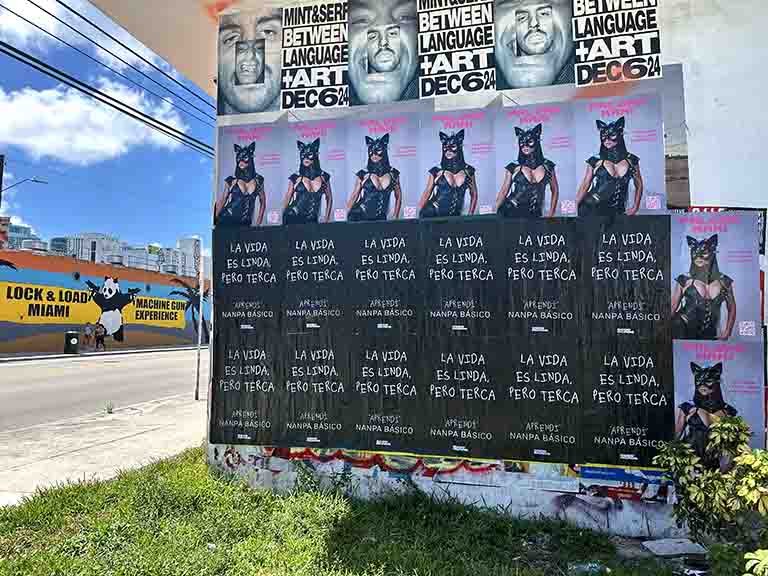
Every few months, a brand contacts us with a version of the same problem. They ran a wheatpaste campaign in New York or LA. It went well. Now they want to take that campaign to Mexico City. They send over the brief they used in the US and ask us to run it in CDMX. And we have to stop them before they make four or five costly, preventable mistakes.
Not because Mexico City is harder. Not because CDMX is a second-tier market. But because a US-standard campaign brief is built for US production systems, US neighborhoods, US installation timing, and US audiences. None of those defaults apply in Mexico City, and the gaps between assumption and reality will cost you campaign performance, wasted production budget, or both.
American Guerrilla Marketing field operators have placed campaigns firsthand in Roma Norte, Condesa, Insurgentes corridor, Polanco, and Zona Rosa. We know where the brief breaks down, and we know exactly how to fix it. This is a direct guide to those failure points and what a CDMX-ready brief looks like instead.
Failure Point 1: The Format Specs Don’t Exist in Mexico
The most common brief problem we see from US brands going to CDMX is format specification. A standard US wheatpaste brief specifies artwork in 24×36 inches, sometimes 18×24, sometimes 36×48. Those are standard US print formats. They do not exist in Mexican print production.
Mexico uses metric paper sizes. The ISO standard sizes that CDMX graficas and print shops work with are A1 (594 x 841mm), A0 (841 x 1189mm), 70x100cm, 50x70cm, and 90x120cm for larger exterior applications. When a US brief arrives at a CDMX printer specifying 24×36 inches, one of three things happens: the printer converts to the nearest metric equivalent (which may not match your artwork proportions), the printer makes a judgment call on sizing that you won’t find out about until you see the photos, or — in the worst case — the print job gets delayed while someone tries to figure out what the US team actually wanted.
The fix is simple: convert your format specs before the brief leaves New York. A 24×36 inch poster is closest to A1 (roughly 23.4 x 33.1 inches). If your artwork is sized at 24×36, it will need a minor crop or reformat to fit A1 properly. That’s a 10-minute adjustment in the design file. It prevents a production delay or a misprinted campaign.
On one CDMX campaign we ran for a music label, the US team sent a brief specifying “24×36 poster” without metric conversion. The CDMX printer produced A1 — close, but not identical proportions. The artwork had a solid border that ended up slightly asymmetrical in the printed version. Small issue, but entirely preventable with a format conversion step before the brief was sent.
For large-format applications — full wall coverings, large exterior placements — 90x120cm is the standard CDMX exterior format. If your US brief says “banner” or “large format” without metric dimensions, you’re asking a CDMX operator to make a sizing decision that should be yours.
Failure Point 2: Spanish Copy That Doesn’t Sound Mexican
This is the one that creates the most brand risk. Copy localization is not the same as translation.
Mexican Spanish has distinct grammar patterns, vocabulary, and colloquialisms that differ significantly from Castilian Spanish, and that also differ from the generic “Latin American Spanish” that most translation services produce. A CDMX audience reads copy fluently and immediately registers when something was written by a non-native speaker or adapted without regional context.
The most common issue: US brand teams use translation services or in-house translators who speak general Spanish but not specifically Mexican Spanish, let alone chilango Spanish (the colloquial dialect of Mexico City). The result is grammatically correct copy that nobody in Roma Norte talks like. It reads as foreign. That’s brand damage in a market where authenticity is the currency.
Specific issues we’ve seen:
- Using “vosotros” constructions (Castilian Spanish) in copy for a Mexican audience — it reads as distinctly Spanish, not Mexican
- Translating colloquial US English into formal Spanish that’s technically correct but tonally wrong for street-level advertising
- Using idioms that translate correctly but don’t land in Mexican cultural context
- Missing slang that would make copy feel genuinely local vs. imported
- Using brand names or campaign titles without checking for unintended meaning in Mexican Spanish slang
The fix: hire a native CDMX copywriter for copy review. Not a translation service. Not someone who learned Spanish in school. A writer who grew up in Mexico City, understands the cultural context of the colonias you’re targeting, and can tell you whether your tagline lands the way you intend it to. This is a one-day job for a qualified writer, and it prevents campaign copy from actively undermining the visual impact of your creative.
Failure Point 3: Neighborhood Logic — “High Foot Traffic Areas” Means Nothing in CDMX
US briefs typically describe target locations with phrases like “high foot traffic areas,” “culturally relevant neighborhoods,” or “dense urban corridors.” These descriptions are nearly useless for a CDMX operator who needs to allocate placements across a city of 9 million people across 16 alcaldías with wildly different demographic profiles.
Mexico City’s colonias are distinct geographic and cultural units. Two colonias that are a 10-minute walk apart can have completely different pedestrian demographics, different cultural associations, and different relevance for different brand categories. A US brief that doesn’t specify colonias — or that specifies them without demographic logic — is asking the operator to make audience targeting decisions that should belong to the brand team.
Here’s a quick map of the primary CDMX colonias and what they mean for campaign targeting:
| Colonia |
Primary Audience |
Best For |
Foot Traffic Peak |
| Roma Norte |
Creative industry, media, young professionals, influencers |
Music, fashion, entertainment, CPG premium |
Midday through late evening |
| Condesa |
Similar to Roma Norte, slightly more affluent, heavy expat and tourist mix |
Brand launches, lifestyle, premium food/beverage |
Midday through evening |
| Insurgentes corridor |
Broad urban mix, heavy transit commuter volume, office workers |
Mass awareness, app launches, broad demographic reach |
Morning and evening commute |
| Polanco |
Luxury consumer, business professional, international visitors |
Luxury goods, financial services, premium brand extensions |
Business hours and evening dining |
| Zona Rosa |
Entertainment seekers, LGBTQ+ community, youth nightlife |
Entertainment, events, night economy brands |
Evening and weekend |
| Centro Histórico |
High-volume tourist, government/office worker, broad demographics |
Tourist-facing brands, broad awareness |
Business hours and weekend |
A brief targeting a new streaming platform release should specify Roma Norte and Condesa with secondary coverage on Insurgentes. A brief for a luxury product launch should specify Polanco with Roma Norte secondary. A brief that says “culturally relevant CDMX neighborhoods” without this specificity will result in a campaign that’s geographically scattered and demographically unfocused.
Failure Point 4: US Night Timing vs. CDMX Dawn Timing
US wheatpaste campaigns typically install between 10 PM and 2 AM. This timing reflects US enforcement patterns, street conditions, and the cultural context of nighttime installation as part of the street art tradition. CDMX operates on a different schedule.
Experienced Mexico City field operators install between 4 AM and 7 AM — dawn, not late night. The reasons are specific to CDMX conditions:
Traffic. CDMX late-night streets are not uniformly quiet. The city’s nightlife culture means that 11 PM on a Thursday in Roma Norte is not a low-traffic installation window. Early morning — 4-6 AM — offers genuinely clear streets in most colonias.
Paste behavior. Mexico City’s altitude (2,240 meters above sea level) and typical overnight temperature drop create paste conditions that favor early morning installation. Surfaces are cool and often slightly damp from overnight air, which improves adhesion. Direct morning sun beginning around 7-8 AM gives the paste time to set before heat exposure.
Enforcement patterns. Mexico City’s enforcement on unauthorized posting varies by alcaldía, but in most active areas, municipal workers do early morning rounds. Having posters installed and set before 7 AM means they’re established before enforcement crews are active.
A US brief that says “install between 11 PM and 2 AM” is asking CDMX crews to work on a schedule that experienced local operators don’t use. The operator will either comply and get worse results, or they’ll ignore the brief timing and install at the proper time without telling you — which means your brief is being overridden without your knowledge. A CDMX-ready brief specifies dawn installation (4-7 AM) and explains why.
Failure Point 5: Legal and Permit Framework Assumptions
US brands often carry assumptions about permits and legal exposure from their domestic experience that don’t transfer to Mexico City.
The US market has relatively formalized legal frameworks for outdoor advertising — municipal codes, signage permits, and liability structures that brands either work through or deliberately avoid. CDMX’s framework is different. It’s governed by alcaldía-level authority, and the interpretation of outdoor advertising rules varies meaningfully from one alcaldía to the next.
In Cuauhtémoc (which covers Centro Histórico and part of Roma Norte), there is active enforcement against unauthorized posting on public property and some commercial areas. In Benito Juárez (which covers Condesa and Insurgentes corridor areas), enforcement is present but less consistent. In Miguel Hidalgo (which covers Polanco), enforcement standards are higher given the affluence of the area.
Permissioned placements on private property — building walls with documented property owner consent — are the safe operating zone in all alcaldías. But a US brief that doesn’t acknowledge the alcaldía variable, or that assumes the US model of “permitted commercial posting” has an exact CDMX equivalent, is leaving legal risk assessment to the operator rather than building it into the brief.
A CDMX-ready brief specifies: permissioned private property placements only, notes target alcaldías and any specific restrictions, and identifies the operator’s responsibility for property owner documentation. That structure shifts accountability appropriately and removes ambiguity about what standard you’re holding the campaign to.
Failure Point 6: Weather — Humidity, Altitude, and Paste Adhesion
This one seems technical, but its impact on campaign outcomes is real. Mexico City’s combination of high altitude (2,240 meters), relatively low humidity during the dry season, and afternoon rain during the rainy season (June through October) creates paste conditions that differ significantly from sea-level US cities.
The practical effect on your campaign:
- Paste formulas that work well in New York or LA may not provide adequate adhesion in CDMX — experienced operators use higher-concentration formulas to compensate
- Rainy-season afternoon rains can hit quickly and damage freshly installed posters — CDMX operators time installations to maximize dry time before rain exposure
- The dry season (November through May) is generally better for paste campaigns, though well-prepared operators can run effective campaigns year-round
- Heavy, coated paper stock performs better than lightweight uncoated stock in CDMX conditions — a format spec issue that connects back to Failure Point 1
A US brief that doesn’t account for CDMX weather doesn’t need to include a meteorology section — it needs to either specify that the operator should account for local conditions in paste formula and timing, or leave that decision explicitly to the operator rather than defaulting to US-standard practices.
What a CDMX-Ready Brief Looks Like vs. a US Brief
Side by side, here’s how the same campaign brief changes when adapted from US to CDMX standard:
| Brief Element |
US Version |
CDMX-Ready Version |
| Format spec |
24×36 inches |
A1 (594x841mm) or 70x100cm |
| Copy language |
English; Spanish TBD |
Mexican Spanish, native CDMX copywriter reviewed |
| Target area |
High foot traffic areas, culturally relevant zones |
Roma Norte (primary), Condesa (secondary), Insurgentes corridor (volume) |
| Installation timing |
10 PM — 2 AM |
4 AM — 7 AM (dawn installation) |
| Placement type |
Permissioned and high-visibility locations |
Permissioned private property only; property owner documentation required |
| Paper stock |
80lb coated |
100-115 gsm coated exterior, weather-resistant |
| Proof of posting |
Photos delivered post-campaign |
GPS-tagged photos with timestamp, map view of coordinates, delivered within 48 hours |
| Permit language |
Not specified |
Permissioned private property; operator responsible for alcaldía compliance in target zones |
| Paste specification |
Standard wheat paste |
High-concentration exterior paste formula for altitude and dry season conditions |
| Campaign window |
2-week campaign |
2-week campaign, dry season preferred; rainy season contingency timing noted |
This is not a drastic rewrite. Most of the changes are substitutions — inch measurements become metric, generic location descriptions become colonia names, timing shifts by a few hours. But each of these changes is the difference between a brief that a professional CDMX operator can execute exactly as intended, and one that leaves room for interpretation that doesn’t serve the campaign.
A Real Comparison: What We Changed for a Music Label Campaign
A music label came to AGM planning a record release campaign in New York and Mexico City simultaneously. Their New York brief was tight: 24×36 format, English tagline with strong visual, installation in Williamsburg and LES between midnight and 3 AM, delivery of photos within 72 hours of installation.
Here’s what the CDMX brief looked like after adaptation:
Format: Converted artwork to A1 (594x841mm). The original 24×36 is a 2:3 ratio; A1 is roughly the same proportion (√2 ratio), so the conversion was clean with minor bleed adjustment.
Copy: The English tagline was three words — no copy to translate. But the artist name appeared in a stylized English format that we verified with the operator for any unintended slang associations in Mexican Spanish. Clean on both counts.
Neighborhoods: Roma Norte (primary — music and creative industry concentration), Condesa (secondary — similar demographic, slightly higher social documentation density), Insurgentes corridor near Metrobus stops (volume).
Timing: Dawn installation, 4:30 AM start. Mexico City crew was familiar with this timing — it was their standard approach.
Documentation: GPS-tagged with timestamp. Map view of all coordinates delivered within 48 hours of installation. Same standard as the New York campaign.
The campaign ran in both cities within a 12-hour window. The CDMX documentation was delivered to the label on the same day as the New York report. The colonia targeting generated strong organic social documentation from Roma Norte residents — which was the on-the-ground validation that the neighborhood selection was right.
None of that required extraordinary effort. It required knowing which defaults to change, and having operator partners in CDMX who execute at the same documentation standard as our US network.
Building a CDMX Campaign Brief From Scratch
If you’re building a CDMX brief independently rather than through AGM, here’s the checklist:
- Convert all format specs to metric. A1, 70x100cm, 50x70cm, or 90x120cm for large format. No inch measurements.
- Specify Mexican Spanish copy with native CDMX review. Not general Spanish. Not translation service output. A native Mexico City writer who can sign off on colloquial accuracy.
- Name the colonias and explain the demographic logic. Not “high foot traffic” — Roma Norte for creative industry, Polanco for luxury, Insurgentes for volume, etc.
- Set dawn installation timing (4-7 AM). Not US late-night timing.
- Specify permissioned private property placements with documentation requirement. Name the alcaldías and note that the operator is responsible for local compliance within those alcaldías.
- Specify paper stock in GSM, exterior grade. 100-115gsm coated exterior, weather-resistant.
- Require GPS-tagged proof with timestamp, delivered within 48 hours. Map view of coordinates, English-language report.
- Include a weather contingency note for rainy season campaigns. Ask the operator to confirm paste formula and installation timing contingency for afternoon rain exposure.
This brief can go to a professional CDMX operator and be executed without major clarification needed. That’s the goal — a brief that functions as genuine operating instructions rather than a starting point for a phone call to figure out what you actually want.
We’ve walked campaigns from brief to proof-of-posting in Roma Norte and Condesa enough times to know where the friction lives. It’s almost never the creative. It’s almost never the operator’s field capability. It’s the brief — specifically, the assumptions that traveled from a US campaign without being examined. Fix the brief and the campaign runs. Leave the brief as-is and you’re asking a CDMX operator to interpret your US assumptions in real time, on a street in a city you’re not in.
Frequently Asked Questions
What format sizes should I use for wheatpaste in Mexico City?
Standard US sizes like 24×36 don’t exist in Mexican print production. The correct CDMX equivalents are A1 (594x841mm), 70x100cm, or 50x70cm for standard poster formats. For large-format exterior applications, 90x120cm is common. Convert your format spec before sending the brief — your CDMX printer works in metric and will make a judgment call if you don’t give them the right dimensions.
Does Spanish copy for CDMX need to be different from general Spanish translation?
Yes, significantly. Mexican Spanish uses distinct colloquialisms, vocabulary, and regional slang that differs from Castilian Spanish and generic Latin American Spanish. Copy that’s been machine-translated or produced from a general Spanish template often reads as stiff or foreign to a CDMX audience. Use a native Mexico City copywriter for review — it’s a one-day investment that protects the authenticity of everything you’re spending on creative and placement.
Why does neighborhood selection matter so much for Mexico City campaigns?
Because CDMX’s colonias have completely different demographics and cultural identities over short distances. Roma Norte reaches creative industry and media professionals. Polanco reaches luxury consumers. Insurgentes corridor reaches high daily transit volume across demographics. A brief that says “high foot traffic areas” gives your CDMX operator no useful targeting direction. Specify colonias with demographic logic — it’s the most important targeting decision in the campaign.
What time do installations typically happen in Mexico City?
Professional CDMX operators install between 4 AM and 7 AM — dawn, not late night. This timing reflects CDMX’s street conditions, paste performance at altitude, and enforcement patterns. US briefs specifying 10 PM to 2 AM installation create scheduling conflicts with how experienced CDMX crews actually operate. Adjust the timing spec to match local practice and you’ll get better results.
Does AGM adapt US briefs for Mexico City campaigns?
Yes. Brief adaptation — format conversion, copy review coordination, colonia-level mapping, timing adjustment, and permit framework notation — is part of AGM’s CDMX campaign process. You submit the brief in US terms and we adapt it before it goes to our CDMX operator partners. The goal is for you to get a campaign that runs exactly as intended in the CDMX market without having to rebuild the brief from scratch yourself.