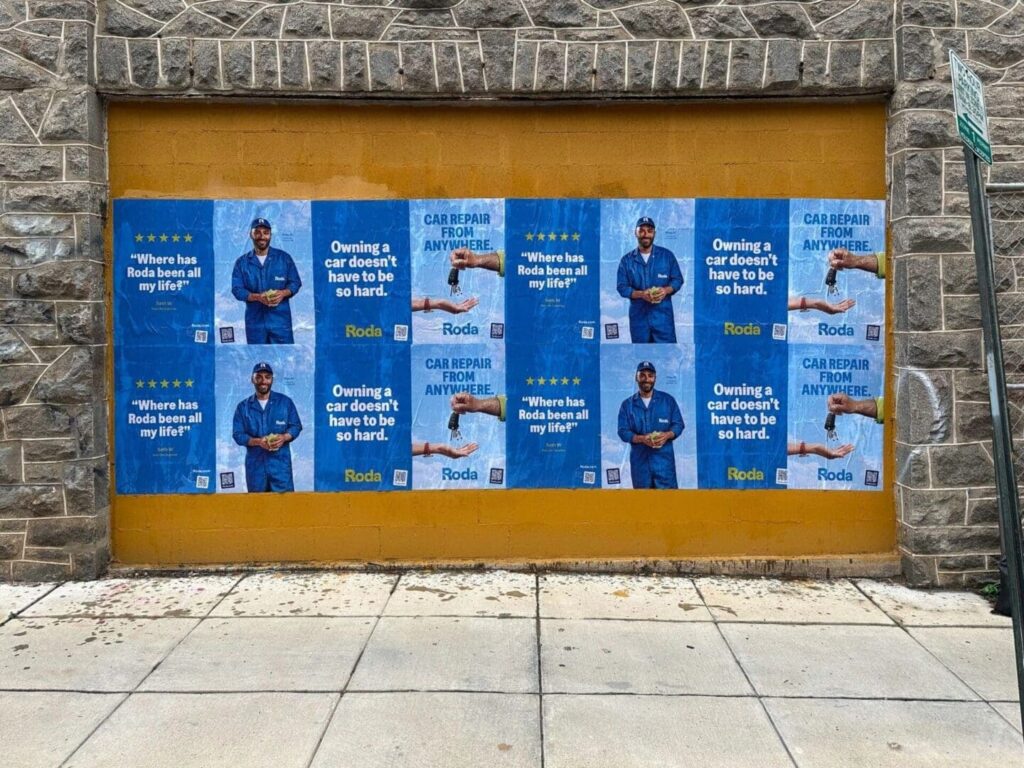
Wheatpasting: The Practitioner’s Guide to Street Poster Campaigns in NYC
Wheatpasting is one of the oldest forms of street advertising, and it’s still one of the most effective. Our crews have wheatpasted tens of thousands of posters across the walls, hoardings, and construction barriers of New York City. We’ve done it in January rain in the Bronx and on summer nights in Bushwick. We’ve covered entire blocks of the Lower East Side for record label releases and placed precise single-panel installations on specific walls in SoHo for fashion brands. This guide covers how wheatpasting works, how to do it right, and what makes a professional campaign different from a DIY job.
If you’re a brand considering wheatpasting as part of your marketing mix, this will tell you what to expect. If you’re trying to understand the craft itself, this covers the practice from preparation through execution through measurement. We’re not holding anything back. This is how it actually works.
Wheatpasting is the practice of adhering paper to exterior surfaces using a paste made from wheat starch or flour mixed with water. The term covers everything from small-format single-sheet poster placements to large multi-panel building-side murals. The paste is the constant. The format and scale vary enormously.
Wheatpasting has been used for advertising since the 19th century, when bill posters covered the walls of American cities with announcements for traveling circuses, patent medicines, and political candidates. New York’s building stock, with its flat-faced brick construction, its long runs of hoarding along major streets, and its density of construction sites, has always been particularly suited to the format. The walls of this city have been covered in pasted paper for 150 years.
Why Wheatpasting Survives Every Advertising Trend
We get asked whether wheatpasting is still relevant in a world saturated with digital advertising. The answer is yes, and the reason is straightforward: it reaches people where they actually are, in a form they didn’t expect, in a way that doesn’t require any device or platform between the brand and the audience. A poster on the wall at the corner of Graham Avenue and Maujer Street in East Williamsburg is seen by every person who walks that corner. There’s no algorithm deciding who gets the impression and who doesn’t. There’s no ad blocker. There’s no skip button. It’s just there.
The other reason wheatpasting persists is that it photographs well and generates organic social content. A striking poster on the right wall in the right neighborhood gets documented hundreds of times by passersby. That organic content extends the campaign’s reach far beyond the number of people who walked past it. Wheatpasting generates digital exposures without paying a platform for them, which in an era of rising digital advertising costs is a significant advantage.
Wheatpasting vs. Other Street Advertising Formats
Stickers, spray paint, chalk art, stencil work, and wheatpasting all fall under the broad category of street-level brand presence. Wheatpasting is the format that offers the best combination of scale, print quality, and cost efficiency. A single wheat paste poster can deliver a high-resolution, full-color brand image at sizes up to several feet in any dimension. That’s not achievable with stickers at any practical scale, and it delivers far more print quality than stencil or chalk work. For brands that need their identity, their artwork, or their campaign photography to be reproduced accurately at street scale, wheatpasting is the format that delivers.
The Craft of Wheatpasting: Materials, Preparation, and Application
Professional wheatpasting is a craft. The difference between a campaign that holds for six weeks and one that peels in three days is almost entirely in the materials and application technique. Here’s how we approach it.
Paste Formulation
We use wheat starch rather than wheat flour as the base. Starch produces a cleaner, less odorous paste with longer shelf life and better bonding strength. The cooking process matters: bring water to a boil, whisk in starch gradually to avoid lumps, continue heating until the mixture reaches a thick, translucent gel. Pull it off heat and let it cool to a workable temperature before adding methyl cellulose, which we include at about 5 percent by volume. The methyl cellulose extends the paste’s open time, which is the window during which it remains workable after application, and improves its flexibility when dry, which reduces cracking and edge peeling.
Final consistency should be thick enough to coat a brush and cling to a vertical surface without running, but fluid enough to penetrate into slight surface texture. Paste that’s too thick will create thick deposits that crack as they dry. Paste that’s too thin won’t bond with enough strength. Getting this calibration right takes practice. We’ve refined our recipe over years of field work.
Surface Assessment and Preparation
Not every wall is a good wheatpaste wall. The best surfaces are smooth or lightly textured, non-porous or low-porosity, and stable. Smooth painted concrete is ideal. Sealed plywood hoarding panels are excellent. Rough brick is workable with the right technique but requires more paste and more time to get good adhesion. Highly porous surfaces like raw concrete block are difficult because the surface absorbs paste so aggressively that adhesion at the paper-surface interface is compromised.
We assess every surface before application. We look for flaking paint, loose substrate, moisture damage, and prior paste residue that could interfere with adhesion. On new surfaces we haven’t worked before, we sometimes do a small test piece and check it after 24 hours before committing to a full run on that site.
Application Technique
The correct sequence for a professional paste job is: coat the surface first, apply the poster, then coat the top of the poster. The surface coat creates a bonding layer the paper can merge into. The top coat seals the paper edges, protects the ink surface from weather, and helps the paper conform to any slight surface variation without lifting. Skipping the surface coat is the most common amateur mistake, and it’s the primary reason cheap paste jobs peel within days.
We use wide natural-bristle brushes for most surface work. On smooth, flat surfaces like metal or sealed plywood, we switch to a short-nap roller for faster, more even coverage. For large-format multi-panel assemblies, we establish a center point and work outward, using registration marks to keep panels aligned. Overlap between panels of roughly an inch creates a bond that holds the join through weather. Air bubbles are worked out with a squeegee immediately after placement, before the paste begins to set.
Weather Conditions and Field Judgment
Temperature matters. Below about 40 degrees Fahrenheit, paste viscosity increases significantly and adhesion is compromised. We avoid wheatpasting in freezing temperatures unless the surface and paste have both been managed for cold-weather application. Rain is a mixed factor. Light moisture on a surface can actually aid adhesion by softening any loose particles and allowing better paste penetration. Heavy rain during or immediately after application is destructive, washing paste before it sets. We check hourly weather forecasts before every crew deployment and build schedule flexibility around rain windows.
Planning a Wheatpasting Campaign: Location Strategy in New York
Execution quality means nothing if the campaign is in the wrong locations. Location strategy is where campaigns are won or lost before a single poster goes up.
How We Identify High-Performance Locations
We’ve maintained a location database for years. Every site we’ve worked, we have documented: foot traffic estimates, surface quality, hold time history, competitive poster activity, and proximity to key audience attractors like transit exits, retail destinations, bars, and cultural venues. When we scope a campaign, we pull from this database first, then validate with a current site walk.
The site walk is non-negotiable. Databases go stale. Construction sites open and close. New retail moves in and changes the foot traffic profile of a block. A location that was excellent six months ago might now be blocked by scaffolding, or might now be adjacent to a new venue that makes it twice as valuable. You can’t know from a map. You have to walk it.
Prime Wheatpasting Zones by Audience Type
For music, nightlife, and youth culture brands, our top zones include the walls along Rivington and Orchard Streets on the Lower East Side, the corridors surrounding the Bowery Ballroom and Mercury Lounge on the Lower East Side, the Wythe Avenue and Metropolitan Avenue stretch in Williamsburg, the Myrtle-Wyckoff area in Bushwick, and the blocks surrounding the House of Vans venue space in Brooklyn. These locations deliver high foot traffic from the exact demographic that follows new music and nightlife brands.
For fashion, streetwear, and lifestyle brands, we prioritize the side streets in SoHo between Prince and Spring, the blocks around the Nolita boutique cluster on Mulberry and Elizabeth Streets, the Greene Street warehouse corridor, and the section of Bedford Avenue in Williamsburg that runs between North 7th and North 11th Streets. The Greene Street corridor in particular offers long, clean wall sections on the east-facing facades that face morning light, making them highly visible for the midday foot traffic that’s heaviest in SoHo.
For food, beverage, and hospitality brands targeting a neighborhood audience rather than a citywide one, we work the commercial streets of the specific neighborhood. A restaurant opening on Smith Street in Carroll Gardens gets posters up and down Smith, along Atlantic Avenue, and on the residential streets within a 10-block radius. The audience is hyperlocal. The coverage should be hyperlocal too.
Avoiding Common Location Mistakes
The most common location mistake is over-concentrating in the “famous” poster zones. Every agency knows the east wall of the Bowery Savings Bank building is a high-value site. Every agency targets it. The result is a constant churn of overlapping campaigns that reduces the visibility of any single one. We balance high-profile sites with less-celebrated but equally high-traffic sites where our clients’ campaigns don’t compete with a dozen others for the same wall space.
The second mistake is ignoring transit entry and exit points. The blocks immediately surrounding subway entrances are among the highest-value micro-locations in the city. Someone who has just emerged from the L train at Bedford Avenue and is walking toward wherever they’re going is in the first 60 seconds of their street experience. They’re looking around. They’re orienting. A poster in their direct sight line in that moment has a dramatically higher chance of registering than a poster three blocks away.
Campaign Formats and Structures
Wheatpasting campaigns come in several structural formats, each suited to different objectives and budgets.
Neighborhood Saturation
A neighborhood saturation campaign covers a single neighborhood or district with high-density placements. The goal is to create a sense of ubiquity within that zone. For someone living in Greenpoint who walks past your poster on Manhattan Avenue on Monday morning, again on Noble Street on Tuesday afternoon, and again on the wall next to the G train entrance on Thursday evening, the brand has made three separate exposures without paying for three separate ad placements. Density within a geography multiplies effective impression frequency at lower cost than spreading the same number of posters across a wider area.
Corridor Coverage
Corridor coverage targets a specific walking or commuting route rather than a geography. The classic corridor campaign maps the route from a transit hub to a destination. The blocks between the Barclays Center subway complex on Atlantic Avenue and the arena entrance are a corridor. The path from the 6 train at 77th Street down Lexington Avenue toward the shops on Madison is a corridor. Corridor campaigns are ideal when the target audience has predictable movement patterns, which is common for event-based campaigns and neighborhood-specific retail or restaurant launches.
Feature Wall Placements
Feature wall campaigns prioritize a small number of very high-quality, large-format placements over a large number of standard-format placements. Instead of 200 24×36 posters across a borough, we might do 15 large-format multi-panel assemblies on premium wall sections in key locations. The visual impact per placement is much higher, the organic photography rate is higher, and the campaign has a gallery-quality presence in each location. Feature wall campaigns work particularly well for fashion and luxury brands for whom the brand presentation quality matters as much as coverage volume.
Multi-Phase Campaign Runs
A multi-phase campaign runs in sequential waves, typically timed to build toward an event or release date. Phase one covers broad awareness with wide geographic placement. Phase two concentrates in high-value zones as the launch approaches. Phase three, often run the day before or the week of the launch, saturates the core neighborhoods with maximum density. Each phase primes the audience for the next. By launch day, the audience has seen the campaign multiple times across multiple contexts, and the final saturation wave creates the feeling of something about to happen that they’re already aware of.
Wheatpasting Campaign Costs: How Budgets Break Down
Here’s a transparent breakdown of how wheatpasting campaign costs typically structure in New York City.
Cost Component
DIY Estimate
Agency (Budget)
Agency (Premium)
Notes
Print Production (200 posters, 24×36)
$400-600
$500-800
$600-900
Paper weight and quantity affect price
Paste Materials and Field Supplies
$50-100
Included
Included
Starch, methyl cellulose, brushes, buckets
Crew Labor (one night, 2-3 people)
Personal time
$800-1,500
$1,200-2,000
Experienced crews paste faster and better
Location Scouting
DIY walk
Included
Included
Professional scouts have pre-vetted databases
Campaign Documentation
Phone photos
Included
Geo-tagged, compiled report
Proof-of-performance documentation
Campaign Management
Self
Included
Included
Scheduling, logistics, crew coordination
Total (200-poster neighborhood campaign)
$500-800
$2,500-4,500
$4,000-7,000
Agency cost buys quality, speed, and accountability
DIY campaigns are lower in direct cost but carry significant hidden costs in time, quality risk, and the absence of professional documentation. Brands that try to save money on execution often produce campaigns that underperform because of paste quality, location selection errors, or application technique issues. The investment in professional execution is almost always recovered in campaign performance.
What Separates a Great Wheatpasting Campaign from a Forgettable One
After running hundreds of campaigns, we’ve identified the variables that consistently separate the ones that generate buzz from the ones that get ignored.
The Creative Has to Earn Attention
A poster on a wall in New York is competing with the entire visual environment of one of the most visually dense cities on earth. The design has to stop someone in the act of looking elsewhere. That’s a high bar. Bold scale, unexpected imagery, a typographic choice that doesn’t look like every other typographic choice on every other poster in the city, a visual joke or reference that lands in under two seconds. Generic creative in a street context is invisible. It wastes the placement.
The Location Has to Match the Audience
A brilliantly designed campaign for a premium fashion brand placed on a low-traffic block in a neighborhood that doesn’t match the target demographic is a wasted investment no matter how good the paste job is. Location and audience alignment is the strategic foundation. Everything else builds on top of it.
The Execution Has to Be Flawless
Peeling corners, air bubbles, misaligned panels, and paste residue outside the poster edges all undermine the brand impression the poster is supposed to create. A poorly pasted poster communicates carelessness. A cleanly pasted, perfectly positioned poster communicates quality. The application quality is part of the brand message. We train our crews to treat every placement like it’s the feature wall that’s going to be photographed for the campaign report.
Frequently Asked Questions
What is wheatpasting?
Wheatpasting is an outdoor advertising technique that uses a paste made from wheat flour and water to adhere large-format printed posters to walls, construction hoardings, and other flat surfaces in urban environments.
How long does a wheatpaste poster last?
Longevity depends on weather exposure, surface texture, and paste application quality. A properly applied wheatpaste on a protected surface can last several weeks to months. Direct rain exposure shortens lifespan significantly.
Is wheatpasting legal?
Wheatpasting requires permission from property owners or placement within legal posting zones. AGM only executes permitted wheatpaste campaigns. We do not conduct unauthorized placements.
Common wheatpaste sizes run from 24×36 inches through large-scale multi-panel composites that cover entire building walls. Format depends on the wall surface available and the visual requirements of the campaign.