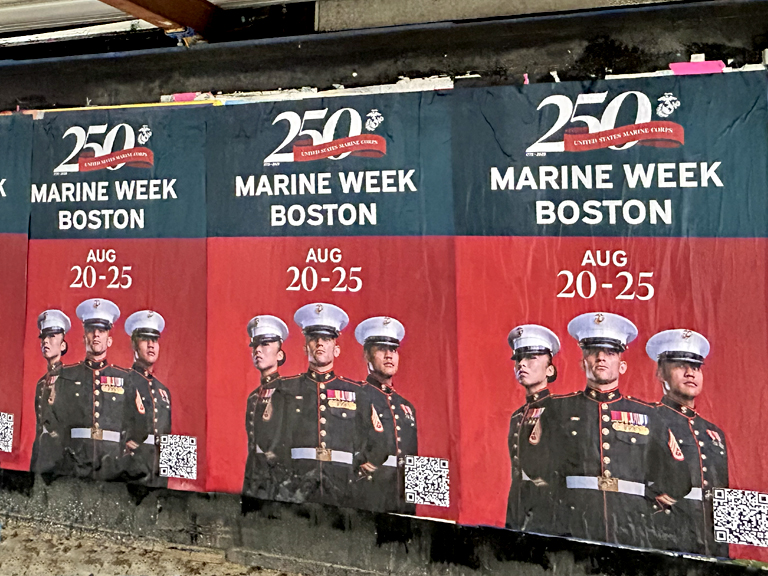
Boston’s poster culture has always been inseparable from its music scene, its universities, and its independent creative community. Walk through Allston on any given week and you’ll see the walls of the neighborhood doing what they’ve done for decades: communicating the show lineups, the new releases, the brands that understand where Boston’s culture actually lives. Wheatpaste campaigns in Boston work because the city’s residents read walls — they’ve been doing it since before digital advertising existed, and they haven’t stopped.
American Guerrilla Marketing runs wheatpasting campaigns across Boston’s key neighborhoods — Allston, Fenway, Jamaica Plain, South End, Cambridge, Downtown, and beyond. Our team scouts locations, installs overnight, and delivers GPS-tagged photo documentation of every placement so clients have proof of performance by the time the city wakes up.
Boston’s Neighborhoods: Where Wheatpaste Campaigns Work
Boston’s neighborhoods are distinct communities with different cultural characters, demographics, and foot traffic patterns. The right neighborhood mix for a campaign depends on who the campaign is trying to reach.
Allston and Brighton
Allston is the spiritual home of Boston’s independent music scene, student population, and young creative community. Harvard Avenue and Commonwealth Avenue are lined with music venues, independent bars, record stores, and the coffee shops where Boston’s creative class gathers. For any campaign targeting the 18-to-35 music and arts audience, Allston is mandatory. The walls photograph well, the audience is attentive to street-level advertising, and the neighborhood’s poster culture means new campaigns are expected and looked for.
Brighton, adjacent to Allston, shares much of the same demographic character with a slightly more residential character that makes it excellent for campaigns seeking sustained exposure to the same audience over the full campaign window.
Fenway and Kenmore Square
Fenway and Kenmore Square concentrate some of the highest foot traffic in the city — the Boston Red Sox, Fenway Park events, major concert venues including House of Blues and the Paradise Rock Club, and several university campuses including Boston University and Northeastern all contribute to a dense, active pedestrian environment. For entertainment campaigns — concerts, album launches, streaming releases — the Fenway corridor offers both the audience concentration and the foot traffic volume that drives maximum impressions per placement.
Jamaica Plain
Jamaica Plain has evolved into one of Boston’s most vibrant independent neighborhood communities — locally owned businesses, progressive community organizations, the Centre Street corridor’s mix of restaurants and independent retail, and a residential population that is engaged with arts, music, and local culture. For campaigns targeting the progressive young professional and creative community, JP is among the highest-value neighborhoods in the Boston market.
South End
The South End concentrates Boston’s arts and design community, upscale independent retail, and the LGBTQ+ community that has shaped the neighborhood for decades. For lifestyle, fashion, hospitality, and entertainment brands targeting arts-engaged adult audiences, the South End offers both the demographic and the aesthetic context that makes campaigns feel appropriate rather than imposed.
Cambridge
Cambridge splits into several distinct sub-communities with different targeting implications. Harvard Square reaches the academic, international, and culturally engaged population clustered around Harvard University. Central Square reaches the music venue community — the area around the Middle East and Central Square Theater is the core of Cambridge’s live music scene. MIT’s east Cambridge neighborhood reaches the tech-oriented younger professional community. Campaign geography within Cambridge should be selected based on which sub-community aligns with the campaign’s target audience.
Downtown and Financial District
Downtown Boston and the Financial District serve specific campaign types: B2B campaigns targeting financial and professional services decision-makers, conference perimeter campaigns for events at the Boston Convention and Exhibition Center or Hynes Convention Center, and broad consumer campaigns that need high-visibility placement in the highest-traffic zones of the city.
What Makes Boston Different from Other Major Markets
Boston’s poster culture is shaped by its specific geography and history. The city is compact and walkable in ways that New York and Los Angeles are not — foot traffic is concentrated in defined corridors rather than spread across a vast street grid. That concentration means precise location selection in Boston can achieve higher impressions per placement than equivalent spend in larger, more diffuse markets.
Boston also has a strong university influence on its cultural geography that differs from markets like Chicago or Miami. The student population creates predictable seasonal patterns — fall semester arrivals in September are a particularly high-value window for brands targeting the 18-to-25 demographic, as new students are actively mapping their new city’s cultural landscape and receptive to street-level brand discovery.
The city’s weather creates a practical consideration: winter campaigns face more challenging installation conditions and slightly compressed hold times for outdoor materials. Our crews have experience with Boston winter campaigns and adjust paste formulation and installation technique for cold-weather conditions.
Campaign Types That Perform Well in Boston
Concert and Music Venue Promotion
Boston’s deep music culture makes it one of the best markets in the country for concert promotion wheatpasting. The Allston-Fenway corridor alone concentrates enough music venues, engaged fans, and organic poster-reading culture to make a focused campaign punch significantly above its cost. We execute concert campaigns across the full range of venue sizes — from club-scale Allston shows to arena campaigns at TD Garden — with neighborhood selection calibrated to the audience profile of the specific artist and genre.
Entertainment and Streaming Launches
Streaming platform campaigns in Boston target the educated, media-engaged urban professional demographic that concentrates in South End, Jamaica Plain, and Cambridge. These audiences are both highly responsive to visual street culture and heavily represented on social media platforms where organic campaign photography spreads. A streaming launch campaign in these neighborhoods generates both direct impressions and earned social amplification.
University and Student Market Campaigns
Boston’s extraordinary concentration of universities — Harvard, MIT, Northeastern, Boston University, Boston College, Tufts, Emerson, and more — makes it one of the highest-density student markets in the country. Campus-adjacent wheatpaste campaigns in the residential neighborhoods around each university reach student audiences at the ground level where their attention lives, rather than through digital channels where they’re inundated with marketing.
Brand Awareness and Consumer Product Campaigns
For brands entering the Boston market or building city-specific presence, wheatpaste campaigns establish physical credibility in the neighborhoods where the target demographic lives. A campaign that appears in Allston, JP, and South End simultaneously creates the impression that the brand is woven into Boston’s cultural fabric — not just advertising in the city, but part of it.
Campaign Types That Perform Best in Boston
Boston’s specific demographic mix and cultural geography make some campaign types particularly well-suited to the market. Here is how we approach the most common Boston campaign categories:
Concert and Live Event Promotion
Boston has one of the most active live music markets in the country relative to its size, with the Allston-Fenway corridor anchoring a music venue density that serves artists from local club acts to international touring headliners. Concert promotion wheatpasting in Boston follows the music geography: Allston walls for indie, rock, and DIY shows; Fenway and Kenmore for major venue shows at the House of Blues and Paradise; Cambridge for the Middle East, Sinclair, and the arts-adjacent touring circuit.
We execute concert campaigns for touring labels and independent promoters regularly in Boston, with neighborhood selection calibrated to the specific artist, genre, and venue. A metal show at O’Brien’s Pub in Allston calls for different placement than a pop headliner at the Wang Theatre downtown.
University and Student Market Campaigns
Boston’s concentration of universities creates a student market that’s larger relative to the city’s total population than any other major U.S. market. More than 100,000 college students live within the city’s boundaries, concentrated in Allston/Brighton, Fenway, Cambridge, and Mission Hill. For brands targeting 18-to-24-year-olds — streaming services, consumer tech, fashion, food and beverage, entertainment — this market is accessible through the commercial corridors adjacent to each university cluster.
The September back-to-school window (late August through October) is the highest-value period for student-targeted wheatpaste campaigns. New students arriving in the city are actively mapping their neighborhood, discovering local businesses, and forming brand preferences that often persist through their full university period. A campaign that reaches new students during their first few weeks of arrival in Boston creates brand familiarity at a high-plasticity moment.
Streaming and Film Launch Campaigns
Boston’s highly educated, media-engaged population makes it a top-tier streaming and entertainment launch market. The South End, Jamaica Plain, and Cambridge neighborhoods concentrate exactly the prestige content audience that streaming platforms most value — subscribers who engage with original programming, discuss content socially, and write the reviews and recommendations that shape broader viewing behavior. Campaigns in these neighborhoods for streaming launches consistently generate organic social documentation from exactly the audience whose sharing matters most for the platform’s cultural positioning.
Brand Awareness Campaigns for Market Entry
For brands entering the Boston market from outside the region, a wheatpaste campaign creates physical credibility that digital-only launches can’t generate. Boston’s strong sense of local identity means that brands that demonstrate genuine investment in the city’s neighborhoods — through physical presence in the areas where the target audience lives and moves — are received differently than brands that market to Boston as a data point in a national campaign.
Our team can advise on neighborhood selection that signals the right level of market understanding for different brand categories and target demographics. A brand entering the Allston market demonstrates different cultural alignment than a brand targeting Back Bay or the South End, and those distinctions matter to the audiences in each neighborhood.
Creative Standards for Boston Campaigns
Boston’s visual culture is influenced by its academic heritage and music scene in ways that affect what creative approaches generate the strongest response. The city’s audience tends to be more text-responsive than image-only creative suggests — copy-led campaigns with strong, specific headlines consistently generate attention in Allston and Cambridge in ways that pure visual campaigns may not.
For music campaigns specifically, the entertainment poster tradition is well-established enough in Boston that the standard concert poster format (artist name, venue, date, supporting acts) reads as both informational and culturally legitimate. Clean, well-designed versions of this format in the right neighborhoods generate organic photography from music fans who document shows they’re interested in attending.
For brand campaigns outside the entertainment category, the creative principles that work best in Boston are specificity and genuine relevance to the neighborhood being targeted. A campaign that references the actual neighborhood — or at minimum demonstrates understanding of the audience who lives there — generates stronger response than generic national campaign creative deployed without local consideration.
Overnight Installation in Boston
Our Boston campaigns install overnight, with crews operating in the early morning hours (midnight to 5 AM) when foot traffic is minimal and wall access is unobstructed. The overnight installation creates the “appeared everywhere at once” effect that distinguishes a genuine city presence campaign from a handful of scattered placements.
For multi-neighborhood campaigns, we deploy split crews working different zones simultaneously — Allston crew while Jamaica Plain crew installs, both completing before the morning commute. This approach allows us to cover five or more neighborhoods in a single overnight window without compromising installation quality at any location.
Campaign Costs and Budget Planning in Boston
Boston is a mid-size wheatpaste market with costs that are competitive relative to New York and Los Angeles while delivering access to a demographic that punches above its market-size weight in cultural influence and media engagement.
Typical Campaign Cost Ranges
Single-neighborhood campaigns in Boston (Allston or JP, for example) with 50 to 100 poster placements typically run $2,000 to $4,500 all-in, including location scouting, print production, overnight installation, and GPS documentation. Multi-neighborhood campaigns covering Allston, Fenway, and Cambridge or South End simultaneously run $5,000 to $15,000 depending on total volume and format mix.
Print production for a Boston campaign costs $500 to $2,000 depending on volume and format. Standard 24×36 single-sheet is the most cost-efficient format; 27×40 entertainment-industry-standard is slightly more expensive per unit but carries the visual weight appropriate for entertainment launch campaigns. Multi-panel anchor placements at the best Allston and Fenway walls add a premium that’s typically worth the investment for campaigns where earned media photography is a key objective.
Rush Timelines
Standard Boston campaign lead time is five to seven business days from creative approval. Rush campaigns targeting three to four business days are available for established clients or with appropriate rush fees covering expedited print production and crew scheduling. Concert promotion campaigns with fixed show dates often require rush coordination; we build our entertainment client scheduling to accommodate the tight timelines that concert promotion logistics require.
Comparing Boston with Other New England Markets
Boston wheatpaste campaigns are sometimes paired with coverage in adjacent New England markets to extend regional reach. Providence (RI) has a vibrant creative community centered around RISD and Brown University that makes it a natural complement to Boston for campaigns targeting the New England arts and academic audience. New Haven (CT) offers Yale University proximity and a growing arts district. Portland (ME) has developed a highly active creative and food culture that punches above its size for campaigns targeting the independent lifestyle consumer.
For campaigns planning multi-market New England rollouts, Boston is always the anchor market. Adjacent markets can be added to the campaign scope with the same overnight installation model, using our regional crew network to cover Providence, New Haven, or Portland on the same timeline as the Boston installation.
GPS Documentation and Campaign Reporting
Every placement in every Boston campaign receives GPS-tagged photo documentation at the time of installation. Post-campaign reports include location addresses organized by neighborhood, installation timestamps, and photographs of each placement. For clients with agency reporting requirements, we format documentation to standard marketing report templates.
Boston’s Academic Community as a Campaign Audience
No other American city has Boston’s concentration of research universities, professional schools, and the academically-oriented professional workforce that those institutions produce and retain. Harvard, MIT, Tufts, Northeastern, Boston University, Boston College, Emerson, the Massachusetts College of Art, and dozens of other institutions create an audience with specific characteristics that affect how campaigns in Boston should be designed and targeted.
Academic and professionally educated audiences tend to be more text-responsive and more skeptical of generic advertising language than typical consumer audiences. Campaigns in the neighborhoods these audiences inhabit — Cambridge, Allston, the South End — perform better when they demonstrate genuine specificity and category knowledge rather than broad claims. A streaming campaign that leads with a specific show’s premise performs better than one that leads with platform features. A food brand campaign that references something specific and true about the product performs better than one with generic lifestyle imagery.
This is not a reason to avoid wheatpaste campaigns in Boston’s academic neighborhoods — it’s a reason to approach creative development with the same intellectual rigor the audience applies to everything else. Campaigns that pass that bar generate the kind of word-of-mouth in academic communities that is qualitatively different from the social sharing that entertainment campaigns generate. Academic-adjacent audiences discuss and recommend things they find genuinely interesting rather than simply sharing things that look good on Instagram.
Integrating Wheatpaste with Other Boston Street Campaigns
- Street team activations in Allston and JP on the morning after installation to extend the campaign into direct audience engagement
- Sidewalk stencil campaigns at Fenway venue approaches and Allston pedestrian corridors adding horizontal surface coverage
- Mobile LED billboard trucks routing through Fenway on event nights and along Commonwealth Avenue for high-traffic visibility
- Integrated guerrilla campaign strategy combining multiple Boston formats for major launches and brand moments
Frequently Asked Questions
Which Boston neighborhoods work best for wheatpaste campaigns?
Allston and Brighton for the student, music, and young creative community. Fenway and Kenmore Square for concert and sports-adjacent audiences. Jamaica Plain for the independent progressive community. South End and Back Bay for professional and arts-forward audiences. Downtown and Financial District for B2B conference and business campaigns. Neighborhood selection should match your target demographic.
Is wheatpasting legal in Boston?
Legal wheatpasting in Boston requires property owner permission. AGM operates exclusively on permitted locations — walls where we have established relationships with property owners or posting network operators. We do not install on surfaces without explicit authorization.
How much does a Boston wheatpaste campaign cost?
Single-neighborhood campaigns in Boston typically run $2,000 to $5,000. Multi-neighborhood city coverage campaigns run $6,000 to $18,000 depending on volume and format. We provide itemized quotes after a brief campaign discussion.
How long does it take to launch a wheatpaste campaign in Boston?
Standard lead time is five to seven business days from creative approval to installation. Rush campaigns can often launch in three to four days with a rush fee. We manage location scouting, print production, crew coordination, and documentation.
Can AGM run Boston wheatpaste campaigns for concerts and entertainment?
Yes. Entertainment campaigns are a primary use case for Boston wheatpasting. We target the Allston/Fenway corridor for music shows, arts-adjacent neighborhoods for film and streaming launches, and university areas for content targeting student audiences.
Do I get documentation for my Boston campaign?
Every placement receives GPS-tagged photo documentation with timestamps. Your post-campaign report includes location addresses, installation times, and photographs of every placement organized by neighborhood.