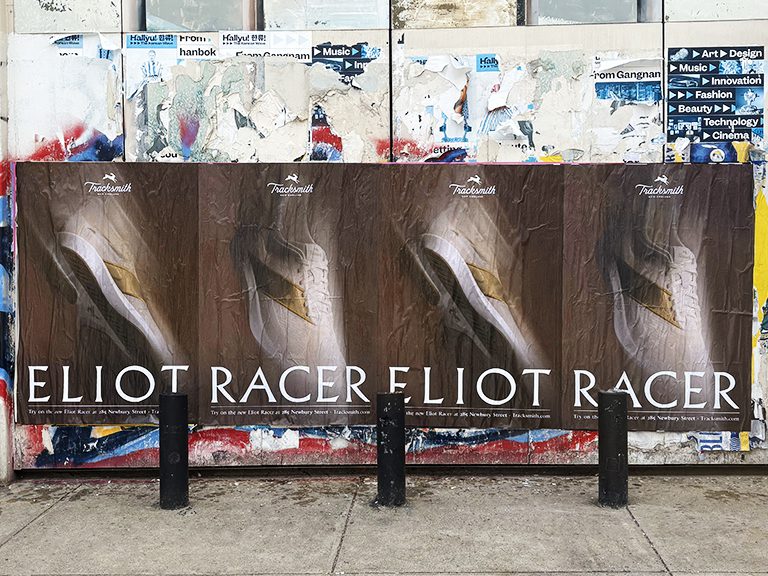
A wheatpaste poster puts a brand directly into the visual field of a city, at street level, in the neighborhoods where the target audience actually spends time, at a scale no screen can replicate.
The wheatpaste poster is the foundational format of street-level guerrilla marketing. It is a large-format paper print applied to a wall surface using a paste adhesive, most commonly wheat starch based, producing a durable, weatherproof installation that occupies real estate in the urban visual environment that conventional advertising inventory cannot reach. Every major poster campaign we have run over the past decade, whether for a record label, a footwear brand, a film studio, or a consumer product launch, has had wheatpaste poster production at its core.
Understanding the wheatpaste poster as a format, what makes it effective, what the production process looks like, and how it compares to other outdoor advertising options, is essential for any brand considering a street-level campaign. This is that resource.
At the technical level, a wheatpaste poster is a paper print applied to a wall using a paste adhesive. The print is typically produced on uncoated stock at 60 lb to 100 lb weight using wide-format inkjet printing. The paste is a water-based adhesive made from cooked wheat starch or a similar plant-based material. The combination of paste, paper, and surface creates a bond that holds the poster in place for weeks to months, depending on conditions.
The format has been in use as a communication medium since the earliest days of commercial printing. Political broadside printers, theater promotion crews, and street advertisers in the nineteenth century used essentially the same paste-and-paper technique that modern brand campaigns use today. The difference is in the scale of production, the precision of location targeting, and the integration of wheatpaste poster campaigns into broader digital and experiential marketing programs.
How a Wheatpaste Poster Differs from Vinyl Signage
Vinyl adhesive signage is smooth, precision-cut, and requires a clean, flat, non-porous surface for proper adhesion. Wheatpaste posters bond to rough brick, textured concrete, painted metal, and plywood surfaces where vinyl would not adhere properly or would look out of place. Vinyl also leaves adhesive residue when removed. A wheatpaste poster degrades gradually and naturally, lifting at the edges first and weathering over time in a way that many brands and artists consider part of the aesthetic.
The practical implication is that wheatpaste posters access wall inventory that vinyl simply cannot. The rough brick face on the side of a Bushwick building, the plywood hoarding around a construction site on the Lower East Side, the painted concrete loading dock door on Melrose Ave. None of these are candidates for vinyl signage. All of them are excellent wheatpaste poster locations.
Why the Wheatpaste Poster Works as an Advertising Format
The wheatpaste poster’s effectiveness as an advertising format comes from a specific combination of characteristics that no other outdoor format replicates.
Scale
A standard four-panel wheatpaste poster build covers 48 inches wide by 72 inches tall. Larger builds reach six, eight, or twelve feet in any dimension. These are formats that command attention in a way that a digital display or transit shelter card cannot. The physical scale of a large wheatpaste poster installation in an active pedestrian corridor is genuinely difficult to ignore.
Location Specificity
Wheatpaste posters go exactly where we put them. Not in a media network’s inventory of 100 locations, five of which are where the audience is. On specific walls in specific blocks, selected for pedestrian flow, demographic concentration, and visual prominence. This level of placement precision is not available from any traditional outdoor advertising channel.
Cultural Register
A wheatpaste poster reads differently in the urban visual environment than a backlit panel or a digital billboard. It reads as something placed in the city, at street level, by people who know the city. For brands targeting creative, culturally engaged, urban audiences, this signal carries genuine value. It is the difference between advertising and presence.
Speed and Flexibility
A wheatpaste poster campaign can be conceived, produced, and installed in as few as ten business days with ready artwork. Adjustments to creative, market, and scale can be made right up to the point of print production. Traditional outdoor advertising requires months of advance booking and cannot accommodate late-stage changes to creative or market selection.
AGM Field Note: We have run wheatpaste poster campaigns on six-day timelines for album release campaigns where the artist’s label called us after the release date was moved up and the existing production timeline could no longer hit the street. Six days from confirmed brief to posters on the wall in four cities. That kind of speed requires a prepared operation. It is possible, but not comfortable. Ten to fourteen days is the timeline that produces clean execution without heroics.
Wheatpaste Poster Materials and Production
Understanding the materials that go into a wheatpaste poster helps brands make better decisions about print specifications, budget allocation, and campaign longevity expectations.
Paper Stock
The paper for a wheatpaste poster campaign needs to balance three properties: porosity for paste absorption, durability for outdoor exposure, and surface quality for print reproduction. The standard choice is 60 lb to 80 lb uncoated text weight, which absorbs paste evenly, holds ink well on an inkjet printer, and conforms to uneven surfaces without cracking during application.
Heavier stocks (100 lb and above) are more strong and show less wear over time, but require more paste volume to achieve full adhesion and are heavier to transport in roll form. Lighter stocks (40 lb and below) are used occasionally for layered paste-up aesthetics where the intention is a translucent, layered look, but they tear more easily during application and have shorter outdoor life.
Paste Formulation
Professional paste for wheatpaste posters is made from cooked wheat starch (or corn starch as a substitute) in a ratio of approximately one part starch to five parts water, cooked until the mixture becomes clear and thickened. The cooked base can be modified with a small addition of methyl cellulose to extend working time in warm weather, or slightly thinned with warm water when working in cold conditions where paste thickens in the bucket.
The paste consistency should be smooth enough to brush evenly but thick enough to support the paper without running. Too thin and the paper slides during positioning. Too thick and the paste does not penetrate the paper surface, which weakens the bond and causes lifting as the installation dries.
Wide-Format Print Production
Wheatpaste posters are printed on wide-format inkjet printers in most professional campaign executions. Roll-fed wide-format printers can output 24″ x 36″ panels continuously, which is the most efficient format for standard campaign production. For offset litho production at high volumes, standard press sheet sizes dictate slightly different panel dimensions, but the assembled format is equivalent.
Print Method
Minimum Economical Quantity
Production Time
Best For
Wide-Format Inkjet
1 copy (no minimum)
3-5 business days
Most brand campaigns, variable quantities
Digital Offset
50-100 copies
5-7 business days
Mid-volume, consistent quality
Sheet-Fed Offset Litho
500+ copies
7-12 business days
Large national campaigns, archive quality
Wheatpaste Poster Installation: What the Process Looks Like in the Field
The quality of a wheatpaste poster campaign is determined as much by installation technique as by print quality. A beautiful poster applied with poor technique will peel at the edges, bubble across the face, and look amateurish within days. A well-applied poster on the same substrate will hold cleanly for weeks.
Surface Preparation
Installation begins with a surface assessment at each site. Loose paint or debris in the paste zone is brushed off or scraped to create a surface that can accept paste without compromising adhesion. Any oils, wax, or highly glossy coatings in the paste zone need to be addressed before paste application, since these surfaces resist absorption and weaken bond strength.
Paste Application
A first coat of paste is applied to the wall in the area where the poster will be placed, brushed out to even coverage. On porous surfaces like brick, this first coat begins to absorb immediately. On smoother surfaces, the paste stays on the surface longer before penetrating. In either case, the paste is left to tack slightly before the paper goes down. On cold nights, paste tacks faster and the window for positioning is shorter. On warm humid nights, the window is longer.
Paper Positioning and Smoothing
The poster is carried rolled and brought to the wall. The top edge is positioned first, held in place against the paste, and the roll is released downward while the second crew member smooths from center to edges as the paper is lowered. This technique prevents air pockets from being trapped under the paper. A wide brush or squeegee moves across the surface in overlapping strokes from center to edge, pushing out any remaining air and pressing the paper into contact with the paste at every point.
Sealing Coat
After the poster is fully positioned and smoothed, a final coat of paste is brushed over the entire surface. This sealing coat penetrates the back of the paper through to the first paste coat at the wall, and also creates a protective surface layer that seals the paper against initial moisture and wear. Edges and corners receive extra paste pressure to ensure they are fully bonded. The finished installation should look smooth and even across the face, with no visible bubbles and no lifting edges.
Wheatpaste Poster Longevity and Weather Performance
How long a wheatpaste poster lasts on the wall depends on a combination of factors, and it is worth understanding all of them before making campaign duration decisions.
Surface Adhesion Quality
The single largest determinant of poster longevity is how well the paste bonded to the specific wall surface during installation. A strong bond on fresh-painted brick with a properly prepared paste will hold for six to ten weeks under normal conditions. A weak bond on a glossy surface might start lifting within two weeks, especially if the location sees direct rain exposure.
Weather Exposure
Rain is the primary weather threat to wheatpaste posters. While the paste is water-based and therefore water-resistant once cured, sustained rain re-saturates the paper at exposed edges and can break the bond at corners and along the bottom edge. In markets with heavy rainfall periods, placement in sheltered locations (under building overhangs, inside covered passages) dramatically extends poster life compared to fully exposed locations.
Freeze-thaw cycles in northern markets (New York, Chicago) create thermal expansion and contraction in wall substrates that can break the paper fiber and cause cracking and lifting. This is the primary reason poster longevity in New York winter campaigns is shorter than in Los Angeles or Miami campaigns.
Foot Traffic Wear
The bottom edge of a poster at pedestrian contact height (roughly below three feet from the ground) is subject to scuffing, kicking, and repeated contact from people moving past. We install the bottom panel edge at four feet from the ground where possible, which keeps the base of the poster above the primary contact zone and dramatically extends the lifespan of the lower edge.
Wheatpaste Posters Across US Markets
We operate wheatpaste poster campaigns in every major US market. Here is what distinguishes each primary market from an execution standpoint.
New York City
New York is the most concentrated and most competitive market for wheatpaste poster campaigns. Pedestrian density in neighborhoods like Bushwick, Williamsburg, and the Lower East Side means that a single well-placed poster is seen by thousands of people per day. The wall inventory is dense, the surface variety is high, and the audience is sophisticated. A New York wheatpaste campaign requires good site selection and strong creative to cut through an environment that is saturated with visual information at every scale.
Los Angeles
Los Angeles campaigns require thinking about both pedestrian and vehicle traffic. The corridor along Melrose Ave from Highland to Fairfax is the closest thing LA has to a walkable high-traffic poster strip, and it is where fashion and streetwear campaigns land with maximum audience concentration. The Arts District adds a different demographic concentration for brands in that space. Los Angeles’s dry climate means posters last longer here than in most other markets.
Chicago
Chicago’s primary campaign neighborhoods, Wicker Park, Bucktown, and Logan Square, have strong concentration of young creative and professional demographics. Pilsen adds reach into Chicago’s Latino creative community and is an important market for campaigns targeting that audience. Winter campaigns in Chicago require adjusted paste formulas and can experience shorter poster life due to freeze-thaw conditions.
Miami and Austin
Miami’s Wynwood district is one of the most receptive markets in the country for wheatpaste poster campaigns, partly because of the area’s existing visual culture built around large-format art installations, and partly because the property ownership structure in Wynwood has historically been favorable to wall-based advertising programs. Austin’s East 6th Street and South Congress corridors carry strong pedestrian concentrations for campaigns targeting the music, food, and tech brand audiences that dominate the city’s cultural economy.
AGM Field Note: In every market, we start from existing crew relationships and pre-scouted wall inventory. This means a campaign brief can move from confirmed to execution-ready faster than if we were building the location list from zero. In New York and Los Angeles, our preferred location inventory is extensive enough that we rarely need more than a week to finalize a site list for a campaign of 50 to 100 locations.
Wheatpaste Poster Campaigns and the Broader Media Mix
Wheatpaste posters rarely run as standalone campaigns. They are most effective when integrated into a broader media program where the street-level physical presence reinforces digital, social, and experiential elements.
Pre-Launch Social Content
Execution photography from a wheatpaste poster campaign produces content that performs well on social media because it shows real people, real streets, and real scale, which is different in character from studio-produced brand content. We have seen campaign documentation photography used for weeks following execution as a source of social content that continues to deliver engagement well after the campaign’s execution window has closed.
Launch Day Physical Presence
For product launches, album releases, and store openings, having a wheatpaste poster campaign live on the streets on launch day creates a physical dimension to the announcement that is genuinely difficult to fake. It signals investment and presence in the real world, in specific cities, in specific neighborhoods, in a way that no digital advertising placement communicates.
Combined Format Campaigns
Wheatpaste posters combine naturally with chalk stencil campaigns, handbill distribution, and hand-painted murals. For brands that want comprehensive street presence in a target neighborhood, running multiple formats simultaneously creates total saturation that any single format cannot achieve. The mural is the anchor. The posters multiply the presence across surrounding blocks. The chalk and handbills extend reach into pedestrian flow. Together, the brand feels genuinely present in the neighborhood in a way that competitors buying traditional advertising inventory cannot replicate.
Wheatpaste Poster Creative Strategy
The creative strategy for a wheatpaste poster campaign is different from the creative strategy for any other advertising format. Understanding what makes the medium distinct at the design level is essential for getting full value from the investment in production and execution.
Designing for the Wall, Not the Screen
Every advertising format has a primary context: digital ads are seen on screens, transit shelter ads are seen in brief glances at public transit interfaces, billboards are seen from moving vehicles. Wheatpaste posters are seen by pedestrians at street level, at variable distances from three to thirty feet, under ambient and artificial lighting, in a visual environment full of competing information. The design needs to perform in this specific context, not in the mockup window on a laptop.
What works in this context: high contrast between figure and ground, bold type at a minimum of one inch tall at final output per word that needs to be read, primary visual that reads at twenty feet as a clear and coherent image, and a color palette that holds up under warm sodium vapor streetlight as well as natural daylight. What does not work: fine gradients, small supporting text, imagery that depends on screen-quality resolution to read, and color combinations that rely on hue differentiation rather than value contrast.
Brand Identity at Scale
Brand identity elements, logos, wordmarks, and primary type, need to be sized for the actual viewing distance of the campaign locations. A logo that looks correct on a product package or a website reads very differently on a 48-inch by 72-inch poster viewed from fifteen feet. The logo should be sized so that it reads clearly at the maximum expected viewing distance for each placement type. For high-foot-traffic pedestrian locations, ten to fifteen feet is the effective viewing distance. For corner placements visible across an intersection, thirty to forty feet is more appropriate.
Message Compression
A wheatpaste poster is not a medium for complex messaging. The most effective campaigns deliver one message, supported by one visual, with one brand identifier. Campaigns that try to include secondary messages, supporting copy, or multiple offers compete with themselves for attention in the limited time a pedestrian spends in visual contact with the poster. The discipline of message compression is the single most common creative improvement we suggest during artwork review.
Different brand sectors use wheatpaste posters for different strategic purposes. Understanding how the format serves each sector clarifies how to brief and scope a campaign in each context.
Music Industry Applications
Record labels have used wheatpaste posters as a primary release marketing vehicle since the format crossed into commercial use. For album releases, the campaign typically launches in the week before the release date with placements concentrated in the neighborhoods where the artist’s core audience is resident. For touring acts, campaigns run in the weeks before each tour stop, concentrated around the venue and the surrounding bars, restaurants, and transit routes that the concert audience moves through.
Music wheatpaste campaigns benefit from high visual impact and immediate message clarity: artist name, album or tour name, date if applicable, and a visual that is strongly associated with the artist’s identity. The audience that responds to music wheatpaste campaigns is culturally literate about the format and pays attention to campaigns in active poster neighborhoods in ways that audiences in lower-density street environments do not.
Fashion and Streetwear Applications
Fashion and streetwear brands use wheatpaste poster campaigns to signal cultural investment in the neighborhoods where their most important consumers are concentrated. A campaign on the walls of Melrose Ave or Fairfax signals something specific to the streetwear community: that the brand is present in that physical cultural space, not just advertising into it from outside. The visual treatment for fashion campaigns tends toward strong brand identity and product imagery over text-heavy messaging, reflecting the industry’s visual communication conventions.
Food, Beverage, and Restaurant Applications
New restaurant and bar openings use wheatpaste posters for neighborhood-level awareness campaigns that reach the local pedestrian audience who will become the establishment’s core customer base. Beverage brands use the format to associate their product with the social contexts, music venues, nightlife corridors, and culturally active neighborhoods, where their target consumer spends time. The key for food and beverage campaigns is geographic precision: the campaign should be concentrated in the specific blocks and corridors where the target customer actually lives and moves, not just in the surrounding market area at large.
Frequently Asked Questions
What is a wheatpaste poster?
A wheatpaste poster is a large-format paper print applied to a wall using a water-based paste adhesive, most commonly made from wheat starch. The poster bonds to the surface and holds for weeks to months, depending on the substrate, weather conditions, and installation quality. It is the core format of street-level guerrilla marketing campaigns.
Wheatpaste posters are built from standard 24″ x 36″ panels that tile into any configuration. The most common campaign format is a four-panel build producing a 48″ x 72″ finished face. Larger builds of six, eight, twelve panels or more are used for anchor placements and large-scale installations.
What paper is used for wheatpaste posters?
Standard campaign paper is 60 lb to 80 lb uncoated text weight. This weight absorbs paste evenly, holds ink well, and conforms to uneven wall surfaces without cracking. Heavier stocks are used for premium productions. Lighter stocks are used for layered aesthetic effects.
How long do wheatpaste posters last?
Duration depends on surface adhesion quality, weather exposure, and foot traffic wear. In most markets, a properly installed wheatpaste poster remains visually intact for four to eight weeks. In dry markets like Los Angeles, posters routinely last two to three months. Northern markets in winter see shorter durations due to freeze-thaw cycles.
What surfaces can wheatpaste posters go on?
Wheatpaste posters bond well to fresh-painted brick, raw brick, painted concrete, smooth concrete, painted metal, and plywood. They work on surfaces where vinyl signage would not adhere properly or would look out of place. Highly glossy or waxed surfaces require surface preparation or a primer coat to achieve reliable adhesion.
How fast can you execute a wheatpaste poster campaign?
Minimum timeline from confirmed brief to posters on the wall is approximately ten business days with ready-to-print artwork. Our preferred timeline is two to three weeks, which provides comfortable room for artwork review, print production, scouting, and crew briefing. Six to seven day timelines are possible but require everything to go right on the first try.
Do you handle print production?
Yes. We manage print production end-to-end, including artwork review, print vendor selection, quality control, and delivery to field crew. Clients who prefer to handle their own print production can supply pre-printed panels, though we review all incoming materials before accepting them into the campaign workflow to ensure quality consistency.
How are wheatpaste poster campaigns documented?
Every placement is photographed at installation, with wide context shots and close detail shots. Larger campaigns include geo-tagged placement maps. Documentation is compiled into a campaign report and delivered within 48 to 72 hours of campaign completion, in high resolution suitable for social, press, and internal marketing use.
What cities do you cover?
We cover every major US market. Our primary markets with established crews and pre-scouted inventory include New York, Los Angeles, Chicago, Miami, and Austin. We also execute campaigns in Atlanta, Dallas, Nashville, Denver, Seattle, and other cities with appropriate lead time for crew and location preparation.
Call us at (646) 776-2770 or email [email protected]. Tell us the market, campaign objective, timing, and approximate scale. We will scope the campaign and provide a proposal covering locations, format, print, crew, and delivery within one to two business days.