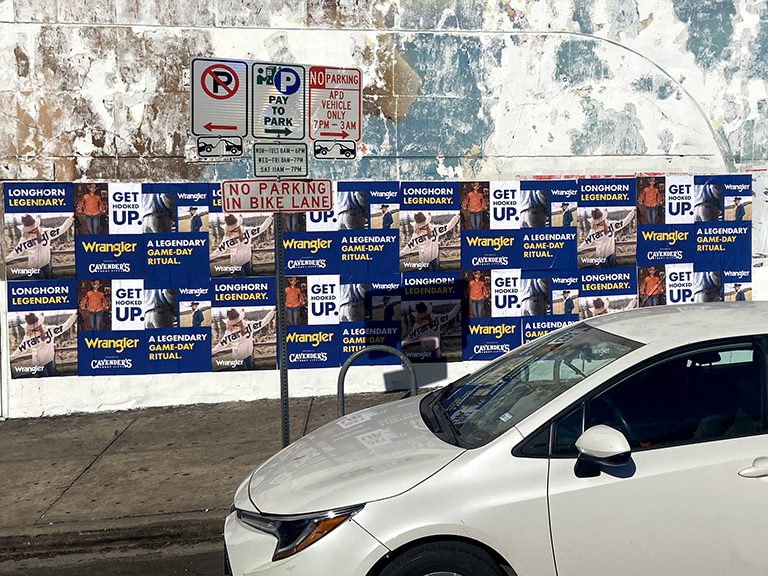
From paper selection to paste mix to placement logistics, here is everything a brand needs to know before running a wheat poster campaign in a real American city.
A wheat poster is a large-format paper print applied to a wall using a paste made primarily from wheat starch or flour. The paste soaks into the paper and bonds it to brick, concrete, painted metal, or plywood at a fraction of the cost of a vinyl billboard. Done right, a wheat poster campaign fills high-pedestrian corridors with full-bleed imagery that is difficult to ignore and impossible to scroll past.
We have been running wheat poster campaigns for over a decade. In that time, we have put up posters in Bushwick and Williamsburg, along Melrose Ave in Los Angeles, under the L tracks in Wicker Park, across the Wynwood arts district in Miami, and on the east side corridors of Austin. The format scales from a handful of key placements to hundreds of sites running simultaneously across multiple cities.
This guide covers everything: what wheat posters are, why they work, how to prepare artwork, what the production process looks like, how we select and scout locations, how a campaign gets executed in the field, what you receive when it is done, and how wheat posters compare to other outdoor formats. If you are considering a wheat poster campaign and want to understand what you are actually buying, this is the resource.
The term “wheat poster” refers to both the physical object and the method of application. The poster itself is a paper print, usually on 60 lb to 100 lb uncoated stock, produced on a wide-format printer or through offset litho depending on quantity. The “wheat” part refers to the paste used to apply it, which has traditionally been made from wheat flour or starch cooked into a smooth, high-tack adhesive.
Modern paste formulas used by professional crews have evolved beyond simple flour mixes. We use a cooked starch base that is slightly thickened with a small addition of methyl cellulose to extend working time and improve cold-weather adhesion. The base is water-based and non-toxic. It goes down in one or two coats, the paper goes on top, and a final sealing coat is brushed over the surface to laminate the poster and push out air pockets.
The result is a poster that bonds tightly to the wall. On rough brick it conforms to the surface texture, which creates a mural-like aesthetic. On smooth painted walls or sheet metal, it reads almost like a printed panel. In wet weather it becomes more pliable during application, but once cured, most wheat posters remain on the wall for weeks to months depending on surface, weather conditions, and the amount of foot traffic generating wear at the edges.
Wheat Poster vs. Vinyl Signage
Vinyl adhesive signs require a smooth, clean surface, professional installation tools, and leave residue behind. They are the right format for retail, indoor signage, and vehicle graphics. Wheat posters go where vinyl cannot, specifically on rough surfaces, textured concrete, painted brick, and surfaces where a semi-permanent paste application is the only practical option. Wheat posters also age more naturally in street environments, which contributes to their authenticity.
Wheat Poster vs. Wheatpaste Art
Wheatpaste art is an expressive medium associated with street artists and muralists. A wheat poster campaign is a commercial execution using the same technique. The process is nearly identical. The intention, content, and scale of production differ. We handle both: commissioned paste-up art for brands that want an editorial aesthetic, and straight wheat poster runs for brands that need geographic saturation with clean branded imagery.
Why Brands Use Wheat Posters
The appeal of wheat posters comes down to a few distinct advantages over other formats.
Cost Per Square Foot
A wheat poster covering 40 square feet of wall space costs a fraction of what that equivalent square footage would run on a backlit transit panel or a painted wall mural. The materials are paper and paste. The labor is skilled but not highly specialized equipment-dependent. When you need to saturate a corridor or a neighborhood, the format allows you to do it at a scale that would be economically impossible with traditional outdoor advertising.
Placement Flexibility
Wheat posters go up on surfaces that have no formal advertising inventory. Construction scaffolding, plywood hoardings, the sides of buildings with permission from the owner, loading dock doors, boarded storefronts, raw brick faces in active pedestrian zones. These are walls that no media buyer can book through a network. We source them directly, which means we are able to place your brand in spots that your competitors simply cannot access through traditional channels.
Authentic Street Aesthetic
There is a specific visual register that street-level poster campaigns carry. It reads as local, real, and culturally present in a way that digital out-of-home and transit shelter ads cannot replicate. For brands targeting urban consumers, music fans, fashion audiences, sneakerheads, and early adopter segments, that authenticity is not a side effect. It is the entire point.
Scale and Speed
A well-organized crew can put up a significant volume of posters overnight. We typically execute large runs across multiple neighborhoods simultaneously using coordinated teams. A campaign that requires 150 placements across three neighborhoods in one city can be up in a single night. For launches, album drops, event announcements, and product releases where timing is everything, that speed is a real operational advantage.
AGM Field Note: We pre-scout every site before any paste goes on a wall. Location scouting happens in the days before execution, on foot, with a focus on pedestrian flow, surface quality, and visibility. We are not sending a crew to put up posters blind. Every placement is confirmed before the production night starts.
Wheat Poster Sizes and Formats
Wheat posters come in a range of standard sizes. The most common formats we use are:
Format Name
Dimensions
Common Use Case
Panels to Fill Wall
24-Sheet Broadside
24″ x 36″
Single-location placements, column wraps
1
Double Wide
48″ x 36″
Doorway and window surrounds
1
Two-Panel Stack
24″ x 72″
Tall narrow wall sections
2
Four-Panel Stack
48″ x 72″
Standard wall fill, most common format
4
Six-Panel Build
72″ x 72″
Wide wall sections, scaffolding panels
6
Custom Takeover
Variable
Full wall coverage, murals, building wraps
8-24+
The most common execution for a brand campaign is the four-panel build: four 24″ x 36″ sheets arranged in a two-by-two grid to produce a 48″ x 72″ finished face. This format is large enough to read from across the street, small enough to fit on most available wall sections, and uses a standard roll-fed print size that keeps production costs manageable at volume.
Multi-Panel Builds and Oversized Installations
For larger walls, we build up from the standard panel. A six-panel arrangement fills a roughly six-foot by six-foot wall section. Twelve-panel builds can fill an entire side of a building. We have done full building takeovers in Bushwick where the imagery covers two full stories, assembled from 30+ individual sheets that tile efficiently edge-to-edge. At that scale the finished installation looks like a mural from the street, but it prints, ships, and installs at a fraction of the cost of hand-painted work.
Paper Choices
Standard wheat poster paper runs 60 lb to 80 lb uncoated. This weight absorbs paste well, conforms to surface texture, and dries without cracking. Heavier stocks (100 lb and above) are more durable but require more paste volume and longer drying time to bond fully. Semi-gloss and coated stocks are occasionally used for aesthetic effect, but they require careful paste application since the coating resists absorption and can cause bubbling if the technique is not adjusted accordingly.
Artwork Preparation for Wheat Poster Campaigns
Getting artwork right before print is the difference between a campaign that looks polished in the field and one that loses detail on brick or washes out in low light. Here is what we ask for and why.
File Specifications
We prefer print-ready PDFs or high-resolution TIFFs at 150 to 200 DPI at final output size. For most standard panel formats, a 24″ x 36″ panel at 150 DPI requires a file that is 3600 x 5400 pixels minimum. Vector elements (logos, type, geometric shapes) should be embedded or supplied as separate vector files. Live area should be kept at least 0.5 inches inside the bleed edge to prevent text from being clipped during trimming.
Color and Contrast for Street Environments
Wheat poster placements are viewed in variable lighting conditions: mid-day sun, evening sodium vapor streetlight, morning overcast. We recommend high contrast between background and type, bold type weights at display sizes, and avoiding pale pastels that disappear in low light. Color mode is CMYK for offset print. Wide-format inkjet production can handle extended gamut, but we advise speccing to CMYK to ensure consistency across print runs.
What Happens When Artwork Misses the Mark
We have seen clients submit beautiful digital mockups that fall apart at 48 inches wide because the source file was 72 DPI from a web export. We catch this in production review before anything goes to print. If artwork does not meet spec, we communicate it back to the client’s creative team with specific guidance on what needs to be fixed. No prints go out the door if we know the resolution is going to make the brand look bad on the wall.
AGM Field Note: If your creative team can send us an 8.5″ x 11″ mockup of the design at the correct proportions, we can scale it and do a soft proof before committing to a full print run. For campaigns where the visual needs to work across multiple panel configurations, we produce mockups showing how the design tiles across a four-panel and six-panel arrangement before any paper gets loaded.
Location Scouting and Site Selection
The wall matters as much as the poster. A well-designed poster on a wall nobody walks past is a wasted print. Our scouting process is built around pedestrian flow and audience concentration, not just available wall space.
How We Scout
Scouting happens on foot. We walk the target corridors during the time of day that reflects the campaign’s target audience activity. A campaign for a late-night venue gets scouted in the evening. A campaign for a coffee brand gets scouted in the morning commute window. We are looking at who is actually moving through the area, at what pace, and at what visual angle relative to the wall.
Surface Quality Assessment
Not every available wall is a viable wall. We assess each surface for texture, porosity, and condition. Fresh paint over brick is often the best substrate for wheat posting, since it is slightly porous and the paste grabs quickly. Bare raw brick is workable but requires a heavier paste coat to fill the texture. Smooth concrete is clean and fast to work on but requires adequate surface preparation. Shiny painted metal and coated surfaces need a base coat of paste to be left to tack up before the poster goes down, or the bond will be weak.
Permission and Sourced Walls
For campaigns that require clean, guaranteed placements, we work with walls that we have relationships with, specifically building owners and property managers who have agreed to accept poster applications. These are confirmed, stable locations that will not result in removal. They exist in high-density pedestrian corridors across all of our primary markets, and they represent the most reliable inventory in the format.
Target Markets and Neighborhoods We Regularly Execute In
In New York: Bushwick, Williamsburg, Lower East Side, Crown Heights, Astoria, Long Island City. In Los Angeles: Melrose Ave, Fairfax District, Arts District, Silver Lake, Echo Park. In Chicago: Wicker Park, Bucktown, Logan Square, Pilsen. In Miami: Wynwood, Little Havana, Design District. In Austin: East 6th Street, South Congress, North Loop. In each of these markets we have existing relationships, pre-scouted inventory, and crew ready to execute.
Field Execution: How a Wheat Poster Campaign Actually Runs
Production night is where a wheat poster campaign either holds together or falls apart. We have been through enough campaigns to know what preparation looks like and what causes problems in the field.
Pre-Night Preparation
Posters ship rolled in tubes, organized by location and panel number. Paste is prepared the day before using a cooked starch base, cooled and stored in sealed containers. Each crew vehicle carries paste buckets, large-format brushes, squeegees, extension poles, water jugs for thinning paste in cold weather, and surface prep materials. Crew members each have a specific role: paste applicator, poster carrier, smoother, and documentation.
The Application Process
The wall gets a first coat of paste in the area where the poster will go. The paste coat is brushed out to even coverage and allowed to tack slightly before the paper goes up. The poster is positioned from the top edge, smoothed downward to push air out, and then a sealing coat of paste goes over the entire surface. For multi-panel builds, panels are aligned edge-to-edge with seams minimized. A good crew can put up a four-panel build in under four minutes on a prepared surface.
Documentation
Every placement gets photographed. We shoot wide to show street context and close to show poster detail. For larger campaigns we produce geo-tagged placement maps showing where each site landed. These photos and maps become part of the campaign report we deliver after execution. The documentation is thorough enough to give your marketing team material for social content, internal reporting, and post-campaign review.
Crew Coordination Across Markets
Multi-city campaigns run with separate crews in each market executing on the same night or across a coordinated window. We have trusted crews in every primary market we operate in. They are briefed, they have the materials, and they have the site list. Campaign-night communication runs on a shared reporting structure so we know when each location is confirmed up. By morning, we have a complete account of every placement that was executed.
Wheat Poster Longevity and Campaign Duration
One of the most common questions we get is: how long will the posters stay up? The honest answer is that it depends, and it depends on a specific set of factors.
What Determines Lifespan
Surface adhesion quality is the primary factor. A poster on a well-prepped brick wall with a strong paste bond can last six to twelve weeks before weather and normal wear start peeling edges. A poster on a smooth metal surface with a weaker initial bond might start lifting within two to three weeks if there is rain and pedestrian traffic scraping the bottom edge.
Weather matters. Freeze-thaw cycles in northern markets create thermal expansion in walls that breaks the paper fiber and causes peeling. Sustained rain softens the paper at edges. Hot and dry conditions in Southwest markets can actually preserve posters for extended periods. In our experience, Los Angeles placements last substantially longer on average than New York placements for this reason.
Foot traffic creates wear at the lower edge of posters. We typically apply the bottom edge of a four-panel build at a height that keeps it above the contact zone where pedestrians would graze it. This simple adjustment extends bottom-edge integrity significantly.
Campaign Windows
Most wheat poster campaigns are designed for a two to six week active window. Launch campaigns targeting a specific event or release date are often designed for two to three weeks of active presence. Longer brand-awareness campaigns run four to six weeks with a refresh option where crews return to replace posters that have degraded at high-wear locations.
Wheat Poster Campaigns by Market
New York City
New York is the most competitive and most active wheat poster market in the country. The density of pedestrian traffic means that a well-placed poster in Williamsburg or the Lower East Side sees more eyes per day than a comparable outdoor format in most other American cities. Our New York operation covers all five boroughs, with particular depth in Brooklyn and Manhattan. Execution typically happens late at night to minimize interference with pedestrian flow during application.
Los Angeles
Los Angeles campaigns concentrate along Melrose Ave, through the Fairfax District, and in the Arts District near the eastern edge of downtown. The car culture means that placement visibility at street level must account for both pedestrian viewing and vehicle passenger viewing from the adjacent lane. Wider, lower placements perform better in LA than they do in New York, where vertical height matters more for foot traffic visibility.
Chicago
Chicago campaigns concentrate in Wicker Park, Bucktown, and Logan Square for lifestyle and cultural brands. Pilsen carries strong audience concentration for campaigns targeting creative and Latin urban demographics. Winter weather in Chicago makes October through March the more challenging execution window, and we adjust paste formula and application technique accordingly when temperatures drop.
Miami
Miami’s Wynwood is a purpose-built art and brand activation district and a natural home for wheat poster campaigns. The wall density, foot traffic from both tourists and local creative community, and receptive property owners make it one of the most campaign-friendly districts in the country. The Design District and Little Havana extend reach into different demographic corridors for campaigns that need broader Miami market presence.
How Wheat Poster Campaigns Fit Into a Broader Media Mix
Wheat posters rarely run in complete isolation from other campaign elements. The format works particularly well in combination with digital social, event-based activations, and experiential marketing, with each channel reinforcing the others.
Wheat Posters and Social Content
People photograph posters they find interesting. A striking wheat poster in a well-trafficked location in Bushwick or Melrose will generate organic photo content from passersby within hours of going up. Seeding that content with your own campaign documentation and publishing it through owned social channels amplifies the street presence into a digital audience. We have seen single placements in high-profile locations generate dozens of organic posts before any brand-managed distribution happens.
Event Launches and Release Campaigns
Wheat posters are a natural tool for launching something. An album, a product, a store opening, a film, a brand collaboration. The format creates physical presence in the city on a specific date, which maps directly to a news cycle and a social moment. Running posters in the week leading into a launch creates ambient city-level awareness that feeds opening-day traffic and media coverage.
Multi-Format Street Campaigns
Wheat posters combine well with hand-painted murals, branded chalk, and distributed handbill programs. For brands that want wall-to-wall presence in a target neighborhood, a coordinated execution of multiple formats creates a sense of total market saturation that no single format can achieve on its own.
AGM Field Note: We regularly build multi-format campaigns where wheat posters handle the volume locations and a hand-painted mural handles the anchor placement. The mural draws attention and earns organic coverage; the wheat posters multiply presence across the surrounding blocks. Both formats reinforce each other without competing visually when the creative is coordinated.
Budget and Production Considerations
Wheat poster campaign budgets have three primary cost centers: print production, field labor and crew, and any location fees for sourced inventory.
Print Production
Print costs scale with quantity and format size. Wide-format inkjet production is economical for short runs of large panels. Offset litho production becomes cost-competitive at quantities of 1,000 sheets or more and produces a slightly different aesthetic (denser ink coverage, more saturated color). For most brand campaigns in the 50 to 200 location range, wide-format is the practical production method.
Field Labor
Crew costs depend on the number of sites, the market, the timing, and any access requirements. Single-city campaigns with 25 to 50 locations are typically executed in one night with a small crew. Multi-city campaigns or large-scale single-city runs with 100+ locations require larger crews and sometimes two execution nights. We price campaigns with crew included, not as a line item that brands need to estimate separately.
Working With Our Team
The most efficient path is to start with a market and a location target, tell us what you are trying to accomplish, and let us scope the campaign from there. The format is accessible at smaller scales and powerful at larger ones. Contact AGM for a package-based quote for your market and objectives.
Frequently Asked Questions
What exactly is a wheat poster?
A wheat poster is a large-format paper print applied to a wall surface using a water-based paste made from wheat starch or a similar adhesive. The paste is brushed onto the wall, the paper is positioned and smoothed down, and a final sealing coat is applied over the surface. The result is a durable, fully bonded poster that holds up to outdoor weather for weeks to months depending on surface and conditions.
How long do wheat posters last?
Longevity depends heavily on the surface, the paste bond quality, local weather conditions, and foot traffic wear. In most markets, a well-applied wheat poster on a good surface lasts four to eight weeks before noticeable degradation. In drier markets like Los Angeles, posters routinely last two to three months. In New York during winter, posters in high-wear locations may show significant wear within three to four weeks.
The most common campaign format is a four-panel build that produces a 48″ x 72″ finished face. This size reads clearly from across the street, fits in most standard wall sections, and keeps print costs manageable at volume. Larger builds up to full building wraps are possible for anchor placements or high-profile campaign moments.
What file format do you need for artwork?
We prefer print-ready PDFs or high-resolution TIFFs at 150 to 200 DPI at final output size. CMYK color mode. Vector elements for logos and type. Bleed of at least 0.25 inches on all edges, with live area kept 0.5 inches inside the trim. We review all submitted artwork before sending to print and will communicate any issues that would affect quality in the field.
Do you need permission to put up wheat posters?
Permission requirements vary by city and placement type. For campaigns that require clean, stable, guaranteed placements, we source walls where we have relationships with property owners. For placements on public-facing construction hoardings and scaffolding, we navigate site-by-site based on our field experience in each market. We scope each campaign with a clear understanding of the placement approach and communicate it before execution.
How many posters can you put up in one night?
A two-person crew can put up 20 to 40 four-panel builds in a standard six-hour execution window, depending on travel time between sites and surface conditions. Larger crews running multiple vehicles can execute 100+ locations in a single night in a single city. For campaigns that need simultaneous multi-city execution, we coordinate crews in each market to run concurrently.
How do you document the campaign?
We photograph every placement after it goes up, capturing both wide context shots and close-up detail. For larger campaigns we produce geo-tagged placement maps. These are compiled into a campaign report and delivered after execution. The photos are available for use in your marketing materials, social content, and internal reporting.
Can you run wheat poster campaigns in multiple cities at once?
Yes. We operate in every major US market and have established crews in New York, Los Angeles, Chicago, Miami, Austin, and other cities. Multi-city campaigns can be coordinated to run simultaneously on the same night or over a defined window. We manage the logistics centrally and deliver a unified campaign report covering all markets.
What makes a good location for a wheat poster?
High pedestrian flow, surface quality, and audience match. We look for locations where the specific people your brand is trying to reach are actually moving on foot at a pace that allows them to register and absorb the poster. A beautiful wall in a low-traffic area is worth less than a rough brick surface in a dense pedestrian corridor.
How do I get started with a wheat poster campaign?
Call us at (646) 776-2770 or email [email protected]. Tell us the market or markets you want to hit, the campaign objective, the timing, and any existing creative. We scope the campaign from there and give you a clear proposal covering locations, format, quantities, and execution timeline.