Wheat Pastings: How to Plan and Run Street Poster Campaigns
This is American Guerrilla Marketing’s operational guide to wheat pastings: everything that goes into running a campaign that shows up on the right walls, in the right neighborhoods, and produces documentation you can actually use.
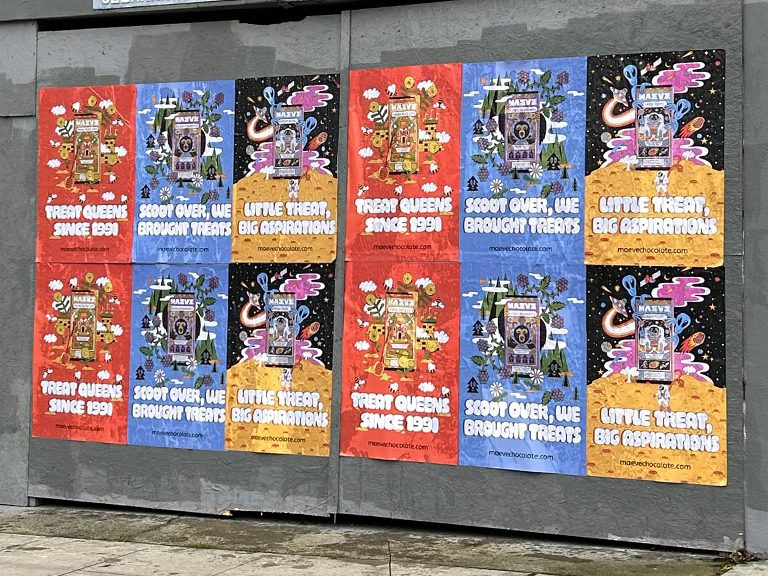
Wheat pastings are the plural: the campaigns, the individual placements, the series of poster installations that together constitute a street presence in a city. When a brand runs a wheat pasting campaign in New York or Los Angeles, what they are actually running is a collection of wheat pastings: 50 or 200 or 400 individual poster placements across specific neighborhoods, executed by a trained crew, documented at each location, and reported back as a campaign record.
American Guerrilla Marketing has been executing professional wheat pastings in New York City, Los Angeles, Chicago, Miami, Austin, and other markets for over a decade. We have run campaigns for fashion brands, record labels, streaming platforms, tech startups, consumer goods companies, and event promoters. The work is the same regardless of client category: strategic location planning, professional installation, thorough documentation, and clear measurement against campaign objectives.
This guide explains how wheat pastings work at a professional level. What goes into selecting the right locations. What the technical execution involves. What documentation looks like. And how you measure the results of putting physical paper on physical walls in specific neighborhoods.
Wheat pastings are individual instances of poster installation using wheatpaste as the adhesive: paper bonded to an outdoor wall surface. In a campaign context, wheat pastings refers to the aggregate of multiple individual placements executed as part of a coordinated street advertising campaign.
The term encompasses the full range of the activity: from a single artist placing one large paste-up work on a wall to a marketing agency running 400-placement multi-city campaigns for national brands. The adhesive and the technique are the same. The scale, the strategic intent, and the documentation requirements scale with the scope of the campaign.
At American Guerrilla Marketing, when we talk about wheat pastings we are talking about the campaign-scale execution: multiple placements across targeted neighborhood zones, installed by professional crews, documented at every location, and delivered to clients as a complete campaign record. That is the professional version of what wheat pastings means in a commercial context.
The Case for Wheat Pastings as a Marketing Channel
Before planning wheat pastings for a brand, the first question to answer is why the format is the right tool for the objective. Here is the honest case for wheat pastings as a commercial advertising channel.
Physical Presence That Lasts
A professionally installed wheat pasting on a good surface stays on a wall for two to six weeks. During that time, everyone who walks past that wall sees the campaign. Multiple times. The person who commutes past your poster every weekday morning receives ten or more exposures from a single placement. That frequency is built into the format and requires no additional budget to generate.
Digital advertising does not accumulate value over time the way a physical placement does. An ad impression disappears in milliseconds. A wheat pasting accumulates exposure over its entire lifespan. The total audience contact delivered by a well-placed poster over four weeks often exceeds what a single paid digital impression delivers by a significant multiple.
Unmediated Audience Contact
Wheat pastings reach audiences without a platform intermediary. There is no algorithm deciding whether to show the campaign to a user. There is no ad blocker preventing the audience from seeing it. The poster is in the physical world, and everyone who moves through that space encounters it directly. This unmediated contact is increasingly valuable as digital advertising becomes more filtered, more expensive, and less effective per dollar spent.
Cultural Context and Credibility
In neighborhoods with active street culture, wheat pastings carry cultural positioning that conventional advertising formats cannot deliver. A brand that shows up on the walls of Bushwick or Fairfax Avenue is communicating cultural presence, not just commercial awareness. That difference in how audiences read the brand’s presence matters for categories where cultural credibility drives purchase intent.
Organic Social Amplification
Good creative executed well in the right neighborhood makes people stop, photograph, and share. Organic social posts from people who photographed your campaign in their neighborhood extend its reach into digital channels without additional media spend. A single well-executed wheat pasting in a high-foot-traffic location with strong creative can generate dozens of organic social posts from the people who encountered it. That amplification is unique to physical advertising with genuine creative quality.
Selecting Locations for Wheat Pastings
Location selection is where most wheat pasting campaigns win or lose before a single poster goes up. The wrong locations produce campaign investment with no return. The right locations put the message in front of the right audience at the right density to produce the awareness that justifies the spend.
Audience-First Location Logic
The starting point for any location selection process is a clear picture of who the campaign is trying to reach. Not a broad demographic category: a specific audience with specific lifestyle characteristics, neighborhood patterns, and cultural touchpoints. That specificity maps to specific neighborhoods in specific cities.
For a streetwear brand targeting Black men ages 18 to 28 in New York City, the audience maps primarily to Crown Heights, Flatbush, Harlem, and the Bronx, with secondary presence in Williamsburg and the Lower East Side. Running the campaign only in Williamsburg misses the majority of the primary audience. Running it across all six zones captures everyone but dilutes density and requires significantly more budget. The right answer depends on the campaign objectives and the available budget, which is why audience mapping happens before geography selection, not after.
Neighborhood Scouting
After the neighborhood list is determined, scouting maps the specific surfaces available in each zone. A scout walks the target blocks and identifies walls with the right combination of foot traffic visibility, surface adhesion quality, and audience positioning. Not every wall on a target block is a viable paste location. The scout determines which specific surfaces make the route.
Good scouting produces an installation map that tells the crew exactly where to go and in what order. Bad scouting or no scouting produces a crew that drives around looking for places to paste on installation day, which wastes time, produces random placement geography, and misses the specific high-value locations the campaign should be concentrating on.
Zone Density vs. Coverage Area
The single most important strategic decision in wheat pasting location planning is zone density versus coverage area. A campaign with 100 placements spread across 20 blocks in five neighborhoods has ten placements per neighborhood zone. A campaign with 100 placements concentrated in two neighborhoods of two blocks each has 25 placements per block zone. The second campaign creates visible saturation in its target zones. The first campaign is nearly invisible in each neighborhood it touches.
We consistently recommend concentration over coverage for campaigns with defined audience targets. Concentrated campaigns create the density that makes individual audience members encounter the campaign multiple times from multiple angles, which drives recall in a way that single-exposure, spread-thin campaigns cannot achieve.
The Technical Side of Wheat Pastings
The quality of individual wheat pastings is determined by the technical execution of each installation. Professional wheat pasting technique produces flat, durable placements that hold for weeks. Amateur technique produces placements that peel at corners, bubble across the face, and look neglected within days. Here is what professional execution looks like.
Paste Preparation
Professional wheat pastings use a paste formula calibrated for the day’s conditions. The base is wheat starch cooked with water to a thick, smooth consistency. PVA glue is incorporated after cooling to add water resistance. The working consistency is thick enough to coat surfaces fully without dripping freely. Hot-weather campaigns use thicker paste to extend working time before the paste skins over in heat. Cold-weather campaigns use slightly thinner paste to maintain brush-ability as temperatures drop.
Installation Sequence
Every placement follows the same sequence. Surface check: confirm the wall is dry, stable, and suitable for paste adhesion. Pre-wet: apply clean water to the wall surface before paste, particularly on porous brick and concrete. Base coat: apply a generous coat of paste to the wall in the target area, slightly larger than the poster dimensions. Position: place the poster against the paste-coated surface, aligned carefully before pressing. Center press: push from the center outward to eliminate air pockets. Top coat: apply paste over the entire face of the posted paper, covering every square inch. Edge seal: use a detail brush to force paste under all edges and into all corners. Photograph: document the placement before moving on.
Paper and Format Specifications
70 to 80 pound uncoated text or cover stock is the standard for outdoor wheat pastings. This weight bonds well, handles outdoor conditions, and prints accurately across the full color range. Glossy coated stock does not work for outdoor wheatpaste applications because the coating prevents paste penetration.
Format selection depends on campaign objectives and neighborhood surface inventory. 24×36 inches is the most common professional format: large enough to command street-level attention, manageable for efficient multi-location installation. 18×24 inches for higher-volume, cost-efficient campaigns. Multi-panel formats for feature placements requiring maximum visual impact on a specific high-priority wall.
Campaign Type
Recommended Format
Typical Placement Count
Installation Days
Neighborhood awareness push
18×24 or 24×36
25 to 75
1 to 2
City-wide brand awareness
24×36
100 to 250
2 to 4
Product or album launch
24×36 primary + multi-panel feature
150 to 300
2 to 5
Multi-city national rollout
24×36
100 to 200 per city
2 to 4 per market
Event promotion
18×24 or 24×36
50 to 150
1 to 2
Documentation: What Every Wheat Pasting Campaign Should Produce
Documentation is where wheat pasting campaigns prove their value. Without documentation, a campaign is a claim: “we put up posters.” With documentation, it is a record: “here is every placement, here is what it looked like, here is where it ran.”
At American Guerrilla Marketing, photo documentation from every placement is a standard deliverable on every campaign we run. Not a sample. Not highlights. Every placement.
What the Photo Documentation Covers
Each placement photo record includes: one context photo taken from across the street or at a distance that shows the neighborhood setting and wall context, and one closer photo that shows the poster condition, installation quality, and readability clearly. Both photos are taken on installation day, before the crew moves to the next location.
Context photos show where in the neighborhood each placement landed. Anyone reviewing the campaign report can see not just that posters went up, but where specifically they went up and what the surrounding environment looks like. This matters for clients who want to know whether the locations match the audience-targeting strategy that was planned.
Quality photos confirm that each placement was installed correctly: flat against the surface, edges sealed, no visible bubbling or lifting. If a placement failed on installation day (wrong surface, weather issue, poster damaged during transport), the photo record shows that rather than counting it as a successful placement in the final tally.
Geo-Tagged Placement Maps
For larger campaigns, we provide geo-tagged placement maps showing the full campaign geography. These maps plot each placement location on a neighborhood or city map, giving clients a visual representation of where the campaign ran across the target zones. Geo-tagged maps are particularly useful for multi-neighborhood and multi-city campaigns where the geographic spread of the campaign is a key deliverable.
AGM Field Note: Documentation Photos Are Campaign Assets
Every campaign report we deliver generates organic use beyond the accountability function. Clients post placement photos to their Instagram, use them in press materials, include them in marketing decks to demonstrate street presence, and share them in team updates to show the campaign running in the real world. We shoot every placement with the knowledge that those photos are going somewhere beyond the campaign report. That mindset affects how we frame and compose each shot.
Measuring Wheat Pasting Campaign Results
Measuring wheat pastings requires combining signals from multiple channels. No single measurement captures the full impact, and the measurement framework needs to be set up before the campaign launches to capture baseline data for comparison.
QR Code Tracking
Every poster design should include a campaign-specific QR code. Each scan is a direct engagement data point: a person who stopped in front of the poster, noticed the QR code, and pulled out their phone to scan it. Scan volume during and after the campaign period is a direct measurement of active engagement. Unique destination URLs behind the QR code allow downstream tracking of what scanners did after clicking through: site visits, sign-ups, purchases, app downloads.
QR code data is the most direct measurement available for wheat pasting campaigns and the one most clients find most compelling when presenting results to decision-makers. Set up campaign-specific QR codes before printing. Do not use the same URL you use everywhere else because you will not be able to attribute scans to the campaign specifically.
Branded Search Monitoring
Pull branded search volume data from Google Search Console before the campaign launches. Note the baseline query volume for your brand name in the target geographic areas. Compare to the same data for the two to four weeks following installation. Street campaigns consistently produce measurable increases in branded search queries from the neighborhoods where they ran. This is one of the most reliable and underutilized measurement signals for physical advertising campaigns.
Direct Traffic Analysis
Monitor your website’s direct traffic from the campaign launch date. Campaigns that include a memorable URL in the poster design drive direct navigation, which shows up in web analytics as direct traffic from the install geography and timing. Compare the install period direct traffic to the same window from the prior month or prior year to isolate the campaign-driven change.
Social Listening
Set up monitoring for your brand name, campaign hashtag (if used), and the neighborhood names of your target zones before the campaign launches. Track organic social mentions in these contexts during and after the campaign period. Every organic social post from someone who photographed your campaign in their neighborhood is earned media that the campaign generated without additional spend.
Campaign Reports with Placement Photos
The documentation itself is a form of measurement: it tells you exactly how many placements ran, exactly where they were, and what they looked like on installation day. Combined with the other measurement signals, it provides the geographic and temporal context that makes sense of changes in search, traffic, and social data. Without the documentation, the other measurement signals lack the specific context needed to attribute them to the campaign with confidence.
What Brands Get Wrong About Wheat Pastings
Having run campaigns for clients across many categories and experience levels with the format, we have seen the same mistakes consistently. Here is what goes wrong most often.
Geographic scope without geographic depth: Spreading a 100-placement campaign across six neighborhoods to cover the whole city. Each neighborhood gets 15 to 20 placements. No neighborhood zone achieves real density. The campaign feels like noise in each location rather than presence. Concentration produces better results than coverage at every budget level.
Wrong paper stock: Glossy coated paper ordered because it “looks nicer” or because it was available from the regular print vendor. Paste does not penetrate the coating. Placements peel within days. The campaign looks bad to exactly the audience it was supposed to impress.
Creative designed for screens: Art that was designed for digital use and then exported to print at a large size. Text that was readable at 72 DPI at a small size becomes illegible at 300 DPI at large format. Low-contrast design that worked on a backlit screen disappears on a wall in full daylight. Get the creative to full-scale print before finalizing the print run.
No measurement baseline: Running the campaign without pulling pre-campaign data. Then trying to evaluate results without comparison data. Set up measurement tracking before the installation happens, not after.
Hiring on price without asking questions: The cheapest wheat pasting company is not the right company for a brand campaign. Ask the questions. See the documentation. Confirm the location knowledge. The difference in results between a professional operation and a low-cost operator is large enough to make the budget difference insignificant.
AGM Field Note: Volume Without Standards Is Just Mess
People sometimes talk about wheat pastings as if the plural automatically means scale. It does not. A hundred weak installs on random walls create clutter, not presence. Real scale comes from disciplined route building, consistent creative, and clean execution across the whole batch.
What Wheat Pastings Look Like at Campaign Scale
The plural form usually comes up when people are talking about a batch of posters rather than a single placement. In practice, wheat pastings means a coordinated field operation. Multiple posters, multiple surfaces, one creative idea carried across a route. The value is not in the number alone. The value is in how those placements work together.
At campaign scale, we think about wheat pastings as a system of encounters. A person sees one poster near a coffee shop, another near a venue, and another a few blocks later on a construction barrier. Each placement reinforces the previous one. The city becomes the delivery system for repeated brand contact.
Batch Planning Basics
To run a strong batch, start by grouping placements into zones. Count the poster inventory by zone, not just by city. Match each zone to a specific audience behavior such as nightlife traffic, retail walking, or commuter spillover. Then confirm the art, size, and paper stock fit the surface mix in that zone. These choices sound simple, but they are what separate coordinated wheat pastings from a stack of posters slapped up without a plan.
We also budget for overage. A batch needs backup sheets because some walls get rejected in the field, some posters get damaged in handling, and some blocks turn out better than expected and deserve extra saturation. Printing exact counts is false efficiency.
Operational Differences Between Small and Large Batches
A small batch of 20 to 30 posters can be flexible. A large batch of 150 or 300 needs process. Paste consistency, route order, carrying logistics, crew assignments, and photo documentation all become more important as volume rises. The margin for improvisation shrinks because one small error repeated 100 times becomes a visible campaign problem.
This is why large wheat pastings benefit from experienced crew leads. Someone has to own route pacing, quality checks, and whether the installs are staying consistent from the first block to the last. When that leadership is missing, later placements usually get sloppier as the day goes on.
Why the Best Batches Still Feel Local
Even large batches should feel rooted in the neighborhoods where they appear. The creative can be national, but the route should still respond to local conditions. A poster that feels right on a plywood wall in Bushwick may need different density or different neighboring surfaces in Silver Lake or Wicker Park. Street media scales best when it keeps that local intelligence instead of flattening every city into the same plan.
That is the balance we aim for on multi-city work: one campaign identity, adapted through neighborhood-level route decisions so each batch feels placed, not dumped.
Frequently Asked Questions
What are wheat pastings exactly?
Wheat pastings are outdoor poster placements installed using wheatpaste as the adhesive: a starch-based adhesive made from wheat flour or starch cooked with water. In a campaign context, wheat pastings refers to multiple individual poster placements executed across a set of target locations as part of a coordinated street advertising campaign. American Guerrilla Marketing has run professional wheat pasting campaigns for over a decade in New York, Los Angeles, Chicago, Miami, Austin, and other major markets.
How is a wheat pasting different from a regular poster stuck to a wall?
A wheat pasting uses a starch-based adhesive applied on both the wall surface (base coat) and over the face of the poster (top coat), creating a through-saturated bond that bonds the paper to the surface on all sides. The result is a flat, completely adhered placement that holds for weeks. A regular poster stuck to a wall with tape is only attached at its edges, curls in heat, falls off in rain, and typically looks unprofessional within hours. The technique is what makes wheat pasting durable and visually clean at street scale.
How many wheat pastings does a campaign need?
Enough to create density in the target zones. For a single neighborhood campaign, 30 to 50 placements achieves meaningful visibility. For a citywide campaign across four to six target zones, 150 to 300 placements. For multi-city national rollouts, 100 to 200 per market minimum. Density within the zone matters more than total count across a broad area. Concentrated campaigns in fewer zones outperform scattered campaigns across many zones at the same total placement count.
Who does American Guerrilla Marketing work with?
We work with brands across fashion, music, consumer packaged goods, tech and startups, streaming and entertainment, events and venues, and retail. Campaign scale ranges from small neighborhood pushes of 25 to 50 placements to national multi-city rollouts of 500-plus placements. We work with brands directly and with agencies running campaigns on behalf of their clients. Our primary markets are New York City, Los Angeles, Chicago, Miami, and Austin, with coverage in additional markets through our crew network.
How long do wheat pastings last on outdoor walls?
Two to six weeks is the typical range for a professionally installed wheat pasting on a well-prepared surface in standard outdoor conditions. Duration is affected by weather (rain and direct sun accelerate degradation), surface type (porous surfaces hold better than smooth ones), and local poster turnover rate (high-activity postering corridors see faster replacement). Planning refresh installations for campaigns where sustained duration is critical is standard practice.
What does the campaign report from American Guerrilla Marketing include?
Every campaign report includes photo documentation from every placement, organized by location. Each location’s documentation includes a context photo showing the neighborhood and wall setting, and a closer photo confirming installation quality and poster readability. For larger campaigns, geo-tagged placement maps are included alongside the placement photos. Reports are delivered within a few days of installation completion and serve as both accountability documentation and a content asset for brand use.
Can wheat pastings be measured the way digital ads can?
Wheat pastings produce measurable results through multiple channels: QR code scans from posters with embedded codes, branded search lift in the target geography measured in Google Search Console, direct traffic changes correlated with install timing and geography, and organic social mentions from people who photographed and shared campaign placements. No single metric captures everything, but combining two or three measurement approaches gives a clear picture of campaign impact relative to investment.
What is the minimum budget for a professional wheat pasting campaign?
The entry point for a professionally documented street campaign starts at $4,500 for 100 standard posters (24×36) including installation, GPS documentation, and reporting. Contact AGM to discuss the right scope for your market and objectives.
How far in advance do we need to plan wheat pastings?
Two to four weeks from brief to installed campaign is the standard lead time for a professional wheat pasting campaign. This covers brief review and audience mapping, neighborhood scouting, print production (typically 5 to 7 business days at standard turnaround), paste preparation, crew scheduling, and weather monitoring. Campaigns with tighter timelines are possible but carry some execution risk. Larger or multi-city campaigns benefit from four to six weeks of lead time for logistics and crew coordination.
Rain within 12 to 18 hours of installation weakens the paste bond before it cures. Direct sun in summer accelerates paste drying and can reduce working time during installation. Cold below 28 degrees Fahrenheit slows cure time significantly. Professional operations monitor weather and schedule installations during dry windows with appropriate temperatures. We adjust paste formulas for weather conditions and reschedule campaigns rather than install in rain. This is a standard professional practice that amateur operations often skip, which is why their campaigns fail in the first weather event.