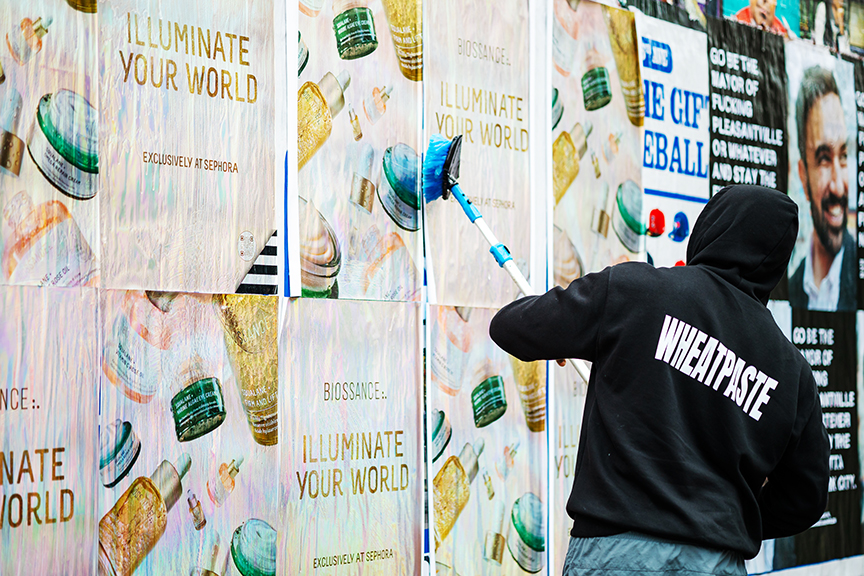
Wheat pasting means bonding printed paper to outdoor surfaces with a starch-based adhesive, and in a commercial context it means one of the most direct and culturally resonant forms of street-level advertising available.
Wheat pasting is the practice of applying printed paper posters to outdoor surfaces using wheatpaste as the adhesive. The paste is made from wheat starch or flour cooked with water into a thick, sticky gel. The paper is applied to the pasted surface and then coated with more paste on top, creating a fully bonded, flat placement that integrates visually with its surface.
That is the technical meaning. The cultural meaning is broader and more layered. Wheat pasting is how underground movements, artists, musicians, and political organizers have communicated in urban environments for over a century. It is also how professional marketing campaigns reach specific audiences in specific neighborhoods at street level in a way that conventional outdoor advertising cannot replicate.
At American Guerrilla Marketing, wheat pasting is our primary medium. We have executed campaigns in New York, Los Angeles, Chicago, Miami, Austin, and other markets across the country. We know what wheat pasting means in a technical sense and in a cultural sense, and we know how to make it work as a commercial advertising tool. This piece covers both meanings in full.
Wheat pasting is, at its most basic, the application of paper to a surface using wheat-based adhesive. The name breaks down into its components: wheat (the source of the starch used in the adhesive) and pasting (the action of applying adhesive and attaching material to a surface).
The adhesive itself, wheatpaste, is made by cooking wheat starch or flour with water until the starch granules rupture and the mixture thickens into a viscous gel. This gel has strong adhesive properties when applied to porous surfaces because it penetrates the surface material and forms a mechanical bond as it dries. Applied to both the surface and the face of the paper, it creates a through-saturated composite that bonds the paper to the wall so completely that the poster appears to grow from the surface.
Wheat pasting as a term covers the full activity: mixing the paste, preparing the surface, applying the adhesive, positioning the paper, pressing and smoothing, applying the top coat, and sealing the edges. Done correctly, the result is a flat, durable poster placement that holds for weeks in outdoor conditions.
The Historical Meaning: Where Wheat Pasting Comes From
The practice of applying printed paper to outdoor surfaces with adhesive is as old as commercial printing. In 19th century American cities, “billposting” referred to the professional activity of affixing advertising notices, event bills, and political messaging to available surfaces. The adhesive used was a wheat-based paste or a mixture of paste and other available adhesives.
Billposting became a formal commercial industry in the United States by the 1870s and 1880s. Professional companies negotiated exclusive rights to surfaces in specific territories and managed large-scale outdoor advertising installations. This industry is the direct ancestor of modern billboard advertising. The standardized panel sizes, the route-based installation approach, and the documentation-and-reporting practices of modern outdoor advertising all trace back to the organized billposting companies of the late 19th century.
The term “wheat pasting” as a distinct reference to the practice entered common use as a way to describe unauthorized or semi-authorized street postering as distinguished from organized commercial billposting. The underground and subcultural associations of wheat pasting as a term come from this history: it was the technique used by those who did not have access to or could not afford organized commercial outdoor advertising space.
Through the 20th century, wheat pasting remained closely associated with subcultural, underground, and activist communication. Punk shows and underground music events. Political campaigns and organizing efforts. Independent art distribution. The paste-up poster on a construction barrier or a brick wall was the medium of choice for anyone with a message, a print shop, and a bucket of paste but without a conventional advertising budget.
By the late 1990s and early 2000s, commercial brands began deliberately using wheat pasting as an advertising strategy, seeking the cultural credibility and audience access that the format provided in neighborhoods where conventional outdoor advertising was either less present or less effective at reaching specific demographic targets. What had been a subcultural medium became a professional advertising channel, though the two applications continue to coexist in every active city.
The Cultural Meaning: What Wheat Pasting Communicates
Wheat pasting communicates something beyond whatever message is printed on the poster. The format itself carries meaning that arrives before the viewer reads a single word of copy. Understanding that meta-message is essential for brands trying to use wheat pasting authentically.
Presence in Physical Space
Wheat pasting is physical. It occupies space in the real world. The brand or artist or organization that puts a poster on a wall in Bushwick or Fairfax is making a claim on physical territory in a way that digital advertising cannot. That physical presence communicates investment. It says: we showed up here, in this place, in your neighborhood, with enough conviction to put paper on a wall and paste it down. That act of showing up matters to audiences who spend time in those neighborhoods.
Participation in Street Culture
In neighborhoods with active postering cultures, the act of wheat pasting declares participation in the visual culture of that environment. A poster in Bushwick exists alongside paste-up works by artists who use the same technique and the same walls. That co-presence creates cultural association. The brand that shows up on those walls with strong creative is communicating that it is part of the same world, not looking in from outside through conventional advertising channels.
Accessibility Over Hierarchy
Wheat pasting has historically been the medium of those who could not access controlled advertising channels. That history gives it an association with accessibility, directness, and grassroots energy that more expensive and controlled advertising formats do not carry. A brand that uses wheat pasting is implicitly aligning with that tradition of direct communication, which resonates with audiences who are resistant to obviously corporate advertising.
Wheat Pasting in Different Contexts: What It Means in Each
Context
Who Uses It
What It Means
Primary Goal
Street Art
Fine artists, illustrators, printmakers
Public art, cultural commentary, self-expression
Visual presence, artistic statement
Activist Communication
Political organizers, advocacy groups
Public messaging, consciousness raising
Audience awareness, behavior change
Music Promotion
Independent artists, labels
Local presence, cultural belonging
Awareness for shows, albums, artists
Commercial Advertising
Brands, marketing agencies
Street-level brand presence with cultural context
Awareness, launch support, market entry
Event Promotion
Venues, promoters, festivals
Physical visibility in the neighborhood
Ticket sales, attendance
What Wheat Pasting Means for Brands Today
For brands, wheat pasting means a specific combination of things: street-level reach in audience-targeted neighborhoods, cultural positioning within the visual environment of those neighborhoods, physical advertising presence that persists over days and weeks rather than milliseconds, and documented campaign execution that produces a record of where and how the brand showed up.
The brands that have used wheat pasting most effectively over the past two decades are ones that understood both the practical and cultural meanings of the format. They chose neighborhoods based on where their target audiences actually spend time. They invested in creative strong enough to earn its place alongside genuine street art. They ran campaigns consistently enough to build recognizable presence in the neighborhoods they targeted, rather than treating it as a one-off stunt.
Fashion and Music: Native Wheat Pasting Users
Fashion and music have used wheat pasting as a commercial advertising medium longer than any other brand categories. The alignment between streetwear culture and street art culture, and between music industry promotion and the physical-world media channels that music audiences use, made wheat pasting a natural fit for these categories long before it became common in others.
For fashion brands targeting young urban consumers, wheat pasting in the right neighborhoods communicates cultural fluency. The poster on the wall in Williamsburg is not just an advertisement for a collection; it is a signal that the brand understands and belongs to the cultural geography of that neighborhood. That signal carries persuasive weight that digital advertising in the same demographic cannot generate.
For music labels and artists, the wheat paste poster is part of an established cultural vocabulary. Show bills have been going up on walls with paste since before digital distribution existed. A music campaign that includes wheat pasting is participating in a tradition that the target audience recognizes and responds to as authentic promotion rather than advertising.
Consumer Goods and Tech: Learning to Use the Format
Consumer packaged goods brands and tech companies have adopted wheat pasting more recently, often as part of new market entry strategies or product launch support. These categories use the format differently from fashion and music. The creative is typically more message-forward and less art-driven. The geographic strategy emphasizes market entry and brand familiarity building rather than cultural embedding.
When CPG brands use wheat pasting in new markets, the meaning is: “we are here now, in this neighborhood, as part of the local environment.” The physical presence of a beverage brand’s posters across Williamsburg or Crown Heights in the first weeks of a market launch signals arrival in a way that accelerates retail discovery and word-of-mouth spread.
AGM Field Note: The Meaning Changes with the Neighborhood
The same wheat pasting campaign means something slightly different in Crown Heights than it does in the West Village, and something different again in Bushwick. The neighborhood context shapes how audiences read the work. A campaign in Crown Heights is speaking to a predominantly Black millennial audience on their own cultural territory. A campaign in Bushwick enters a space dominated by established street art culture. A campaign in the West Village enters a more commercially oriented pedestrian environment. We think about neighborhood context as part of what the campaign communicates, not just as a distribution variable.
What Wheat Pasting Does That Other Advertising Cannot
Wheat pasting occupies a distinct position in the advertising environment precisely because of what it does that other formats cannot replicate.
It exists in the physical world without mediation. A poster on a wall in the audience’s neighborhood reaches the viewer directly, without a platform intermediary, an algorithm, or an ad blocker in between. The message arrives as a physical object in physical space. That unmediated contact is increasingly rare and increasingly valuable as digital advertising becomes more crowded and more filtered.
It accumulates frequency through repeated exposure. The person who walks past a poster on Monday morning and again on Tuesday afternoon and again on Friday evening has received three exposures from a single placement without paying for three separate ad deliveries. Physical advertising builds frequency through the audience’s own movement patterns, which is a fundamentally different and in many ways more efficient model than buying the same user multiple times on a digital platform.
It generates organic social content. Compelling street campaigns make people stop and photograph them. Those photos appear in Instagram stories, TikTok posts, and Twitter threads. A single well-placed and well-designed poster can generate dozens of organic social posts, extending the campaign’s reach beyond the physical placement into digital channels without additional media spend. This organic amplification effect is unique to physical advertising with strong creative.
It creates a spatial relationship with the audience. The person who walks past a brand’s poster in their neighborhood every day for three weeks has a different relationship with that brand than someone who saw the brand’s pre-roll ad three times on YouTube. The physical proximity of wheat pasting to the audience’s daily experience creates a familiarity that is qualitatively different from digital exposure. That familiarity translates into brand recall and purchase consideration in ways that are difficult to model but consistently reported by brands running street campaigns alongside digital ones.
AGM Field Note: People Feel the Meaning of the Format Before They Analyze It
Most pedestrians do not stop and say, this is a wheat-pasted poster using a historic street medium. They simply feel that the poster belongs to the city in a different way than a bus shelter ad does. That emotional read is part of why the format matters.
Why Wheat Pasting Means More Than Putting Paper on a Wall
When people ask about the meaning of wheat pasting, they are usually asking about more than the dictionary definition. They want to know why the format carries cultural weight. The answer is that wheat pasting sits at the intersection of public space, repetition, and intention. It is not private media, and it is not background decoration. It asks to be seen inside the city itself.
That public quality changes the meaning of the message. A poster encountered on a neighborhood wall feels different from the same design encountered in a feed. It feels more physical, more local, and more embedded in the audience’s lived environment. That is why artists use it to claim visibility and why brands use it to build relevance.
A Meaning Built Through Repetition
Wheat pasting also means repetition with purpose. One poster can be dismissed as noise. A sequence of posters across a district starts to look intentional. It tells the audience that someone wanted this image or idea to live in public view, not just appear as a paid interruption. That repeated presence is how the medium builds memory.
In brand work, that repeated presence becomes a strategic asset. Instead of buying one big moment, the campaign creates multiple smaller encounters that add up. The audience notices the poster on one block, then sees it again near a venue, then spots a third version outside a coffee shop. The city stitches those encounters together into a stronger impression of the brand without the campaign needing long copy or explicit explanation.
The Difference Between Meaning and Message
The message is what the poster says. The meaning is what the format tells the audience before they even read the copy. A blunt product headline on a wheat-pasted wall can still communicate energy, edge, or cultural proximity because the medium carries those associations. A beautifully written poster can still feel flat if it is placed in the wrong context or designed with no street awareness.
This is why format choice matters so much in campaign planning. A brand choosing wheat pasting is not just choosing a cheaper billboard. It is choosing a form of communication that signals confidence, local intent, and willingness to meet the audience in its actual environment.
How the Meaning Changes by Neighborhood
The same poster means different things in different parts of a city. On a layered construction wall in Bushwick, it may read as part of an active visual conversation. On a cleaner retail corridor in SoHo, it may feel more like a fashion activation. In a music-heavy corridor in the Lower East Side, it can feel like scene communication. The block changes the interpretation.
That is why we plan routes at the neighborhood level. The meaning of wheat pasting is not fixed. It is shaped by the wall, the surrounding visuals, and the audience that sees it there. Smart campaign planning uses that shift instead of ignoring it.
AGM Field Note: Meaning Gets Sharper When the Route Is Cohesive
A scattered poster drop rarely carries much weight. When the same visual shows up across a tight set of blocks, the audience starts to read it as a deliberate presence. That shift from random sighting to neighborhood pattern is where the medium picks up real force.
Why Brands Care About That Meaning in Practice
For brands, the meaning of wheat pasting turns into a practical advantage when it is matched to the right category. Music, nightlife, fashion, beverage, and culture-led consumer brands benefit because the format feels socially proximate to how those audiences already discover things. The poster does not arrive as a polished interruption. It arrives as part of the visual fabric of the block.
That can change how the brand is discussed. People are more likely to describe the campaign as something they saw out in the city rather than something they were shown by an ad platform. That difference sounds small, but it affects recall, conversation, and the likelihood that someone photographs the work or texts it to a friend.
Why the Medium Still Feels Current
Wheat pasting remains current because it gives brands something digital channels cannot fully replicate: physical repetition in a shared public environment. The audience can point to it, walk past it again, and associate it with a specific part of town. That sense of place keeps the format relevant even as media channels multiply.
It also remains current because the production barrier is still low enough to be agile. A brand can move from art approval to printed posters quickly, then show up in market while a larger outdoor buy is still working through production schedules. That speed gives wheat pasting an immediacy that feels aligned with how culture moves now.
Frequently Asked Questions
What does wheat pasting mean?
Wheat pasting means applying printed paper posters to outdoor surfaces using wheatpaste, an adhesive made from wheat starch or flour cooked with water, as the bonding agent. In a commercial context it refers to the practice of using this technique to run outdoor poster advertising campaigns in urban environments. The term covers both unauthorized street art applications and professional commercial campaign execution using the same technique.
Where did the term wheat pasting come from?
The term combines “wheat” (the grain used to make the starch adhesive) and “pasting” (the action of applying adhesive and attaching material to a surface). The practice of applying printed paper to walls with wheat-based adhesive has been used in commercial advertising and public communication for centuries. The specific term “wheat pasting” as a common name for the practice became standard in English-language street art and underground culture contexts by the 1980s and 1990s.
Is wheat pasting the same as wheatpasting?
Yes. “Wheat pasting” (two words), “wheat-pasting” (hyphenated), and “wheatpasting” (one word) all refer to the same practice. The spelling varies by context: two words is the most common in general writing; one word appears frequently in street art and marketing industry usage. The meaning is the same regardless of how the term is spelled.
Why do brands use wheat pasting instead of digital advertising?
Brands use wheat pasting alongside (not instead of) digital advertising for several reasons. It reaches audiences in the physical environments where they spend time, without platform mediation or ad filtering. It builds frequency through the audience’s own movement patterns at zero additional cost per repeat exposure. It generates organic social content that extends campaign reach. And it carries cultural positioning in specific neighborhoods that digital advertising cannot provide, particularly for brands trying to reach audiences who are resistant to conventional commercial advertising.
What is the difference between wheat pasting and billposting?
Billposting is the historical commercial trade of affixing advertising posters to outdoor surfaces. Wheat pasting refers specifically to the adhesive technique used in that process. Modern professional billposting uses wheat pasting as its installation method. The terms are sometimes used interchangeably, though billposting more often implies a commercial, professional context and wheat pasting more often implies the physical technique regardless of the commercial or artistic context.
How long does wheat pasting last on a wall?
Professionally applied wheat pasting typically lasts two to six weeks on a well-prepared outdoor surface. Duration depends on weather exposure (direct sun and heavy rain accelerate degradation), surface quality (porous brick holds better than smooth sealed surfaces), and local poster turnover rate (high-activity postering corridors see faster replacement as new campaigns go over existing ones). Adding PVA glue to the paste formula extends weather resistance and tends to push campaign duration toward the longer end of that range.
What is the difference between wheat pasting and tape postering?
Wheat pasting bonds paper to a surface through adhesive penetration, creating a flat, integrated placement that holds for weeks. Tape postering uses pressure-sensitive adhesive tape to attach posters to surfaces at the edges. Tape degrades in outdoor conditions within days, curls in heat, fails in rain, and produces a visually inferior result compared to wheat pasting. Tape postering is acceptable for very short-term indoor use. For any outdoor application or any campaign requiring durability and visual quality, wheat pasting is the correct method.
Can small brands use wheat pasting, or is it only for large companies?
Wheat pasting is used effectively by brands at every scale. A focused campaign of 25 to 50 posters in one neighborhood is accessible to small businesses and independent artists and can generate meaningful local awareness at relatively low cost. The format scales from small local campaigns to national rollouts. What matters is not the brand’s size but the quality of the creative, the precision of the location targeting, and the professionalism of the installation and documentation.
What does a professional wheat pasting campaign deliver?
A professional wheat pasting campaign delivers documented street presence in audience-appropriate locations: posters installed at street level in neighborhoods where the target audience concentrates, photographed at every location, reported in a campaign document that shows where the campaign ran and what each placement looked like. Beyond the physical placements, it delivers measurable downstream effects including branded search lift, direct traffic increases, and organic social amplification from people who photographed and shared the campaign in their neighborhood.
How does American Guerrilla Marketing approach wheat pasting campaigns?
We start with the client’s audience profile and work backward to the geographic targeting. We scout target neighborhoods on foot to identify viable surfaces and map installation routes. We prepare paste to professional standards calibrated for current conditions. Our installation crews execute the full professional sequence at every placement: surface check, pre-wet, base coat, position, press, top coat, edge seal, photograph. We deliver campaign reports with photo documentation from every placement within a few days of installation completion.