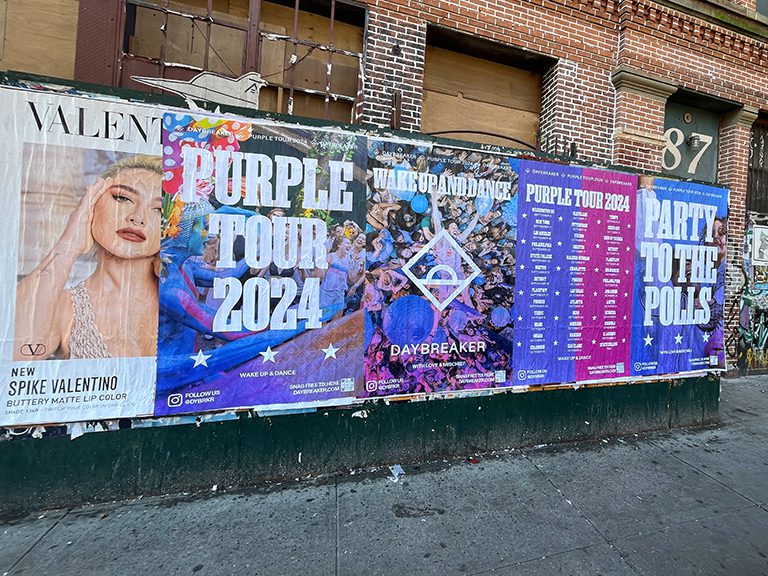
The regular poster size in the United States is 18 inches by 24 inches. That is the answer you will get from most print shops, most designers, and most event coordinators when you ask what a regular poster looks like. It is the format the industry has settled on as the default starting point for poster production.
But “regular” is a relative term. In some contexts, a regular poster is 24×36. In retail, it is 22×28. For film, it is 27×40. The right regular size depends on the industry and application. We work with all of these sizes daily and know when each one makes sense.
This guide explains what makes 18×24 the dominant regular format, when you should use a different size, and everything you need to know to make the right poster size decision for your project.
The 18×24 earned its status as the regular format through decades of consistent use across multiple industries. Here is why it stuck:
It is large enough to carry bold visual design and readable headlines
It is small enough to fit in a standard venue window or on most bulletin boards
It is affordable to print in short runs (25 to 100 pieces) without specialized equipment
It fits most standard poster frames sold in retail stores
It stores flat and ships easily without custom packaging
Both portrait and environment orientations work well at this dimension
Print shops stockpile 18×24 media. They set up print queues around this size. Online print vendors feature it as a first-page option. Design software presets include it by name. The whole network supports it, which reinforces it as the default.
The Quick Answer
Regular poster size = 18×24 inches. That is your safe default for events, concerts, retail promotions, and indoor campaigns. For outdoor and high-visibility placements, step up to 24×36. For very tight spaces, step down to 11×17.
Regular Poster Sizes by Industry
Here is how different industries define “regular” with poster dimensions:
Industry
Regular Size
Notes
Music and Events
18 x 24 inches
Used for concerts, shows, club nights
Film and Entertainment
27 x 40 inches
The theatrical one-sheet standard
Retail / Grocery
22 x 28 inches
Standard for point-of-purchase displays
Outdoor / Street
24 x 36 inches
Preferred for street-level visibility
Academic / Campus
11 x 17 inches
Fits most campus bulletin boards
Trade Shows
24 x 36 or 36 x 48 inches
Varies by booth size and display hardware
When someone outside of any specific industry asks about a regular poster size, 18×24 is the most broadly applicable answer. It works across more contexts than any other single format. But if you are in film, retail, or trade shows, you are working with different standards.
How to Choose Between the Two Most Common Regular Sizes
Most of the time, the choice comes down to 18×24 versus 24×36. Here is how we think about it:
Choose 18×24 When:
Your placements are primarily indoors (venues, windows, bulletin boards)
Viewing distance is under 15 feet
You are printing in larger quantities and need to control per-unit cost
You are placing in tight spaces where 24×36 would not fit cleanly
You are distributing through partner venues that handle their own display
Choose 24×36 When:
Your placements are outdoors or in high-traffic areas
Viewing distance is 15 to 30 feet
You want to maximize visual impact with fewer pieces
You are competing against heavy visual noise in a dense urban environment
You are targeting high-value key placements rather than broad distribution
Many effective campaigns use both. Print 100 to 200 copies at 18×24 for broad indoor distribution and 50 copies at 24×36 for the most impactful outdoor surfaces. Mixing sizes lets you optimize for different placement contexts without redesigning.
What Fits in a Regular Poster?
Design within your size constraints. Here is what a well-designed regular 18×24 poster can carry:
Headline: One strong headline in 72 to 120 point type that reads from 15 feet
Visual: A single dominant image, illustration, or graphic element
Secondary info: Date, time, location, or supporting copy in 24 to 36 point type
Logo or brand mark: Clearly placed but not dominant
Contact or call-to-action: Website, phone, or QR code in smaller type
Overcrowding an 18×24 is one of the most common mistakes we see. Designers fit the content to the screen without considering how it will read in the real world. Less is more at poster size. Every additional element that competes for attention reduces the effectiveness of the overall piece.
Regular Poster Size vs. Tabloid (11×17)
The 11×17 format is sometimes called “poster size” in informal contexts, especially in academic settings and small venues. Here is how it compares to the true regular 18×24:
Feature
11 x 17 inches
18 x 24 inches
Surface area
187 sq inches
432 sq inches (2.3x larger)
Readable from
Up to 8 feet
Up to 15 feet
Print cost per unit
Lower
Moderate
Available from desktop printers
Yes (tabloid capable)
No (requires large format)
Fits standard frames
Yes (IKEA, Target)
Yes (IKEA, Target, art supply)
Visual presence in a crowd
Low to medium
Medium to high
The 11×17 is a solid choice for tight budgets and tight spaces. But it is not a substitute for a real poster in any campaign that requires street-level visibility. If you can afford the 18×24 upgrade, it almost always makes sense.
Quantity vs. Size Trade-off
A common mistake is printing a large number of small posters to cover a market, when a smaller number of properly sized posters in key locations would perform better. In our experience, 50 well-placed 24×36 posters outperform 300 scattered 11×17 posters in most urban campaign contexts. Think placement quality, more than quantity.
Printing a Regular Poster: What You Need to Know
Getting a good print at regular poster size requires a few basics:
File Setup
Set your document to exactly 18×24 inches (or whatever your target size is) with 0.125 inches of bleed on all sides. Work in CMYK color mode for accurate print color rendering. Set resolution to 150 DPI minimum at the final output size.
Proofing
Print a proof before your full run if cost allows. Even at small quantities, a proof lets you catch color issues, typography errors, and layout problems before they are multiplied across your entire print run. Soft proofing on screen is helpful but not a substitute for a physical print check.
Paper Stock
For a regular indoor 18×24 poster, 100 lb gloss text is the standard. It prints bright and vivid and holds up in typical indoor conditions. For outdoor use, add a UV laminate. For a premium finish on an 18×24, try satin or semi-gloss laminate over a standard gloss print.
Turnaround
Most commercial print shops can produce regular-size poster orders in 1 to 3 business days. Rush production (24 hours) is available at most vendors at a premium. Plan your print timeline with at least 3 to 5 days of buffer before your campaign launch date.
Regular Poster Size in New York City: What the Street Demands
Street-level poster campaigns in New York City operate under different conditions than campaigns in smaller markets. The visual competition is intense. On a given block in Manhattan or Brooklyn, a viewer’s eye can land on dozens of competing images in seconds. In that environment, size is survival.
For NYC street campaigns, our regular starting point is 24×36, not 18×24. The 18×24 format simply doesn’t hold attention reliably in most Manhattan or Brooklyn environments when it’s competing with other signage, murals, digital screens, and the general visual noise of a dense city block. The 24×36 has enough presence to stop the eye. The 18×24 can get lost.
That said, the 18×24 still plays an important role in New York campaigns. It works in venues. It works on bulletin boards in bars and coffee shops. It works in store windows and community spaces. It is the right tool for those environments. But on the street, on scaffolding, on construction fencing, it gets dwarfed by the surrounding environment.
Neighborhoods like the East Village, Williamsburg, Crown Heights, and Bushwick have deep walls and slower foot traffic. Those conditions favor large-format placements. Neighborhoods like Midtown, Chelsea, and the Financial District have faster-moving foot traffic and tighter walls. A well-placed cluster of 18×24 or 24×36 posters at pedestrian eye level can outperform a single oversized placement in those contexts.
We’ve run campaigns across all five boroughs. The rule that holds everywhere is this: match your size to the distance your audience will view it from. Get that right, and any standard size can work.
Designing Your Poster at Regular Size: Common Mistakes to Avoid
We review poster designs every week before campaigns go to print. The same mistakes come up repeatedly. Here are the ones to watch for.
Too much copy. A regular 18×24 poster is not a flyer. It should not carry paragraphs of text. Viewers passing by will give it 2 to 3 seconds of attention. In that time, the headline and the primary visual need to do all the work. Keep copy to 15 words or fewer if the poster is for street use.
Small type that doesn’t read at distance. If you can’t read the headline from 10 feet away, it won’t work in the real world. Print a proof and hold it 10 feet from where you’re sitting. If you’re squinting, make the type bigger.
Designing in RGB for a print project. RGB colors look vivid on screen. They shift when converted to CMYK for printing. Design in CMYK from the start. If you receive artwork in RGB, convert it and do a soft proof before sending to print.
No bleed. A poster file without bleed will have white edges after trimming. Add 0.125 inches of bleed to every edge before you design a single element. Background color and image should extend to the full bleed edge.
Critical content too close to the edge. Keep all text and key design elements at least 0.25 inches inside the trim line. At a regular 18×24 poster, that means nothing important within 0.25 inches of the edge. Trim is never perfectly precise. Give your design room to breathe at the border.
How Regular Poster Sizes Compare Across Popular Design Tools
Different design platforms handle poster sizing in slightly different ways. Here’s what to know before you start your project.
Adobe Illustrator and InDesign
Both support custom document sizes. Set your artboard or page to 18×24 (or your target size) in inches. Add bleed in the Document Setup panel. Both applications support CMYK natively and are the professional standard for print-ready poster design.
Canva
Canva’s Poster template defaults to 18×24 inches in the U.S. version of the platform. This matches the standard regular poster size. Canva supports custom dimensions if you need 24×36 or another format. For print output from Canva, download as a PDF (Print) file to preserve quality. Note that Canva works in RGB by default; the PDF output is generally acceptable for most commercial printers, but for critical color work, use a professional design application.
Photoshop
Set your document to the correct pixel dimensions at your target DPI. For an 18×24 poster at 150 DPI, that is 2,700 by 3,600 pixels. For 300 DPI, it is 5,400 by 7,200 pixels. Work in CMYK mode from the start. Add bleed by extending your canvas 0.125 inches on each side before beginning your design.
Google Slides and PowerPoint
These are not designed for print output but are sometimes used in a pinch. If you use them, set your slide to the exact poster dimensions and export as a high-resolution image (PNG or JPEG). The output will be RGB, not CMYK, and may not meet professional print specifications. Use only for internal review, not for final production files.
What is a regular poster size?
The regular poster size in the U.S. is 18 inches by 24 inches. This is the most widely used format for events, concerts, retail promotions, and general indoor campaigns. For outdoor and high-visibility applications, 24×36 is also commonly referred to as a regular large poster size.
Is 11×17 a regular poster size?
The 11×17 format is sometimes called a small poster, but it is not the regular poster size for most applications. It is better suited for tight indoor spaces like campus bulletin boards and small venues. The true regular poster size starts at 18×24 inches.
What regular poster size does Canva use?
Canva defaults to 18×24 inches for its poster template preset. This matches the U.S. standard regular poster size. You can change the size to 24×36 or any other dimension directly in Canva’s document settings.
Can I buy regular poster frames at a store?
Yes. Standard 18×24 and 24×36 frames are available at IKEA, Target, Walmart, Michael’s, and most art supply stores. The 18×24 frame is more common in general retail. For 24×36, you may need to visit an art supply or framing specialty store.
What is the difference between a regular poster and a large poster?
The regular poster (18×24) is about half the surface area of the large poster (24×36). The large poster reads from greater distances and delivers more visual impact in outdoor environments. Regular posters are more cost-effective for indoor campaigns where viewing distance is shorter.
How much does a regular poster cost to print?
An 18×24 regular poster costs approximately $1.50 to $4 per piece depending on quantity, stock, and vendor. At larger quantities (250+), costs can drop below $1 per piece at online print shops. A 24×36 runs approximately $3 to $8 per piece in standard quantities.
What resolution is needed for a regular 18×24 poster?
For most uses, design your 18×24 file at 150 DPI. That translates to a canvas of 2,700 by 3,600 pixels. For close-up or gallery-quality viewing, use 300 DPI (5,400 by 7,200 pixels).
Is there one single regular poster size in the U.S.?
The most universally recognized regular poster size is 18×24 inches. However, “regular” varies by industry. Retail uses 22×28. Film uses 27×40. Outdoor campaigns often use 24×36. The 18×24 is the closest thing to a universal default across most general-use applications.
What paper weight is best for a regular poster?
For most indoor regular poster applications, 80 lb. to 100 lb. coated text stock (gloss or satin) is the standard. Heavier 100 lb. cover stock is better for posters that will be handled, transported, or displayed in high-traffic areas where durability matters.
Can I print a regular poster at home?
An 18×24 poster requires a large-format printer. Most home printers max out at 8.5×11 or 11×17 (tabloid). To print at regular poster size, you need a commercial large-format printer, available at FedEx Office, Staples, or a focused print shop.
What is the safe zone for a regular 18×24 poster?
Keep all critical text and design elements at least 0.25 inches inside the trim edge on all four sides. For an 18×24 poster, that means nothing important within 0.25 inches of the final cut line. Background fills should extend all the way to the bleed edge (0.125 inches past trim). Text and logos that matter go inside the safe zone. Decorative backgrounds go outside it.
Do regular poster sizes change for different print finishes?
No. Gloss, satin, matte, or laminate finishes do not change the physical dimensions of the poster. A gloss 18×24 and a matte 18×24 are the same size. Finish choices affect visual appearance and durability, not dimensions. Outdoor placements typically call for satin or matte finish to reduce glare in natural light. Indoor placements can use gloss for maximum color pop.
Frequently Asked Questions
What is a regular poster size?
The regular poster size in the U.S. is 18 inches by 24 inches. This is the most widely used format for events, concerts, retail promotions, and general indoor campaigns. For outdoor and high-visibility applications, 24×36 is also commonly referred to as a regular large poster size.
Is 11×17 a regular poster size?
The 11×17 format is sometimes called a small poster, but it is not the regular poster size for most applications. It is better suited for tight indoor spaces like campus bulletin boards and small venues. The true regular poster size starts at 18×24 inches.
What regular poster size does Canva use?
Canva defaults to 18×24 inches for its poster template preset. This matches the U.S. standard regular poster size. You can change the size to 24×36 or any other dimension directly in Canva’s document settings.
Can I buy regular poster frames at a store?
Yes. Standard 18×24 and 24×36 frames are available at IKEA, Target, Walmart, Michael’s, and most art supply stores. The 18×24 frame is more common in general retail. For 24×36, you may need to visit an art supply or framing specialty store.
What is the difference between a regular poster and a large poster?
The regular poster (18×24) is about half the surface area of the large poster (24×36). The large poster reads from greater distances and delivers more visual impact in outdoor environments. Regular posters are more cost-effective for indoor campaigns where viewing distance is shorter.
How much does a regular poster cost to print?
An 18×24 regular poster costs approximately $1.50 to $4 per piece depending on quantity, stock, and vendor. At larger quantities (250+), costs can drop below $1 per piece at online print shops. A 24×36 runs approximately $3 to $8 per piece in standard quantities.
What resolution is needed for a regular 18×24 poster?
For most uses, design your 18×24 file at 150 DPI. That translates to a canvas of 2,700 by 3,600 pixels. For close-up or gallery-quality viewing, use 300 DPI (5,400 by 7,200 pixels).