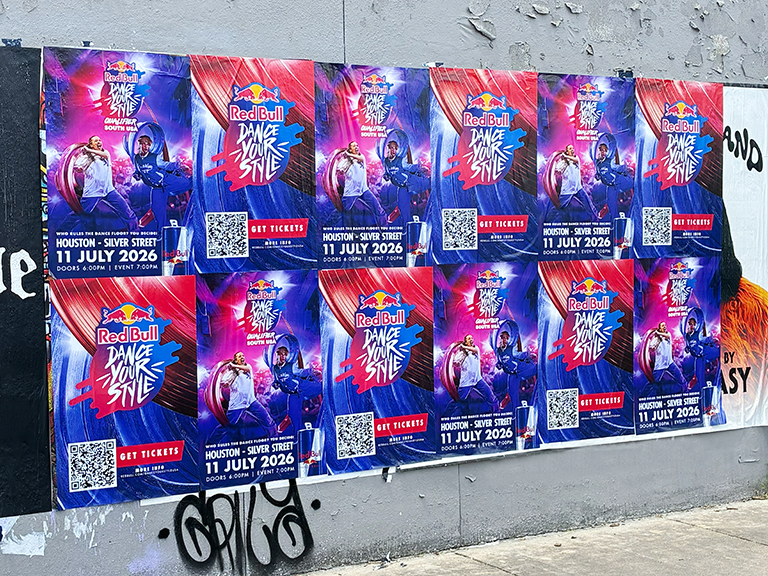
People ask us this question constantly. “What size is a poster?” It seems like it should have a simple answer. It does not. Poster size depends on where the poster will live, what it needs to communicate, and how far away people will be reading it. There is no single universal poster size. There is a range of standard sizes that have emerged from decades of printing, distributing, and placing posters across cities.
We run street-level marketing campaigns across New York City and other major markets. We have placed posters on construction walls in SoHo, utility poles in Williamsburg, and vendor boxes in the Bronx. We know what works at each size and why. This guide gives you the real breakdown.
There are a handful of sizes that the printing industry treats as standard. These are the sizes that print shops stock paper for, that distributors know how to handle, and that campaigns are built around. Here they are:
Poster Size
Dimensions
Common Use
Small Poster
11 x 17 inches
Indoor venues, flyer boards, bulletin boards
Medium Poster
18 x 24 inches
Retail, events, lobbies
Large Poster
24 x 36 inches
Street campaigns, construction walls
Movie Poster
27 x 40 inches
Theater lobbies, entertainment venues
Quad Sheet
30 x 40 inches
Transit, outdoor
Extra Large
36 x 48 inches
Large outdoor placements, events
Each of these has a reason for existing. Print shops did not invent them randomly. They developed from real production and distribution needs. Paper rolls, press sizes, tube mailer dimensions, and standard frame sizes all shaped what became “normal.”
What Is the Most Common Poster Size?
If we had to name one size as the workhorse of the poster world, it would be 24 x 36 inches. This is what most people picture when they say “poster.” It is large enough to command attention from across a street. It fits standard frames sold at every retail store. Print shops run this size on their most efficient equipment. It is the sweet spot of cost, impact, and practicality.
For street campaigns in particular, 24 x 36 is the default. It gives you enough real estate to make a statement. You can put a strong image, a line of copy, and a call to action on this size without anything feeling cramped. When someone walks past on the sidewalk at normal pace, they have time to read everything on a well-designed 24 x 36.
The 18 x 24 is the second most common. It costs less to print and fits tighter spaces. A lot of indoor venue work runs at 18 x 24. Coffee shops, record stores, gallery walls. This size works well when the viewing distance is close and the poster is competing with other material nearby.
Pro Tip from the Field
At 24 x 36 inches, a poster reads clearly from about 15 to 20 feet away. At 18 x 24, readable distance drops to about 10 feet. Match your size to your placement and viewing distance before you print.
Poster Size by Use Case
Understanding poster sizes means understanding context. The “right” size is always relative to where the poster goes and who sees it.
Street and Outdoor Campaigns
Street placement demands size. Pedestrian traffic moves fast. Drivers move faster. You need a poster that registers in a fraction of a second. For outdoor street work, 24 x 36 is the minimum we recommend. Many campaigns step up to 27 x 40 or 30 x 40 for high-traffic intersections. At Bedford and Metropolitan in Williamsburg, you are competing visually with dozens of other signs and posters. Size wins attention.
Event Promotion
Concert venues, club nights, art openings, pop-ups. These campaigns often use 18 x 24 for interior placement and 24 x 36 for outdoor or street-adjacent placements. The indoor size works because people are already in the space and slower-moving. The outdoor size works for the walk-up crowd approaching from a block away.
Retail and Point of Sale
Retail posters often run smaller. 11 x 17 and 18 x 24 are common for window displays and counter placements. Anything larger gets difficult to manage in a typical retail window or display case. The exception is flagship stores with large wall displays, which might run 24 x 36 or even custom large-format prints.
Academic and Corporate
Research posters, conference presentations, and corporate display work often use 36 x 48 or even 48 x 60. These are meant to be read while standing close and reading detail. The design is different from a street poster. More text, smaller font, data-heavy layouts.
Vertical vs. Horizontal Poster Sizes
Most standard poster sizes are vertical (portrait orientation). The 24 x 36 is taller than it is wide. So is the 18 x 24 and the 27 x 40. Portrait orientation mirrors how people naturally stand and move. It is a natural fit for a human-scale message on a wall.
Horizontal (environment) posters exist but are less common in street and event contexts. A environment 24 x 36 would actually be 36 inches wide by 24 inches tall. This orientation works well for panoramic images, wide-format displays, and certain retail applications. For most street placement, portrait is the standard.
environment format shows up more often in transit advertising, banner formats, and certain venue displays. If your design is wide rather than tall, or if your image is a wide environment shot, horizontal may serve you better. Just verify that your placement location supports it.
The Movie Poster Standard: 27 x 40
The 27 x 40 inch size deserves its own section because it has shaped how many people think about posters. This is the “one-sheet” used in movie theater lobbies since the mid-20th century. It became the dominant entertainment poster standard in the United States.
Why this specific size? It fits theater poster cases. Those cases were built to hold one-sheet posters before the one-sheet dimensions were standardized. The industry eventually settled on 27 x 40 as the standard, and now frame manufacturers, print shops, and display hardware are all built around it.
You will see 27 x 40 used for band posters, entertainment event posters, and any campaign trying to evoke that theatrical, big-release feel. It is a commanding size. Noticeably larger than 24 x 36 but not so large it becomes unwieldy.
Size Comparison at a Glance
A 24 x 36 poster has 864 square inches of surface area. A 27 x 40 has 1,080 square inches. That is 25% more visual real estate. In a dense street environment, that difference is visible and felt.
Printing Poster Sizes Correctly
Knowing the dimensions is half the battle. Printing them correctly is the other half. Here is what matters for each common size.
Resolution Requirements
For close-view posters like 11 x 17, print at 300 DPI. The viewer will be 2 to 3 feet away. They will see low resolution if you cheat on this. For large street posters like 24 x 36 and 27 x 40, 150 DPI is usually sufficient because the viewer is further away. For very large format prints at 36 x 48 or bigger, 72 to 100 DPI can work, but verify with your printer.
Bleed and Safe Zones
Always set up your file with bleed. Most printers want 0.125 inches of bleed on each edge. This means your actual file dimensions run slightly larger than the final trim size. Keep all critical text and logos at least 0.25 inches inside the trim edge. This is called the safe zone. Content inside the safe zone will never get cut off.
Color Mode
Design in CMYK for print. RGB is for screens. The difference in color output matters. What looks vivid on your monitor in RGB can look muted when printed in CMYK. If your brand has specific Pantone colors, communicate that to your printer.
How Poster Size Affects Campaign Strategy
We plan every street marketing campaign around size before we plan around design. Size determines where we can place posters, how many we can afford to print, and how much visual impact we generate per dollar spent.
A budget campaign might run 18 x 24 to maximize print volume. More posters, more coverage. A premium campaign for a major brand launch might concentrate resources into fewer 27 x 40 or 30 x 40 placements at the highest-traffic locations in the city.
In neighborhoods like Nolita or the Lower East Side in Manhattan, a tight cluster of 24 x 36 posters on a single construction wall can generate thousands of exposures per day. One wall, well-placed, outperforms scattered smaller formats spread across a wider area.
Size also affects how posters are noticed versus ignored. Humans filter visual information rapidly. A 24 x 36 poster in a sea of 11 x 17 flyers stands out immediately. That contrast effect is real. When everything around you is small, being large is a competitive advantage.
International Poster Sizes vs. US Sizes
If you work with European partners or printers, you will encounter the ISO A-series sizing system. This uses different dimensions than what the US industry uses.
US Size
US Dimensions
ISO Equivalent
ISO Dimensions
Small Poster
11 x 17 in
A3
11.69 x 16.54 in
Medium Poster
18 x 24 in
A2
16.54 x 23.39 in
Large Poster
24 x 36 in
A1
23.39 x 33.11 in
Extra Large
36 x 48 in
A0
33.11 x 46.81 in
The ISO sizes are slightly smaller in most cases. This matters if you are ordering frames, choosing display hardware, or working with an international print vendor. Always confirm which standard your vendor uses before finalizing your file dimensions.
Choosing the Right Poster Size for Your Campaign
Here is the decision framework we use when advising clients on poster size selection:
Step 1: Define your placement environment. Will this poster be indoors or outdoors? On a wall at eye level or elevated? In a controlled venue or in an unpredictable street environment?
Step 2: Estimate viewing distance. If viewers will be 3 feet away, go smaller. If they will be 20 feet away, go larger. Design legibility is a function of size and distance together.
Step 3: Assess your budget. Larger formats cost more per print. If budget is tight, more small posters often outperforms fewer large ones. If you have the budget, invest in size.
Step 4: Consider your design complexity. A bold, simple image reads well at any size. Detailed copy with multiple elements needs more space. Match your design to your format.
Step 5: Check placement constraints. Some locations have physical size limits. A vendor box door is fixed. A construction wall can accept almost any size. Know your placement before you finalize dimensions.
What Happens When You Choose the Wrong Poster Size
Choosing the wrong size is one of the most common and costly mistakes in poster campaign planning. Here’s what we see when size is chosen without strategy.
Too Small for the Surface
A brand commits to 11×17 because the per-unit price is low. The posters go on large flat walls on Flatbush Avenue in Brooklyn. From the sidewalk, they’re barely visible. The per-unit cost was low but the per-impression cost was extremely high because very few people could read the message from normal viewing distance. The campaign budget was spent, the exposures weren’t delivered. That’s the outcome when size is chosen based on print cost alone.
Too Large for the Location
A brand orders 36×48 for a neighborhood saturation campaign. The crews arrive on location and discover that most available wall sections are 18 to 24 inches wide. The 36×48 posters can’t be placed cleanly anywhere. Some get installed at awkward angles, folded at the edges, or skipped entirely. A portion of the print run is wasted. The campaign achieves far fewer placements than budgeted. Oversizing for the available surface is as damaging as undersizing.
Wrong Orientation for the Surface
A brand produces portrait-orientation 24×36 posters for a campaign that includes horizontal under-window strips. The portrait format leaves awkward blank space above and below on horizontal surfaces, or hangs below the bottom of the surface when forced into it. The solution is to identify the surface dimensions before the size and orientation are locked, and design specifically for those dimensions if they don’t match a standard portrait format.
Size Inconsistency Across the Campaign
A multi-neighborhood campaign orders two different sizes without coordinating the design between them. The 18×24 version uses design A and the 24×36 version uses design B. Consumers who see both formats in the same neighborhood get two different brand messages. The campaign feels like two different brands rather than one coherent push. Consistency across sizes is not optional. It’s what makes a multi-size campaign work as a unified presence rather than a fragmented one.
Poster size is a strategic decision. It is more than a printing spec. The right size for your campaign depends on your placement environment, your audience’s behavior, your budget, and your design. We have helped brands from independent artists to Fortune 500 companies figure out the right answer. The decision is always the same process: start with where the poster lives, then build out from there.
How We Run This Type of Campaign
We’ve done this across New York, Los Angeles, Chicago, Miami, and dozens of other markets. Our crews work nights, weekends, and event windows. We scout locations before the campaign starts, document every placement with GPS pins and date-stamped photos, and send reports the same day.
We don’t subcontract. Every campaign runs through our own field staff. That means consistent execution, real accountability, and results you can verify.
The brands that get the most out of this format plan ahead. They know what neighborhoods they want to hit, what their message needs to say, and what success looks like before we start. We help with all of that. But the campaigns that run best are the ones where the client knows their audience.
What to Bring to the First Conversation
Your target audience and where they spend time
Your launch date or campaign window
Your geographic priorities , city, neighborhood, or specific streets
Any creative you already have, or a sense of what you want to say
Call us or email us and we’ll tell you what works in your market, what it costs, and how fast we can move. American Guerrilla Marketing has been running street-level campaigns since before most marketing agencies knew what a street team was.
Frequently Asked Questions
What is the most common poster size?
24 x 36 inches is the most commonly used poster size in the United States. It is the standard street and retail poster size, widely available at print shops, and fits the most common frame dimensions.
What size is a standard movie poster?
The standard US movie poster is 27 x 40 inches, known as a “one-sheet.” This is the size used in theater lobbies and by entertainment marketers across the country.
What is the smallest standard poster size?
11 x 17 inches is generally considered the smallest size that qualifies as a poster rather than a flyer. Below that, you are in standard paper territory.
What is the difference between a poster and a flyer?
Size is the primary distinction. Flyers are typically 8.5 x 11 inches or smaller. Posters start at 11 x 17 and scale up. Both serve promotional purposes but are distributed and placed differently.
What DPI should a poster be printed at?
For small posters viewed close-up (11 x 17, 18 x 24), use 300 DPI. For large street posters (24 x 36 and up), 150 DPI is sufficient for viewing distances of 10 feet or more.
Can I print a poster in environment orientation?
Yes. Any poster size can be printed in environment (horizontal) orientation. Most standard sizes default to portrait (vertical), but if your design calls for a horizontal format, your print shop can accommodate it.
What poster size works best for street marketing?
24 x 36 inches is the street marketing standard. It commands attention at pedestrian distances, fits most placement locations, and is cost-effective to print in volume. High-impact campaigns sometimes step up to 27 x 40 or 30 x 40.