What Size Is a Poster Usually? | American Guerrilla Marketing
Posters usually come in a few sizes that cover almost every situation. We know which ones actually get used in the field and why each one exists.
People ask what size a poster usually is because they want to make the right choice before they commit to a print order. It is a smart question. The wrong size can mean wasted money, a design that does not read at distance, or posters that do not fit the display system at your venue.
We run poster campaigns across New York, Los Angeles, Chicago, and other major cities. We have dealt with every major format in real field conditions. This guide gives you a direct answer based on what we actually see, order, and place every week.
In the United States, most posters fall into one of five size categories. These are the formats that printers stock, that display frames are designed for, and that our campaign crews handle routinely.
Format
Dimensions
Usual Context
Small
11 x 17 inches
Indoor, coffee shops, bulletin boards
Medium
18 x 24 inches
Concerts, events, storefronts
Standard / Large
24 x 36 inches
Outdoor streets, retail walls
One-Sheet
27 x 40 inches
Movie posters, premium displays
Extra Large
36 x 48 inches
High-traffic sites, installations
If you asked us to pick the single most “usual” poster size, we would say 24×36. It is the size most people visualize when they hear the word poster. It is what printers default to when a client says “standard.” It is the size that fits retail poster frames, ships flat in standard tubes, and delivers strong visual impact outdoors.
Why 24×36 Is the Most Common Poster Size
24×36 became the dominant format for several overlapping reasons. Print efficiency, logistics, and visual performance all converge at this dimension.
Most large-format inkjet printers use roll media in 24-inch, 36-inch, and 44-inch widths. A 24×36 poster fits perfectly on a 24-inch roll with no waste in the width dimension. The long side advances down the roll. This efficiency lowers per-unit cost at every print volume.
The 2:3 aspect ratio is a natural proportion for portrait layouts. It mirrors the proportions used in photography, fine art printing, and many classic advertising formats. Designers work in it intuitively.
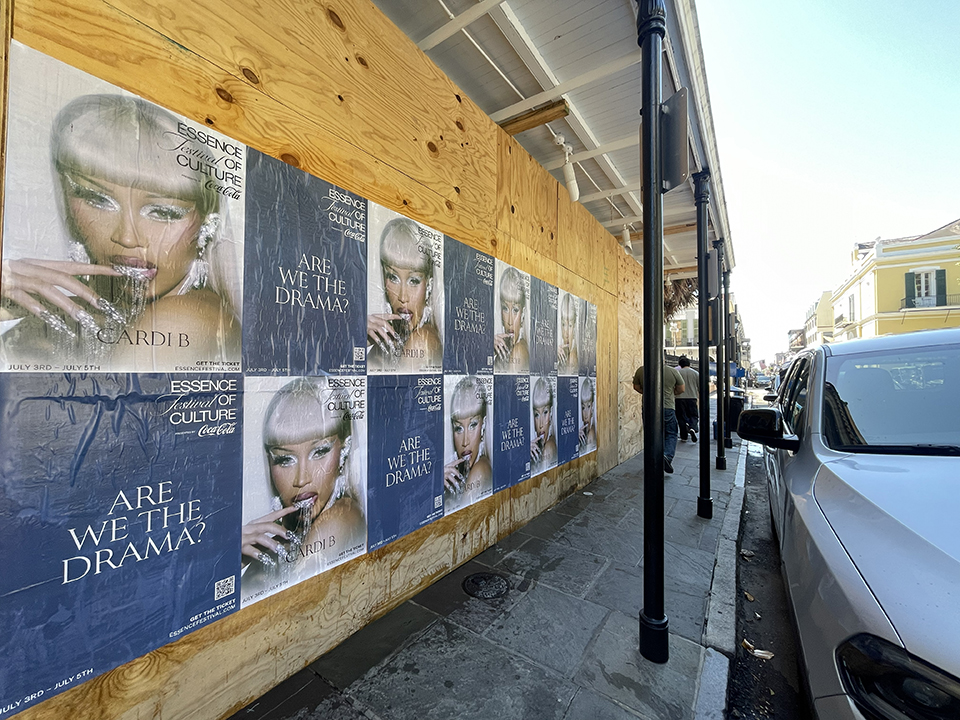
For outdoor street campaigns, 24×36 hits the sweet spot between visual impact and handling ease. It is large enough to read clearly from 50 feet. It is small enough for one person to carry a stack of them, handle them without an assistant, and place them efficiently across a large area.
Most Common Outdoor Size: 24×36 inches. Most Common Event Size: 18×24 inches. Most Common Indoor / High-Volume Size: 11×17 inches.
When 18×24 Is the Usual Size
For concerts, theater performances, film screenings, gallery openings, and similar events, 18×24 is the usual size. The event poster tradition has used this format for decades. Most venue display cases, lobby boards, and pin-up spaces in clubs and bars are built for 18×24.
18×24 is also the right size for campaigns that combine indoor and outdoor placements. It works inside a storefront window, on a bulletin board, in a venue lobby, and on an exterior wall. The versatility of the format makes it the most practical all-purpose size for campaigns that move across different environments.
At about 30 percent lower cost per unit than 24×36, 18×24 also stretches budgets further. For campaigns where quantity and coverage matter more than maximum individual impact, this size is often the smarter choice.
When 11×17 Is the Usual Size
For indoor saturation campaigns, 11×17 is the usual size. It prints on a standard tabloid sheet, making it the cheapest format per unit in the poster category. When you need to cover every coffee shop, laundromat, barbershop, and community board in a neighborhood, 11×17 at high volume is how you do it affordably.
Record stores, music venues, independent bookshops, and dive bars typically display 11×17 posters. The format is small enough to fit in spaces where larger posters would be out of place, but large enough to carry genuine visual presence at close range.
The limitation is distance. An 11×17 poster is essentially invisible past 20 feet. It is a format for close-range viewing by people who are already in the space where it is displayed. For anything that needs to reach pedestrians from across a street, you need at least 18×24.
What Size Posters Are Usually Used for Specific Campaigns
Campaign type is one of the clearest guides to what size a poster usually should be. Here is how different types of campaigns approach size selection.
Music and Concert Campaigns
The usual size for concert posters is 18×24. This has been true for the better part of a century and has not changed meaningfully. Some high-profile shows or festival campaigns go to 24×36 for outdoor placements, but the default is 18×24. Printers who specialize in concert poster runs price 18×24 aggressively because the volume and demand are consistently high.
Brand Awareness Campaigns
Brand campaigns typically go to 24×36 or larger. The goal is presence and impact. Brand awareness lives or dies on how commanding the visual is in a competitive urban environment. A 24×36 with clean, bold design reads strongly from 50 feet. For premium locations where the investment justifies the cost, 36×48 or larger is worth considering.
Film and Entertainment Campaigns
For street placements supporting a film release, the usual size is 24×36. The theatrical one-sheet format of 27×40 is used in theater lobbies, but 24×36 is more practical for street campaigns where the format needs to work across many different surface types and locations.
Retail and Product Launch Campaigns
Retail campaigns often use a mix of sizes depending on the placement context. In-store displays might use 18×24 or 24×36 depending on the available space. Window installations and outdoor street placements typically go to 24×36. Premium launches with focused display installations sometimes use custom or oversized formats.
Orientation: Portrait vs. environment
The sizes listed above all refer to portrait (vertical) orientation. But posters exist in environment orientation too. environment posters are less common but show up in specific contexts.
A environment 24×36 is 36 inches wide and 24 inches tall. Horizontal formats work well for certain design concepts, banner-style displays, and venues where the available wall space is wider than it is tall. Film posters sometimes use environment orientation for specific promotional materials, though the standard one-sheet is always portrait.
For most campaigns, portrait is the usual orientation. It mirrors how people stand and creates a more natural vertical focal point on a wall. environment posters require a horizontal surface area that many urban placements simply do not have.
Material Choices for the Most Common Poster Sizes
The usual size of a poster does not tell the whole story. The material it is printed on determines how the poster performs in real conditions. Here is what we typically specify for each common size.
Size
Usual Material
Why
11 x 17
60-80 lb. uncoated text
Cost-efficient for high-volume indoor use
18 x 24
80-100 lb. coated gloss
Durable, vibrant, works indoors and outdoors
24 x 36
100 lb. coated gloss or UV laminate
Outdoor durability, strong color reproduction
27 x 40
100 lb. coated gloss
Premium indoor display standard
36 x 48
Vinyl or heavy coated stock with laminate
Heavy outdoor use, weather resistance
How to Pick the Right Usual Size for Your Specific Need
The right size depends on where the poster goes, who you want to see it, and how much you are spending. Use this decision path to find your answer.
Step One: Where Is It Going?
Indoor placement: start with 11×17 or 18×24. Outdoor placement: start with 24×36. Premium outdoor with high budget: consider 36×48.
Step Two: How Far Away Is the Viewer?
Under 20 feet: 11×17 or 18×24. 20 to 50 feet: 18×24 or 24×36. Over 50 feet: 24×36 or larger. Match the size to the distance. Visibility at the expected viewing distance is the most important factor in size selection.
Step Three: What Is the Budget?
11×17 costs the least per unit. 18×24 is the middle option. 24×36 costs more. Larger formats cost more still. Set your per-unit budget target, then determine which size you can afford at the quantity you need to cover your target area.
Step Four: Does It Need to Fit a Specific Display System?
If the poster is going into a frame, display case, or proprietary display system, the size is determined by the system. Measure first. Do not assume. A poster that does not fit the frame is wasted money.
File Setup for the Most Common Poster Sizes
Getting your design file right before you send it to print is as important as choosing the right size. Here are the standard specs for each common format.
11 x 17: 3,300 x 5,100 pixels at 300 DPI, CMYK, 0.125 in bleed
18 x 24: 5,400 x 7,200 pixels at 300 DPI, CMYK, 0.125 in bleed
24 x 36: 7,200 x 10,800 pixels at 300 DPI, CMYK, 0.125 in bleed
27 x 40: 8,100 x 12,000 pixels at 300 DPI, CMYK, 0.125 in bleed
36 x 48: 10,800 x 14,400 pixels at 300 DPI, CMYK, 0.125 in bleed
Always submit CMYK files to professional printers. RGB files shift unpredictably during conversion. The difference between a vibrant, accurate color print and a flat, muted one often comes down to whether the file was built in CMYK from the start.
How to Choose a Size When You Have Multiple Placement Environments
A lot of campaigns run in more than one environment at the same time. Your poster might go on outdoor construction walls, inside bar bathrooms, in retail windows, and on community bulletin boards all during the same campaign push. Each of those environments has a different ideal size. How do you pick one size for all of them, or do you produce multiple sizes?
The most common solution is a two-size campaign. Run 24×36 for the outdoor placements and 18×24 or 11×17 for the indoor placements. Design both formats as a visual family so they look like the same campaign even at different scales. Use the same color palette, typography, and hero imagery. The two sizes look coordinated and work in their respective environments.
The common mistake is designing one size and scaling it down for the other. Scaling a 24×36 down to 11×17 almost always produces a layout that is too dense for the smaller format. The design that works at large scale needs to be genuinely redesigned for the smaller format, more than proportionally reduced. Simplify the content, increase the text size relative to the format, and make sure the headline is still the dominant element at the new scale. Treat each size as its own design job, informed by the larger format but more than a miniaturized version of it.
For campaigns with very tight budgets, pick the one environment that matters most and go all-in on the right size for that environment. Two small print runs at two different sizes often cost more than one medium-sized run at a single size. Concentration beats diversity in limited-budget print campaigns.
The most common outdoor poster size in the US is 24×36 inches. The most common event and venue poster size is 18×24 inches. The most common small indoor poster is 11×17. All three are considered standard depending on context.
Is 24×36 or 18×24 more common?
Both are very common. 24×36 dominates outdoor street campaigns and retail displays. 18×24 dominates event promotion and venue-based placements. In total volume across all uses, 18×24 may actually be produced in higher quantities because the event promotion market is enormous.
What size poster fits a standard frame from IKEA or Target?
Most standard poster frames sold at retail are sized for 24×36. Some stores also carry 18×24 and 11×17 frames. If you are buying a frame first and printing later, measure the frame opening before you finalize your print dimensions.
What is the usual size for a band or concert poster?
18×24 is the usual size for band and concert posters. This has been the standard for decades. Some high-profile campaigns go to 24×36 for outdoor placements, but for most shows, events, and tours, 18×24 is the expected format.
What is the usual poster size for a school or science fair?
School projects and science fair displays typically use 22×28 poster board (available at most office supply and craft stores) or a tri-fold version of the same dimensions. These are not the same as standard advertising poster sizes, but they are the norm for educational contexts.
Does a bigger poster always perform better in a campaign?
Not always. A bigger poster commands more attention at distance, but it costs more, handles less efficiently, and is sometimes overkill for the placement. A well-placed 24×36 outperforms a poorly placed 36×48 every time. Strategy matters more than scale.
Can I use any size I want, or should I stick to standard sizes?
Custom sizes are available from most large-format printers. But standard sizes are cheaper, faster, and logistically simpler. If you have a creative reason for a custom dimension, go for it. If you are choosing custom just for novelty, the standard sizes will serve you better.