What Is the Size of a Typical Poster? Full Guide | AGM
Home › Articles › What Is the Size of a Typical Poster?
The answer depends entirely on where the poster is going and what it needs to do. A poster for a coffee shop bulletin board has completely different size requirements than a poster campaign running on the walls of Williamsburg or in the subway corridors of the 14th Street station in Manhattan. Size is more than a design question. It is a strategy question.
We run poster campaigns for a living. We have installed thousands of them across New York, Los Angeles, Chicago, Miami, and beyond. This guide covers every standard poster size you will encounter, what each one is used for, and how size choices affect visibility, print cost, and campaign performance in real environments.
There is no single universal poster size. Different applications have evolved their own size norms over decades. Understanding which size is right for which use case is the foundation of a good print campaign.
Here is the full breakdown of standard poster sizes in the United States.
Poster Size
Dimensions (inches)
Common Use
Viewing Distance
Small
11 x 17
Indoor venues, bulletin boards, retail
2 to 6 feet
Medium
18 x 24
Event posters, indoor campaigns, storefronts
5 to 15 feet
Large
24 x 36
Outdoor campaigns, street-level placements
10 to 30 feet
Extra Large
27 x 40
Movie posters, vertical displays
15 to 40 feet
Tabloid
11 x 14
Counter displays, small venue postings
1 to 4 feet
Bus Shelter Poster
47.5 x 68.5
Transit advertising in bus shelter panels
5 to 20 feet
Subway Poster
46 x 60
MTA subway station displays
5 to 30 feet
Wheatpaste/Street Poster
24 x 36 to 48 x 72
Outdoor street-level installations
10 to 50 feet
The Most Commonly Used Typical Poster Sizes
If you ask most printers what the most common poster size is, they will tell you 18 x 24 or 24 x 36. Those two sizes dominate most general-purpose poster printing because they hit the sweet spot of visibility, printability, and cost.
18 x 24 Inch Posters
The 18 x 24 size is the workhorse of the indoor poster world. It is large enough to be readable from ten to fifteen feet away but small enough to fit in a standard frame or in a window without overwhelming the space. Concert venues use this size constantly. We see it in bars, record shops, coffee shops, independent retailers, and gyms. It is inexpensive to print in quantity and easy to handle during installation.
For retail campaigns, the 18 x 24 is often the default. You can print 500 of them for a fraction of what larger formats cost and saturate a neighborhood with placements in a single day.
24 x 36 Inch Posters
The 24 x 36 is the standard large-format poster. It is what most people picture when they think of a street poster. It is big enough to command attention from across a sidewalk, readable at fifteen to twenty feet, and proportioned well for both vertical and horizontal layouts. Street campaigns, building wraps at the smaller end, and high-visibility retail windows all commonly use this size.
For outdoor street campaigns in cities like New York and Los Angeles, we often print at 24 x 36 or larger. The size creates enough visual mass that the poster reads as a statement, more than a piece of paper on a wall.
27 x 40 Inch Posters
This is the classic movie poster size and it is still widely used for entertainment marketing. The proportions are distinctive, slightly taller and narrower than 24 x 36, and they fill vertical display cases and storefronts very well. If you are marketing a film, a show, an album, or any entertainment product, 27 x 40 is the format people expect to see.
Field Note: Size Determines Readability at Distance
When we scout locations for poster campaigns, we stand at the spot where pedestrians naturally pause or pass and look back at the wall. If we cannot read the headline at a glance from that distance, the poster is too small. For most street-level placements in New York, the 24 x 36 minimum is what actually gets read by passing foot traffic.
Street-Level Poster Sizes and Why They Are Different
Street-level posters, the kind we place on construction walls, building facades, and other outdoor surfaces in urban environments, often go well beyond the standard sizes above. The outdoor world has its own size conventions, and they are driven by visibility at real-world distances, not printing convenience.
Single-Sheet Street Posters (24 x 36)
This is the most common starting size for outdoor street campaigns. One sheet, printed on heavy stock or weatherproof paper, installed with wheat paste or approved adhesive. It is visible from the sidewalk, workable by a single installer, and printable in bulk at reasonable cost. A campaign with 300 of these sheets placed across key neighborhoods in Brooklyn and Manhattan can create a strong sense of presence in a market.
Multi-Sheet Installations (Custom Sizes)
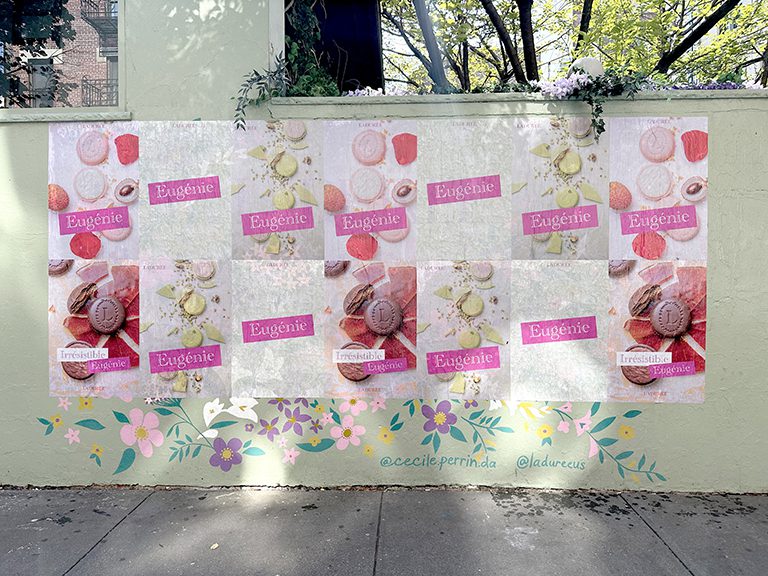
Larger outdoor installations are built by combining multiple sheets into a single image. We work with three-sheet, six-sheet, and twelve-sheet formats regularly. A six-sheet installation might cover a 48 x 72 inch area, which reads as a dominant visual on a busy block. Twelve-sheet installations can fill entire construction walls. The combined effect of multiple sheets creates something that feels like a billboard at a fraction of the cost.
On a block like Grand Street in Williamsburg, or along the construction hoarding on 34th Street near Penn Station, a well-executed multi-sheet installation stops people. They look. They photograph it. That is the whole point.
Horizontal Banner Formats
Some locations favor horizontal formats. A long, low wall on a street like West 14th Street between Ninth and Tenth Avenues in the Meatpacking District, for example, might be better served by a horizontal three-sheet layout than a vertical single sheet. We always look at the shape of the space before deciding the poster format, not the other way around.
How Poster Size Affects Print Cost
Size scales cost in a roughly linear way up to a point, and then large-format printing jumps to a different pricing tier. Here is a general sense of how print costs move with size for a run of 500 units.
Poster Size
Approximate Unit Cost (500 qty)
Total Print Budget
Notes
11 x 17
$0.30 to $0.60
$150 to $300
Very affordable, bulk printing
18 x 24
$0.60 to $1.20
$300 to $600
Standard workhorse size
24 x 36
$1.00 to $2.00
$500 to $1,000
Most common outdoor size
27 x 40
$1.50 to $2.50
$750 to $1,250
Movie poster standard
48 x 72 (multi-sheet)
$3.00 to $6.00 per set
$1,500 to $3,000 per 500 sets
Large format, multiple pieces
These are print costs only. Installation labor, location sourcing, and campaign management are separate line items. For a full outdoor poster campaign, factor print as roughly 20 to 40 percent of the total budget.
Bigger Is Not Always Better
We have run campaigns where a dense distribution of 24 x 36 posters across fifty strategic locations outperformed a smaller number of massive installations. The right answer depends on whether you want saturation (many small posters in many places) or dominance (fewer large installations in high-impact spots). Both are valid strategies. The choice depends on your campaign goals.
How Poster Size Affects Design
Size is more than a printing and placement question. It changes everything about how you design the piece.
Minimum Text Size for Outdoor Readability
At a 24 x 36 poster viewed from fifteen feet away, your headline needs to be a minimum of 100 to 150 points to be readable without effort. Body copy at this scale is basically invisible to anyone walking past. Outdoor posters are not brochures. They are billboards at close range. They need one message, communicated in one visual hit.
The rule we use: if a pedestrian cannot understand the poster in less than three seconds, the design is too complicated. That means the headline does the work, the image does the work, and everything else is secondary or gone.
Image Resolution Requirements by Size
For print, resolution requirements increase with size. A 300 DPI file at 24 x 36 inches is a very large file. Most large-format printers accept files at 150 DPI for oversized prints with the understanding that viewing distance increases proportionally. The practical guidance: always design at the largest intended output size and confirm the required DPI with your printer before finalizing files.
Color Mode for Print
Design in CMYK, not RGB. RGB is for screens. CMYK is for printing. Converting from RGB to CMYK after design is complete often shifts colors in unexpected ways, especially bright yellows and oranges. Design in CMYK from the start, proof your colors before committing to a large print run, and always request a physical proof if the color accuracy of the campaign matters.
Poster Sizes for Specific Campaign Types
The right size shifts based on what you are marketing and where you are marketing it.
Music and Entertainment
Shows, albums, and entertainment events have historically used 11 x 17 for bar and venue placements and 18 x 24 to 24 x 36 for street campaigns. The 27 x 40 format is reserved for major theatrical releases. For independent artists and promoters, 11 x 17 and 18 x 24 are the practical starting points because the print quantities can be high enough to create real market saturation on a modest budget.
Retail Product Launches
Product launch campaigns in retail corridors typically use 18 x 24 for window placements and 24 x 36 for street-facing walls. If the launch is happening in a city like New York, we often layer multiple sizes: small formats inside retail partners, medium formats in windows and on bulletin boards, and large formats on outdoor walls near the target retail footprint.
Event Promotions
Event posters live and die by timeline. For a two-week window before an event, we recommend saturation with 18 x 24 across high-traffic indoor venues plus 24 x 36 on outdoor walls in the neighborhoods where the target audience concentrates. For a festival or large-scale event, the outdoor component might include custom oversized installations to create landmark visibility.
Corporate and Brand Awareness
Brand awareness campaigns tend to go bigger. When the goal is building recognition rather than promoting a specific event or product, larger formats create the sense of scale that signals credibility. We have run transit campaigns for brand awareness using bus shelter panels at 47.5 x 68.5 and subway posters at 46 x 60. Those formats dominate the visual environment and create repeated exposure for commuters who use the same routes every day.
Choosing the Right Poster Size for Your Audience and Environment
The size question is really two questions at once. First, what does the viewing environment require? Second, what does your audience expect to see? Getting both right is what separates a campaign that gets noticed from one that gets ignored.
Matching Size to Foot Traffic Speed
Pedestrians move at roughly three to four miles per hour. A person walking past a wall on a typical sidewalk has about two to four seconds of exposure to any given poster before they are past it. At that speed, a 24 x 36 poster with a clean, high-contrast design gets read. A cluttered 18 x 24 poster with five lines of small text does not.
In commuter corridors, like the entrance to a subway station on 42nd Street or the ground-level corridor at Grand Central Terminal, people are moving faster. They are also more distracted. For those environments, bigger formats with even simpler messages work best. A single strong image and four words of text is not a failure of creativity. It is the right decision.
Size Relative to the Surrounding Visual Environment
A 24 x 36 poster on a quiet residential block in Park Slope reads very differently than the same poster on a wall covered in competing visual material on Bedford Avenue in Williamsburg. In a noisy visual environment, you need more size to compete. In a quiet environment, even a smaller format commands attention simply by being there.
We always assess the visual density of a location before recommending a size. A neighborhood like SoHo in Manhattan has high visual density from retail windows, signage, and pedestrian activity. Size and placement quality both need to be higher there. A neighborhood like Bushwick, with its mix of industrial walls and artistic installations, responds well to large-format outdoor pieces that feel like they belong to the environment.
How the Shape of the Space Dictates the Poster Format
Not every surface is suited to a standard vertical poster format. Some walls are wide and low. Others are tall and narrow. The best campaigns are designed to fit the actual surface, not the other way around. This is why we scout locations before printing. Printing 500 posters in a format that does not fit the available surfaces is an expensive mistake we help clients avoid.
For a horizontal wall section like the long stretch of construction hoarding on Eighth Avenue between 34th and 37th Streets near Penn Station, a horizontal multi-sheet layout works far better than vertical single sheets stacked in a row. The image can run the full length of the wall and create a cinematic quality that a vertical format never could in that space.
Typography and Design Rules at Different Poster Sizes
Design rules change with size. What works on a printed page does not automatically translate to a street poster. Understanding the relationship between size and typography is essential for creating posters that actually communicate.
Headlines at 24 x 36
At a 24 x 36 poster intended for street viewing at ten to twenty feet, your headline should sit between 120 and 200 points, depending on the typeface. Wide, bold sans-serif fonts like Helvetica Neue Black or Gotham Ultra hold up at distance better than serif faces with thin strokes. The serifs disappear at viewing distance and create visual noise instead of clarity.
Image-to-Text Ratio
Outdoor posters work best when the image-to-text ratio is heavily weighted toward the image. A general guideline for street-facing posters: 70 percent image, 30 percent text or less. That might feel like there is not enough space for your message. That feeling is correct. The poster’s job is to create a moment of recognition and a reason to look further, not to explain everything. Reserve explanation for your website, your social media, and your in-store materials.
Contrast Is Not Optional
High contrast between text and background is not a design preference for outdoor printing. It is a functional requirement. Low-contrast color combinations that look fine on a monitor become unreadable on a sunlit wall. We test every campaign design against outdoor viewing conditions before approving final files. A yellow headline on a white background might look elegant on screen and be completely invisible on the street.
How Poster Size Affects Campaign Logistics
The size of your posters affects more than design and printing. It affects how many posters fit in a vehicle, how long each installation takes, how many installers you need, and how the campaign gets documented and tracked.
Transport and Handling
A run of 500 posters at 24 x 36 takes up significantly more vehicle space than 500 posters at 18 x 24. For large campaigns covering multiple neighborhoods in a single night, vehicle capacity can become a genuine logistical constraint. We plan campaigns with physical transport logistics in mind from the start, not as an afterthought.
Installation Time Per Unit
A single 24 x 36 sheet installed with paste takes roughly two to four minutes under good conditions. A six-sheet multi-panel installation on the same wall can take fifteen to twenty-five minutes, depending on surface condition and positioning. That time difference compounds across a campaign. A team of two installers can place roughly 80 to 120 single-sheet posters in a night. Multi-sheet installations reduce that count significantly. Budget accordingly.
Campaign Documentation and Photography
Every campaign we run gets documented. Larger posters photograph better. A 24 x 36 installation on a well-lit street corner creates a photo that works for social media, press coverage, and client reporting. A small 11 x 17 in a busy visual environment is hard to isolate in a photograph. If campaign documentation and social amplification matter to you, bigger formats deliver better imagery.
Written by Livy Phillips, American Guerrilla Marketing. AGM specializes in outdoor poster campaigns, street-level advertising, and print-based marketing for brands running campaigns in major urban markets.
Frequently Asked Questions
What is the size of a typical poster?
The most common typical poster sizes in the United States are 18 x 24 inches and 24 x 36 inches. The 18 x 24 is the standard for indoor use and event promotions. The 24 x 36 is the standard for street-level outdoor campaigns. Both sizes are widely available from print shops at competitive prices.
What is the most popular poster size for a street campaign?
For street campaigns, 24 x 36 inches is the most common single-sheet format. It is large enough to be read from a reasonable sidewalk distance, fits most standard outdoor placement locations, and prints efficiently on large-format presses. Many campaigns start at 24 x 36 and scale up for specific high-impact placements.
What size poster do movie theaters use?
The standard movie poster size is 27 x 40 inches, also called a one-sheet. This is the format used in movie theater display cases, promotional windows, and entertainment marketing campaigns. It has been the industry standard for theatrical film marketing for decades.
What resolution should a poster file be?
For standard print posters at sizes up to 24 x 36, design and submit files at 300 DPI in CMYK color mode. For large-format prints at 48 x 72 and above, most printers accept 150 DPI because viewers see these at greater distances. Always confirm with your printer before finalizing files.
What is the difference between a poster and a flyer?
A flyer is typically a letter-size or slightly larger single-page handout designed for direct distribution. A poster is larger, designed to be displayed on a wall or surface, and intended to be read at a distance. The practical minimum for something to function as a poster rather than a flyer is usually 11 x 17 inches.
In the New York MTA subway system, the standard station poster size is 46 x 60 inches. Bus shelter panels run at approximately 47.5 x 68.5 inches. These are large-format prints that command the full visual field of a commuter standing on a platform or waiting at a stop.
This depends on your market and goals, but a meaningful street campaign in a city like New York typically involves a minimum of 200 to 500 posters to create visible market saturation. For a neighborhood-level campaign in a single area, 100 to 200 may be sufficient. For a city-wide campaign across multiple boroughs, the number climbs into the thousands.