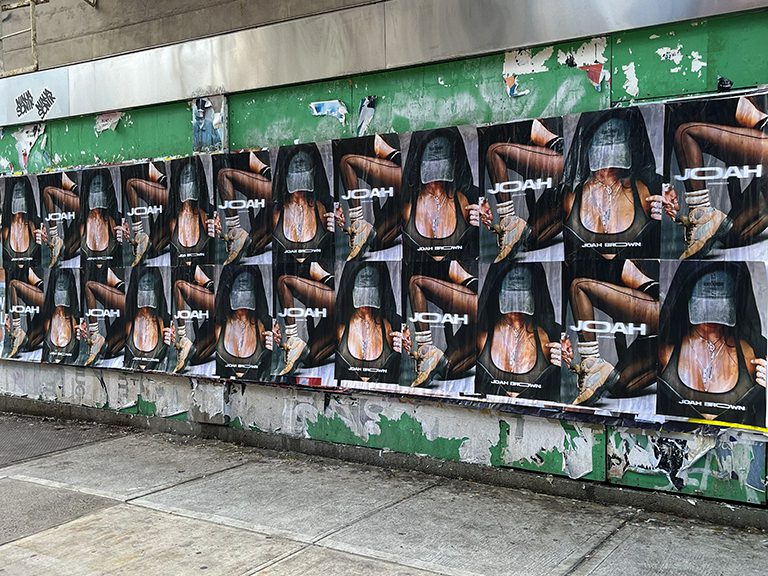
Fly posting is the UK term for street-level poster advertising that puts brands, artists, and causes on the walls of cities — a format with over 300 years of continuous use in British urban environments.
The term “fly posting” comes from British English. It refers to the practice of affixing printed paper posters to outdoor urban surfaces using paste, a format that has been part of the visual culture of British cities since the earliest days of commercial printing. What the UK calls fly posting, the US calls postering, wheatpasting, or bill posting. The names differ. The practice is identical.
We are an American agency. Our primary markets are New York, Los Angeles, Chicago, Miami, Austin, and other major US cities. We work in the same format that the UK calls fly posting and that we call street postering or wheatpasting. We are writing this guide because the people who search for information about UK fly posting are asking questions about the format itself, and those questions have the same answers regardless of which side of the Atlantic they come from.
This guide covers what fly posting is in the UK context, how it has developed as part of British urban culture, how the UK and US approaches to the format compare, who uses it, what the materials look like, and how a professional campaign gets planned and executed. If you are a brand, artist, or agency on either side of the Atlantic trying to understand this format, this is what you need to know.
Fly posting in the UK means placing printed paper posters on outdoor surfaces using paste. The surfaces include walls, construction hoardings, fences, boarded-up shopfronts, and other flat exterior structures in urban environments. The adhesive is typically wheatpaste, a flour-and-water mixture that bonds paper to porous surfaces, or a synthetic methyl cellulose paste for non-porous surfaces. After the paste dries, the poster forms a semi-permanent installation that can hold for weeks under normal weather conditions.
In British English, the term carries a specific cultural charge. “Fly” in this context means done quickly, informally, or without formal arrangement. “Fly posting” originally described the practice of placing posters on surfaces without the landowner’s advance permission, which was its primary form through most of its history. The term has since broadened to encompass the full format, including the professionally managed, approved-surface campaigns that agencies run today, but the informal energy of the original meaning remains part of how the format is perceived in British culture.
This cultural charge is part of what makes fly posting effective as an advertising format in the UK context. A poster on the walls of Brick Lane or in Camden or on the hoardings around a Shoreditch development site reads differently from an advertisement on a transit panel or in a newspaper. The format carries associations with music, art, street culture, and direct communication that its competitors in the outdoor advertising space do not. Those associations were earned over decades of use by artists, musicians, and cultural organizations, and they remain part of the format’s value proposition today.
The History of Fly Posting in the UK
Britain has one of the oldest and most developed fly posting cultures in the world. The practice of posting paper to public surfaces has been part of British urban life since the sixteenth century, when printed broadsides covered the walls of London, Bristol, Edinburgh, and other cities with news, political commentary, and entertainment announcements. The walls of early modern British cities were the primary public information channel for a population that was becoming increasingly literate but did not yet have widespread access to newspapers.
The Victorian Bill Posting Industry
By the Victorian era, bill posting had developed into a substantial commercial industry in Britain. Companies like W.H. Smith and the United Kingdom Bill Posting Company organized professional posting operations across British cities, negotiating rights to post on specific surfaces and selling that access to advertisers on a per-week basis. The industry developed its own professional associations, territorial conventions, and pricing standards. The Billposters’ Association, founded in 1862, was one of the earliest advertising industry trade bodies in Britain.
Victorian-era bill posting covered not just urban walls and hoardings but also the countryside: barns, bridges, railway cuttings, and rural walls were all used as posting surfaces in the nineteenth century’s most aggressive commercial posting era. The visual density of posted paper in Victorian Britain was extraordinary. Reform movements periodically pushed back against the practice, arguing that the walls of cities and countryside had been effectively colonized by advertising. The tension between commercial posting and public space aesthetics has been part of British cultural conversation about the format ever since.
Music and the Modern UK Fly Posting Culture
The cultural identity that UK fly posting carries today was substantially shaped by the British music industry of the 1970s through the 1990s. The punk movement of the mid-1970s brought fly posting into the center of underground music promotion in cities like London, Manchester, Leeds, and Sheffield. Bands, venues, and record shops used fly posting as their primary promotional channel. The visual aesthetic was immediate and raw, photocopied or cheaply offset-printed posters with hand-drawn or typewritten text, placed by the artists themselves on the walls of the neighborhoods where their audiences lived.
The major UK record labels adopted the format at professional scale through the 1980s. Island Records, Factory Records, Virgin, and others built street-level promotional campaigns around fly posting as a standard component of album and tour promotion. The walls of UK cities became competitive posting environments where labels’ crews raced to place the most prominent positions for their artists. The format’s production values improved significantly during this period as print technology advanced and labels invested more seriously in poster creative as an art form.
The Britpop era of the 1990s produced some of the most memorable UK fly posting campaigns on record. Album releases by Oasis, Blur, Suede, and others were accompanied by major poster campaigns across UK cities. Fly posting in this period was so culturally visible that the posters themselves became collector’s items. The visual culture of 1990s Britpop cannot be separated from its fly posting imagery. Bands on walls were part of how the moment was documented and remembered.
AGM Field Note: The UK’s fly posting culture runs deeper than most other markets we work in or alongside. British audiences who grew up in the 1970s through 1990s encountered fly posting as the primary medium for music and cultural communication in their cities. That history gives the format a resonance in UK markets that is built from genuine cultural memory. Campaigns that understand and work with that resonance get more from the format than campaigns that treat it as simply another outdoor media buy.
UK Fly Posting Corridors: Where the Format Lives
UK fly posting activity concentrates in specific urban corridors that have developed as posting environments over decades. These corridors are defined by their foot traffic, their cultural character, and the established visual culture of posted paper that has accumulated on their walls over time.
London
London is the most active fly posting market in the UK by volume and cultural visibility. The primary corridors include Brick Lane and its surrounding streets in the East End, which have been active posting environments since the area’s emergence as a creative and nightlife hub in the 1980s and 1990s. Shoreditch and Hoxton to the north carry similar energy with a slightly more contemporary creative industry focus. Camden High Street and the surrounding streets in North London are historically important music postering corridors. Parts of Hackney, Dalston, and Peckham have developed significant postering cultures as those areas have become creative hubs.
Central London corridors including parts of Soho and Covent Garden see commercial fly posting for entertainment and fashion campaigns. The streets around major music venues throughout London function as natural postering corridors for live music promotion. Areas around university campuses are active postering environments for events and lifestyle brands targeting student audiences.
Manchester
Manchester’s Northern Quarter is the city’s primary fly posting corridor. The streets around the Northern Quarter’s music venues, independent retailers, and creative businesses carry an active visual culture that has made it a productive postering environment since the 1980s Manchester music scene made the city one of the most culturally significant in Britain. Afflecks Palace and its surrounding streets are specifically well-established as music and youth culture posting corridors.
Bristol
Bristol has one of the most distinctive and culturally embedded fly posting cultures in the UK outside London, partly through its association with Banksy and the broader street art and postering community that developed around Bristol’s music and arts scenes in the 1990s and 2000s. Stokes Croft is the primary active posting corridor. The Gloucester Road area and parts of Bedminster carry significant posting activity for arts and music campaigns targeting Bristol’s creative communities.
Edinburgh
Edinburgh’s fly posting culture is strongly shaped by the Edinburgh Fringe Festival, which has made the city one of the most intensively postered urban environments in the world for a concentrated six-week window each summer. The walls of the Old Town, the Royal Mile, and the streets around the Grassmarket and Cowgate are covered in overlapping poster layers during Fringe season in a visual density that has no equivalent outside the festival context. Year-round postering concentrates in Leith and parts of Marchmont for music, arts, and events campaigns.
UK vs US Fly Posting: What’s the Same and What Differs
For brands and agencies comparing UK and US fly posting contexts, the similarities are more significant than the differences. The format is identical. The materials are the same. The installation process runs the same sequence: overnight installation, base coat of paste, poster placement, top coat, photography. The strategic logic, that physical eye-level presence in the street environment creates a different kind of audience engagement than elevated or screen-based advertising, applies equally in both markets.
Variable
UK
US
Common term
Fly posting
Postering / wheatpasting / bill posting
Standard poster sizes
A1 (23.4 x 33.1″), A0 (33.1 x 46.8″), Double Crown (20 x 30″)
24 x 36″, 48 x 72″, 11 x 17″ (snipe)
Primary adhesive
Wheatpaste, methyl cellulose
Wheatpaste, methyl cellulose, hybrid
Installation timing
Overnight (midnight to 5 AM)
Overnight (midnight to 5 AM)
Primary markets
London, Manchester, Bristol, Edinburgh, Leeds
New York, Los Angeles, Chicago, Miami, Austin
Primary users
Music, film, fashion, advocacy
Music, film, fashion, consumer brands, advocacy
Documentation
Post-campaign placement photos and report
Geo-tagged placement photos and report
Who Uses Fly Posting in the UK
The client profile for UK fly posting campaigns covers similar categories to the US market, with some emphasis differences rooted in the UK’s particular cultural history with the format.
Music
Music promotion remains the dominant use case for UK fly posting. Major labels including Universal, Sony, Warner, and their UK subsidiaries run fly posting campaigns for album releases, single launches, and tour announcements. Independent labels and self-releasing artists use the format for targeted campaigns in the specific cities and neighborhoods where their audiences concentrate. The UK music industry’s century-long relationship with fly posting means the format is embedded in how new music is presented to urban audiences in a way that no digital medium has displaced.
Film and Theatre
UK film distributors use fly posting for cinema releases, particularly for films positioned as culturally distinctive or targeting urban audiences. The West End theatre scene uses postering extensively for productions targeting younger audiences and in the lead-up to major openings. Edinburgh Fringe productions use fly posting at extraordinary scale during the festival season, with thousands of productions competing for wall space in the festival’s concentrated three-week postering period.
Fashion and Lifestyle
UK fashion brands and international brands targeting UK urban consumers use fly posting to build neighborhood presence and cultural association. The walls of Shoreditch and Brick Lane are as valuable to a fashion brand trying to reach a creative, culturally engaged London audience as the walls of Williamsburg are to the same brand targeting the same audience in New York. Location is cultural positioning in both markets.
Materials and Production for UK-Context Campaigns
UK fly posting uses the same material standards as professional campaigns globally, with format dimensions calibrated to UK standard sizes rather than US inch-based dimensions.
Paper and Coating
The standard paper weight range for UK fly posting is 90 to 170 gsm, which corresponds roughly to 60 to 115 lb text weight in US measurements. Heavier stock is often specified for UK campaigns due to the country’s higher average rainfall and more frequent winter weather exposure. A UV-resistant matte coating is more commonly specified as standard in UK production than in the drier climates of many US markets. The coating investment extends visual quality across the wetter conditions British cities experience for much of the year.
UK-Specific Format Sizes
UK fly posting commonly uses A-series metric sizes: A1 at 594 x 841mm (23.4 x 33.1 inches) is roughly equivalent to the US 24×36 standard. A0 at 841mm x 1189mm (33.1 x 46.8 inches) fills a similar role to the US 36×48. The Double Crown format at 508 x 762mm (20 x 30 inches) is a traditional British advertising size that has been used in UK outdoor advertising for over a century. Campaign files from US clients are adapted to these standard UK dimensions during production, and UK clients entering US markets have their files adapted to US standard dimensions.
How AGM Approaches UK-Adjacent Campaigns
AGM is a US-based agency. Our core operations cover New York, Los Angeles, Chicago, Miami, Austin, Nashville, and other major American cities. We do work with US-based clients who need fly posting campaigns in UK or European markets as part of a wider international campaign, coordinating local execution through our network of international contacts.
For clients who are UK-based and interested in running campaigns in the United States, we are the primary point of contact. We understand the UK context of fly posting because the format is the same one we execute every day in American cities. The cultural vocabulary, the operational sequence, and the strategic logic all translate directly. What changes is the geography, the specific corridors, and the demographic composition of each market’s audiences.
Whether your campaign is running in London and New York simultaneously, or you are a UK brand exploring your first US fly posting campaign, the entry point is the same: contact us at (646) 776-2770 or [email protected] and we will talk through what your campaign needs and what the execution looks like in each market.
AGM Field Note: UK brands entering the US market often have strong creative because UK music and fashion industries have developed sophisticated fly posting creative traditions. Where they sometimes need guidance is on the US-specific geography: which streets in New York or LA correspond to their target audience, and which are the most culturally credible corridors for their specific brand. That local knowledge is what we bring to those conversations.
Campaign Pricing
For US campaigns coordinated by AGM, pricing is based on poster package, format, and market. Contact us at (646) 776-2770 for a quote based on your campaign’s specific scope. Multi-city campaigns require four to six weeks of planning lead time.
Frequently Asked Questions
What is fly posting in the UK?
In the UK, fly posting refers to the practice of affixing printed paper posters to outdoor surfaces using paste. The term is the standard British English name for what Americans call postering, wheatpasting, or bill posting. It is used for advertising, music promotion, political campaigns, and advocacy across British cities.
Where is fly posting most common in the UK?
Fly posting concentrates in dense urban environments with active street culture. In London, Brick Lane, Shoreditch, Camden, and parts of Hackney are the most active corridors. Manchester’s Northern Quarter, Bristol’s Stokes Croft, and Edinburgh’s Old Town and Leith have their own established postering cultures.
Is fly posting used in the US?
Yes. The same format is widely used across the United States under different names: postering, wheatpasting, and bill posting all describe the same practice. AGM runs campaigns in New York, Los Angeles, Chicago, Miami, Austin, and other major US cities using the same paste-and-paper format.
How much does a fly posting campaign cost?
Poster campaigns are priced by package and market. Standard poster campaigns (24×36) start at $4,500 for 100 posters (two-week run) and $5,500 for 200 posters. Large format (48×72) campaigns start at $10,500 for 100 posters and $13,500 for 200. An optional two-week maintenance extension is $3,500. Contact AGM at (646) 776-2770 for a custom quote based on your market and objectives.
What is the history of fly posting in the UK?
Fly posting has been part of British urban visual culture since the earliest days of printing. By the Victorian era, the walls of every major British city were covered in commercial bill posting. The format took on new cultural significance in the 1970s punk era, when bands and venues used it as a primary promotional tool in cities like London, Manchester, and Leeds.
What paste is used in UK fly posting?
UK fly posting uses wheatpaste for porous surfaces like brick and concrete, and methyl cellulose paste for non-porous surfaces. The choice depends on surface type, weather conditions, and campaign duration requirements.
What poster sizes are used in UK fly posting?
UK fly posting commonly uses A1 (23.4 x 33.1 inches) and A0 (33.1 x 46.8 inches) as standard sizes, plus the traditional Double Crown format (20 x 30 inches). Larger custom formats are used for high-visibility placements.
Does AGM run fly posting campaigns in the UK?
AGM is a US-based agency running campaigns primarily in major American cities. We coordinate international campaign logistics when US-based clients need UK placements alongside their US campaigns. Call (646) 776-2770 to discuss international requirements.
How do UK and US fly posting approaches differ?
The fundamental format and materials are the same. Differences lie in standard poster sizes, the specific street corridors that carry active posting culture, and the terminology used. The operational sequence is identical in both markets.
What documentation do I receive after a fly posting campaign?
Every AGM campaign delivers geo-tagged placement photos taken immediately after installation and a campaign summary report documenting all placements by location. You receive a complete record of the campaign’s physical footprint.