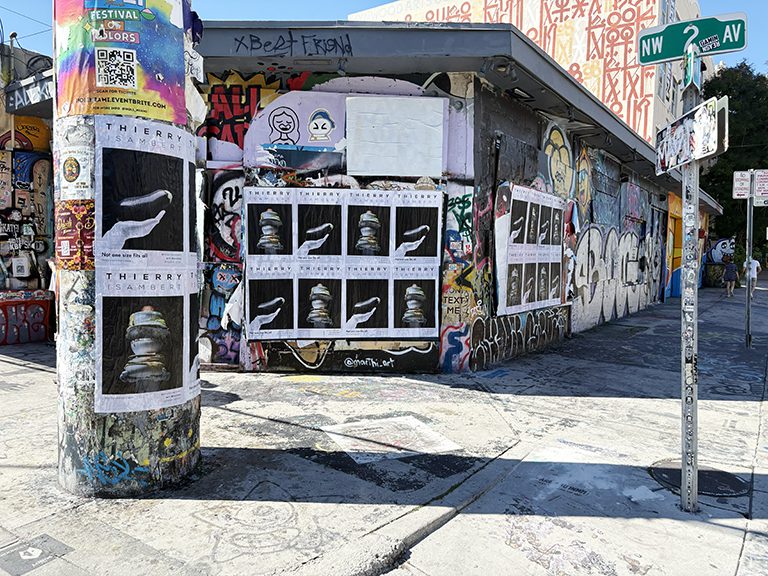
Fly posting means pasting printed posters onto urban surfaces to reach audiences at street level — one of the oldest advertising formats still actively used by major brands and artists today.
If you have seen a poster pasted directly to a wall in a city, not mounted in a frame or stuck to a transit panel, but actually pasted to the surface of a wall or construction barrier, that is fly posting. The poster is applied with paste, it bonds to the surface, and it stays there until it weathers away, gets papered over, or gets removed. The format is simple. It is also one of the most durable advertising methods in existence.
We run fly posting campaigns professionally, across New York, Los Angeles, Chicago, Miami, Austin, and other major markets. The questions we get most often from brands and artists new to the format start with the basics: what it actually is, where the term comes from, how it works operationally, and what it costs. This guide answers all of those questions in full.
Fly posting is the practice of affixing printed paper posters to outdoor surfaces using paste. The surfaces include walls, construction barriers and hoardings, fences, plywood boards, and similar flat exterior surfaces in urban environments. The paste most commonly used is a flour-and-water mixture called wheatpaste, which creates a strong bond between paper and surface and dries into a weather-resistant installation. Professional campaigns also use synthetic methyl cellulose paste or hybrid formulations depending on the surface type and campaign requirements.
The term “fly posting” is primarily British English. In the United Kingdom and parts of Europe, it is the standard way to describe this format. In the United States, the same practice is commonly described as postering, bill posting, street postering, or wheatpasting. Different names, identical format. When you hear any of these terms, they are referring to the same basic activity: printed paper poster, paste, urban surface.
Fly posting differs from other outdoor advertising formats in its directness and its physical integration into the street environment. A billboard is elevated above traffic, illuminated, mounted in a permitted structure, and managed through an outdoor media company. Transit advertising is mounted inside glass or frame systems on buses, trains, and platforms. Fly posting is at eye level, pasted directly to the surfaces of the street environment itself, occupying the same physical space as the people walking past. This is what gives the format its character: proximity and integration rather than elevation and isolation.
Where the Term “Fly Posting” Comes From
The word “fly” in fly posting carries its British English sense of something done quickly, informally, or without formal arrangement. The same sense appears in expressions like “fly-by-night” (operating without established presence), “flying visit” (a quick, brief stop), or “fly-tipping” (dumping waste informally). Applied to posting, it originally described the practice of affixing posters to surfaces rapidly and without formal permission from the surface owner.
The word “posting” in this context refers to the act of affixing paper to a surface, from the same root as “posting a notice” or “bill posting.” Combined, fly posting came to describe the informal, rapid affixing of posters to public surfaces in urban environments. In the British context, the term carried connotations of unauthorized placement, but it has since broadened to encompass the entire format, including the professional, approved-surface campaigns that agencies like ours run today.
In American English, the term “bill posting” covered similar territory in the nineteenth and early twentieth centuries, referring to the commercial practice of affixing advertising paper to every available outdoor surface. Bill posting companies employed crews to cover cities with advertising paper on behalf of clients, much as professional fly posting agencies operate today. The term “wheatpasting” emerged from the artist and music subculture communities that adopted the format in the late twentieth century and used wheatpaste specifically as the adhesive. Each term reflects a different era and cultural context for the same fundamental practice.
The History of Fly Posting
The practice of posting paper to public surfaces for communication is one of the oldest uses of printing technology. Within decades of the printing press becoming widespread in the fifteenth century, printed broadsides and handbills were being posted to walls in European cities to announce markets, events, political positions, and theatrical performances. The walls of cities like London, Paris, and Amsterdam became public communication channels for anyone who could afford to print and had the willingness to post.
The Bill Posting Industry
By the nineteenth century, what had been an informal practice had become a commercial industry. Bill posting companies in Britain and the United States organized professional crews, negotiated rights to post on specific surfaces and structures, and sold posting services to advertisers on a per-week, per-location basis. The streets of Victorian-era cities were blanketed with commercial posting at a density that would be striking by modern standards. Entire building facades, fence lines, and construction barriers were covered in overlapping layers of advertising paper. The industry developed its own professional associations, pricing structures, and territorial conventions.
In the United States, the entertainment industry was one of the primary drivers of bill posting throughout the late nineteenth and early twentieth centuries. Circus companies, theatrical touring productions, and boxing promoters all used massive fly posting campaigns to build awareness in each city before their events arrived. Advance crews would reach a town days before the show and paper every available surface with promotional material. The visual saturation was itself the campaign strategy: if you had seen the posters, you knew the show was coming.
Fly Posting and Music Culture
The punk rock movement of the 1970s gave fly posting its most culturally durable modern identity. In New York’s Lower East Side, London’s Camden and Soho, Los Angeles’ Hollywood, and dozens of other cities, bands, venues, and music promoters used fly posting as their primary promotional tool. The materials were cheap. The application required no media buying relationship. The results were immediate and physical. A band’s poster on the walls of the neighborhood where their audience lived was as direct a communication as any advertising format could produce.
The visual aesthetic that emerged from this period, black and white Xeroxed posters with hand-drawn type, became culturally influential far beyond the music it advertised. It embedded fly posting in the visual language of urban authenticity in a way that has persisted across subsequent decades. When contemporary brands use fly posting, they are drawing on a visual and cultural tradition that was built in those 1970s and 1980s music communities. The associations between fly posting and genuine cultural engagement are not manufactured. They were earned over decades of actual cultural use.
Professional Fly Posting Today
Contemporary fly posting operates at a considerably higher level of production sophistication than its historical predecessors. Digital printing has replaced hand-drawn or photocopied artwork. Professional paste formulations have supplemented traditional wheatpaste. Location strategy draws on demographic data, foot traffic analysis, and deep market knowledge. Installation is done by experienced crews who work overnight to ensure quality and who photograph every placement immediately after completion.
At the same time, the fundamental mechanism of fly posting remains unchanged from its earliest iterations. Paper, paste, wall, urban audience. The technology at each stage has improved. The operational logic has not needed to change because the core format, physical poster in the physical environment at eye level, remains as effective as it has always been at reaching audiences in the spaces where they actually spend time.
AGM Field Note: One question we get from first-time clients is whether fly posting is too old-fashioned for a contemporary brand. The answer is consistently no, and the evidence is in the results. Brands and artists that use fly posting effectively are not using a legacy format. They are using the only advertising format that puts their message at eye level in the physical environment of their audience with the cultural credibility of the street. That combination has no contemporary equivalent.
How Fly Posting Works: The Full Operational Picture
Understanding what fly posting means includes understanding how it actually works as a campaign format. Here is the full operational sequence from brief to street to documentation.
Brief and Strategy
Every campaign starts with a brief that answers three questions: Who is the target audience? What should they take away from seeing the campaign? Where does that audience physically concentrate in the city? The answers determine every other variable: format size, quantity, geography, creative direction, and timeline. A well-built brief is the foundation of a well-executed campaign. Campaigns that skip this step often discover mid-execution that their creative is not right for their locations or their locations are not right for their audience.
Creative Development and Review
Fly posting creative is produced to specific requirements that differ from other advertising formats. Text must be readable at walking pace from 10 to 20 feet away. Color contrast must hold under variable outdoor lighting conditions including bright midday sun and artificial streetlight. Image clarity must be maintained at actual print scale. We review all creative before production and flag any elements that will not perform at street scale. This review prevents the most common production problem in fly posting campaigns: creative that looks excellent in digital preview and disappoints on the wall.
Location Scouting
Location scouting establishes where the campaign will run. For markets we work regularly, scouting draws on our established location knowledge combined with current-conditions verification. For markets we are entering for the first time, we conduct full in-person scouting and deliver a placement plan with surface photos before any production begins. We scout before every campaign because urban environments change continuously. A confirmed location from a previous campaign needs to be re-confirmed before it is included in a new placement plan.
Print Production
Standard production timelines run 7 to 14 days from file approval to printed and shipped posters. We work with print partners who understand outdoor-specific production requirements including paper weight, coating selection, and large-format color management. Physical proofs are reviewed at actual print scale before any large quantity goes to press. This step is not optional. Color management between digital file and physical print output is where most production problems originate, and they are invisible until you see the physical proof.
Installation
All professional fly posting installation happens between midnight and 5 AM. Crew applies paste to the surface, places the poster, smoothes out air pockets, and applies a top coat of paste to seal the paper and prevent edge lifting. Every placement is photographed immediately after completion while paste is still wet. GPS coordinates are recorded at each placement. For multi-city campaigns, installation windows are synchronized across markets to fall within the same 48-hour period.
Documentation and Reporting
After installation, you receive a complete campaign documentation report: geo-tagged photos of every placement, location addresses, and a campaign summary covering all markets and placements. This documentation gives you a physical record of where your campaign ran and what the street presence looked like at every location.
Stage
What Happens
Typical Duration
Brief and Strategy
Audience, goals, markets confirmed
1–3 days
Creative Review
File review, street-scale legibility check
1–3 days
Location Scouting
Surface selection, placement plan delivery
2–5 days
Print Production
Proof, full run, delivery to market
7–14 days
Installation
Overnight crew, paste, photography
1–3 nights
Documentation
Geo-tagged photos, campaign report
2–5 days post-install
What Fly Posting Is Not
Fly posting is sometimes confused with other outdoor advertising formats. The distinctions matter when you are planning a campaign and trying to understand what you are actually buying.
Not a Billboard
A billboard is a permitted structure mounted above traffic, illuminated, managed by an outdoor media company, and sold on a monthly or longer contract basis. Fly posting is applied directly to surfaces at street level, runs for weeks rather than months, and is placed through an agency with relationships on approved wall surfaces rather than through an outdoor media company with owned structures. The audience relationship is completely different: a billboard is seen from a distance; a fly posted poster is encountered at eye level in the pedestrian environment.
Not a Decal or Sticker
Decals and stickers use pressure-sensitive adhesive and are often applied to smooth surfaces like glass, metal, or painted walls. Fly posting uses water-based paste and is applied to porous surfaces. The aesthetics, installation method, removal process, and durability profile are all different. Fly posting is a paper-and-paste installation. Decal campaigns are a separate format with different applications.
Not Street Art
Street art is created by artists as artistic expression, typically without commercial intent. Fly posting is an advertising format with commercial or promotional intent. The two share some materials and some visual territory, but they are different categories with different purposes. Some artists use fly posting methods to distribute their art. Some brands commission artists to create fly posting campaigns in an art-adjacent aesthetic. These hybrid cases exist, but the formats are conceptually distinct.
Why Fly Posting Still Works
Fly posting has been through every wave of media disruption and has not been displaced by any of them. Radio was supposed to make it obsolete. Television was supposed to make it obsolete. Digital advertising, social media, and streaming were all supposed to make it obsolete. None of them did, because none of them do what fly posting does.
Physical presence in the street environment is not a digital deliverable. You cannot download eye-level presence on the walls of a neighborhood. You cannot A/B test your way into street credibility. You cannot geo-target your way into the physical daily experience of urban audiences walking to work, to the subway, to the coffee shop. Fly posting creates that physical presence because it operates in the physical environment rather than on a screen. That is why it has outlasted every medium that has ever been predicted to replace it.
The secondary mechanism that has made fly posting more valuable in recent years is its interaction with digital distribution. A well-designed poster in a high-visibility location in Williamsburg or Fairfax or the Arts District gets photographed and shared by the people who encounter it. The physical placement becomes a digital content event through the organic behavior of the audience. That amplification cannot be bought directly. It has to be earned by creative that is worth sharing in a location that people are already documenting. When a campaign earns it, the street presence multiplies into digital reach without additional spend.
AGM Field Note: We have run campaigns where the organic documentation by pedestrians generated more social reach than the client’s paid digital campaign running in parallel. That outcome cannot be manufactured, but it can be planned for. Strong creative, the right neighborhood, and placements on walls that are already part of a community’s visual culture creates the conditions for it. Location and creative selection are the levers.
Fly Posting Terminology: A Reference Table
Term
Region / Context
Meaning
Fly posting
UK, Europe
Placing paper posters on outdoor surfaces using paste
Wheatpasting
US, artist/music communities
Same practice; emphasizes the flour-and-water adhesive
Bill posting
US, historical/commercial
Commercial poster placement; the 19th-century industry term
Campaign Costs: What Fly Posting Budgets Look Like
Fly posting campaign costs are driven by placement count, market, format size, and production specifications. The approved pricing framework for AGM campaigns is as follows.
Focused single-market campaigns suit neighborhood campaigns, artist launches, event promotion, and targeted advocacy campaigns where placement precision in a specific corridor is the primary goal. At this scale, the quality and specificity of each placement matters more than raw quantity.
Mid-scale campaigns covering multiple neighborhoods suit music campaigns, consumer brand launches, film promotions, and advocacy campaigns building awareness across an urban market. Contact AGM for package pricing based on your market and objectives.
Large campaigns of 200 to 500 placements, single or multi-city, are project-specific. Production, logistics, and crew coordination at this scale require a direct conversation about the campaign scope before pricing can be confirmed. Contact us at (646) 776-2770 to discuss large-scale or multi-market campaigns. Multi-city campaigns require four to six weeks of lead time for planning, production, and crew coordination.
Frequently Asked Questions
What does fly posting mean?
Fly posting means affixing printed paper posters to outdoor surfaces using paste. The term is primarily used in the UK and parts of Europe. In the US, the same practice is commonly called postering, wheatpasting, or bill posting. The format is used by brands, artists, and organizations for street-level advertising in urban environments.
Where does the term “fly posting” come from?
The term originates in British English. “Fly” refers to something done quickly or informally, from the same root as “fly-by-night” or “flying visit.” “Posting” refers to affixing paper to a surface. Combined, fly posting described the rapid, informal affixing of posters to public surfaces, often without prior arrangement.
Is fly posting the same as wheatpasting?
Yes, essentially. Wheatpasting refers to the adhesive method while fly posting refers to the broader practice. Not all fly posting uses wheatpaste; professional campaigns often use methyl cellulose or hybrid adhesives. But the terms refer to the same general format.
Who uses fly posting?
Fly posting is used by music artists and record labels, fashion brands, film studios, streaming platforms, consumer brands, political campaigns, nonprofits, and advocacy organizations. The format spans independent artists running targeted neighborhood campaigns to major brands executing simultaneous campaigns across multiple US cities.
How is fly posting different from a billboard?
A billboard is elevated above street level, illuminated, installed in a permitted structure, and managed through an outdoor media company. Fly posting is at street level, pasted directly to walls and barriers, and placed through an agency with relationships on approved surfaces. Fly posting is integrated into the street environment at eye level; a billboard sits above it.
What paste is used in fly posting?
The traditional paste is wheatpaste, made from flour and water cooked to a thick gel. Professional campaigns also use methyl cellulose paste, which provides more consistent adhesion across surface types. Hybrid formulations are common in professional flyposting work.
How long has fly posting existed?
The practice of posting paper to public surfaces for communication goes back to the earliest days of printing. By the seventeenth century, European cities were covered in posted paper. By the nineteenth century, bill posting had become a commercial industry. The format has been in continuous use for over 300 years.
How much does a fly posting campaign cost?
Campaigns are priced by poster package and market. Contact AGM at (646) 776-2770 for a custom quote based on your market and objectives.
What cities does AGM run fly posting campaigns in?
AGM runs fly posting campaigns in New York City, Los Angeles, Chicago, Miami, Austin, Nashville, and other major US markets. We also coordinate international campaigns. Call (646) 776-2770 to discuss your target markets.
Do I receive documentation after a fly posting campaign?
Yes. Every AGM campaign delivers geo-tagged placement photos taken immediately after installation and a full campaign summary report documenting every placement location. You receive a complete record of where the campaign ran and what the street presence looked like.