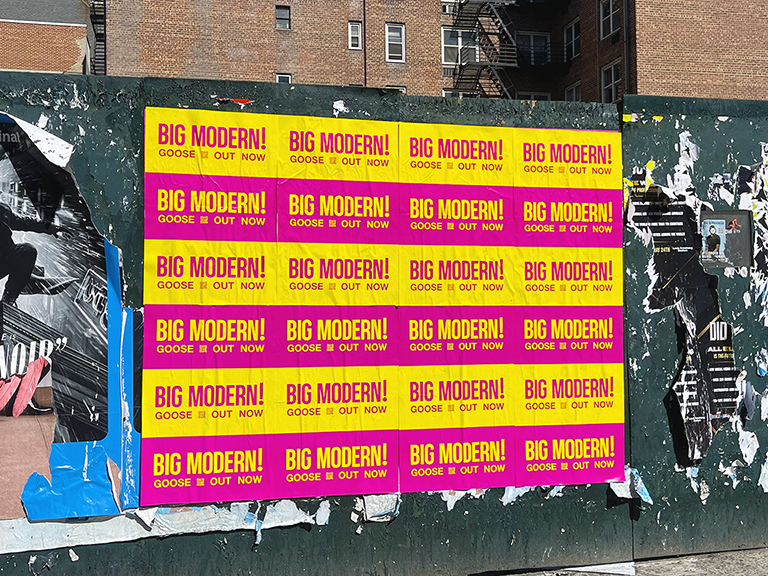
A poster size is the set of dimensions, width and height, that define how large a poster is. In print production, poster size determines everything: how the file is set up, how the poster is printed, what paper is used, what display hardware it fits, and how it reads in the real world. Choosing a poster size is the first and most consequential decision in any print marketing campaign.
We are a street marketing company. We run poster campaigns in New York City, Los Angeles, Miami, and other major markets. We make poster size decisions on every campaign we produce. Here is what we know about what poster sizes are, why they matter, and how to choose among them.
A poster size is simply a width-by-height measurement. In the United States, poster sizes are measured in inches. In most other countries, they follow the ISO A-series standard measured in millimeters. The US system and the ISO system have different standards that are close but not identical.
Poster sizes exist on a spectrum from small to very large. At the small end, poster size overlaps with large document size. At the large end, poster size overlaps with small banner and signage scale. The range most practitioners consider “poster territory” runs from about 11 x 17 inches at the bottom to 48 x 72 inches at the top.
Within that range, the industry has running a set of standard sizes that are produced routinely, supported by frame manufacturers and display hardware companies, and recognized across the printing and marketing industries as the default formats for different applications.
All Standard Poster Sizes
Size
Dimensions (W x H)
Best Use
Small
11 x 17 in
Bars, small venues, campus, high-volume indoor
Medium
18 x 24 in
Retail windows, indoor event promotion
Large (Standard)
24 x 36 in
Street campaigns, construction walls, retail
One-Sheet
27 x 40 in
Entertainment, music, theater, film
Quad Sheet
30 x 40 in
Transit, wide outdoor environments
Extra Large
36 x 48 in
Academic conferences, large venue walls
Jumbo
48 x 72 in
Outdoor installations, building facades
What Makes a Size a Poster Size?
There is no strict rule that defines when a print format becomes a poster. But a few practical criteria separate posters from other printed materials:
Scale: A poster is larger than a standard document. Anything below 11 x 17 inches is generally considered a flyer, handbill, or document. Posters start where standard paper ends.
Single-side printing: Posters are almost always printed on one side only. The front surface is the display face. Flyers and brochures are often double-sided. A single-sided, large-format print is a poster.
Display intent: Posters are designed to be displayed. They go on walls, in windows, on boards. They are not designed to be hand-held and read closely like a brochure. Their size reflects this: they are made to be seen from a distance, not read in hand.
Visual hierarchy: Posters use large, bold visual hierarchy designed for fast comprehension at a distance. A headline, an image, a key piece of information. Less text than a brochure, more visual impact per square inch.
Why Poster Size Matters for Marketing
In marketing, poster size is a strategic variable. Choosing the wrong size means your campaign underperforms or fails entirely in the placement environment. Here is why:
Visibility: A poster that is too small for its environment is invisible. An 11 x 17 on a construction wall in a busy commercial district will not be seen by passing pedestrians. The wrong size means no exposures, no matter how good the design.
Readability: Poster size determines how large your text can be and from how far it can be read. For every 10 feet of viewing distance, your headline needs to be roughly 6 to 8 inches tall to be readable. A 24-inch-wide poster can accommodate a headline of that scale. An 11 x 17 cannot.
Placement compatibility: Posters need to fit where they are being placed. A display case built for 24 x 36 will not hold a 27 x 40. A bulletin board sized for 11 x 17 will not accommodate an 18 x 24. The right size matches the physical constraints of the placement environment.
Cost efficiency: Larger posters cost more per unit. For a fixed budget, the choice between more small posters and fewer large ones affects campaign coverage. Matching your size to your placement environment ensures you are not paying for size you do not need or shortchanging yourself on scale where you do.
The Golden Rule of Poster Size
Match your poster size to your viewing distance. Close-range indoor placement: 11 x 17 or 18 x 24. Mid-range indoor or outdoor: 18 x 24 or 24 x 36. Street-level outdoor: 24 x 36 minimum. High-traffic outdoor: 27 x 40 or larger. The poster needs to be big enough to read from where your audience stands.
Poster Size by Campaign Type
Event Promotion Campaigns
Event campaigns typically run two or three sizes at the same time. An 11 x 17 for bar and small venue distribution. An 18 x 24 for retail windows and larger indoor spaces. A 24 x 36 for outdoor street placement near the event venue and in surrounding neighborhoods.
Running multiple sizes in a single campaign is standard practice. Each size fills a different placement slot in the campaign network. Design them as a family of pieces that share the same visual identity, and your campaign has cohesion across every environment where it appears.
Brand Launch Campaigns
Brand launch campaigns typically concentrate on fewer, larger placements with maximum visual impact. A brand launch in a new market benefits from 24 x 36 minimum, with premium placements stepping up to 27 x 40 or larger. The goal is unmissability, more than coverage.
Product Launch Campaigns
Product launch campaigns often run 18 x 24 for retail distribution to partner stores and 24 x 36 for outdoor street presence near retail locations. The indoor retail size places the product information at purchase-decision distance. The outdoor size drives awareness among people who have not yet entered the store.
Music and Entertainment Campaigns
Music campaigns run the full size spectrum. 11 x 17 for bar and record store distribution. 18 x 24 for venue interiors. 24 x 36 for street placement. 27 x 40 for premium collector prints and venue lobby display. Some major releases run 30 x 40 for transit environments. Size selection for entertainment campaigns often carries cultural signal value beyond pure visibility.
Poster Size vs. Print Quality
Poster size and print quality are related through resolution. The resolution required for a print to look sharp depends on both the print size and the expected viewing distance.
Small posters at close viewing distances require high resolution (300 DPI for 11 x 17). Large posters viewed from greater distances can be printed at lower resolution (150 DPI for 24 x 36, 100 DPI for 36 x 48) without visible quality loss. This is because from 15 feet away, your eye cannot distinguish individual dots in a 150 DPI print.
Understanding this relationship prevents over-specification (setting up 300 DPI files for large outdoor posters, creating unnecessarily large files) and under-specification (setting up 72 DPI files for close-range small posters, resulting in visible pixelation).
Setting Up Your Poster File
Always set your file to the final trim size plus bleed (0.125 inch per edge). Use CMYK color mode. Set resolution based on size and viewing distance. Keep all critical content inside the safe zone (0.25 inches inside the trim). These four rules apply to every poster size.
Poster Size in Different Industries
Different industries have developed their own standard poster sizes based on the specific environments where their posters live:
The movie and entertainment industry: 27 x 40 one-sheet. This is the dominant standard for theatrical and entertainment promotion in the US.
The music industry: 18 x 24 and 24 x 36 for general promotion. 27 x 40 for premium and collector formats.
The retail industry: 18 x 24 for most in-store promotional materials. 24 x 36 for premium display spaces.
The academic sector: 36 x 48 or 48 x 72 for conference research presentations.
The street marketing industry: 24 x 36 as the default, scaling up based on placement environment and budget.
What poster size requires the most printing expertise?
Jumbo formats (48 x 72 and larger) require wide-format printing expertise, specialized equipment, and experienced installation crews. Standard sizes (11 x 17 through 27 x 40) are handled routinely by most commercial print shops.
Frequently Asked Questions
What is the definition of a poster size?
A poster size is the width and height measurement of a poster, expressed in inches in the US. It defines the physical dimensions of the printed piece and determines how it is produced, displayed, and perceived in its placement environment.
What is the most popular poster size?
24 x 36 inches is the most popular poster size in the US for general marketing and street campaigns. It is the size that most people picture when they think of a poster.
What poster size should I use for my first campaign?
If you are running a street marketing campaign, start with 24 x 36. It is the most versatile, widely produced, and consistently effective size for general outdoor marketing.
Are poster sizes standard across the US?
Yes. The standard poster sizes (11 x 17, 18 x 24, 24 x 36, 27 x 40, etc.) are recognized across the US printing and marketing industries. They are produced efficiently by print shops nationwide.
What is the difference between a poster size and a banner size?
Posters are rigid or semi-rigid prints displayed on flat surfaces. Banners are flexible prints (often vinyl) designed for hanging or freestanding display. Banner sizes tend to be wider and taller than poster sizes, often in long horizontal or vertical formats unsuited to standard poster display hardware.
What poster size works best for a window display?
18 x 24 is the standard for most retail window displays. Larger store windows at flagship retail locations may accommodate 24 x 36. The right choice depends on your window dimensions and the distance from the sidewalk to the window.
How do I know if a poster size is right for my placement?
Survey your placement location. Measure the available wall or display space. Estimate how far your audience will be from the poster. Choose the size that fills the space appropriately and reads at the right distance. When in doubt, slightly larger is almost always better than slightly smaller for outdoor applications.