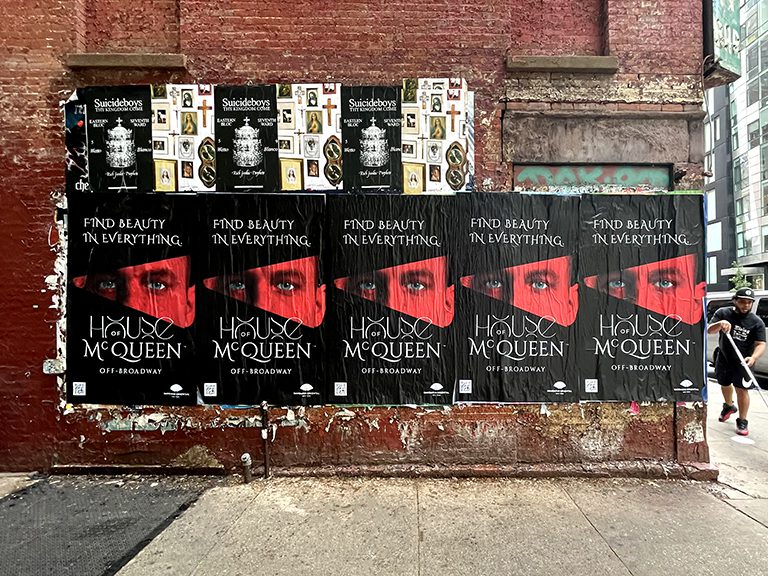
What Is a Movie Poster Size? | American Guerrilla Marketing
The standard movie poster is 27×40 inches. But film marketing uses a whole range of formats. Here is the full picture, from one-sheets to bus shelters.
Movie posters have their own language. The formats, the sizes, the terminology built up over a century of studio distribution. If you are working on a film campaign or using movie poster conventions as inspiration for another kind of project, you need to know the sizes and what each one means.
We work with entertainment clients regularly. Music, film, streaming, live events. These campaigns operate at the intersection of art direction and street presence, which is exactly where we live. We know the formats, we know how they translate from the studio system to street-level execution, and we can tell you what works.
The standard theatrical movie poster in the United States is 27×40 inches. In industry shorthand, this is called the “one-sheet.” It has been the dominant theatrical format for decades.
The 27×40 format was standardized based on the display cases installed in movie theaters across the country. Theater lobby display cases were built to this dimension, so studios standardized their materials around it. The result is a format that is deeply embedded in the physical infrastructure of theatrical exhibition.
The Standard: US theatrical one-sheet = 27 inches wide x 40 inches tall. This is what studio marketing departments produce and what theater display cases are built for.
At 27×40 inches, a one-sheet is slightly larger than a standard 24×36 poster. The extra width and height give designers more room for the complex visual hierarchy that movie posters typically carry: title treatment, star billing, imagery, credits block, and release date information.
The Full Range of Theatrical Movie Poster Formats
The movie industry developed multiple poster formats over its history, each designed for a specific display context within or outside the theater. Here is the complete breakdown.
Format Name
Size (Inches)
Display Location
One-Sheet
27 x 40
Theater lobbies, standard displays
Two-Sheet
41 x 54
Larger lobby displays, transit
Three-Sheet
41 x 81
Theater exteriors, large lobbies
Six-Sheet
81 x 81
Outdoor transit displays
Twenty-Four Sheet
246 x 108
Billboard format
Mini One-Sheet
22 x 28
Smaller theater lobbies, retail
Insert
14 x 36
Theater case inserts
Half-Sheet
22 x 28
Horizontal lobby display
Window Card
14 x 22
Store windows, advance promotion
Most of these historical formats are rarely used in modern theatrical distribution. The one-sheet at 27×40 dominates. But the terminology persists, and collectors, archivists, and some specialty campaigns still work in these formats.
Why the One-Sheet Became the Standard
The standardization of the one-sheet traces back to the golden age of Hollywood studio distribution in the mid-20th century. Studios distributed their films to thousands of theaters at the same time. They needed materials that would fit the display infrastructure at every venue without custom production for each location.
Theater circuits built their lobby cases around the one-sheet format. Once the infrastructure was in place, the format was locked in. Changing it would require replacing display cases at thousands of theaters, which was never economically viable.
The one-sheet also hit a sweet spot in terms of visual impact versus production cost. At 27×40, the format is large enough to carry full portrait compositions with multiple elements, but small enough to print and distribute efficiently on paper at volume.
Movie Poster Sizes for Outdoor and Street Campaigns
When film marketing moves outside the theater lobby, the formats change. Street-level outdoor campaigns for film releases use a different set of sizes that match the infrastructure of urban advertising.
Bus Shelter Advertising
The standard bus shelter display size is approximately 47×69 inches or 47×67 inches depending on the vendor and location. These are sometimes called “junior posters” or “transit shelter” formats. Major studios use these extensively for urban campaigns.
Subway and Transit Posters
New York City subway car cards typically come in 28×11 inches (car card) and 28×21 inches (double car card). Platform posters are considerably larger, often 47×67 or 48×68 inches. Each transit authority has its own specifications, so always confirm with the vendor.
Street-Level Outdoor Posters
When a film is marketed through street-level poster campaigns in neighborhoods, the typical sizes are 18×24 or 24×36 inches. These match the standard US poster sizes that work in urban outdoor environments. The one-sheet format of 27×40 is sometimes used for street placements but is less common than 24×36.
Film Street Marketing: Most street-level film campaigns we run use 24×36 as the primary format. It is widely available, cost-efficient at volume, and reads cleanly on urban walls and surfaces.
International Movie Poster Sizes
Outside the United States, movie poster formats follow different standards. The most common international theatrical format is A1, which is part of the ISO 216 paper standard used in most of the world.
Country / Region
Standard Format
Dimensions
United States
One-Sheet
27 x 40 inches
United Kingdom
Double Crown
20 x 30 inches
UK / Europe
A1
594 x 841 mm (~23 x 33 in)
Australia
A1 / Daybill
A1 or 13 x 30 inches
Japan
B2
515 x 728 mm (~20 x 29 in)
France
Grande
47 x 63 inches
When studios create materials for international distribution, they typically adapt the artwork to each market’s standard format. A film opening in multiple countries will have its key art reproduced in the one-sheet for the US and in A1 or local equivalents for international markets.
Designing for the One-Sheet Format
The 27×40 format presents specific design challenges and opportunities. Here is how we approach it when we work on film-adjacent campaigns.
Vertical Dominance
27×40 is a tall, vertical format. Portrait compositions thrive here. Full-length character shots, towering cityscapes, dramatic sky backgrounds. The vertical nature of the format lends itself to imagery that emphasizes scale and height.
The Credit Block
Theatrical one-sheets are required to carry a specific credit block at the bottom by union and guild agreements. This block lists the key production credits in a standardized format. For non-theatrical uses of the one-sheet format, the credit block is optional, but the convention is so strongly associated with movie posters that many designers include a bottom text section as a design element even when not legally required.
Title Treatment
The title of the film is typically the dominant typographic element. Studio title treatments are often custom-designed lettering rather than off-the-shelf fonts. The title needs to be legible from 20 to 30 feet away when displayed in a lobby or on a street wall.
Tagline Placement
Movie poster taglines typically sit just above or below the title. They are set in a secondary typeface at a smaller size than the title but larger than supporting credits. The tagline needs to be punchy enough to read in a single pass without stopping.
File Specifications for Movie Poster Printing
Whether you are printing a genuine theatrical one-sheet or using the format for a different kind of campaign, the production specs are the same.
Size: 27 x 40 inches at final print size
Resolution: 300 DPI
Pixel dimensions: 8,100 x 12,000 pixels at 300 DPI
Color mode: CMYK
Bleed: 0.125 inches on all four sides
Safety margin: 0.25 inches inside trim line
File format: PDF/X-1a or PDF/X-4
Black text: 100% K only (not rich black)
Large black areas: Rich black (C:60 M:40 Y:40 K:100)
Movie posters are typically printed on 80 to 100 lb. gloss coated stock for theater displays. For outdoor street placements, a UV laminate or water-resistant substrate adds the durability needed to survive weather exposure over the campaign window.
Movie Posters as Collectibles: Size Matters
Beyond their marketing function, movie posters are collected and traded as cultural artifacts. Size is a key factor in collectibility. Original theatrical one-sheets in good condition are the most sought after. Advance prints, alternate versions, and international formats command different prices depending on rarity and condition.
For collectors, the 27×40 one-sheet is the standard. Folded one-sheets (which were standard distribution practice through the 1980s) are worth less than rolled or unfolded examples. “Advance” one-sheets, printed before the final title treatment was set, are often more valuable than the standard release versions.
Understanding the size conventions matters for collectors because reproductions and reprints often differ from originals in subtle ways, including slight variations in dimensions that can help authenticate a piece.
Using Movie Poster Formats for Non-Film Campaigns
The movie poster format is powerful beyond the film industry because it carries cultural weight. People recognize the one-sheet format instantly. When you use 27×40 with bold, graphic imagery and a strong title treatment for a brand campaign, concert, or product launch, you borrow the visual authority of film marketing.
We have helped clients use movie poster conventions for album releases, fashion brand campaigns, and event promotions. The format signals importance. It says this matters. Used intentionally, it elevates the perceived value of whatever it promotes.
The key is committing to the format fully. Half-hearted executions that gesture at movie poster conventions without delivering on the visual ambition fall flat. If you are going to use this format, design it like a studio would. Strong imagery, bold type, clear hierarchy, and a composition that demands attention at 30 feet.
What Makes a Movie Poster Design Work at Any Size
Movie poster design has developed a specific visual language over a century of film marketing. Understanding what works at any size comes from understanding why those design conventions exist and what they accomplish.
Dominant imagery at the center or upper third. The primary visual element of a movie poster is almost always a character, a face, or a scene that communicates the emotional tone of the film. This image occupies the majority of the poster’s surface area. It is what grabs attention from across a lobby or from a passing car. At any size, from a 11×17 lobby card to a 40×60 bus shelter panel, this dominant image is the primary communication vehicle.
Minimal text, maximum impact. Movie poster copy is ruthlessly edited down to the film title, the studio billing block, the release date, and sometimes a tagline. That is all. Every unnecessary word is cut. The visual does the storytelling. The text confirms the logistical details. This discipline produces posters that communicate instantly even at viewing distances where the copy is unreadable. The image tells you what to feel. The title tells you what it is. That is enough.
Strong typographic hierarchy. Title treatment on a movie poster is designed to be read at the greatest possible viewing distance. Large, bold, high-contrast type with generous tracking and strong color contrast against the background. The hierarchy is clear from the first glance: title first, then tagline if there is one, then supporting text. At smaller sizes like the 11×17 lobby card, the same hierarchy principles apply at closer reading distances.
Color used for emotional tone, more than aesthetics. Movie poster color palettes are deliberately chosen to signal genre and emotional register. Action films tend toward cool blues, dark backgrounds, and high contrast. Romantic comedies use warm palettes with pastel or primary accents. Horror uses dark, desaturated palettes with high-contrast accent colors. These color conventions have become so running that audiences read genre from color palette before they read the title. When non-film brands use the movie poster format, the color palette choice sends the same tonal signals and should be chosen deliberately.
Printing Movie Poster Formats for Campaigns
When we produce movie poster formats for actual campaigns, the logistics depend heavily on the size and material. Here is what the production process looks like across the most common theatrical formats.
One-Sheet Production at 27×40
The 27×40 one-sheet prints efficiently on large-format roll equipment using 44-inch wide media. The print fits on a 44-inch roll with 17 inches of unused width, which is somewhat wasteful compared to the 24×36 on a 24-inch roll. This is one reason one-sheets cost slightly more per unit than standard 24×36 posters even though the size difference is not enormous.
For theatrical release campaigns ordering thousands of units, studios use specialized print facilities with offset presses configured for the one-sheet format. These facilities can produce consistent, high-quality output at scale with the tight color registration that studio key art requires.
For smaller campaigns using the movie poster format, large-format digital is the standard production method. The quality is excellent, and modern wide-format inkjet output at 300 DPI on quality coated paper is indistinguishable from offset in most viewing conditions.
Street-Level Campaign Production
When a film campaign moves to street-level placement, the logistics shift. Rather than producing thousands of identical one-sheets for theater distribution, a street campaign might produce 200 to 500 pieces at 24×36 or 18×24 for placement across target neighborhoods in specific cities.
The artwork adaptation from one-sheet to street format requires careful attention. The credit block that fits at 27×40 may become too small to read at 18×24. Type sizing needs to be reviewed at the target print size, more than at the original theatrical dimension. Images may need to be repositioned to work better in the new proportions.
The Cultural Weight of Movie Poster Formats
Movie posters carry cultural authority that few other marketing formats can match. The one-sheet format is one of the most recognized visual formats in the world. When a brand, artist, or event uses it deliberately, they borrow that authority.
We have executed campaigns where the deliberate use of movie poster conventions created earned media and organic social sharing that multiplied the campaign’s reach far beyond the physical placements. People photograph and share striking street posters that feel like they belong in the cultural conversation. A poster that looks and feels like a film promotional piece, if it actually is, taps into decades of audience conditioning.
The key is execution. A half-committed attempt at the movie poster format delivers none of the payoff. A fully committed execution with bold, cinematic imagery, proper type hierarchy, and high production quality can be genuinely powerful for the right brand or project.
The standard US theatrical movie poster is 27×40 inches. This format is called the one-sheet and has been the industry standard for theatrical distribution for decades. It is designed to fit the lobby display cases installed in movie theaters across the country.
Why is a movie poster 27×40?
27×40 became the standard because theater lobby display cases were built to this dimension during the studio distribution era. Once the display infrastructure was standardized, the format was locked in across the industry. Studios producing materials for thousands of theaters needed a single consistent size.
What is the difference between a one-sheet and a regular poster?
A one-sheet is specifically the theatrical movie poster format at 27×40 inches. A regular poster typically refers to 24×36 or another standard size. The one-sheet is slightly larger than 24×36 and carries the design conventions specific to theatrical film marketing.
What size are movie posters in Europe?
The standard theatrical poster format in the UK and most of Europe is A1, which is 594 x 841mm (approximately 23.4 x 33.1 inches). Some markets use locally specific formats as well. A1 is roughly comparable to the US one-sheet in terms of scale but is not the same dimensions.
Can I print a movie-style poster in 24×36 instead of 27×40?
Yes. 24×36 is a common choice for non-theatrical use of movie poster-style designs. The proportions are very similar (both have a roughly 2:3 aspect ratio), and 24×36 is more widely stocked and slightly cheaper to print. For theatrical applications requiring exact display case fit, you need 27×40.
What resolution do I need for a 27×40 movie poster?
300 DPI at final print size. That translates to 8,100 x 12,000 pixels. Submit your file in CMYK color mode as a PDF/X-1a or PDF/X-4 with 0.125 inches of bleed on all sides.
The half-sheet is a horizontal format measuring 22×28 inches. It was used historically for lobby display cases designed for environment-orientation posters. Half-sheets are relatively rare and are primarily of interest to collectors of vintage film materials.