What Are Typical Poster Sizes? All Formats Explained
Typical poster sizes in the US span from 11×17 to 36×48 inches. The most common for advertising are 18×24 and 24×36. Here’s the full breakdown of what’s typical in every context.
Typical poster sizes depend on where the poster is going and what it’s communicating. That’s the core truth that makes this question hard to answer with a single number. What’s typical for a music venue window is not typical for a building wall. What’s typical for a movie theater lobby is not typical for an academic conference.
Our team places posters professionally across major US cities. We know the typical sizes for each context because we work with them constantly. This guide maps out what typical looks like in every category.
This table shows the range of typical poster sizes in US advertising. For most campaigns, the relevant sizes are 18×24 and 24×36. The rest are specialty formats that apply in specific contexts.
Typical Poster Size for Street Advertising
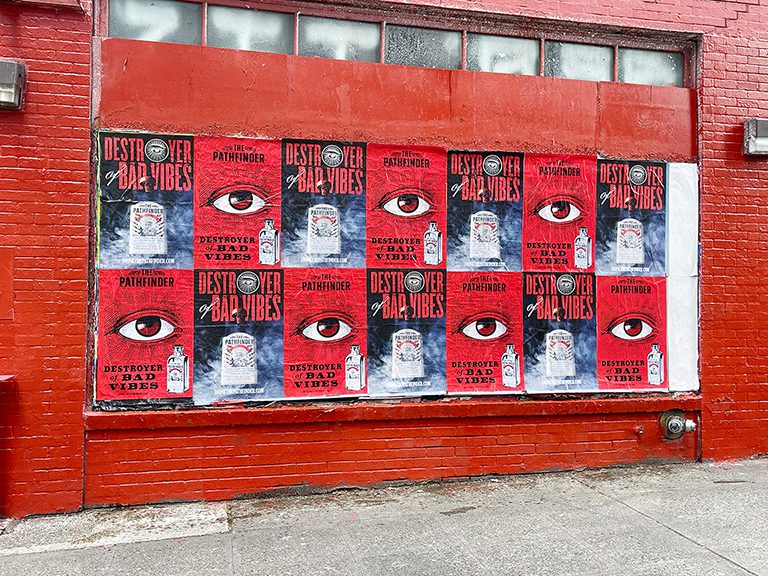
The typical size for street-level poster advertising in US cities is 24×36 inches. Two feet by three feet. This size is visible from across the street in a dense urban environment. It produces a clear campaign presence in any neighborhood.
On a typical brand rollout in New York, our crews post 24×36 pieces across neighborhoods like Williamsburg, SoHo, the Lower East Side, and Crown Heights. The format is right for the urban environment: big enough to catch the eye, compact enough to handle efficiently, and priced for high-volume campaigns.
In Los Angeles, the same 24×36 works on Fairfax, Melrose, Abbott Kinney in Venice, and Sunset in Echo Park. In Chicago, it works on Milwaukee Avenue in Wicker Park and Logan Square, and in the South Loop. The size is urban-market universal because the physical dimensions of city blocks and pedestrian sight lines are broadly consistent across these markets.
Typical outdoor sizing: 24×36 for primary street placements. Sometimes supplemented with 18×24 for secondary window and storefront locations. These two sizes together are typical for a complete urban outdoor poster campaign.
Typical Poster Size for Indoor and Window Use
The typical indoor and window poster size in the US is 18×24 inches. This is 1.5 feet wide and 2 feet tall. It fits the snap frame and display channel infrastructure installed in most US retail stores, restaurants, bars, and music venues.
At 18×24, the poster is readable from 15 to 20 feet under normal lighting. In a venue setting, where lighting may be dimmer than daylight, strong contrast and large type compensate for the reduced ambient illumination. High-contrast designs with 2-inch or larger headline text read well at this size in most indoor environments.
The 18×24 is particularly dominant in music venue and bar window promotion. These businesses use it because the snap frames already in their windows are designed for this size. It’s a self-perpetuating standard: the hardware is built for 18×24, so businesses buy 18×24, so hardware manufacturers keep making frames for 18×24.
Typical Poster Size for the Entertainment Industry
The typical poster size for the US entertainment industry is 27×40 inches (the one-sheet). This is the format used by Hollywood studios for movie promotion. Theater lobby display frames are built for this size. Any major film in wide release has a 27×40 one-sheet.
The 27×40 is also used by major music acts for poster campaigns tied to album releases and concert tours. At this size, the poster has a cinematic quality. The extra inches compared to a 24×36 are noticeable in person, and the format carries associations with professional production quality.
For smaller entertainment projects (independent films, local theater productions, smaller concerts), the typical size steps down to 24×36 or 18×24. The 27×40 is typical at the professional entertainment level, not for grassroots or independent promotion.
Typical Poster Sizes by Industry
Industry
Typical Primary Size
Typical Secondary Size
Notes
Music and Concerts
18 x 24 in
24 x 36 in
18×24 for venues, 24×36 for street
Film and Entertainment
27 x 40 in
24 x 36 in
27×40 for cinema, 24×36 for street
Retail and Brands
18 x 24 in
24 x 36 in
18×24 in-store, 24×36 for windows
Grassroots and Political
11 x 17 in
18 x 24 in
11×17 for mass distribution
Transit Advertising
36 x 48 in
40 x 60 in
Format matches transit panel specs
Academic/Research
36 x 48 in
24 x 36 in
Portrait format standard for conferences
What Factors Make a Poster Size “Typical”?
A poster size is typical in a category when it meets these criteria:
It’s the size most campaigns in that category use
Display infrastructure (frames, panels, display hardware) is built around it
Print vendors have optimized production for it
The cost of this size relative to its visibility works within the budget norms of the category
The 24×36 meets all of these criteria for street advertising. The 18×24 meets all of them for indoor and venue advertising. The 27×40 meets all of them for entertainment. These are the three most clearly “typical” sizes in US poster advertising.
Below these three, you have the 11×17 (typical for grassroots and budget-constrained campaigns) and above them you have the 36×48 (typical for transit and large format). Everything else is either between these benchmarks or a specialty format for a specific use case.
Typical Poster Sizes in Centimeters and Millimeters
For reference, here are the typical US poster sizes in metric units:
US Size
Inches
Centimeters
Millimeters
Small
11 x 17 in
27.9 x 43.2 cm
279 x 432 mm
Indoor Standard
18 x 24 in
45.7 x 61.0 cm
457 x 610 mm
Outdoor Standard
24 x 36 in
61.0 x 91.4 cm
610 x 914 mm
Entertainment
27 x 40 in
68.6 x 101.6 cm
686 x 1016 mm
Large Format
36 x 48 in
91.4 x 121.9 cm
914 x 1219 mm
How Typical Poster Sizes Affect Design
Knowing the typical size for your context helps you design correctly from the start. Each size has specific design implications.
Designing for 11×17
At this size, you’re making design decisions that prioritize density of message versus brevity. Brevity wins. One strong visual. One or two lines of text. Essential information only. The 11×17 is not the format for complex messaging.
Designing for 18×24
At 18×24, you have room for a proper layout. One dominant visual, a headline, a subheadline or supporting text, and a call to action element can all coexist with breathing room. Don’t try to fill all the space. The design should feel open, not crowded.
Designing for 24×36
The 24×36 is the most forgiving size for design because it has the most room. But the same rule applies: don’t fill the space just because it’s there. The best 24×36 posters are simple and bold. The headline fills a large portion of the space. The visual is dramatic and immediately legible. The details are clear but not the focus.
Designing for 27×40
At 27×40, design conventions from the entertainment industry apply. The image fills the poster. The text is sparse. There’s an running visual language for this format that audiences recognize from years of movie poster exposure. Playing into that language increases the poster’s cultural resonance.
Design principle across all typical sizes: Scale your headline text to the typical viewing distance for that format. At 11×17 (8-10 foot viewing), the headline needs to be about 1 inch tall. At 18×24 (15-20 foot viewing), about 2 inches. At 24×36 (25-40 foot viewing), about 3-4 inches. Use this as a starting point, then adjust based on font weight and design.
FAQ: What Are Typical Poster Sizes?
Typical Poster Sizes by City and Region: What We See in the Field
The typical sizes work differently across different US markets. Here is a field-level view of how typical poster sizes play out in specific cities.
New York City
New York is probably the most demanding poster market in the country in terms of visual competition. On blocks like Broadway in SoHo or Bedford Avenue in Williamsburg, the 24×36 is the minimum for effective outdoor communication. The visual noise level means anything smaller simply does not register. Interior campaigns at bars, coffee shops, and record stores use 11×17 and 18×24 effectively because the viewing distance is short and the poster is competing for attention in a different context. Typical NYCd campaigns combine 24×36 for outdoor anchor placements and 11×17 or 18×24 for interior distribution.
Los Angeles
LA’s lower pedestrian density shifts the typical calculation. In pedestrian corridors like Abbot Kinney, Melrose, and Silver Lake, 18×24 and 24×36 both work well. In car-oriented zones, the minimum readable outdoor format steps up to 24×36 or larger. The typical LA outdoor campaign runs 24×36 for primary street placements and 18×24 for venue and boutique windows in walkable neighborhood corridors.
Chicago
Chicago’s grid cities and wide sidewalks work well for 24×36 outdoor campaigns. The Wicker Park, Bucktown, and Logan Square corridors along Milwaukee and Damen support typical 24×36 placements effectively. Interior venue campaigns in bars and independent coffee shops use 18×24 as the typical indoor format. The city’s strong transit culture means placements near elevated CTA stations can reach commuters from 20 to 30 feet away, making 24×36 the typical minimum for transit-adjacent outdoor work.
Combining Typical Poster Sizes for Campaign Coverage
The most effective campaigns use typical sizes in combination rather than committing to a single format. Here is how typical multi-size campaigns are structured in practice.
For a campaign targeting a single urban neighborhood, a typical structure combines 20 to 30 pieces of 24×36 at outdoor anchor locations with 100 to 150 pieces of 18×24 distributed through the venue and retail network in the same neighborhood. The outdoor pieces create the dominant visual impression. The indoor pieces create the sense of omnipresence throughout the area.
For a citywide campaign covering five to eight neighborhoods, typical quantity steps up to 100 to 200 pieces of 24×36 for outdoor and 200 to 500 pieces of 18×24 for indoor, with 11×17 added for high-volume saturation in the most dense commercial corridors. The three-size campaign structure covers the full range of placement surfaces and viewing distances in a major urban market.
For a national multi-city campaign, typical sizes are standardized across all markets. The same 24×36 file and 18×24 file distribute to all cities. Local market teams install to the same spec in each market. This standardization maintains campaign cohesion while allowing the placement strategy to adapt to each city’s specific physical environment.
Typical Poster Size File Specs: Quick Reference
Before you send your file to print, use this quick spec reference for the typical US poster sizes.
11×17: File canvas 11.25 x 17.25 in. Resolution 300 DPI. Color mode CMYK.
18×24: File canvas 18.25 x 24.25 in. Resolution 150 to 300 DPI. Color mode CMYK.
24×36: File canvas 24.25 x 36.25 in. Resolution 150 DPI minimum. Color mode CMYK.
27×40: File canvas 27.25 x 40.25 in. Resolution 150 DPI. Color mode CMYK.
36×48: File canvas 36.25 x 48.25 in. Resolution 100 to 150 DPI. Color mode CMYK.
Frequently Asked Questions
What are the most typical poster sizes in the US?
The two most typical poster sizes in US advertising are 18×24 inches (for indoor and window use) and 24×36 inches (for outdoor and street-level use). For the entertainment industry, 27×40 is the typical standard. For grassroots and budget-focused campaigns, 11×17 is the typical small-format choice.
Is 24×36 a typical poster size?
Yes. The 24×36 inch poster is the most typical size for street-level outdoor advertising in the US. It’s also one of the most popular sizes for decorative home posters. Most print shops produce it as a standard offering with no custom setup required.
What is a typical concert poster size?
A typical concert poster size is 18×24 inches for venue and window placement, and 24×36 inches for street-level and outdoor promotion. The 18×24 is by far the most commonly used size for individual show promotion at the club and venue level.
What is a typical poster size for a school or academic use?
For school projects, a 22×28 poster board is typical. For science fair displays, a 36×48 tri-fold board is typical. For academic conference research presentations, a 36×48 portrait format poster is the standard across most disciplines.
What is the typical poster size for photography or art prints?
For photography prints and art posters, typical sizes include 11×14, 16×20, 18×24, and 24×36 inches. These sizes match standard picture frame dimensions available at retail. The 24×36 is the most popular large-size art print format sold by commercial print-on-demand services.
How do I order typical poster sizes from a print shop?
Specify the size in inches (e.g., “24×36”) and the quantity. Choose a paper stock (80 lb or 100 lb coated is standard for most applications). Specify glossy or matte finish. Provide a PDF or high-resolution image file at the correct dimensions and 150-300 DPI. Most online print vendors accept these specs and produce standard poster sizes efficiently.
Are typical poster sizes the same for digital and print?
Digital “poster” sizes (for screens, social media, or websites) follow different conventions. A social media post-size image is very different from a print poster, even if both are called posters in everyday usage. For print advertising, use the standard inch-based sizes. For digital, use pixel dimensions appropriate to the specific platform and placement.