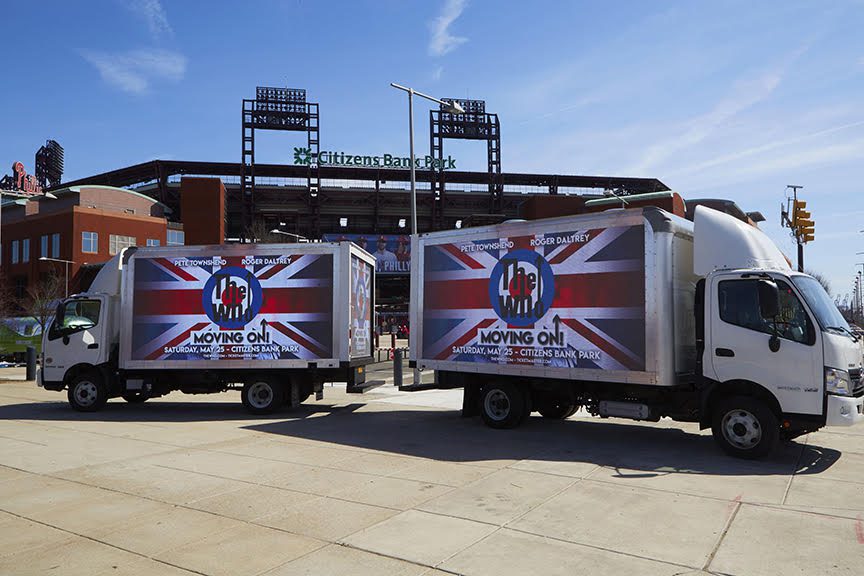
A concert tour moves through cities on a schedule, and the advertising that supports it needs to move with the same energy. Mobile billboard advertising is the format built for exactly this kind of campaign: instead of buying a fixed placement that reaches whoever happens to pass it, you send the advertising to where the audience already is. For tour promotion, where the target audience concentrates in specific neighborhoods, entertainment districts, and venue surroundings, mobile billboards give you precision that no fixed format can match.
American Guerrilla Marketing operates LED billboard trucks in major markets across the country and coordinates mobile advertising in tour stops nationwide. We have deployed LED trucks for music tours ranging from club-level runs to arena shows, and we understand how to design routes, content, and timing to maximize impact for each stop on the route. This guide covers how tour mobile billboard advertising works, why it is one of the highest-impact formats for concert promotion, and how to execute it across a national tour route.
Why Mobile Billboards Are Especially Effective for Tour Promotion
Concert tours have a specific audience geography challenge: the people who will buy tickets are distributed across each city, but they concentrate in specific neighborhoods and move through specific corridors. A fixed billboard captures whoever passes it, which may or may not include significant concentrations of the tour’s target demographic. A mobile billboard goes to where the audience is.
For music tours, this means music neighborhoods, record shops, college areas, entertainment districts, and venue surroundings. An LED truck that spends a full day routing through these locations in each city will encounter a much higher concentration of the tour’s target audience than a fixed placement in a generic high-traffic area. The efficiency of targeted delivery is one of mobile billboard advertising’s core advantages for concert promotion.
The visual impact of an LED truck is also significant. A large, full-motion LED display on a moving vehicle is difficult to ignore. It catches attention in ways that static advertising does not, especially in environments where people are accustomed to filtering out fixed advertising. For tour promotion where creating a strong visual impression quickly is important, the format’s inherent attention-getting quality is a real advantage.
LED Trucks compared with. Printed Mobile Billboards
Tour mobile billboard advertising is available in two primary formats: LED digital trucks and printed vinyl truck displays. Each has different characteristics that make them appropriate for different situations.
LED trucks display high-resolution, full-motion digital content. The content can be updated remotely, which is valuable for tour campaigns where dates, venues, or messaging change over the course of the tour. The visual quality of LED displays is superior to printed vinyl, and the ability to use motion, animation, and video content makes them significantly more attention-getting. For most music tour promotions, LED trucks are the preferred format.
Printed vinyl truck displays are a lower-cost alternative that works well when the tour’s creative is strong enough to be compelling as a static image. Printed displays cannot be updated remotely, which means any changes to dates or venue information require reprinting. For tours with stable schedules and strong visual creative, printed mobile billboards are a cost-effective way to add mobile advertising to the campaign mix.
Route Planning for Maximum Tour Promotion Impact
The effectiveness of mobile billboard advertising for tour promotion is almost entirely determined by route quality. A well-planned route that moves through the right neighborhoods at the right times of day, capturing the target audience during their daily routines, generates significantly more impact than a route that simply covers high-traffic areas without targeting the specific audience.
Our route planning process for each tour market starts with audience mapping: where does this tour’s target demographic live, work, shop, eat, and go out in this specific city? For a hip-hop tour in Los Angeles, the relevant neighborhoods and corridors are different from what they would be for the same tour in Chicago or Atlanta. Local knowledge matters, and our routing team draws on city-specific knowledge built through years of executing campaigns in each market.
Time-of-day planning is as important as geographic routing. Positioning trucks near college campuses during the late afternoon catches students as they leave class. Routing through entertainment districts during early evening reaches the restaurant and bar crowd. Positioning near venues on show night captures both arriving fans and passersby. We plan routes to maximize these high-density moments rather than driving broad geographic coverage without timing precision.
Content Design for Tour Mobile Billboard Advertising
Mobile billboard content for tour promotion needs to be designed for the specific viewing conditions of the format: large scale, moving vehicle, variable viewing distances, and a fraction of a second of direct attention from most viewers. This is very different from the design requirements of a poster that someone might stop and read, or a social media ad that they scroll to and optionally engage with.
The primary design principles for tour mobile billboard content are: high contrast visuals that are readable at distance and in varying light conditions, a hierarchy that puts the most important information (artist name and show dates) in the most immediately readable position, and a visual identity that is instantly recognizable as belonging to this specific tour. Motion elements on LED trucks should support these goals rather than competing with them for attention.
We advise clients on content design for mobile billboard formats as part of our tour advertising services. If a client’s existing creative does not translate well to the mobile format, we work with their creative team to adapt it rather than deploying something that will underperform simply because it was not designed for this specific application.
Integrating Mobile Billboards Into the Full Tour Campaign
Tour mobile billboard advertising is most effective as part of an integrated campaign rather than as a standalone tactic. When LED trucks are coordinated with poster campaigns in the same neighborhoods, the combination creates a multi-format presence that registers more strongly than either element alone. Fans who see a poster on a wall in their neighborhood and then see an LED truck driving past with the same campaign are having their second or third brand encounter with the tour, and repeated encounters dramatically increase the likelihood of ticket purchase.
Mobile billboards also amplify other campaign elements. When a truck passes near a poster installation, the moving display draws attention that some people then direct toward the static poster. When a truck routes through neighborhoods where ambassadors are working, it provides a visual backdrop that ambassadors can reference in their conversations. The mobile format connects the fixed elements of the campaign and creates a sense of campaign saturation in the target neighborhoods.
Show Night Mobile Billboard Deployment
One of the highest-impact uses of mobile billboard advertising for tour promotion is show night deployment near the venue. Positioning an LED truck outside the venue entrance on show night serves multiple purposes: it energizes the arriving fan crowd, it creates an impressive visual moment that fans document and share on social media, and it generates awareness among people in the surrounding area who may not have known the show was happening.
Show night LED truck content is typically adapted from the general tour campaign to include more event-specific messaging: the show is tonight, it is happening right here, tickets may still be available at the door. This time-sensitive messaging creates urgency for people who are in the vicinity but were not planning to attend.
The social content generated by a show night LED truck placement is also valuable beyond the night itself. Photos and videos of a striking LED truck outside a major venue become shareable content that travels across fan networks and builds awareness of the tour for upcoming markets.
Coordinating Mobile Billboard Advertising Across a National Tour
Running mobile billboard advertising across a national tour requires coordination with truck operators in each market, content delivery logistics, site approval site-rule alignment where required, and route planning that reflects local market knowledge. Our team manages all of this centrally, with market-specific coordination handled by our existing partner relationships in each city.
For clients, this means a single contract and a single point of contact covers mobile billboard activity in every tour market. Content is delivered to our team and distributed to each market’s operator. Routes are planned and reviewed centrally. Documentation and reporting from each market flows back to our central reporting infrastructure.
Frequently Asked Questions
What is tour mobile billboard advertising?
Tour mobile billboard advertising uses LED or printed truck-mounted displays to promote a concert tour in each city on the route. Mobile billboards drive through priority neighborhoods, near venues, and at high-traffic locations where the tour’s audience concentrates, creating high-visibility advertising that reaches fans in their daily environment.
Why use mobile billboards instead of fixed billboards for tour advertising?
Fixed billboards are static and location-bound. Mobile billboards go where the audience is. For tour advertising where the target audience is concentrated in specific neighborhoods, a mobile unit can cover music districts, venue surroundings, and transit corridors in a single route, reaching multiple audience clusters in one day.
How do LED trucks compare to printed mobile billboards for tour promotion?
LED trucks display high-resolution, full-motion digital content that is more visually striking than printed static displays. They also allow content to be updated remotely, which is valuable for tour campaigns where dates, venues, or messaging may change. For most music tour promotions, LED trucks are the preferred format.
Where do mobile billboards drive during a tour promotion?
Route selection is based on where the target audience concentrates in each city. For music tours, priority routes include music neighborhoods, record shops and music retail areas, college campuses, entertainment districts, major transit corridors, and venue surroundings in the days before and on show night.
How do you coordinate mobile billboard advertising across a national tour?
We have mobile billboard partners and LED truck resources in major tour markets across the country. For each city on the route, we coordinate truck availability, content deployment, route planning, and site approval site-rule alignment. A single centrally managed plan covers the full tour without requiring market-by-market coordination from the client.
What content works best on mobile billboards for concert promotion?
Concert promotion mobile billboard content should be high-contrast, visually striking, and readable at speed. Artist imagery, show dates, venue names, and ticket purchase information should be immediately legible. Motion elements on LED trucks can add visual interest, but legibility of key information is always the priority.
Can mobile billboard advertising help with day-of-show promotion?
Yes. Mobile billboard trucks positioned near venue entrances on show night capture the fan energy of the arriving crowd and create an impression for people in the surrounding area who may not have tickets. Day-of-show mobile billboard placement is one of the most effective tactics for creating visual impact at the precise moment of maximum relevance.
How early should a brand start planning?
For most campaigns, the smart move is to start planning at least two to four weeks before the launch window so production, routing, staffing, and reporting are all lined up.
What makes one market perform better than another?
Market fit depends on audience density, neighborhood behavior, route efficiency, and whether the creative belongs in that setting. The busiest city is not always the best city.
Can AGM bundle this with other services?
Yes. AGM often combines this work with supporting formats so the campaign has stronger repetition and cleaner reporting across the whole run.
How does AGM quote pages like this?
We quote from official rate cards where they apply, then scope the remaining production, staffing, and routing details to the actual job.