South by Southwest is unlike any other event in the marketing calendar. SXSW combines a major technology conference, one of the world’s most important music showcases, and a significant film festival in one city for ten days every March. The result is an audience of 300,000 plus that spans startup founders and venture capitalists, touring musicians and record label executives, independent filmmakers and streaming platform buyers, and the cultural tastemakers who determine what becomes relevant in the twelve months that follow. For brands that want genuine cultural influence, not just convention-floor visibility, SXSW marketing is the highest-stakes event in the year. At American Guerrilla Marketing, we build and execute street-level campaigns that capture the SXSW audience across Austin’s full event geography, before the first badge is scanned and after the last show ends.
The SXSW Audience: Why It Matters to Every Brand Category
SXSW’s audience is disproportionately influential relative to its size. The Interactive Festival alone brings together the people who fund technology companies, the founders who build them, the journalists who cover them, and the early adopters who determine which products cross from niche to mainstream. The Music Festival brings the artists, managers, and label executives who create the cultural narratives that consumer brands spend billions trying to associate with. The Film Festival brings the storytellers whose work shapes how audiences understand themselves and the world.
The Early Adopter Premium
SXSW attendees are not average consumers. They are the segment that tries new things first, talks about them loudly, and influences the wider market. A brand that earns genuine enthusiasm from the SXSW audience earns an endorsement from the cohort whose recommendations carry the most weight with everyone else. This amplification dynamic is why SXSW continues to be worth significant brand investment even at a time when event marketing budgets are under pressure in every other category.
The Media Saturation Opportunity
SXSW is one of the most media-covered events in the world during its ten-day run. Technology journalists, music writers, film critics, business reporters, and cultural commentators all converge on Austin with publishing deadlines and an active need for interesting stories. Any brand that creates a genuinely memorable street-level moment during SXSW week has an unusually high probability of generating earned media coverage without a dedicated PR outreach budget.
SXSW Marketing Geography: Austin’s Event Zones
Austin’s SXSW geography is more spread out than most convention cities. The event operates across dozens of official and unofficial venues throughout downtown, South Congress, East Austin, and the broader city. Understanding which zones carry which audience segments at which times is the foundation of effective SXSW campaign planning.
Sixth Street and Red River Cultural District
Sixth Street is the center of Austin’s music and nightlife culture and the heart of SXSW Music. During the festival, it closes to vehicles and operates as a continuous open-air music and brand activation zone throughout the evening hours. The Red River Cultural District, just north of 6th, hosts the highest concentration of official SXSW music venues and the most intense foot traffic of any zone in the city during peak festival hours. Street-level activations in this zone reach the music industry and fan audience in its most engaged, social state.
Wheatpaste campaigns in the blocks around the Red River District, ambassador programs at venue entry queues and bar transitions, and LED truck routes through the Sixth Street closure perimeter all perform at peak efficiency during SXSW music evenings.
Austin Convention Center and Trinity Street
The Austin Convention Center on Trinity Street is the hub of SXSW Interactive and hosts the event’s largest keynotes, sessions, and badge pickup operations. The surrounding blocks carry the technology conference audience during the day: startup founders, investors, product teams, and the technology press who dominate the Interactive audience. Morning arrival windows at the convention center, lunch break pedestrian traffic, and evening transition flows toward Sixth Street and Rainey are the highest-value windows for Interactive-targeted activations.
Rainey Street
Rainey Street is Austin’s adult beverage and social dining corridor, a two-block stretch of bungalow bars and patios that fills with SXSW attendees during the afternoon and evening hours across the full ten-day festival. The Rainey audience skews toward the professional-creative overlap: tech industry people who also care about music and culture, the kind of cross-category SXSW audience that no other event in the calendar concentrates. Brand ambassador programs and ambient activations on Rainey reach this high-value audience in a relaxed, social, unhurried state.
Congress Avenue and South Congress
Congress Avenue runs from the Convention Center north to the Texas State Capitol and south toward South Congress Avenue, one of Austin’s most culturally active commercial corridors. During SXSW, both the north and south Congress zones carry significant audience traffic. North Congress sees daytime foot traffic from convention attendees. South Congress draws the music, film, and fashion-oriented SXSW crowd during afternoon browsing and evening social hours. Wheatpasting along South Congress creates brand presence in one of Austin’s most photographed retail and dining environments.
East Austin
East Austin has emerged as the SXSW venue zone for the independent, emerging, and DIY music and creative communities that make up a significant portion of the festival’s cultural energy. The Red River District bleeds into East 6th and the broader East Austin neighborhood, where unofficial and semi-official SXSW programming runs continuously throughout the festival. Wheatpasting and ambient activations in East Austin reach the younger, more culturally adventurous segment of the SXSW audience.
SXSW Marketing Format Playbook
Wheatpasting
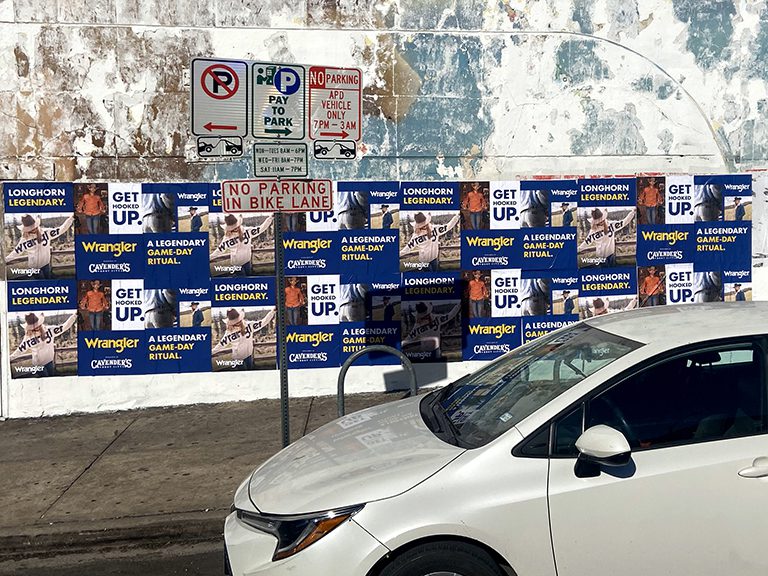
Wheatpasting is one of the most culturally native formats available at SXSW. Austin has a strong tradition of music poster culture, concert bill graphics, and street art, and the SXSW audience is deeply familiar with and receptive to well-executed large-format poster campaigns. Our team scouts and confirms surfaces throughout the Red River District, East 6th, South Congress, and the Convention Center corridor, installing overnight before each wave of festival activity to capture the morning reveal moment when audiences are freshest.
SXSW wheatpaste creative should lean into the festival’s visual tradition. Concert-poster aesthetics, bold typography, and visually ambitious design outperform corporate advertising formats in this context. Brands that commission genuine creative work for their SXSW poster campaigns rather than adapting existing marketing collateral earn audience recognition and documentation that generic adapted campaigns do not.
LED Billboard Trucks
LED billboard trucks during SXSW cover Austin’s spread-out event geography in ways that fixed-format campaigns cannot. A truck route running from the Convention Center through the Red River District, down to Rainey Street, and back through the 2nd Street hotel corridor reaches the full SXSW audience across all three festival tracks in a single deployment cycle. We run morning routes during the Interactive conference peak (8am to noon) and evening routes during the music and social circuit (7pm to midnight), capturing both the technology audience and the music and entertainment audience in their respective peak windows.
Brand Ambassador and Street Team Programs
Brand ambassador programs at SXSW require talent who are genuinely of the festival culture. The SXSW audience is exceptionally skilled at identifying inauthentic brand engagement, and ambassadors who feel like they were bused in from a staffing agency create negative brand exposures rather than positive ones. Our SXSW talent sourcing prioritizes locally-based Austin team members with genuine knowledge of the festival, its culture, and its audience segments.
The most effective SXSW ambassador programs create genuine discovery moments rather than promotional pitches. Distributing something worth keeping, creating a moment of genuine utility, or facilitating access to something the SXSW audience values (a venue recommendation, an unofficial party invite, a useful piece of information) generates more goodwill than any amount of branded swag. The festival audience is saturated with brand contact. The ones that create genuine moments break through. Everything else disappears.
Projection Advertising
Projection advertising on building facades during SXSW evenings creates the kind of large-scale, unexpected visual spectacle that the festival audience actively documents and shares. A branded projection on a prominent Red River District building, on the exterior of the Convention Center, or on a Congress Avenue landmark during a peak evening hour becomes a social media moment before the projector is even warmed up. The SXSW audience photographs everything remarkable they see. Projection formats are inherently photograph-worthy.
Ambient and Sidewalk Activations
Sidewalk stencils and ambient formats throughout the SXSW pedestrian zones create brand touchpoints that are encountered organically during the festival’s endless walking circuits. Ground-level creative near the highest-traffic intersections on 6th Street, at the Convention Center approaches, and along the Rainey Street entrance points creates unavoidable brand presence for every SXSW attendee moving through those zones on foot.
Ready to Launch Your Campaign?
SXSW Marketing Before, During, and After
SXSW’s ten-day run creates a before, during, and after campaign structure that is more extended than most event marketing windows. Each phase of the festival cycle has distinct audience characteristics and marketing opportunities.
Before SXSW: Building Anticipation
The month leading into SXSW is when the festival audience begins arriving in Austin in waves. Musicians and bands start setting up for unofficial shows. Tech founders arrive early for pre-SXSW investor meetings. Local Austin creative community is in preparation mode. Early wheatpaste installations in the key zones before the official badge-holder wave arrives create the impression of established presence before the competition’s campaigns even launch. Brands that are visible on Austin streets the week before SXSW begins earn a first-mover advantage in the festival’s visual environment.
Pre-SXSW digital campaigns targeting confirmed SXSW registrants and Austin-based creative professionals extend the campaign’s reach beyond the physical footprint and build brand awareness among the audience that will encounter the street-level campaign when they arrive.
During SXSW: Full Activation
The ten-day festival window is the peak physical activation period. LED trucks run daily routes. Ambassador programs deploy during each conference track’s peak hours. Wheatpaste installations are refreshed mid-festival to maintain visual freshness. Projection events anchor high-traffic evenings. The full campaign stack runs at maximum intensity throughout the official festival window.
Within the ten-day period, different days carry different audience profiles. The Interactive conference audience dominates early in the week. Music overtakes as the middle days arrive. The film and overlap crowd peaks in the later days. We build day-by-day deployment plans that align format and creative emphasis with the audience profile present on each festival day.
After SXSW: Conversion and Follow-Through
The week after SXSW is when the decisions made during the festival begin to convert into actions. Startup founders who saw a product launch follow up. Music industry professionals who encountered a brand at a showcase look them up. Investors who received a pitch deck request more information. Post-SXSW digital campaigns, follow-up content, and targeted outreach to contacts made during the festival all perform at elevated efficiency in this window. Brands that plan for the post-festival conversion phase extract significantly more value from their SXSW investment than those who treat the festival as the end rather than the beginning of the campaign cycle.
What Brands Get Wrong at SXSW
SXSW has a well-documented history of brand activation failures. The most common mistakes:
- Big production, no cultural relevance: An expensive build in the wrong location reaches no one the brand cares about. Location and audience alignment matters more than production scale.
- Ignoring unofficial SXSW: The most culturally significant moments at SXSW often happen outside the official badge-holder events. Brands that focus exclusively on official programming miss the audience that drives organic amplification.
- Generic brand presence: The SXSW audience sees hundreds of brand activations across the ten days. The ones that stand out are either surprising, genuinely useful, or visually exceptional. Everything else becomes background noise by day three.
- Wrong creative for the context: Corporate-clean advertising creative looks out of place against SXSW’s street art and music poster visual tradition. Brands that invest in creative development specifically for the SXSW context consistently outperform those that adapt existing marketing materials.
SXSW Campaign Planning Timeline
SXSW takes place in early-to-mid March. Planning must begin by November at the latest:
- October/November: Campaign brief, format selection, Austin location research and early site holding
- November/December: Creative development, location confirmation, talent sourcing, LED truck scheduling
- January: Creative production, ambassador briefing, logistics finalization
- February: Pre-SXSW digital campaign launch, early installations in Austin
- SXSW (March): Full campaign deployment across all ten festival days
- Post-SXSW: Follow-through campaign, documentation report, performance summary
What is SXSW marketing?
SXSW marketing refers to brand campaigns designed to reach the 300,000+ music industry professionals, technology innovators, film creators, and cultural tastemakers who attend South by Southwest in Austin, Texas each March. It includes street-level activations throughout downtown Austin, brand ambassador programs, wheatpaste campaigns, LED truck routes, and ambient activations across the event’s sprawling geography.
What are the best locations in Austin for SXSW brand activations?
Sixth Street and the Red River Cultural District are the core activation zones. The Convention Center area on Trinity Street, the Rainey Street bar district, Congress Avenue, South Congress for the film and music overlap crowd, and the hotel district around 2nd Street are the highest-value SXSW marketing locations.
How do brands stand out at SXSW without a massive budget?
Street-level campaigns that intercept SXSW attendees outside the official event perimeter consistently outperform overspent official activations on a cost-per-impression basis. Nimble street team deployments, targeted wheatpaste campaigns in high-traffic Austin zones, and ambient activations that create genuine discovery moments reach the SXSW audience at a fraction of official sponsorship costs.
How much does SXSW marketing cost?
SXSW street marketing campaigns typically run $15,000 to custom quote USD depending on format mix, geographic scope, and how many of the three conference tracks (Interactive, Music, Film) the campaign targets. Austin production costs are lower than New York but higher than Las Vegas, reflecting the city’s creative market position.
When should brands start planning SXSW marketing?
SXSW takes place in early-to-mid March. We recommend starting campaign planning in November or December of the prior year. Austin venue and location inventory for SXSW week is extremely competitive, with the best locations booking out months in advance. Ten to twelve weeks of lead time from completed brief to first installation is standard.
What makes SXSW marketing different from other event campaigns?
SXSW combines technology, music, and film audiences in one city over ten days. The attendee mix is unusually diverse for a professional event: startup founders and venture capitalists attend the same venues as touring musicians and Hollywood producers. This breadth means street-level campaigns can reach multiple high-value audience segments simultaneously without separate targeting.
What types of brands benefit most from SXSW marketing?
Technology brands launching consumer or enterprise products, music and entertainment companies, streaming platforms, creative software companies, consumer brands targeting early adopters, and any brand that wants association with innovation and cultural leadership benefits from SXSW marketing. The event’s audience is among the most influential in determining which brands become culturally relevant in the following twelve months.
Official Wheatpaste Pricing
We only quote from AGM’s published rate cards or from a custom scope tied to the actual market, route, staffing plan, and production load.
- 24×36 wheatpaste campaign, 100 posters: $4,500
- 24×36 wheatpaste campaign, 200 posters: $5,500
- 48×72 wheatpaste campaign, 100 posters: $10,500
- 48×72 wheatpaste campaign, 200 posters: $13,500
- Optional maintenance for the final two weeks of a monthly run: $3,500
If your campaign needs a different city mix, custom fabrication, or rush timing, contact AGM for a quote built from the same rate-card logic.
How AGM scopes SXSW Marketing: How to Stand Out in Austin Before, During, and After
Every wheatpaste deployment plan starts with the same field questions. Where will the audience actually see the work, how long will the message stay in view, what kind of crew does the job need, and what proof will the client want after the run is live. We scope those answers before we talk about volume. That keeps the program grounded in real conditions instead of broad theory. For sxsw marketing: how to stand out in austin before, during, and after, the planning work matters because one weak choice at the start can waste the whole run. A strong route, a realistic install pace, and a clean recap process are what make the campaign feel sharp in the street instead of rushed.
What changes performance in the field
Performance usually comes down to placement, timing, and repetition. The best campaigns do not chase every possible block. They pick the blocks, venues, walls, stations, storefronts, or pedestrian paths that line up with the right audience behavior. We watch how people move through a neighborhood, what side of the street they face, how long they dwell, and what else is competing for attention. For sxsw marketing: how to stand out in austin before, during, and after, that means the visible details, sightline, lighting, install condition, and recap quality all matter. Good field work looks obvious after the fact, but it only feels obvious because the plan was tight before the crew ever rolled.
Budget and timing without guesswork
AGM does not pad numbers with vague ranges. We tie budgets to rate cards where a public rate exists, then fill in the rest with real production needs, staffing, route density, timing, and market conditions. That keeps the conversation honest. On sxsw marketing: how to stand out in austin before, during, and after jobs, timing is often shaped by access windows, weather, production lead time, and how much documentation the client wants back. If a project is simple, the schedule stays simple. If it has many neighborhoods, many surfaces, or several city teams moving at once, the schedule expands because the work on the ground expands. That is a normal operations decision, not filler.
How we document results
Clients do not just need the work done. They need to know where it landed, how it looked, and whether the rollout matched the brief. Our recap process is built around timestamped photos, neighborhood notes, route summaries, and clear proof of completion. On sxsw marketing: how to stand out in austin before, during, and after work, recap quality often decides whether a client books the next run. Clean reporting also helps the next wave because the team can see what held up, what drew the strongest response, and which placements deserve a second pass. The recap is not an afterthought. It is part of the product.
Common mistakes brands make with SXSW Marketing: How to Stand Out in Austin Before, During, and After
The most common mistake is chasing surface area without enough planning. Brands sometimes assume that more units or more neighborhoods always means better results. In practice, sloppy spread kills recall. Another mistake is forcing creative that is too dense for the setting. Street work needs clear hierarchy, strong contrast, and a message that makes sense at the distance where the audience sees it. A third mistake is underestimating production details. The stock, finish, weather window, shift timing, and recap expectations all shape the outcome. Strong campaigns respect the boring details because the boring details decide whether the visible work looks premium.
Why this topic matters to AGM clients
Clients hire AGM because they need people who understand street conditions, not just ad concepts. SXSW Marketing: How to Stand Out in Austin Before, During, and After is valuable when it turns a broad brand idea into something that holds up in a real place, in front of moving people, with real constraints. That is where execution matters. A page like this should leave you with a clear sense of what the work involves, what can go wrong, and what a disciplined rollout looks like. If the campaign needs city selection, route design, crew planning, printing, fabrication, staffing, reporting, or a combined package, AGM can scope it from one operating plan instead of handing the job off across five vendors.
Frequently Asked Questions
How early should a brand start planning?
For most campaigns, the smart move is to start planning at least two to four weeks before the launch window so production, routing, staffing, and reporting are all lined up.
What makes one market perform better than another?
Market fit depends on audience density, neighborhood behavior, route efficiency, and whether the creative belongs in that setting. The busiest city is not always the best city.
Can AGM bundle this with other services?
Yes. AGM often combines this work with supporting formats so the campaign has stronger repetition and cleaner reporting across the whole run.
How does AGM quote pages like this?
We quote from official rate cards where they apply, then scope the remaining production, staffing, and routing details to the actual job.