Beer festivals are not passive events. Tens of thousands of adults spend a full afternoon or evening moving from sample to sample, talking to people in matching shirts, looking at signage, and forming opinions about brands they may never have seen before. The crowd is warm, the social barriers are low, and people are in the market to be surprised by something new. For brands that know how to show up, beer festival marketing is one of the most efficient direct-to-consumer channels that exists.
At American Guerrilla Marketing, we have executed campaigns around craft beer events across the country, from the Great American Beer Festival in Denver to regional pour fests that move through neighborhood blocks in Brooklyn and Chicago. What we know from that experience: the brands that win beer festivals are rarely the ones with the biggest booths inside the gates. They are the ones whose names are already in front of the crowd before they walk through the door, and who stay with them in conversation and memory after they leave.
This guide covers how to build a beer festival marketing program that actually works, from pre-event street-level tactics to on-the-ground brand ambassador strategy to the festival mobile billboard advertising that positions your name in front of every attendee walking in.
Why Beer Festival Audiences Are Worth the Investment
Before talking tactics, it is worth understanding who shows up at beer festivals and why they are worth reaching. Beer festival attendees skew 25 to 45, with disposable income and a genuine interest in discovery. They are not channel-surfing past your ad on a screen. They paid to be there, often weeks in advance, and they came specifically to find things they like.
The average beer festival draws anywhere from 2,000 to 60,000 attendees depending on scale. The Great American Beer Festival in Denver brings 60,000+ people across three days. Regional events like Portland’s Beervana or the Philly Beer Week footprint pull dense, engaged crowds numbering in the thousands over multiple days. For brands in the beverage, lifestyle, food, apparel, tech accessories, and consumer goods categories, that is a concentrated audience of exactly the right people showing up in exactly the right frame of mind.
Festival sponsorship activation inside the gates can be effective. But the booth fee, production cost, and competition for attention inside a crowded hall often make the math harder than it looks. That is why our team focuses heavily on the exterior game: the routes fans walk, the rideshares they wait for, the bars they hit before and after the pour, the neighborhoods they pass through on the way.
The Pre-Festival Window: Own the Street Before the Doors Open
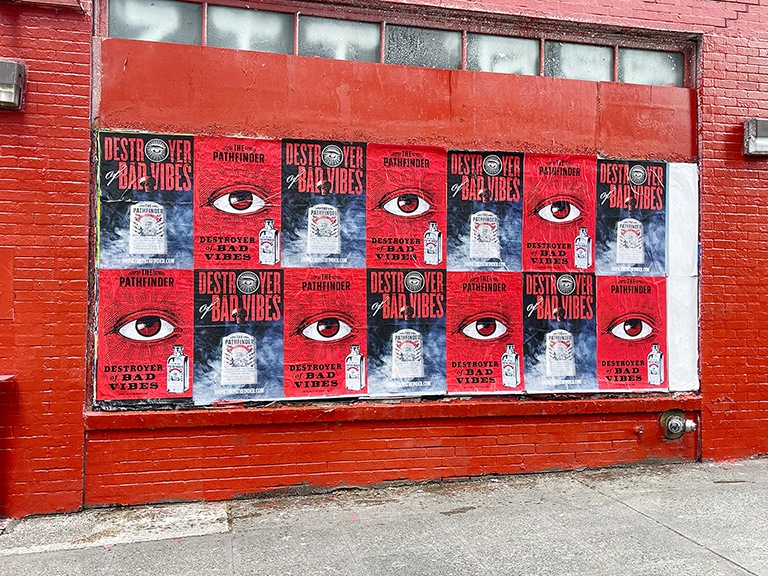
The two weeks before a major beer festival are when the city around the venue activates. Ticket-holders are thinking about the event, talking about it, and noticing anything relevant in their environment. This is when wheatpaste poster campaigns go up in the corridors around the venue, in the neighborhoods where festival-goers live, and near the bars and beer shops they frequent.
Wheatpasting at this stage is not about one impression. It is about frequency. A person who sees your brand three times in two weeks before the festival walks through the door already knowing your name. That recognition does real work at the point of sale, or when a brand ambassador hands them a sample and says your name out loud.
We also deploy sidewalk stencils on the walking routes to festival venues, turning foot traffic into brand exposure in the 20 to 30 minutes before someone enters. This is high-dwell territory. People are walking, sometimes waiting in line, and genuinely looking at their surroundings in a way they often do not on a normal commute.
Festival Mobile Billboard Advertising: The High-Impact Perimeter Play
The most efficient tool in our beer festival marketing toolkit is the LED billboard truck. We route our trucks along the primary ingress and egress corridors of the festival venue during peak arrival and departure windows, which is when density and attention are both at their highest.
A single LED truck on a well-planned route can reach 5,000 to 20,000 people in a three-hour window around a major festival, depending on venue footprint and foot traffic volume. The creative on the truck can be brand-only, or it can carry a specific message, an invite to a nearby activation, or a QR code driving to a digital destination.
Festival mobile billboard advertising works because it is unavoidable without being intrusive. The truck is on a public road. The display is bright and visible from a distance. And the audience is already primed to notice things related to the category, because they spent the last three hours thinking about beer, food, and brands. We have run this in Denver around GABF, in Philadelphia around beer week activations, and around neighborhood pour fests in multiple cities. The results in terms of brand recall and foot traffic to associated activations are consistently strong.
For brands that want to layer, we pair the truck with street teams working the same corridor, handing out samples or collateral to people waiting for rideshares or walking to nearby bars. The truck creates visibility, the street team creates the human interaction, and together they create a memory.
Brand Ambassadors at Beer Festivals: What They Do and Why It Matters
Inside the festival, if you have a sponsorship footprint, brand ambassadors are the people who turn passive brand presence into actual conversations. They are not just handing out branded cups or standing behind a table. They are telling your story, fielding questions, and qualifying leads for whatever the next step of the relationship looks like, whether that is a follow on social, a subscription, a visit to your taproom, or just a name lodged in memory.
Outside the festival, ambassadors work the perimeter. They cover bar patios in the surrounding neighborhood during the evening hours, when festival-goers are regrouping and decompressing. They work the rideshare and transit wait zones. They operate sampling stations near festival entrances, distributing product where the crowd is dense and dwell time is high.
We staff beer festival ambassador teams with adults 21 and over who are trained on the brand’s product story, talking points, and objectives. For alcohol sampling specifically, our team ensures all required site approvals and certifications are in place before any product changes hands. Depending on the state, this involves state liquor authority coordination, event site approvals, and sometimes approved server certifications for the ambassadors themselves.
Ambassador briefings cover three things: what to say, what not to say, and what to do when someone asks a hard question. The goal is never a scripted pitch. It is a genuine conversation that leaves the person feeling like they encountered something worth remembering.
Festival Sponsorship Activation: Getting the Most From Official Relationships
If your brand has an official festival sponsorship, the question is not whether to activate it, but how to activate it well. Most official sponsorships underperform because the activation is passive: your logo on a banner, your name in a program, maybe a signage placement near the entrance. Attendees see that. They do not feel it.
The brands that extract real value from festival sponsorship activation layer their official placement with an experiential element. A sponsored pour station with trained ambassadors who know the brand’s story. A custom photo moment inside the venue that drives social sharing with a branded hashtag. A sample product paired with a note card or QR code that extends the interaction beyond the festival grounds.
Our team works with sponsored brands to build activation plans that justify the sponsorship investment. That means identifying the two or three moments inside the festival where your presence can create a genuine experience, rather than just a logo impression, and building the staffing, materials, and logistics to execute those moments at scale.
We also always layer the interior sponsorship with exterior tactics. The LED truck outside. The wheatpaste campaign in the surrounding neighborhood in the weeks before. The sidewalk stencils on the approach routes. Official and unofficial tactics working together create a surround effect that neither can achieve alone.
Sampling Strategy: How to Put Product in Hands That Want It
Beer festivals are built around sampling. The culture of the event is try-before-you-buy, which means brands that offer something to try have a natural entry point. For non-alcohol brands marketing at beer festivals, the sampling logic still applies: food brands, snack companies, accessory brands, and lifestyle products all do well when they integrate their offering into the sampling culture rather than fighting against it.
Effective sampling at beer festivals follows a few principles we have developed over years of execution:
Keep the handoff simple. A festival crowd is moving and slightly overwhelmed with choices. The sample needs to come with one sentence, not a three-minute explanation. Train your ambassadors to deliver the core message in ten words or fewer, and let the product do the rest of the talking.
Time the push to traffic patterns. Festival crowds peak at entry, slow in the middle hours, and spike again at the end. Position your street teams and sampling operations where the crowd is densest, not where the booth real estate is most convenient. We map approach routes, rideshare zones, and transit exits before every event to place teams where exposure is guaranteed.
Create a reason to remember beyond the sample. A sample consumed and forgotten is a marketing expense with no residual value. Pair the sample with something physical: a card with a URL, a sticker, a discount code, a QR code to a playlist or piece of content. Give people something to carry out so your brand travels beyond the festival footprint.
Post-Festival: Extending the Campaign Window
The beer festival ends at 10 PM. Your marketing window does not. The night of and the day after a major festival, the surrounding bars and neighborhoods fill with people who are still in a social, brand-receptive mood and still thinking and talking about what they experienced. This is a prime window for brand ambassador presence in those venues and for OOH that capitalizes on the festival afterglow.
We plan our campaigns to include a post-festival element for this reason. An LED truck running the neighborhoods around the festival venue on the Saturday night after a Friday/Saturday event captures the crowd that is still out and still talking. A wheatpaste that goes up on the Sunday after the festival is seen all week by everyone who attended, reinforcing whatever impression the campaign created inside the gates.
For brands with a physical retail or taproom presence near the festival, we build ambassador programs designed to drive foot traffic in the 48 to 72 hours following the event. A card handed out Saturday becomes a reason to visit on Monday. A discount code distributed on Friday drives online orders through the following week.
The Corridor Strategy: Covering Every Touchpoint
Our approach to beer festival marketing is built around what we call the corridor strategy. Festival attendees follow predictable paths: from home to transit, from transit to the venue, from the venue to a post-event bar, from the bar to a rideshare. We identify every point on that corridor where our brand can be present and assign the right tactic to each one.
Two weeks before: wheatpaste in the neighborhoods where the audience lives and the venues they frequent.
Day of, arrival: LED billboard truck on the approach routes, sidewalk stencils on the final two blocks, ambassador team near the rideshare drop zone.
During event: if sponsored, activation inside; if not, perimeter ambassador presence in nearby bars and gathering spots.
Post-event: truck running again during peak departure, ambassador teams in the neighborhood bars, retargeting creative on social pushing the same message people saw on the street.
Each touchpoint alone would produce some return. All of them together produce brand saturation in the mind of a target audience that had no idea they were being marketed to, because every impression felt like it belonged to the environment they were already in.
Planning a Beer Festival Marketing Campaign: What We Need to Know
When brands come to us for beer festival marketing, the first conversation is about objectives. Are you trying to drive trial for a new product? Build awareness in a market where you have low penetration? Drive foot traffic to a nearby taproom or retail location? The answers shape every tactical decision that follows.
From there, we need the following information to build a campaign plan:
Event details: Which festival, which dates, expected attendance, venue location, and any known foot traffic patterns around the venue.
Target audience: Age, geography, income level, category interests. Beer festival crowds are not monolithic. GABF skews toward craft enthusiasts who know the difference between a double IPA and a hazy pale. A neighborhood block party beer festival might skew more casual. The messaging and creative should reflect who is actually in front of you.
Budget parameters: This determines the mix. A full corridor campaign with LED trucks, wheatpaste, sidewalk stencils, and a street team runs differently than a focused ambassador-only program. We work at a range of budget levels and will tell you honestly what is achievable at each tier.
Lead time: We recommend starting conversations 6 to 8 weeks before the festival date. site approval timelines, print production for wheatpaste, and ambassador staffing all have lead times that can compress your options if you wait too long. For major national events like GABF, 10 to 12 weeks is the right planning window.
Ready to Launch Your Campaign?
Measuring Beer Festival Marketing Results
We track campaign results through a combination of direct metrics and qualitative data. For LED billboard truck deployments, we provide GPS-tracked route reports showing actual coverage, estimated impression counts based on pedestrian and vehicle traffic data, and geo-fencing reports where applicable.
For ambassador programs, we track handouts distributed, conversations logged (with notes on questions asked and responses given), and any direct conversion actions like QR code scans, coupon redemptions, or email sign-ups captured in the field.
For wheatpaste and stencil campaigns, we provide location photo documentation and, where brands request it, post-campaign street audit reports confirming placement status.
Brand recall surveys, run in coordination with brands that have existing customer research programs, have consistently shown that attendees who encountered our street-level campaigns around beer festivals recall the brand at rates 40 to 60 percent higher than those who only saw interior sponsorship placements. The street is not the backup plan. It is often the primary channel.
Beer Festival Marketing Across Categories
Not every brand at a beer festival makes beer. Some of the most effective campaigns we have executed at craft beer events were for food brands, apparel labels, fintech apps, and consumer lifestyle products that were simply smart enough to go where their audience already was.
Beer festival attendees are adults with money, time on a weekend afternoon, and a disposition toward discovery and conversation. They are not just beer buyers. They are also food buyers, clothing buyers, tech buyers, and service buyers. For brands in any of these categories, beer festival marketing offers a way to reach a self-selected, high-affinity audience in a context where they are genuinely open to new experiences.
The key for non-beer brands is to find the authentic connection. A snack company whose product pairs well with craft beer has a natural story to tell. A fintech brand targeting young professionals might find that the craft beer crowd is exactly the demographic they are trying to reach. A streetwear label can integrate into the culture of the event without feeling like it does not belong.
We help brands identify which festivals make sense for their category and how to position their activation so it feels native to the environment rather than dropped in from outside. Authenticity is the difference between a beer festival presence that generates genuine interest and one that generates eye-rolls.
Regional compared with. National Beer Festival Strategy
National events like the Great American Beer Festival are high-profile and high-competition. Brands that show up at GABF are competing for attention in a very crowded field. The upside is scale: 60,000 people in Denver over three days, with significant media and influencer coverage that extends the campaign beyond the event itself.
Regional events offer a different value proposition. A major regional craft beer festival in a mid-sized market may draw 8,000 to 15,000 people, but those people are often less saturated with brand marketing, more accessible through street-level tactics, and more likely to have conversations that stick. The competition for visual real estate around a regional festival is lower. The cost of executing a corridor campaign is lower. And the return, measured per dollar spent, can be higher.
Our recommendation for most brands is to build a regional festival presence first, test messaging and tactics, and then bring what works to the national stage. The brands that win at GABF typically did not start at GABF. They refined their approach over two or three seasons at regional events and then showed up to the national event knowing exactly what they were doing.
For brands with national distribution goals, we can build a multi-market beer festival calendar covering events across the country in a single season, with consistent creative and coordinated street-level execution in each market. This is how you build national awareness without buying a national media campaign
Official Wheatpaste Pricing
We only quote from AGM’s published rate cards or from a custom scope tied to the actual market, route, staffing plan, and production load.
- 24×36 wheatpaste campaign, 100 posters: $4,500
- 24×36 wheatpaste campaign, 200 posters: $5,500
- 48×72 wheatpaste campaign, 100 posters: $10,500
- 48×72 wheatpaste campaign, 200 posters: $13,500
- Optional maintenance for the final two weeks of a monthly run: $3,500
If your campaign needs a different city mix, custom fabrication, or rush timing, contact AGM for a quote built from the same rate-card logic.
Frequently Asked Questions
How far in advance should we book beer festival marketing?
We recommend booking 6 to 8 weeks before the festival date. site approval timelines, print production, and ambassador staffing all require lead time. For major events like GABF, 10 to 12 weeks is the right planning window.
Can we run campaigns outside the festival perimeter without official sponsorship?
Yes. Guerrilla marketing and OOH campaigns in public corridors surrounding festival venues are approved and effective. LED billboard trucks, wheatpaste campaigns, and street teams operate on public property and require no official festival relationship. Many of the strongest beer festival campaigns we have executed were entirely perimeter-based.
What is the most cost-effective beer festival marketing tactic?
Mobile LED billboard trucks circling the venue offer the best cost-per-impression ratio at most events. They reach fans during approach and departure when attention is highest, with no venue fees required. Paired with a small street team, the truck creates both visibility and human interaction at a fraction of the cost of interior sponsorship packages.
Do brand ambassadors at beer festivals need to be over 21?
Yes, all AGM ambassadors deployed at alcohol-related events are 21 and over. For product sampling of alcoholic beverages, additional site approvals and certifications apply depending on the state and local event site rules. We handle site-approval planning coordination as part of every ambassador program.
Which beer festivals get the most marketing traffic nationally?
The Great American Beer Festival in Denver draws 60,000 or more attendees over three days. Firestone Walker Invitational, Beervana in Portland, Philly Beer Week, and regional events in Chicago, New York, and Los Angeles each attract dense, engaged audiences ideal for brand activation. We can advise on festival selection based on your target market and distribution geography.
How does festival mobile billboard advertising work?
Our LED billboard trucks drive pre-planned routes around the festival venue during peak ingress and egress windows. The trucks carry high-resolution digital displays showing your brand creative. We provide GPS-tracked route data and impression estimates post-campaign. Creative can be updated during the run, allowing different messages during arrival and departure windows.
What makes beer festival marketing different from general event marketing?
Beer festival audiences are highly self-selected: adults, leisure-mode, and gathered specifically to try and evaluate products. That mindset makes them uniquely receptive to sampling, brand storytelling, and physical touchpoints that would feel intrusive in other contexts. The social environment of a beer festival, people moving through stations with friends, actively discussing what they are tasting, creates natural word-of-mouth amplification that other event types do not produce as dependably.