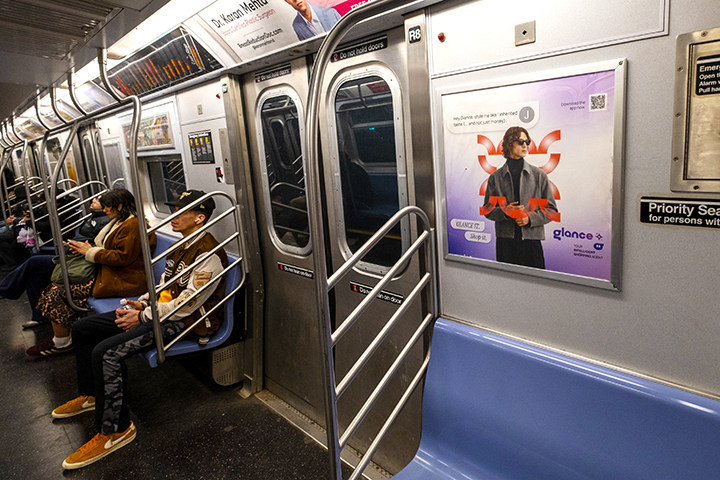
Los Angeles is a car city. Everyone knows that. But LA Metro Rail now carries over 300,000 daily riders across seven lines and 107 stations, and that number has been climbing steadily since the system’s expansion toward LAX and Santa Monica. If you’re advertising in Los Angeles, ignoring transit is increasingly leaving a specific, valuable, and concentrated audience untouched.
Subway advertising in Los Angeles works differently than New York or Chicago. The city’s transit density is lower, but the stations that do perform are performing hard. Hollywood/Highland during tourist season, Union Station during commute hours, and the Expo Line during Culver City weekend traffic all produce genuinely impressive pedestrian volumes in a city where foot traffic is otherwise dispersed across 503 square miles.
This guide covers the highest-value Metro Rail lines and stations for advertising, what transit-adjacent street campaigns can accomplish around those stations, and how our team uses a combined Metro-adjacent approach to reach the LA transit audience at scale without the cost of formal station domination buys.
LA Metro System Overview: Lines, Ridership, and Geographic Coverage
LA Metro operates six rail lines: the A Line (Blue), B Line (Red), C Line (Green), D Line (Purple), E Line (Expo), K Line (Crenshaw), and L Line (Gold). For brand advertising purposes, the lines are not created equal. Ridership volume, demographic composition, and station environments vary dramatically across the system.
B Line (Red): Hollywood and the Entertainment Corridor
The B Line runs from Union Station through downtown, under Wilshire, and north through Hollywood to North Hollywood. This is the most brand-valuable line in the system for entertainment, media, consumer, and lifestyle brands. Hollywood/Highland station sits at the intersection of the Walk of Fame and the Dolby Theatre and handles hundreds of thousands of monthly visitors beyond regular commuters. Hollywood/Vine sits a block from the Capitol Records building and draws entertainment industry riders along with tourists.
For brands targeting entertainment professionals, creatives, or cultural audiences, the B Line is the starting point. Our team deploys wheatpaste poster campaigns in the pedestrian zones surrounding Hollywood/Highland and Hollywood/Vine stations, capturing riders at surface level before they descend and after they emerge.
E Line (Expo): Culver City, Venice, and Santa Monica
The E Line connects downtown LA to Culver City and terminates at Santa Monica’s Downtown station. This line has attracted significant ridership growth since its Santa Monica extension and now carries a demographic skewing toward tech workers, creative professionals, and weekend leisure riders heading toward the beach. Culver City Station sits near the heart of Culver City’s restaurant and media district, while the Bergamot and Memorial Park stations serve the arts corridor and Santa Monica residential zones.
For tech brands, consumer apps, and lifestyle products targeting the creative class, the E Line is worth serious consideration. We run street-level campaigns along the Culver City and Santa Monica station corridors, combining transit-adjacent poster placements with brand ambassador teams during high-traffic weekend windows.
D Line (Purple): Wilshire Corridor Extension
The D Line is undergoing significant westward extension through the Wilshire corridor. As new stations open toward Beverly Hills, Century City, and Westwood, this will become one of the most demographically premium lines in the system. Current high-value stops include Wilshire/Normandie (Koreatown adjacency) and Wilshire/Vermont, which draws significant foot traffic from the surrounding mid-city neighborhoods.
Union Station: The System Hub and Best Single Buy
Union Station at 800 N Alameda Street is LA Metro’s highest-volume hub and the convergence point for the B, D, and A Lines plus Metrolink commuter rail. Platform-level advertising at Union Station reaches the broadest cross-section of the Metro rider base and benefits from the station’s dramatic architecture, which keeps riders in the space longer than a typical underground commuter stop.
Union Station is also adjacent to the El Pueblo Historic District and Olvera Street, creating a tourism overlap with the commuter audience. For brands with broad audience targeting requirements, Union Station offers the best single-station impression volume in the LA Metro system.
We run LED billboard trucks along Alameda Street outside Union Station during peak AM and PM commute windows, complementing any formal Metro buy with additional street-level impressions from the surface commuter pedestrian flow.
Transit-Adjacent Street Campaigns: Extending Your Buy Beyond the Station
Formal Metro advertising through LA Metro’s vendor contracts is well-structured but expensive at scale. Station domination buys at major hubs start in the $30,000-$50,000 range for a four-week period. Platform posters at individual stations are more accessible but still require vendor contracts and production timelines.
Transit-adjacent street campaigns offer a different equation. Deploying wheatpaste posters in the two-block radius surrounding high-traffic stations, running street teams at station exits during commute windows, and placing sidewalk stencils on the pedestrian paths approaching station entrances all reach the same rider audience at significantly lower cost per impression.
Hollywood Station Zone Tactics
The Hollywood/Highland and Hollywood/Vine station zones encompass some of LA’s highest-pedestrian-density blocks. The Hollywood Walk of Fame, the Chinese Theatre, the Dolby Theatre, Amoeba Music, and dozens of retail and restaurant blocks all sit within a two-block radius of these stations. This zone supports high-volume wheatpaste campaigns, street team distributions, and branded installations that generate organic social sharing from the tourist audience.
Downtown LA Station Approaches
Downtown LA Metro stations at 7th/Metro Center and Pershing Square connect to the city’s highest office tower density. Morning commute windows from 7:30 to 9:30 AM produce concentrated professional foot traffic on Hope, Flower, and Grand Avenue approaching the station entrances. This is where we deploy brand ambassadors for B2B-targeted morning campaigns, distributing branded materials or samples to the professional commuter stream.
A Line (Blue): The Volume Line and South Bay Connection
The A Line carries the highest total daily riders in the LA Metro system, connecting downtown to Long Beach through Watts, Compton, and Carson. While this line serves a high volume of essential commuters rather than the discretionary riders on the B or E Lines, the sheer volume creates advertising value for mass-market consumer brands, food and beverage, and retail with South Bay presence.
Transit-adjacent campaigns near A Line stations like Expo/Vermont, Slauson, and Compton reach high-density pedestrian zones that traditional outdoor media underserves. Our team executes guerrilla marketing campaigns in these corridors for brands reaching the South LA consumer market.
LED Billboard Trucks on LA Metro Approach Routes
LED mobile billboard trucks running circuits along Metro approach routes are a high-impact complement to any transit advertising strategy. A truck running Hollywood Boulevard from Highland to Vine during evening commute hours reaches every rider emerging from the B Line stations plus the dense pedestrian tourist traffic. A truck on Wilshire between Vermont and Western captures the D Line rider base along the most commercially dense stretch of the Wilshire corridor.
We route LED billboard trucks to maximize Metro station adjacency. Our routing team uses pedestrian count data to identify the windows when station exits produce the highest surface foot traffic and schedules truck circuits accordingly. A typical 4-hour truck run can make multiple passes through two or three station zones on a single circuit.
Koreatown: The Dense Mid-City Opportunity
Koreatown sits between the D Line’s Wilshire/Normandie and Wilshire/Vermont stations and is one of the densest pedestrian zones in Los Angeles. K-Town’s density of retail, restaurant, and residential use creates foot traffic volumes that rival Hollywood and Downtown at peak hours. This is one of the best-value zones in the city for wheatpaste campaigns because the pedestrian density is genuine and the advertising environment is relatively uncluttered compared to Hollywood.
Santa Monica and the Beach Cities: E Line Terminal Zone
Santa Monica’s Downtown Metro Station on Colorado Avenue is the western terminus of the E Line and sits at the convergence of the Third Street Promenade and Main Street retail districts. The pedestrian environment around this station is extremely high-density, especially on weekends. Brands targeting the affluent, health-conscious, and activity-oriented Santa Monica demographic should consider this one of LA’s highest-value transit-adjacent campaign zones.
We deploy combined campaigns in Santa Monica’s station zone: wheatpaste in the alleys off Third Street Promenade, street teams on the Promenade itself, and sidewalk stencils on the pedestrian paths approaching the beach. The zone rewards brands that can create genuinely interesting street-level experiences rather than simple logo placements.
Frequently Asked Questions
What is subway advertising in Los Angeles?
Subway advertising in Los Angeles refers to paid placements inside LA Metro Rail stations and trains, including platform posters, digital screens, train car wraps, and station domination buys. It also includes transit-adjacent street campaigns deployed outside high-traffic Metro stations to capture riders at surface level.
Which LA Metro stations get the most ridership?
Union Station is the highest-volume Metro hub. On the B Line (Red), Hollywood/Highland and Hollywood/Vine are the strongest cultural corridor stations. On the E Line (Expo), Culver City Station and Santa Monica Downtown Station generate strong ridership. The A Line (Blue) serves the highest total daily riders system-wide.
How does transit-adjacent street marketing complement Metro advertising in LA?
Transit-adjacent campaigns deploy wheatpaste posters, sidewalk stencils, and street teams in the two-block radius surrounding high-traffic Metro stations. These placements capture riders at surface level before they enter the station and after they exit, extending the reach of any Metro buy at a fraction of the cost of formal transit advertising inventory.
What does subway advertising cost in Los Angeles?
Metro Rail advertising through official vendors typically starts around $3,000-$5,000 per station per four-week period for standard platform posters, scaling to $50,000+ for station domination buys at major hubs like Union Station. Transit-adjacent street campaigns can be executed for a fraction of those rates while still reaching riders at the station level.
Which LA Metro lines are most valuable for brand advertising?
The B Line (Red) connecting downtown to Hollywood and North Hollywood is the most brand-valuable line for entertainment, media, and consumer brands due to its entertainment industry rider base. The E Line (Expo) connecting downtown to Culver City and Santa Monica reaches a creative and tech-adjacent demographic. The A Line (Blue) carries the highest volume of daily commuters.
Does American Guerrilla Marketing run LA Metro transit campaigns?
Our team executes transit-adjacent guerrilla campaigns around LA Metro stations citywide. We deploy wheatpaste posters, street teams, and LED billboard trucks in the pedestrian zones outside the most trafficked stations. We operate in Los Angeles across Hollywood, DTLA, Culver City, Koreatown, and Santa Monica.