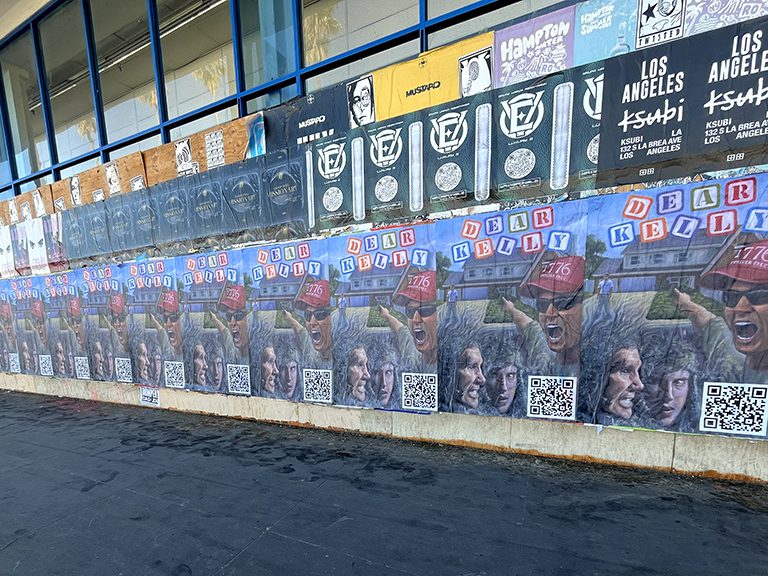
Los Angeles is a collection of distinct neighborhoods, each with its own culture and consumer base. Effective street marketing here means knowing which blocks matter for your brand, not just which city you are in.
Los Angeles is one of the most complex street marketing environments in the United States. The city sprawls across hundreds of square miles and does not have the concentrated pedestrian density that makes street marketing straightforward in New York. But within the right corridors, the right neighborhoods, and on the right blocks, Los Angeles has some of the most culturally influential street marketing territory in the country. The Fairfax District, the Downtown Arts District, Silver Lake, Venice, and the Hollywood corridors reach audiences that shape national brand narratives in music, fashion, entertainment, and lifestyle.
We run street marketing campaigns in Los Angeles regularly. We have crews in the city, location relationships across the key neighborhoods, and ten years of knowing which specific blocks in which specific neighborhoods produce genuine brand impact versus which blocks simply have available space. This guide covers the LA street marketing environment in the detail that actually matters for brands trying to make decisions about how to run campaigns in this market.
The fundamental challenge of street marketing in Los Angeles is that the city does not have a single dense pedestrian core the way New York does. In New York, you can run a campaign in Midtown, SoHo, and Williamsburg and have meaningful coverage of the city’s primary cultural and commercial consumer zones. In Los Angeles, the equivalent cultural zones are distributed across thirty to forty miles of city geography, each with its own pedestrian environment, its own demographic profile, and its own advertising culture.
This means that effective street marketing in LA is more about selecting the right zones for the specific campaign than about covering broad geographic area. A campaign that tries to cover all of Los Angeles will spread thin across too many low-value locations. A campaign that concentrates on the three or four zones where the target audience is most dense will produce significantly better results on the same budget. That concentration decision is where our location knowledge creates the most value for our clients.
The other unique characteristic of the LA street marketing environment is the relative scarcity of genuine pedestrian activity compared to the overall population size. A brand that places advertising in a mid-density commercial corridor in LA and counts cars as exposures is misreading the format. Street-level advertising in LA works when it is in zones with actual foot traffic, actual pedestrians, actual people moving at walking speed who can absorb a brand message and potentially act on it. Those zones exist, and they are specific. Finding them requires knowledge, not assumptions.
The Primary LA Street Marketing Zones
The Fairfax District: Melrose and Fairfax
The Fairfax District is the most culturally loaded street marketing zone in Los Angeles. The intersection of Melrose Avenue and Fairfax Avenue, extending north along Fairfax to Oakwood Avenue and east along Melrose to La Brea Avenue, is the epicenter of American streetwear and sneaker culture. Supreme LA, Undefeated, and dozens of independent streetwear and vintage retailers define the commercial identity of this corridor. The foot traffic on Fairfax between Melrose and Oakwood on a weekend afternoon is among the densest in LA, and it is composed almost entirely of fashion-forward, culturally engaged young men and women who are among the most socially amplifying consumer audiences in the country.
For brands targeting streetwear, sneaker, music, or youth lifestyle categories, a street marketing campaign that concentrates on the Fairfax and Melrose corridor is speaking directly to the culture’s most active participants. The organic social documentation rate in this corridor is extremely high: the people who spend time on these blocks photograph everything, share everything, and their networks amplify brand encounters at rates that are difficult to achieve anywhere else in LA.
Campaign formats that work on Fairfax: postering on the side streets east and west of Fairfax between Melrose and Santa Monica Boulevard, where wall space is more available than on the main avenue; street team activations positioned at the Fairfax and Melrose corner on weekend afternoons, which is the foot traffic peak; and large-format wheat paste campaigns on the industrial and mixed-use buildings on the blocks immediately west of Fairfax, which serve as de facto outdoor gallery space for this neighborhood.
The Downtown Arts District
The Downtown LA Arts District, centered on Traction Avenue, Mateo Street, and Santa Fe Avenue between the 4th Street bridge and the 7th Street corridor, is one of the most photographically active neighborhoods in Los Angeles. Former industrial buildings converted into galleries, studios, restaurants, and retail create a visual environment that is already oriented toward interesting and visually striking things. Brand activations in the Arts District are received in a context where the audience expects and welcomes visual stimulation.
The Arts District supports large-format wheat paste campaigns on the many available building walls in the neighborhood’s industrial blocks. The scale of the buildings and the density of available surfaces make it possible to run campaigns that are genuinely impressive in terms of size and visual impact. Building projections are also highly effective in the Arts District because the large, flat industrial building faces provide ideal projection surfaces and the neighborhood’s pedestrian traffic in the evening is concentrated and socially active.
The Arts District demographic skews toward creative professionals, media and entertainment industry workers, and culturally engaged young adults. For brands targeting this demographic in LA, the Arts District is the primary zone, followed by Silver Lake and the Fairfax District for different audience sub-segments within the same broad demographic.
Silver Lake and Los Feliz
Silver Lake’s Sunset Boulevard corridor between Fountain Avenue and Silver Lake Boulevard, and the adjacent Hyperion Avenue commercial strip, is LA’s primary music and indie culture neighborhood. The concentration of independent music venues, record shops, independent restaurants, and the cultural community that supports them makes this corridor the right target for music, entertainment, and indie lifestyle brands. The audience here is educated, culturally engaged, and attentive to brand presence in their neighborhood in ways that audiences in commercial corridors in other parts of the city are not.
Los Feliz’s Vermont Avenue commercial corridor between Hollywood Boulevard and Sunset Boulevard is the Silver Lake audience’s adjacent zone. Street marketing campaigns that cover both Silver Lake and Los Feliz reach the same demographic across a wider geographic slice of the east side of the city. The two neighborhoods together function as the east side equivalent of the Fairfax District for a different cultural cohort: indie music rather than streetwear, but equally socially engaged and amplifying.
Venice and Abbot Kinney
Abbot Kinney Boulevard from Venice Boulevard to Main Street in Venice is LA’s primary destination for the wellness, outdoor, and lifestyle category consumer. The concentration of yoga studios, juice bars, boutique fitness, and design-forward retail on this street serves a demographic that is affluent, health-conscious, and highly active on social media. Foot traffic on Abbot Kinney on a weekend afternoon, particularly on the first Friday of each month during Abbot Kinney First Fridays, creates a density of the right audience that is difficult to match elsewhere in Venice.
The Ocean Front Walk boardwalk running north and south from Venice Beach is a separate zone that serves a mixed tourist and local audience. Street marketing on the boardwalk reaches high volumes of foot traffic but at a lower audience specificity than Abbot Kinney. For brands with broad appeal to outdoor and beach lifestyle audiences, the boardwalk zone works. For brands targeting the more specific Abbot Kinney demographic, the boulevard itself is the right focus.
West Hollywood and the Sunset Strip
Sunset Boulevard between La Cienega Boulevard and Laurel Canyon Boulevard in West Hollywood, the Sunset Strip, is LA’s primary music and nightlife corridor. The Roxy, Whisky a Go Go, and the Troubadour anchor an entertainment district that attracts a heavily music-industry and entertainment-adjacent audience. Street marketing on the Sunset Strip and the immediately surrounding streets, including the Santa Monica Boulevard corridor, reaches that audience in a context that is highly relevant for music, entertainment, and nightlife brands.
West Hollywood’s Santa Monica Boulevard from La Cienega to La Brea is also a strong street marketing corridor for brands targeting the LGBTQ+ community. The commercial and social density of this corridor makes it one of the most community-specific street marketing opportunities in LA, and brands that are genuine about their engagement with that community find strong reception here.
LA Zone
Primary Audience
Best Campaign Format
Peak Foot Traffic Window
Fairfax / Melrose
Streetwear, sneaker culture
Postering, street teams, wheat paste
Weekend afternoons
Downtown Arts District
Creative professionals, media
Wheat paste, projections, installations
Thursday to Saturday evenings
Silver Lake / Los Feliz
Indie music, creative class
Postering, street teams
Thursday to Sunday, evenings
Venice / Abbot Kinney
Wellness, outdoor, lifestyle
Street teams, ambient, postering
Weekend mornings and afternoons
West Hollywood / Sunset Strip
Music, entertainment, nightlife
Postering, street teams, projections
Thursday to Saturday nights
Hollywood / Highland
Tourist, entertainment adjacent
Street teams, ambient
Daily, peak afternoons
Street Marketing Services We Offer in LA
Postering and Wheat Paste Campaigns
We run postering campaigns across every major LA zone, from standard street boards to large-format wheat paste installations on building walls. Our location relationships give our clients access to placement opportunities that are not available through generic outdoor advertising networks. We scout locations before production begins, select placements with precision based on audience profile and foot traffic data, and install with professional crews that produce clean, brand-appropriate work at every site. Installation is documented with GPS-tagged photographs delivered to the client before the next business day.
Street Team Activations
We recruit, train, brief, and manage street teams in Los Angeles for sampling, direct engagement, product distribution, and event support. Our LA crew pool is deep enough to staff activations from a three-person sampling team to a thirty-person coordinated deployment. Every ambassador is briefed on the brand and the product before deployment, and every activation is managed in real time by a field supervisor who monitors positioning, intercept rates, and quality of engagement throughout the activation day.
Building Projections
We execute building projection campaigns in the Arts District, Culver City, Silver Lake, and other LA zones with appropriate building surfaces and favorable evening foot traffic. The logistics of projection in LA require advance scouting of the projection surface, throw distance, and ambient light conditions, plus coordination on the activation date for power, equipment positioning, and documentation. We manage all of this and deliver a projection activation that produces both a live audience experience and high-quality documentation content for digital distribution.
Event Adjacency and Festival Marketing
Los Angeles hosts more major cultural events and festivals than almost any other US city. Coachella, Lollapalooza LA, and Rolling Loud at Banc of California Stadium, major film and television events, and dozens of neighborhood festivals create concentrated audience opportunities that we plan campaigns around. We position postering and street team activations along the approach routes and in the adjacent neighborhoods before and during major events, reaching event audiences in contexts where brand encounters feel organic rather than imposed.
AGM Field Note: Coachella weekend is the single most intensely brand-activated period in the LA-adjacent market calendar. Brands that want to activate around Coachella but cannot afford official festival partnerships can build significant presence in the Palm Springs and Indio corridors, along the I-10, and in the LA neighborhoods that are emptied of their cultural class for the weekend. That absence of competition in Fairfax and Silver Lake during Coachella weekend is itself a campaign opportunity.
How We Plan an LA Street Marketing Campaign
Every LA street marketing campaign we build starts with a direct conversation about the brand, the target audience, the LA-specific demographic goals, and the timeline. Los Angeles requires a neighborhood selection conversation that does not apply to other markets, because the choice of which zones to include and which to exclude is the most consequential single decision in the campaign plan.
Once the zones are selected, we conduct a location scout in each target neighborhood to validate the specific placement opportunities available within the campaign window. The scout confirms surface availability, foot traffic patterns, competitive advertising environment, and any location-specific conditions that affect the placement plan. The scout report gives the client a clear picture of exactly where the campaign will run and the rationale for every location decision.
Production, installation, and activation follow the same operational standards we apply in every market: professional materials, professional crew, GPS-documented installation, and real-time field management. Post-campaign reporting includes full documentation, organic social volume analysis, and honest assessment of what each placement and format delivered.
The LA Street Marketing Creative Brief
Creative for LA street marketing campaigns needs to account for how the city’s specific outdoor environments display brand content. Los Angeles is a visually competitive city: the walls of Fairfax and Melrose, the streets of the Arts District, and the commercial corridors of Silver Lake already have a high density of visual content from artists, independent brands, and other advertisers. Standing out in that environment requires creative that is genuinely strong, not just competent. A poster that would be the strongest visual on a block in a mid-tier market might be unremarkable on Fairfax, where the audience has a high baseline for visual quality and is not easily impressed by standard advertising executions.
Scale matters in Los Angeles in ways that differ from other markets. The Arts District’s large industrial building faces support campaigns that are genuinely large, where the physical scale of the creative is itself part of the impact. A wheat paste installation that covers a full three-story building face on Traction Avenue creates an impression of brand investment and visual confidence that a standard-size poster in the same neighborhood does not. For brands with the creative and production capacity to work at that scale, Los Angeles offers opportunities that few other markets can match.
The socially engaged nature of the target audience in most LA cultural neighborhoods means that creative should be designed with photography in mind. What does this look like in a portrait-format phone photograph taken from ten feet away? Does the brand logo, the tagline, and the primary visual all resolve in a thumbnail? Does the composition work as a frame for a person standing in front of it? These are questions that matter in every guerrilla market, but they matter with particular force in LA, where the audience’s social documentation instinct is among the strongest in the country.
Measuring Street Marketing Results in Los Angeles
Street marketing measurement in Los Angeles follows the same framework we apply in other markets: brand recall surveys, organic social volume tracking, and client-provided commercial metrics where available. The LA-specific context for this measurement includes a few considerations that differ from other markets.
The entertainment and media industry’s concentration in Los Angeles means that press and earned media coverage of compelling street campaigns in the city’s cultural neighborhoods is more likely here than in almost any other US market. Entertainment journalists, music and culture bloggers, and social media accounts focused on LA street culture are all active consumers of interesting brand activations in the neighborhoods where they live and work. A campaign that generates press coverage in LA generates coverage that reaches national audiences because LA-based media has national distribution.
The social documentation culture in LA’s creative neighborhoods, particularly the Arts District, Fairfax, and Abbot Kinney, is stronger than almost any comparable area in the country except perhaps SoHo and Williamsburg in New York. Brands that run visually compelling campaigns in these neighborhoods consistently generate organic social content that extends the campaign’s reach well beyond the foot traffic at the placement locations. We monitor organic social volume throughout every LA campaign and include it in post-campaign reporting as a key performance signal.
Brand recall surveys in Los Angeles require specific attention to the geographic spread of the survey population. Because the city is so large and the target audience is so geographically concentrated in specific neighborhoods, surveying a broad sample of LA residents will dilute the recall signal from the specific neighborhoods where the campaign ran. We target recall surveys to respondents who live in or regularly visit the specific neighborhoods where the campaign was placed, which produces a more accurate measure of campaign impact on the actual target audience.
Seasonal Street Marketing in Los Angeles
Los Angeles has a more consistent outdoor marketing calendar than most other major US cities, but seasonal variations in audience behavior and event density still shape the optimal campaign windows for specific neighborhoods and formats.
Summer in Los Angeles is the outdoor marketing season for the beaches and the entertainment corridor. Venice and Abbot Kinney foot traffic peaks from June through August, with weekend afternoon density reaching some of the highest levels of the year. Brands targeting the wellness, outdoor, and lifestyle categories should concentrate their LA summer campaigns on the Venice and Abbot Kinney zone, where the audience is at its most concentrated and most receptive. The Sunset Strip’s outdoor advertising environment also intensifies during summer concert season, when major venue dates drive sustained elevated foot traffic through the West Hollywood corridors on nights from Thursday through Sunday.
Award season, running roughly from January through early April, is the most entertainment-industry-concentrated period in the LA calendar. The concentration of film, television, and music industry professionals attending events, screenings, and industry gatherings during this period creates specific audience concentration at event venues and the surrounding corridors in Beverly Hills, West Hollywood, and Century City. Brands targeting entertainment industry professionals use award season as their primary activation window, positioning street teams and postering campaigns along the corridors leading to major award venues during the weeks surrounding major ceremony dates.
The fall period from September through November is LA’s strongest window for brand launches targeting the young professional creative demographic. The summer travel period has ended, the city’s creative communities have returned to their regular neighborhood routines, and the concentrated cultural activity of fall, including gallery openings, music releases, and the beginning of awards season, creates an audience that is highly engaged with cultural news and brand activity in their neighborhoods. A brand launch that runs street marketing in the Arts District, Silver Lake, and Fairfax during September and October reaches this demographic at a moment of high receptivity and high social activity.
Why Brands Come to AGM for LA Street Marketing
The most common reason brands come to us for Los Angeles street marketing after working with other agencies or self-executing is location selection. The neighborhoods are known by name to most marketers. The specific blocks within those neighborhoods that actually have the foot traffic, the surface availability, and the cultural specificity to justify a premium placement are known only through field experience in the market. We have that experience. Our crews have been working in Los Angeles long enough to know the difference between the blocks on Fairfax that matter and the blocks that look similar but do not carry the same cultural weight, and that knowledge is what makes location strategy in LA actually work rather than just sounding convincing in a presentation.
The second reason is execution consistency. Los Angeles is a city where street marketing self-execution and low-quality subcontracting are common, which means that much of the guerrilla marketing that runs in the city is executed at a quality level that reflects poorly on the brands behind it. We run all campaigns with our own LA crews, briefed to the same standards as our New York and Chicago crews, and every placement is documented before we move on. That consistency is visible in the final campaign, and it is what allows brands to use their LA street marketing in client presentations and on their own channels without qualification.
LA client relationships tend to evolve into collaborative long-term partnerships. We get to know the brand visual language, cultural positioning, and community in a way that makes each subsequent campaign sharper than the one before. That iterative improvement is a genuine advantage of working with an agency that maintains a long-term view of your market presence rather than treating each campaign as an isolated project. The brands that build sustained street presence in Los Angeles over years consistently report that the cumulative effect on brand recognition within the target neighborhoods far exceeds what any individual campaign achieves on its own.
Frequently Asked Questions
What are the best neighborhoods for street marketing in Los Angeles?
The Fairfax District for streetwear and youth culture, the Downtown Arts District for creative professionals and entertainment industry adjacent audiences, Silver Lake for indie music and creative class, Venice and Abbot Kinney for wellness and outdoor lifestyle, and West Hollywood and the Sunset Strip for music and nightlife. The right neighborhood depends entirely on the brand’s target audience profile.
Why is street marketing harder in LA than in New York?
Los Angeles has lower pedestrian density overall than New York, and the culturally relevant pedestrian zones are spread across a large geographic area rather than concentrated in a dense core. Effective street marketing in LA requires precise neighborhood selection rather than broad geographic coverage. The brands that approach LA with a New York-style “cover as much area as possible” strategy consistently underperform because they spread their budget across low-foot-traffic locations between the zones that actually matter.
How does AGM run street teams in Los Angeles?
We recruit, train, brief, and manage street teams in LA for sampling, direct engagement, product distribution, and event support. Every ambassador is briefed on the brand and the product before deployment, and every activation is managed in real time by a field supervisor. We do not use generic staffing agencies for brand ambassador work because the briefing quality and brand alignment that matter for effective street teams are not achievable through generic staffing channels.
Can you run building projections in Los Angeles?
Yes. We execute building projection campaigns in the Arts District, Culver City, Silver Lake, and other LA zones with appropriate building surfaces and favorable evening pedestrian environments. The Arts District is particularly well-suited for projections because of its large industrial building faces and its socially active evening foot traffic.
How far in advance should we plan a street marketing campaign in LA?
For campaigns with printed materials and street team components, four to six weeks from brief to activation is the standard timeline. For campaigns that include building projections or large-format wheat paste productions, six to eight weeks is appropriate. For campaigns timed to major LA events like Coachella or Rolling Loud, we recommend starting the planning conversation eight to ten weeks before the target activation date.
Do you work with entertainment industry brands in LA?
Yes. Entertainment brands including film studios, streaming platforms, record labels, and music management companies are among our most frequent LA clients. The entertainment industry’s deep alignment with street culture makes guerrilla and street marketing a natural fit for releases, launches, tour support, and streaming platform growth campaigns. We have executed entertainment campaigns across every major LA zone and understand the specific geography and timing requirements for entertainment marketing in this market.
What does a street marketing campaign in Los Angeles cost?
Investment depends on the number of zones, the formats, and the scale of the activation. A focused postering campaign in the Fairfax District or Arts District is the lowest-cost single-zone entry point. Multi-zone campaigns across three to five LA neighborhoods with a street team component represent a mid-tier investment. Full multi-format campaigns including postering, street teams, and a projection component represent a larger investment. Contact us at (646) 776-2770 for a scope-specific estimate.
How do I get started with street marketing in Los Angeles with AGM?
Call (646) 776-2770 or email [email protected]. We will discuss your brand, your target audience, your LA-specific goals, and your timeline. We can turn around a campaign proposal quickly once we understand the brief. If you are not certain which LA neighborhoods are right for your brand, we can advise on that as part of the initial conversation.