
November 3, 2026
Snipe Advertising for San Francisco Brands
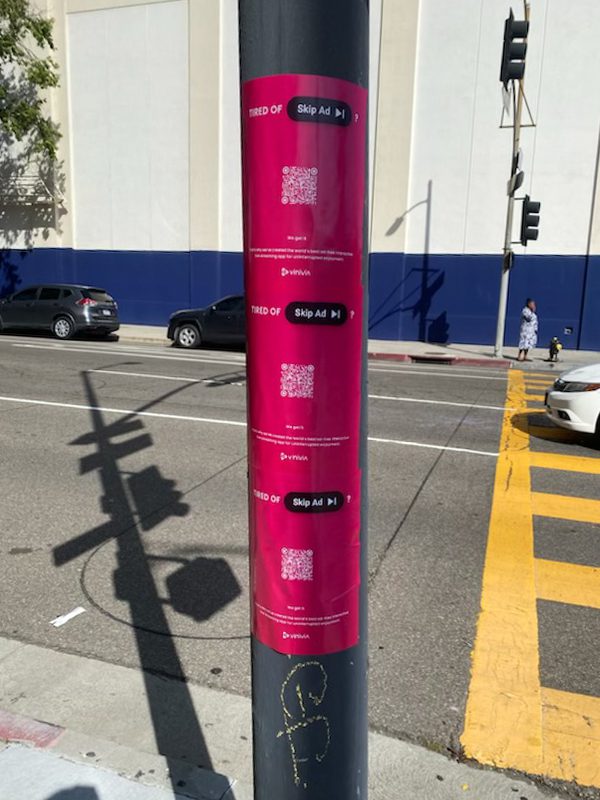
Snipe Advertising is the small-format end of street media. Pole-mounted cards, compact panels, repeated placement along a route rather than one large statement on a wall. It is the format that works on frequency: the same person passing the same corridor four times a week.
San Francisco is a better snipe market than most American cities, and the reason is geometry. The corridors here are linear and walkable. People move along Valencia, along 24th, along Folsom, along the Castro strip, on foot, at predictable hours. A format built on repetition needs exactly that, and most car-dependent cities cannot supply it.
It is also a market with unusual paperwork. San Francisco Public Works publishes guidance specifically about affixing signs to utility and light poles in the public right of way. Most cities leave that question unaddressed and let crews guess. Here there is a written expectation, and it shapes how a sensible operator specs the job: size, banding material, mounting height, dating and a removal window.
So the San Francisco snipe conversation is not "can we do it". It is "which corridor, what material, which weeks, and who is coming back for it".
That last part is where most campaigns fall down, and it is where I will spend a fair amount of this page.
Why snipes suit this city's street geometry
Seven miles square, and an unusual number of distinct commercial corridors packed into it. That is the planning fact that matters.
Snipe advertising earns its keep through repetition along a path. You are not trying to stop someone. You are trying to be the thing they have now seen eleven times between the BART stop and their front door. That requires a corridor with a consistent pedestrian flow and a consistent set of mounting points along it.
The Mission supplies that better than anywhere else in the city. Valencia Street runs as the trend corridor, dense with bistros and boutiques, and it holds people on foot across a long stretch. Sixteenth and Valencia together form the main bar corridor and stay well trafficked late into the night. Twenty-fourth Street is the tree-lined Latino commercial spine with long-established businesses along it, including La Palma Mexicatessen, La Victoria Panadería and La Torta Gorda, and it carries a steady daily rhythm of people doing ordinary errands rather than going out. Twentieth Street has come up as the newest restaurant corridor.
Those are different frequencies against different audiences, and for a repetition format that distinction matters more than it does for a single large poster. On 24th you are reaching the same households repeatedly across a week. On 16th and Valencia at the weekend you are reaching a larger, younger, more transient flow with less repetition per head.
The Castro's commercial strip, Hayes Valley, Haight-Ashbury and the Tenderloin arts corridor each hold their own identity and each run as linear strips, which is what the format wants.
SoMa works differently and needs saying plainly. It is larger modern buildings, more office and commercial use, and a rhythm driven by weekday work and convention traffic rather than by people who live there. Harrison and Folsom carry the nightlife weight. Snipes in SoMa reach a commuting and convention population on weekdays and considerably fewer people at the weekend. That is fine if it is what you intended and a waste if it is not.
Bernal Heights I usually argue against for this format. Hilly, mostly residential, without nightlife clusters that concentrate people onto a walkable strip. Repetition needs a path, and Bernal does not really offer one.
Fog, sun and what a small-format card actually survives here
The regional climate is Mediterranean, dry summers and cool rainy winters, and if that were the whole story San Francisco would be straightforward. It is not, because of fog.
San Francisco gets advection fog, formed when warm moist Pacific air meets the cold coastal current. It is present year round, heaviest in the late-summer stretch locals call Fogust, and it is so constant a presence that it has a nickname, Karl.
For small-format media the fog problem is persistent surface moisture rather than driving rain. That is a different failure mode from a storm. A card mounted on the ocean side sits damp more or less continuously. Paper-based stock wicks moisture from the edges inward, softens, and goes soft-cornered and wavy long before anything dramatic happens to it. It does not blow away. It just stops reading as a professional piece of media, which for a brand is the same outcome.
Microclimate variation here is extreme for a city this small. Temperature can differ by ten degrees or more from one side to the other, and the gap widens in summer. You can walk from heavy fog on the Pacific side, up a hill into direct sun, and then into channelled wind between towers.
What that means in a spec:
On the western half of the city, specify for continuous damp or do not run paper there at all. Synthetic stock and sealed edges are the difference between two weeks and two months.
In the Mission, which sits in one of the sunniest parts of the city, adhesion and cure are notably better than the Sunset or the Richmond, and the trade is a higher UV load. Unprotected inks fade faster there. Dark saturated fields and fine coloured type go first. If a run is meant to hold through a summer, spec against sun in the Mission and against moisture in the Sunset, and accept that those are two different print orders.
Wind is a real failure mode in San Francisco in a way it is not in most US cities. Downtown and SoMa channel wind between towers. For snipes that stresses the banding and the top corners of a card, and a panel that works loose becomes a flapping piece of litter with your name on it within a night or two. Over-fix, keep the format compact on exposed elevations, and avoid large unsupported spans entirely there.
There is no meaningful freeze-thaw cycle in San Francisco, which removes a whole category of failure that dominates cold-winter markets. Winter rain is the concentrated wet period and the shortest-life season for unprotected paper. Summer is dry, which helps, except on the coastal side where Fogust works directly against it.
The posting guidance here, and why it changes the spec
This is a grey area and I will not pretend otherwise. What is unusual about San Francisco is that the city has published explicit public guidance rather than leaving the subject unspoken.
San Francisco Public Works maintains a public-facing page on posting signs. It defines a sign as a card, decoration, poster or similar object affixed to a utility or light pole permanently attached to the street or sidewalk, and it specifically excludes handbills, banners and A-frame boards from that definition. For snipe work that definition is the relevant one, because pole-mounted cards are squarely what it describes.
The published expectations include limits on dimensions, restrictions on banding material, a requirement that placement be less than twelve feet from the ground, a requirement that the posting date be indicated, and removal by the poster within ten days after an event or election date, with a general outside removal window of seventy calendar days from the posting date. Public Works states that postings in the public right of way falling outside these rules may be removed by its Bureau of Street Environmental Services and may carry fines.
None of that is legal advice and nothing on this page should be read as legal advice. What it is, is a description of operational character. San Francisco is tolerant in principle and administrative in practice. There is a published path, and the attention is pointed at blight and litter rather than at what your card says.
The practical effect on a snipe spec is concrete rather than philosophical. It means we size the card deliberately rather than printing whatever the press likes. It means banding material is a specification line, not an afterthought. It means mounting height is checked on the night rather than left to whoever is holding the ladder. It means the posting date goes on the artwork, which designers resist and which I insist on. And it means the takedown date is in the schedule before the install date is confirmed.
Residents here are informed too. The Haight Ashbury Neighborhood Council has published its own reading of the posting guidelines. When a neighbourhood association writes the rules up themselves, the people on that street know what correct looks like.
For anything on private surfaces, hoarding, scaffolding or walls, we work from written property-owner permission carried by the crew on the night. No permission, no surface.
And verify current Public Works guidance before every campaign, because published details are updated and last year's reading is not a spec.
Removal is the whole game in San Francisco
I want to separate this out, because in this city it is not a footnote.
Enforcement culture here is oriented toward blight. The difference between material that is dated, correctly sized, properly banded and taken down on schedule, and material left to weather on a pole for a season, is the difference between a brand that can keep working these corridors and one that cannot.
So we document. Every placement gets recorded at install, which means the takedown crew works from a list rather than retracing somebody's memory of a Tuesday night three weeks earlier. On a dense corridor run that list is the only thing that makes a complete removal pass possible.
We also build the removal pass into the crew plan as a required item. Clients sometimes try to drop it to stretch the install wider. In San Francisco that is the wrong trade, and we say so. A smaller, fully removed run is worth more than a larger run that leaves residue on Valencia for two months.
One practical note specific to the format: snipe removal is slower per unit than poster removal, because each card has its own banding to cut down and collect. Budget crew hours accordingly. A run that took one night to install does not always come down in one night.
Timing a snipe run against the San Francisco calendar
Frequency formats reward being present during the weeks when the corridor is busiest. Here are the anchors that actually move this city.
Convention traffic at Moscone Center is the backbone of SoMa's audience and runs heavily in the first quarter. Recent and announced cycles have included SPIE Photonics West in January, GDC in March and the RSA Conference in late March, all at Moscone. Those weeks transform SoMa foot traffic and hotel occupancy, and for a weekday-facing snipe run they are the difference between a corridor full of people and a corridor of parked cars.
San Francisco Pride is in late June, with a parade and a Civic Center celebration, heaviest around Market Street and Civic Center. It is a citywide saturation event. For a repetition format, Pride week is difficult, because the whole value of frequency is being noticed on the fourth pass and during that week every surface in the centre is shouting.
Outside Lands occupies Golden Gate Park in early August and pulls a young music audience across the west side. The scheduling collision is worth stating: early August is Fogust, and the west side is the fog side. The audience and the worst adhesion conditions of the year arrive in the same place at the same time. If you want that audience, spec synthetic.
Carnaval is rooted in the Mission, builds from February and peaks with a parade and festival in May. It is described as California's largest multicultural event, drawing over 400,000 people. For any Mission-focused run it is the anchor of the first half of the year.
Fleet Week is an autumn fixture on the northern waterfront.
Twenty twenty-six is an atypically heavy year for the Bay Area, with the Super Bowl and six FIFA World Cup matches in the region on top of the normal calendar. Expect compressed availability and more competition for attention across the whole year. Verify exact dates against official sources before committing a flight, because published dates shift.
University terms matter less here than in a classic college town, because the student population is spread across several institutions rather than concentrated in one district. UNVERIFIED: specific term dates for individual Bay Area institutions.
Crew logistics for a snipe run in this city
San Francisco is one of the few genuinely walkable large American cities for this kind of work, and for snipes that advantage compounds. The format needs many placements along a route, and here the route is walkable. The Mission, the Castro, Hayes Valley, Haight-Ashbury and the Tenderloin corridor can each be covered on foot in a single shift once a crew is in place.
The offsetting problems are parking, hills and vehicle security.
Parking in the Mission and SoMa is difficult, street cleaning restrictions are enforced, and a loaded crew vehicle left kerbside is a target. The sane pattern is one secured park per zone with a walking route out and back, rather than hopping the van block to block. For a snipe run that works well, because the material is compact and a crew can carry a zone's worth on foot.
Hills matter. Plan routes so material and ladders are not carried uphill repeatedly across a shift. The flatter Mission grid is the easiest terrain in the city, which is one more reason most street-level work concentrates there.
Traffic downtown and through SoMa is congested in both commute peaks, and Market Street has restricted private vehicle access in parts of the central stretch, so vehicle routing and pedestrian routing are different problems here. Check current restrictions before scheduling.
Night windows are comfortable. Temperatures are mild year round and there is no freeze risk, so overnight work here is easy compared with a cold-winter market. The constraints are fog damp on the western half, nightlife crowds on Valencia and 16th until bar close at weekends, and ordinary personal safety awareness in some corridors late at night. The cleanest window in the Mission and SoMa is after bar close and before commuter traffic.
One inversion worth knowing: in the foggiest neighbourhoods, a late-morning or afternoon pass after the fog burns off gives much better adhesion than working overnight. That is the opposite of standard practice and it is correct here.
What goes wrong, and what we talk clients out of
A few things come up on most San Francisco snipe briefs.
Clients ask for citywide coverage with one card. We push back. Seven miles square reads as one market on a map and behaves as six on the ground. Two corridors run properly beats six run thinly.
Clients ask for an oversized card because it will stand out. On pole mounts in a city with published dimension expectations and genuine wind channelling downtown, oversized is the wrong instinct twice over. Compact and well banded survives and reads clean. Oversized gets stressed at the corners and looks wrong even before it fails.
Clients want to skip dating the artwork because it clutters the design. In San Francisco I hold the line on this one. It is part of the published expectation set and it signals a crew that knows the city.
Clients want to run paper on the Sunset or Richmond to save on stock. Continuous fog damp will take it apart from the edges. Either spec synthetic or choose a different zone.
Clients want weekend-weighted SoMa coverage. SoMa's rhythm is weekday and convention-driven. Weekend-weighted SoMa is spending against an empty district.
And clients want to buy install only. In a blight-oriented city with a documented removal expectation, that is the one line item I will not quietly drop.
Pairing snipes with a second format here
Snipes deliver frequency along a corridor. They do not deliver a concentrated moment, and they do not deliver reach outside the walkable core.
In San Francisco the natural companion is Wheatpasting & Poster Campaigns on the larger permitted surfaces along the same corridors. The snipe run builds the repetition. The larger pasted pieces give the campaign a visual anchor with enough scale to carry an image rather than just a line of type. Running both along Valencia or Folsom in the same flight means someone walking that route meets the campaign at two different sizes, which reads as a presence rather than as a scatter of cards.
The sequencing we prefer is to install the larger pieces first and layer the snipe frequency on top, so the corridor does not look like it filled up overnight from nothing.
What a workable San Francisco snipe brief contains
Which corridor by name, and the audience you are buying. Valencia at the weekend and 24th on a weekday are not the same purchase.
Which weeks, checked against Moscone cycles, Carnaval, Pride, Outside Lands and the heavy 2026 calendar.
Whether your zone is fog side or sun side, because that decides stock before anything else.
Whether exposed downtown or SoMa elevations are in scope, because that decides format and fixing.
How long the run must hold, which decides material against winter rain or summer UV.
And confirmation that a documented removal pass is in scope, with enough crew hours for the per-unit work it involves.
Frequently asked questions
What is snipe advertising?
It is the small-format end of street media, typically compact cards or panels mounted along a pedestrian route rather than one large piece on a wall. It works through frequency, the same person passing the same corridor repeatedly across a week. San Francisco suits it because the commercial corridors here are linear and genuinely walkable.
Is snipe advertising allowed in San Francisco?
It is a grey area and depends on surface ownership, local ordinance and permission. San Francisco Public Works publishes guidance on signs affixed to utility and light poles in the public right of way, covering dimensions, banding material, mounting height, dating and removal windows. We spec to that guidance, use written owner permission on private surfaces, and verify current guidance before each campaign.
Which San Francisco corridor works best for a frequency campaign?
The Mission generally. Valencia carries dense evening foot traffic, 16th and Valencia hold late at weekends, and 24th Street gives steady repeat exposure to neighbourhood households on weekday errands. The Castro strip, Hayes Valley and Haight-Ashbury also run as linear walkable strips. SoMa works, but only against a weekday or convention rhythm.
Will fog damage the cards?
On the western half of the city, yes, if you use paper. Advection fog keeps surfaces continuously damp rather than briefly wet, so paper stock wicks at the edges, softens and goes wavy. Synthetic stock with sealed edges is the fix. In the sunnier Mission the problem inverts and UV fade on unprotected inks becomes the limit.
How is removal handled?
Every placement is documented at install so the takedown crew works from a list rather than memory. Snipe removal runs slower per unit than poster removal because each card has banding to cut down and collect, so we schedule crew hours for it separately. In San Francisco we treat the removal pass as required rather than optional.
When should a San Francisco snipe campaign run?
Match the corridor’s own rhythm. SoMa runs best in the first-quarter Moscone convention stretch. Mission campaigns anchor well to the Carnaval build from February into May. Avoid Pride week unless you have something specific to say, because a frequency format loses its advantage when every surface downtown is already saturated.
Request a campaign quote
If you are planning snipe advertising in San Francisco and you want it built around a real corridor, the right stock for that side of the city, and a removal plan written in from the start, talk to us. Tell us who you want to reach and which weeks matter, and we will come back with a corridor route, a material spec, and a takedown schedule.
Request a campaign quote and we will scope it properly.

Ready to Run Your Campaign?
Call us or email us. We’ll tell you exactly what we can do in your market and what it costs.
Related Service
Explore similar advertising solutions offered by American Guerrilla Marketing.
American Guerrilla Marketing — Los Angeles
Street-level campaigns in Los Angeles and nationwide. Wheatpasting, LED trucks, street teams, and more.
(646) 776-2770
Related Articles
-
Snipe Advertising for Philadelphia Brands
November 3, 2026
-
Snipes vs Transit Advertising: What to Expect
November 2, 2026
-
Pull Tab Poster: How It Works in Street Marketing
August 8, 2026
-
Take One Flyer: How to Design and Deploy Them Effectively | AGM
August 8, 2026
-
Tear Off Poster: Design, Placement, and Tracking Guide | AGM
August 8, 2026