
November 12, 2026
Snipe Advertising for Oklahoma City Brands
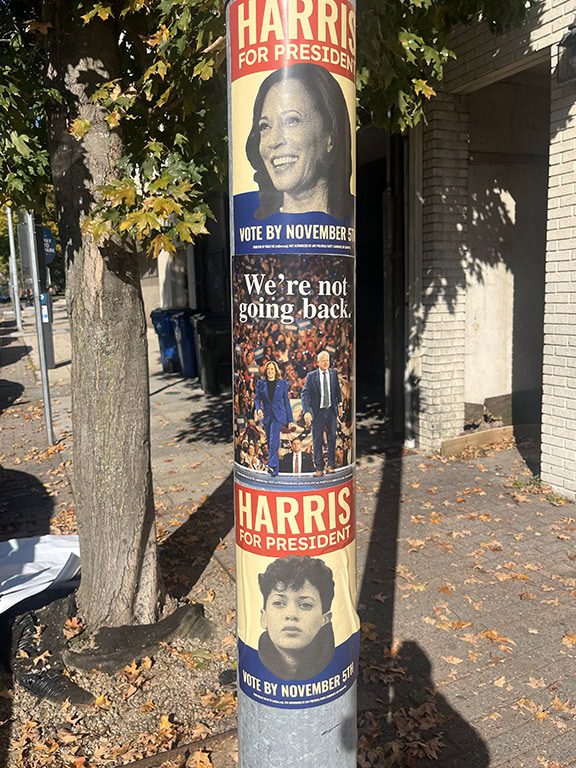
Snipe Advertising is a repetition format. It does not work because one sheet is persuasive. It works because someone sees the same small sheet eleven times between their car and their table, and by the eighth one the name has lodged.
That mechanic needs a corridor. A continuous run of surface, in a line, along a route people actually travel on foot.
Oklahoma City does not have one.
This is the thing I end up explaining on nearly every call about this market. The city is built as a set of small, separately branded districts with real driving distance between them. There is no long walking spine threading them together. The repetition that snipe depends on has to be manufactured inside a district rather than strung along a route, and the surfaces it rides on here are almost entirely private.
So the format has to be rebuilt for this city. Not scaled down, rebuilt. Different surfaces, different sheet count, different sequencing, different conversation about permission.
Below is how we actually do it, what we have changed about our method for Oklahoma wind, and the scope we decline outright in this market.
The format assumes a corridor, and this city is built out of islands
Work out where snipe normally lives and the Oklahoma City problem becomes obvious.
In most markets, snipe rides linear public infrastructure. Poles down a commercial street. Signposts at every intersection. Barricades and temporary fence along a construction run. The format is fast to produce and quick to apply precisely because that linear furniture already exists in a continuous line, and the audience walks the line.
Oklahoma City breaks that in two ways at once.
First, public infrastructure here should be treated as closed. Utility poles, signposts and city furniture are not a surface we will plan onto, and I do not know a reading of this market that makes it a defensible plan. That removes the default snipe substrate entirely.
Second, the walking spine does not exist. The Paseo Arts District is about two blocks of curving street along Paseo Drive between NW 28th and NW 30th. The Plaza District is a short, tight commercial strip. Automobile Alley runs along Broadway Avenue north of downtown. The Asian District sits on Classen Boulevard between NW 23rd and NW 30th. Uptown 23rd runs along NW 23rd Street. Each is genuinely small, and no two of them connect on foot.
From the Paseo it is roughly ten minutes by car to Bricktown, about five to the Plaza District, around four to Uptown 23rd. Those are short drives. They are not walks, and nobody treats them as walks.
So the repetition has to happen inside one district, across its length, in the space of a few hundred yards. That is achievable, and it is a completely different plan from the one most briefs arrive with. It means higher density per block and fewer blocks. It means the sequence has to be designed, because a viewer walking the Plaza strip will pass your full set in about four minutes and will either feel a rhythm or feel nothing.
And it means picking districts where the walking actually happens. Bricktown around the canal, the Plaza District, the Paseo, Uptown 23rd, Automobile Alley and the Asian District restaurant run all have real pedestrian life. Plenty of the rest of the city does not, and a snipe run in a place where people arrive by car and walk fifteen feet is money spent on nobody.
Where snipe has an honest surface in Oklahoma City
Strip out public furniture and the inventory that remains is still real. It is just private.
Construction hoarding is the best of it. Oklahoma City has run sustained public and private redevelopment through the downtown core, and hoarding is the single cleanest route to a repeating linear surface in this city. It is continuous, it is at eye level, it is designed to be temporary, and it is controlled by named contractors who can actually give permission. When a client wants genuine snipe cadence here, hoarding is usually the answer, and the availability of it is the thing we check first before we promise anything.
Scaffolding runs behave similarly, with the added constraint that the fabric or board you are applying to may come down on a schedule that has nothing to do with your campaign.
Private perimeter is the next tier. Side walls, service elevations, rear frontage facing a parking area, and the long blank stretches between storefronts. In districts built out of restored early-twentieth-century commercial stock, like Automobile Alley and Midtown, those blank side elevations are often the most useful surface on the block, because the street frontage is too precious to the owner and the side wall is not.
Window frontage is available in the small-business strips. Uptown 23rd, the Asian District and Western Avenue are lines of individually owned businesses, and a window is a surface an owner can say yes to in thirty seconds without consulting anyone. In my experience that is the most straightforward yes in Oklahoma City, and it is badly underused.
Interior-adjacent surfaces at venues in Bricktown exist but run through the venue operator, which is a slower conversation for reasons I will get to.
What I will not do is pretend the city has more linear surface than it has. If hoarding is thin in a given quarter and the campaign needs a long repeating run, the honest answer is that this is not the quarter for a big snipe programme here, and we should look at format instead of forcing it.
Small sheets, big wind, and why edges decide everything
Snipe stock is small, and people assume small means safe in wind. The opposite is true, and this is the material detail I would most want an Oklahoma City buyer to understand.
Wind damage is an edge problem, not an area problem. A small sheet has far more edge relative to its area than a large one. That means proportionally more opportunity for the wind to find a lift point, and a small sheet that starts lifting has very little adhered area left to hold it once a corner goes.
Oklahoma City has consistent wind, generally out of the south or south-southeast through the warm months. Consistent is the operative word. This is sustained load, not occasional gusts, and it works at a lifted corner continuously for days rather than hitting it once.
So the method we use here is edge-first. Full contact across the whole sheet, perimeter sealed deliberately, then a second pass over the perimeter before the crew leaves the block. On hoarding, which is usually a smooth board surface rather than porous brick, the surface preparation matters more than the paste formula. A dusty or chalky hoarding panel will take paste and release it two days later with the sheet still intact and the bond failed at the substrate. We wipe down before we apply, every time, and crews new to this market find that fussy until they see a week-old run that was not wiped.
The other sheet-size factor is orientation. On an exposed elevation we favour placements where the prevailing southerly flow hits the sheet face-on rather than raking across it. Face-on pressure pushes a well-adhered sheet into the wall. A raking flow across an edge peels it.
Then the seasonal layer. Spring, roughly March into June, is severe weather season in Oklahoma, bringing squall lines, organised convective systems and supercells capable of very large hail. Hail does not care how well you sealed the perimeter. It perforates. A run of small sheets after a severe storm looks worse than a run of large ones, because you get a repeating line of damaged units and the repetition that was working for you now works against you. Spring programmes here get spare stock printed and held in the city, and alternate dates built in from the start.
Summer brings humidity commonly in the seventy to eighty percent range alongside hard sun, which slows cure while baking the surface. Summer snipe goes up overnight or at first light, not in the afternoon. Winter brings ice more than deep snow, and freeze-thaw on a wetted surface lifts edges from underneath. UV load through the long Southern Plains summer fades untreated stock quickly on south and west elevations, so anything that needs to read cleanly in week four needs UV-stable ink specified at print.
The permission ladder, district by district
Permission in this market is not one process. It is five or six different conversations, and knowing which one you are in saves weeks.
The frame first. Whether a given placement is acceptable depends on who owns the surface, what the local ordinance says, what the owner agrees to and how enforcement happens to be running. It varies by municipality and it varies inside this city by district. It is a grey area, nobody honest will hand you a clean answer, and we do not give advice on it. What we do is lower exposure: permission from the property owner, private surfaces only, photographs of every placement at install, a written record of who granted what, and removal that actually happens.
Enforcement character here reads as complaint-driven rather than patrol-driven. That matters enormously for a format built on repetition, because a repeating run has a repeating chance of generating the one complaint that ends it. The practical defence is that every unit in the run is on a surface someone agreed to, which turns a complaint into a short phone call.
The ladder, roughly easiest to hardest:
Small-business strips first. Uptown 23rd, the Asian District along Classen, and Western Avenue are individually owned businesses. You are talking to the person who owns the decision. Bring a sample, be straight about duration and removal, and you often have an answer the same day.
Arts districts second. The Plaza District and the Paseo are the most culturally receptive surfaces in the city, with organised district associations, established mural culture and owners who understand why a campaign wants their wall. Go through the association first and the individual gallery, venue or shop owner second. Arts-aligned content is genuinely welcome there. Purely commercial content is a harder sell, and it should be put plainly rather than dressed up, because these are small districts where the same people talk to each other.
Restored historic stock third. Automobile Alley and Midtown have landlords with visible money in their buildings and an active preservation interest. The first question will be about reversibility of method. If you cannot describe removal credibly, the conversation ends there.
Contractors fourth. Hoarding permission runs through the named contractor, which is a different kind of conversation to a shop owner and tends to be more procedural than cultural.
Bricktown last. It has the best audience in the city and the tightest control. Concentrated ownership and managed district operation mean you negotiate with venue operators and property owners rather than working the street. It is slow. That is exactly why the surfaces there stay clean, and why a placement you do win there holds its value.
One structural point about this city. With this many formally branded districts, the district association functions as the practical gatekeeper even where it holds no formal role. Build that relationship once, properly, and it serves every campaign you run here afterwards. Burn it with one run that went up without asking and you have closed a district to yourself.
Timing a repetition run against the local calendar
Snipe rewards being in place before a crowd arrives, not during. The sheets need a few days of ordinary foot traffic to start registering before the event week does the heavy lifting.
Late April brings the Oklahoma City Memorial Marathon through the central city, closing streets across the core. It is an audience peak and an access problem on the same day, which for a format that needs to be installed in advance is actually fine. Get up the week before.
June brings deadCenter Film Festival in and around downtown, the state's largest festival and an Oscar-qualifying one. That audience is concentrated, culturally engaged and walking, which is close to ideal for this format. Film Row and the downtown blocks are the weighting.
September brings the Oklahoma State Fair at the fairgrounds, the biggest sustained crowd event of the year.
The NBA season runs autumn through spring downtown, and playoff runs change Bricktown and downtown evening traffic completely, with hotels along the downtown corridor booking out weeks ahead.
The underused one is the equine calendar. Oklahoma City hosts more national and international equine championships than any other city, producing repeated multi-day influxes at the fairgrounds that never appear on a standard event list. For a regional audience, those weeks are real.
Seasonally, early autumn, September into October, is the best window in this city: settled weather, comfortable walking conditions and a full calendar at once. Spring is beautiful outdoors and carries severe weather risk. Mid-summer afternoons are hostile to pedestrian dwell, which for a walking-repetition format is close to disqualifying, so summer runs are evening-weighted or they are not worth doing.
Running the route: crew, parking, sequence
A snipe night here is usually a two to three person crew, which is smaller than a poster night because sheet handling is one-person work.
Parking is the quiet advantage of this market. Outside Bricktown and event days, surface parking and kerb space are widely available, which removes the single biggest time sink that eats crews in denser cities. You park once per district and work on foot from there.
Night windows are wide. Most districts outside Bricktown quiet down well before midnight, so a mid-evening to early-morning window gives clean working conditions with little friction. Traffic is commuter-pattern on the interstates and highways ringing the core rather than inside the districts, so the short hops between districts move fast at night.
Bricktown is the exception on every count. On game nights, festival weekends and summer evenings it fills, parking tightens and the canal-side pedestrian crush makes working space poor. We work it midweek or early evening.
Sequence is the part that is specific to this format and this city. Because each district is small, the crew is not racing distance, they are placing a rhythm. We walk the strip first with no stock, mark the sequence, then install in order. That sounds slow and it is the difference between a run that reads as a campaign and a run that reads as litter. In a two-block district you have maybe fifteen good sightlines and you need them spaced, not clustered at the easy end of the street.
Wind is a crew factor too. Handling sheets in sustained Oklahoma wind is slower, and a crew fighting the material is a crew not sealing edges. We check wind forecasts the way crews elsewhere check rain, and the calm early-morning hours are frequently the best working window of the entire day, which pushes our Oklahoma City nights later than clients expect.
What we decline in this market
Public furniture placements. Briefs arrive with pole and signpost placements drawn in because that is what worked in another city. We move that scope to private frontage or hoarding, or we change format. We will not run it.
A long thin line across multiple districts. It is the instinct every time, and it is wrong here. A sequence spread across five districts is invisible in all five, because the repetition never completes for any one viewer. Pick two districts and go deep enough that someone walking the strip passes your set repeatedly.
Snipe in the car-dependent stretches. If people arrive by car and walk fifteen feet to a door, repetition has nowhere to happen. This format needs the walking districts, and there are a limited number of them here.
Big spring programmes with no contingency. March into June, we want spare stock in the city and alternate dates agreed before anything goes up.
Where a client genuinely needs reach across the whole metro rather than depth in a walking district, snipe is the wrong tool and I say so. In a drive-between city like this one, LED Trucks and Mobile Billboards cover the distance that snipe cannot, and the two work well together: depth inside the Plaza District or Bricktown on foot, and reach along the highway and arterial pattern on wheels.
Frequently asked questions
Why can’t we just run snipes along a main street here?
Because the linear public furniture that format normally uses should be treated as closed in this market, and because Oklahoma City has no continuous walking spine between districts. The repetition has to be built inside one compact district instead, using private frontage, side elevations and construction hoarding, which changes both the surface plan and the sequencing.
How many sheets does a district actually need?
Enough that a person walking the strip passes your set several times in a few minutes. In a two-block district like the Paseo that is a surprisingly small number placed well, and a large number placed badly still fails. We walk the strip and mark sightlines before any stock goes up, because spacing matters more than count here.
Is snipe advertising allowed in Oklahoma City?
It is a grey area that depends on surface ownership, local ordinance and how enforcement is running at the time, and we do not give advice on it. Our approach is to work only on private surfaces with property-owner permission, document every placement with photographs and records, and carry out removal. That is what keeps exposure low.
Does the wind really affect small sheets that much?
Yes, and more than large ones proportionally. A small sheet has far more edge relative to its area, so there are more places for sustained southerly wind to find a lift point, and less adhered area left once a corner goes. We seal perimeters deliberately and re-pass them before leaving the block.
Which districts should a first campaign choose?
If the content is arts-aligned, the Plaza District or the Paseo, because both are receptive and have real mural culture. If it is straight commercial, the small-business strips along NW 23rd, Classen or Western Avenue tend to give the fastest permission. Bricktown has the biggest audience and the slowest, tightest approval process.
When should we avoid running here?
Mid-summer afternoons, because pedestrian dwell collapses in the heat and humidity and this format depends on people walking. Spring from March into June is workable but needs replacement stock and alternate dates because of severe weather and hail. Early autumn is the strongest window, with settled weather and a full event calendar together.
Request a campaign quote
Tell us which districts matter, what the content is, and whether your dates are fixed. We will tell you what surface is actually available in this city right now, which districts are likely to say yes to your specific content, and whether snipe is the right format for what you are trying to do here or whether something else covers the distance better.
Request a campaign quote and we will come back with a district plan, a surface approach and an honest view of what the season will do to it.

Ready to Run Your Campaign?
Call us or email us. We’ll tell you exactly what we can do in your market and what it costs.
Related Service
Explore similar advertising solutions offered by American Guerrilla Marketing.
American Guerrilla Marketing — Los Angeles
Street-level campaigns in Los Angeles and nationwide. Wheatpasting, LED trucks, street teams, and more.
(646) 776-2770
Related Articles
-
Snipe Advertising for Richmond Brands
November 12, 2026
-
Snipe Advertising for Seattle Brands
November 11, 2026
-
Snipe Advertising for Virginia Beach Brands
November 11, 2026
-
Snipe Advertising for Albany Brands
November 10, 2026
-
Snipe Advertising for Milwaukee Brands
November 10, 2026