
November 10, 2026
Snipe Advertising for Albany Brands
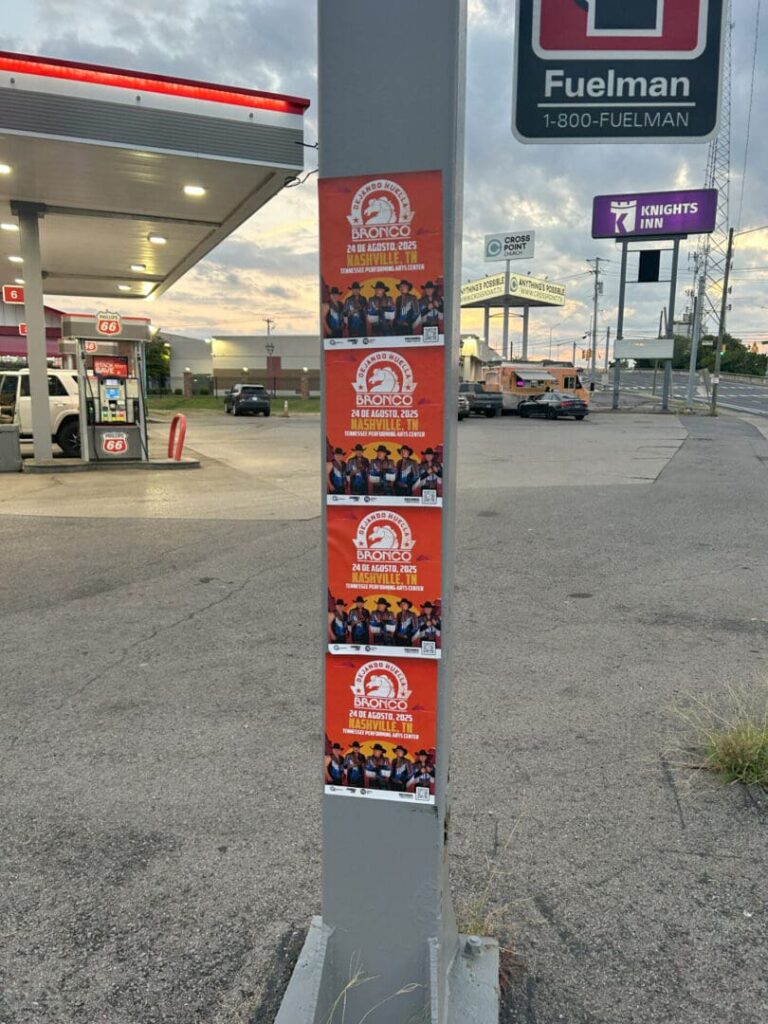
Snipe Advertising gets bought for the wrong reason in Albany more often than any other format we run here.
A client wants street-level presence in January. Someone tells them paste will not hold in an Albany winter, which is true. So they ask for snipes instead, picturing small signs on poles up and down Lark Street and Central Avenue, and they assume the problem is solved.
It is half solved. The material question is solved. The surface question is not.
Snipes are mechanically attached rather than pasted. That single difference is why they can run in months when a wheatpaste campaign cannot. But the classic snipe surface, the utility or signal pole, is close to the worst piece of real estate in this city once the ploughs start running.
So the useful version of this conversation is narrower than it sounds. Snipes are the right call in Albany for a specific set of months, on a specific set of surfaces, with permission handled in a specific way. Get those three right and this is the most durable street format available here in the cold half of the year. Get them wrong and you are paying a crew to install signs that a plough, a salt truck or a business improvement district will remove inside a week.
Here is how I plan snipe work in Albany.
Snipes survive an Albany winter in a way paste does not
Albany sits in a humid continental climate with very large seasonal swings, running from roughly 17°F in winter to around 83°F at the summer peak. The city averages about 56 inches of snow and about 42 inches of total precipitation a year. Snow generally starts in November and can persist into April.
Wheat paste needs to cure, and below roughly 40°F that process stalls. Worse, Albany’s repeated freeze-thaw cycling from November through April drives water into the bond layer and into masonry pores, where it freezes, expands and breaks the adhesion from behind. Pasted sheets come off in whole panels.
A snipe has no bond to break. It is fixed with hardware to a substrate, and it is printed on stock chosen to survive weather rather than to take paste. Vinyl and substrate-backed media outlast paper by a wide margin through the winter half of the year in this city.
That makes snipe advertising the honest answer for Albany campaigns landing between November and April, which in practice is a lot of them. This is a state capital. A great deal of the city’s commercial and civic activity is concentrated in exactly those months, for reasons I will come back to.
Two climate details still shape the work.
The salt band is real and it is measurable. Road salt is in constant use through a 56-inch snow season. Salt spray and slush splash climb the bottom 18 to 30 inches of any vertical surface along a ploughed street. A snipe mounted inside that band gets abraded, stained and undermined at the fixings regardless of substrate quality. We mount above the splash line wherever the surface allows. Where a sign has to sit low, we treat the bottom edge as sacrificial and keep the message out of it.
UV load here is moderate, not extreme. Albany is a northern inland city with a partly cloudy regime year-round, so pigment fade is a slow failure mode compared with moisture, ice and mechanical damage. Colours hold. Fixings and edges fail first. That is where the inspection effort goes on a refresh pass.
The pole problem in a 56-inch snow city
This is the part most buyers do not want to hear, and it is the single most valuable thing on this page.
Utility and signal poles are the highest-friction, lowest-durability snipe surface in Albany. Two separate forces work against them.
The first is weather and street operations. A 56-inch snow season means ploughs running repeatedly along kerb lines, throwing slush and salt, and building berms against the base of every pole on the route. Anything mounted in the lower band of a pole on a ploughed street takes that abuse directly. Material gets destroyed quickly here whether or not a single person objects to it.
The second is attention. Poles and street furniture are the most visible unsanctioned surfaces in any city, and Albany has a watchful street culture, which I will cover in the permission section. Pole material on a managed corridor has a short life expectancy.
Put those together and pole saturation is a poor way to spend an Albany campaign. The signs that survive the ploughs tend to get removed, and the ones that avoid attention tend to get wrecked by the ploughs.
I am not saying poles never work. On the outer, less-managed stretches of a commercial corridor, mounted high, on winter-rated substrate, they have a role. But a plan that is mostly poles is a plan that is mostly refresh cost, and we will tell a client that before they book it rather than after.
Where snipes actually earn their place in Albany
The good ground here is private, and it is more available than people expect.
Construction hoarding is the strongest snipe surface in Albany. It is usually plywood, which takes mechanical fixing extremely well. It is temporary, so the owner’s tolerance for promotional material is higher than on a finished building. It is often set under a deck or overhang that keeps snow and salt off the face. And critically, hoarding follows the contractor and the permit holder rather than the city, so there is a specific person whose sign-off genuinely settles the question. We identify the general contractor on the site board and start there.
Central Avenue is the long commercial spine running northwest out of downtown, with high-frequency transit and dense small retail. It is a different audience from Lark Street’s walkers, more commuting and shopping than strolling, and it is car-oriented. That has two consequences for snipe creative. Copy has to work at a glance and at a distance, not at reading range. And the density of small independent businesses along it means there are a lot of individual owners who can say yes to a sign on their own frontage.
The Warehouse District, north of downtown, carries much of the city’s later-night and DJ-driven activity. For a crew it is the friendliest zone in Albany: lower density, industrial in character, commercial building stock, approachable owners, and far easier vehicle access than the hill. If a campaign is chasing a nightlife or music audience in the cold months, this is the first place I look.
Lark Street is the primary arts and entertainment corridor, running one block east of Washington Park and threading Center Square, Hudson/Park, Park South, Sheridan Hollow and Arbor Hill. It is a historic commercial street of independently owned shops, coffee houses, restaurants and galleries, managed by the Lark Street Business Improvement District, which reports over 80 businesses along it. Lark carries the best arts and nightlife audience in Albany. It is also the corridor where unsanctioned pole material disappears fastest. Snipes work on Lark when they are on merchant frontage with that merchant’s agreement, and poorly otherwise.
The venue anchors shape timing rather than placement. The Palace Theatre books national acts, Lark Hall programmes jazz through electronic, and The Hollow Bar + Kitchen runs indie, hip-hop and Americana. Those three produce repeatable foot traffic on show nights, and a music-adjacent snipe campaign should be timed against their calendars.
One piece of ground we leave alone: the government core. Downtown Albany is thick with state buildings, plazas and institutional frontage. That is the least forgiving surface in the city and the least worth testing. We reach the weekday state workforce on the commercial blocks they walk to at lunch instead.
Permission here is a surface-ownership question
Snipe advertising sits in a grey area in Albany, as it does in most American cities. I am not going to tell you it is legal, and I am not going to tell you it is illegal. What is permitted depends on who owns the surface, what the local ordinance says and how it is enforced in practice, and enforcement is inconsistent by nature. Verify current requirements with the City of Albany directly, and with the relevant business improvement district, before a campaign runs.
What I can describe is the character of this market, because that is what actually determines outcomes.
Albany has an unusually organised civic street culture for a city its size. Lark Street is BID-managed, which means the streetscape is watched by people with both an interest in it and a direct line to the city. That cuts both ways. Unsanctioned material on poles and street furniture there gets noticed and removed quickly. But permissioned placement is genuinely achievable, because there is an identifiable body to talk to and a merchant base that benefits from arts and event promotion. On Lark, the BID is the first call, not the obstacle.
Neighbourhood associations also carry real weight. Local discussion of how Albany’s nightlife migrated from Lark Street toward the Warehouse District credits the Center Square Neighborhood Association and the Lark Street BID with influencing that shift. A city where residents’ associations can move the nightlife map is a city where residents’ associations can get your signs taken down. In the residential-adjacent blocks of Center Square, Hudson/Park and Park South, neighbourhood sentiment operates long before any municipal process does.
So our posture is built around surface ownership rather than municipal tolerance. Written owner or tenant permission on a commercial building, or contractor sign-off on hoarding, moves the question onto property rights, which is far more solid ground. We document every placement and we hold removal commitments, so the signs come down when the run ends rather than becoming someone else’s litter.
Posture matters too. A daytime, uniformed, clearly-scheduled crew that reads as contractors draws far fewer questions than furtive late-night activity. In a compact downtown where the same people walk the same blocks daily, looking routine is the cheapest cover available. The normal outcome of an unsanctioned placement here is removal rather than escalation, so plan for refresh, not conflict.
Crew logistics in a capital city built on a hill
Albany is a small, genuinely walkable core wrapped in a car-dependent metro, and it is built on a slope rising west from the Hudson.
Lark Street and Center Square sit up on the hill. The Warehouse District and riverfront sit low. For a snipe crew carrying substrate, ladders and hardware, that elevation change is a real cost. The efficient pattern is park once, work the core on foot, then drive the corridors. Downtown plus Center Square plus Lark can be covered on foot in a single shift by a small crew. Outer Central Avenue, the university area and the surrounding Capital Region towns need a vehicle.
A snipe run is usually a two person crew. Mechanical fixing is faster per unit than pasting and does not need water, buckets or dwell time, which is exactly why it suits cold-weather work. The constraint is access and height rather than cure time.
Parking is the quiet problem. The government core is dominated by state employee and institutional parking, heavily used on legislative-session weekdays and close to impossible for a working vehicle mid-morning. In the evening and at weekends it empties out. Lark Street is the opposite case: a narrow historic commercial street with residential blocks immediately behind it, where kerbside space is contested and residents notice an idling van. We stage off-corridor and walk in.
On timing, the best all-round window in Albany is early morning on a weekday. Before the state workforce arrives, after the bars have cleared, with daylight coming up for quality control. Late-night work on Lark specifically is a liability given the residential adjacency and active neighbourhood associations. The Warehouse District and Central Avenue tolerate later activity far better.
Winter adds a logistics tax beyond materials. Plough berms, blocked kerbs and narrowed sidewalks on the hill streets slow a crew down, and ladder work on a kerb line with a berm behind you is not something I will put a crew on. We build snow days into any November to April schedule.
Timing snipes to Albany’s calendar
Albany’s year has sharp, plannable peaks, and snipe advertising covers the parts of it that paste cannot.
Legislative season is the big one, and it is the reason snipes matter here more than in a comparable city. As the state capital, Albany’s downtown weekday population swells while the New York State Legislature is in session, broadly January into June, and thins markedly afterward. That is a large weekday, business-hours audience concentrated in the government core and nearby restaurant blocks, and it peaks in exactly the months when paper campaigns perform worst. Winter-rated snipes on permissioned commercial frontage are the format that reaches it. Session dates vary year to year, so confirm against the Legislature’s published calendar.
The Albany Chefs’ Food & Wine Festival is a cold-season event that brings a spending audience downtown when street-level paper is weak. Another natural snipe window.
Dr. Martin Luther King Jr. observances anchor the January civic calendar.
The January term start is one of the two highest-leverage student-facing windows in the year. Albany is a substantial student city, with the University at Albany, SUNY in the metro alongside other regional institutions. Late August into early September, covering arrival and orientation, is the other. I have not confirmed exact academic dates, so check the registrar’s published calendar before building a schedule around them.
Tulip Festival in Washington Park, on Mother’s Day weekend in May, is the biggest consolidated-audience weekend of the year, built around Albany’s Dutch heritage. The Washington Park and Lark Street adjacency makes the Lark corridor the most valuable ground in the city in the days before it.
Alive at Five, the recurring summer concert series programmed by the city’s Office of Cultural Affairs, gives a repeating weekday-evening downtown audience through the warm months, which rewards rotating creative rather than one static install.
Note the pattern. The cold-season peaks are the ones snipes own outright. From May through October you have a genuine choice of format, and often a better one.
What goes wrong, and what we push back on
We talk Albany clients out of pole-heavy plans. Covered above, and it is the pushback we give most often in this market. Ploughs and salt destroy low-mounted pole material through a 56-inch snow season, and managed corridors strip what survives. We redirect that budget to hoarding and permissioned frontage.
We talk clients out of treating Lark Street as a volume play. Buyers see a dense walkable arts corridor and want a sign on every pole. In Albany that is the fastest route to a stripped campaign and a burnt relationship with the one organised body that could have given you good placement.
We talk clients out of the government core. The weekday crowd is there, so someone always asks. The answer is no, and the workaround is the surrounding commercial blocks.
We talk clients out of snipes when paste is simply better. This is the honest one. If a campaign runs between May and October, wants large-format impact, and has access to a real wall in the Warehouse District or along Central Avenue, a Wheatpasting & Poster Campaigns run will usually deliver more presence per surface than a set of small signs. Snipes are a durability format and a cold-season format. In the summer window, on a big wall, paste wins. We run both, so we have no reason to sell you the wrong one.
The failure we see most in practice is a campaign installed correctly in late autumn with no refresh pass scheduled. Fixings loosen, edges lift, ploughs clip the low ones, and by February the run looks neglected even though the install was sound. Any Albany winter snipe campaign needs at least one inspection and refresh built into the schedule.
Frequently asked questions
Can snipe advertising run in Albany during winter?
Yes, and that is its main advantage here. Snipes are mechanically fixed rather than pasted, so there is no adhesive bond for freeze-thaw cycling to break. On winter-rated substrate they hold through the November to April months when wheat paste fails. Build in at least one inspection and refresh pass, because fixings and edges loosen over a long snow season.
Why does AGM advise against pole snipes in Albany?
Albany averages around 56 inches of snow, so ploughs and salt trucks work kerb lines constantly, throwing slush into the bottom 18 to 30 inches of every pole. Material there gets abraded and undermined quickly. Poles are also the most visible unsanctioned surface, and managed corridors remove them fast. Hoarding and permissioned frontage last far longer.
Is snipe advertising allowed in Albany?
It is a grey area that depends on surface ownership, local ordinance and inconsistent enforcement. We do not give legal advice. We reduce risk by working private surfaces with written owner or tenant permission, taking contractor sign-off on construction hoarding, documenting placements and committing to removal. Verify current requirements with the City of Albany and the relevant BID.
Which Albany corridors suit snipe campaigns best?
Central Avenue offers dense small retail, transit frequency and many individual owners who can approve their own frontage. The Warehouse District is the easiest zone for vehicle access and suits nightlife audiences. Construction hoarding anywhere in the city is the strongest surface. Lark Street works on merchant frontage with agreement, but not as a pole volume play.
What time of day does an Albany snipe crew work?
Early morning on a weekday is the best all-round window, before the state workforce arrives and after the bars clear, with daylight for quality control. Lark Street should be worked early evening or in daylight because of tight residential adjacency and active neighbourhood associations. The Warehouse District and Central Avenue tolerate later activity comfortably.
When should an Albany brand run snipes rather than posters?
Run snipes from November through April, when freeze-thaw rules out paste, and whenever durability across a long flight matters more than large-format impact. That covers legislative session, the January term start and cold-season downtown events. From May through October, with access to a real wall, a poster campaign usually delivers more presence per surface.
Request a campaign quote
If you are planning snipe work in Albany, start with two questions: which months, and whose surfaces.
Tell me the window you are working toward and the audience you need, whether that is the weekday state workforce during session, the Central Avenue retail and transit crowd, the Warehouse District late-night audience or students at term start. Tell me whether your dates are fixed. If they sit in the warm months and you have wall access, I will probably point you at posters instead.
Scope here is driven by surface count, how spread out your zones are across the hill, how many install nights the run takes, what permissions we secure, how many refresh passes a winter flight needs and how removal is handled at the end.
Request a campaign quote and we will build an Albany plan around surfaces that will still be standing when the run ends.

Ready to Run Your Campaign?
Call us or email us. We’ll tell you exactly what we can do in your market and what it costs.
Related Service
Explore similar advertising solutions offered by American Guerrilla Marketing.
American Guerrilla Marketing — Los Angeles
Street-level campaigns in Los Angeles and nationwide. Wheatpasting, LED trucks, street teams, and more.
(646) 776-2770
Related Articles
-
Snipe Advertising for Seattle Brands
November 11, 2026
-
Snipe Advertising for Virginia Beach Brands
November 11, 2026
-
Snipe Advertising for Milwaukee Brands
November 10, 2026
-
Snipe Advertising for Salt Lake City Brands
November 10, 2026
-
Snipe Advertising for Tacoma Brands
November 6, 2026