
November 11, 2026
Sidewalk Decals & Stencils in Tempe: How It Runs
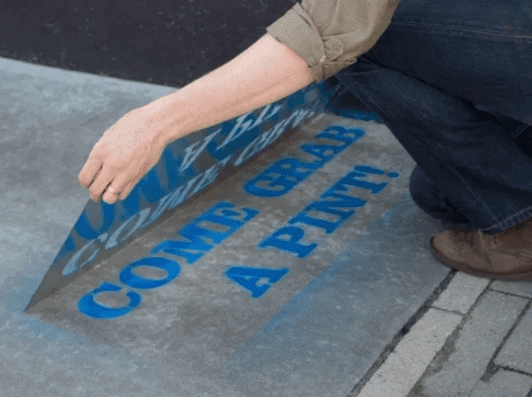
Pavement media is the format people most often misjudge, and Tempe is the market where the misjudgement is most expensive, because the city looks so easy.
Downtown Tempe is dense, young, walkable and linear. Everybody looks at that and assumes the sidewalk is wide open. Then they discover that the concrete runs above air temperature for four months of the year, that desert grit is a release layer sitting on every surface, that a large share of the best walkways belong to a university rather than the city, and that the one street everything hangs off gets physically occupied by a festival for three days at a time.
None of that makes the format wrong here. Pavement graphics work in Tempe better than in almost any other Arizona city, for one simple reason: there are genuinely a lot of people looking down at their feet while walking, and the walking happens in a corridor small enough to cover properly.
But the plan has to respect the surface and the calendar. This page covers where decals and stencils earn their place in Tempe, what the Sonoran climate does to adhesion and to the graphics themselves, how permission works on ground that changes owner without warning, and the things we routinely talk clients out of.
Where pavement media actually lands in Tempe
Tempe is the one Valley city with a genuinely dense, genuinely young, genuinely walkable core, and almost all of it hangs off a single street.
Mill Avenue is the spine. The Mill Avenue District is the city’s nightlife core, packed with bars, clubs and late-night eating, with most venues within walking distance of campus. Downtown Tempe is accurately described as an urban walkable destination combining nightlife, food, cultural arts and events inside one district. For pavement media that combination is close to ideal, because the format only works where people walk, slow down, queue and gather.
Arizona State University sits immediately adjacent, and the relationship matters more here than the adjacency suggests. This is not a campus near a town. The campus and the bar district are continuous, and student movement is the street traffic. The desire lines between lecture halls and Mill Avenue food are the highest-value pavement in the city, and they are also the most jurisdictionally complicated.
Sun Devil Stadium brings the football crowd on autumn Saturdays. ASU Gammage, the Frank Lloyd Wright venue, puts a Broadway audience into the district on performance nights, and that audience arrives in a very different pattern: concentrated, time-bound, converging on one building and then queueing outside it. Queue positions are the best pavement positions that exist, because the viewer is stationary and bored.
Named Mill-area venues include Varsity Tavern, which becomes a sports hub on ASU game days, plus 414 Pub and Monkey Pants, both known for karaoke. Outdoor patios are a defining feature of the district and are used heavily in the cooler months. Patio frontage creates exactly the right pavement condition: a narrowed walking channel, people seated at the edge of it, and a natural pause as pedestrians negotiate past.
Tempe Marketplace is the out-of-core retail destination with free live music. It is car-based and parking-lot-fronted. Pavement media does not work there in the same way, because the approach is a car park rather than a sidewalk, and there is no sustained walking channel to place into.
Tempe Beach Park is the large outdoor event ground used for the biggest festival draws, and it behaves as an event surface rather than a daily one.
The operational read: the targets in Tempe are entry approaches, queue lines, patio-narrowed channels, crossing approaches on Mill, and the pedestrian desire lines running between campus and the bar district. Not open sidewalk. Open sidewalk is where people walk fastest and look up.
Concrete, heat and dust: the surface truth
Pavement media lives or dies on the substrate, and Tempe’s substrate has three specific problems.
Dust is a year-round release layer. This is the single biggest cause of failure in this market and it is entirely preventable. Desert grit settles on every horizontal surface continuously. An adhesive-backed graphic applied to a dusty sidewalk is bonding to the dust, not the concrete, and it will lift at the corners within days. Surface prep in Tempe is not a nicety, it is most of the job. A crew that spends longer cleaning than applying is a crew that is doing it correctly.
Hot substrate defeats adhesive. A sun-loaded sidewalk in July runs far above air temperature. Concrete holds that heat well into the evening, which is the part people miss. Air temperature at nine at night tells you very little about what the slab is doing. We work shaded sections, or we work late enough that the slab has actually released its heat, and we allow the bond time to set before the sun comes round in the morning.
Low humidity gives fast cure and short working time. Helpful for overnight turnaround. Unhelpful for anyone slow with a squeegee. Material has to be laid and worked flat immediately, and a hesitant application leaves trapped air that becomes a lifted edge within a week of foot traffic.
Then there is what the sun does to the graphic once it is down.
Extreme UV is the dominant degradation force. The Valley averages more than three hundred sunny days a year, with summer UV Index readings regularly hitting 11 and reported as high as 12. Trade commentary on vinyl in this market puts Arizona sun at roughly twenty-five percent stronger than in many other major cities and identifies bronzing, progressive laminate breakdown, as a local failure mode. On a horizontal surface the UV load is worse than on a wall, because the pavement takes the sun for most of the day rather than part of it. UV-stable inks and laminates are the baseline specification here, and even then, a decal on an unshaded Mill Avenue sidewalk in June is on a shorter clock than the same decal in a temperate city.
Abrasion is the other half. Pavement graphics are walked on. In a nightlife district they are walked on by crowds, and in summer they are walked on by crowds over hot, grit-covered concrete, which is effectively a sanding operation. Anti-slip laminate is a safety requirement and it also takes the wear. Position matters too: a graphic in the centre of the walking channel wears several times faster than the same graphic set slightly off the main line.
Monsoon season runs roughly mid-June to the end of September, commonly cited as 15 June to 30 September with the thunderstorm peak July through September. It brings haboobs reported up to a hundred miles wide, microbursts, hail and gusts above fifty miles an hour. For pavement media the issue is less wind than water and grit: run-off carries abrasive material across the sidewalk, edges lift, and a storm can undo a week-old install. Edge-sealing matters, and no critical install should be scheduled against a single window in those months.
Stencils behave differently from decals, and in this climate that is sometimes an advantage. Water-based and temporary stencil work has no adhesive bond to fail, so dust and hot slab stop being the deciding variables. The trade-off is that it is far more weather-exposed and short-lived, and in monsoon season it can disappear in one afternoon. We choose between the two based on hold time and surface condition, not on preference.
The seasonal shape is kind. October to April is both the best window for the material and the busiest season on the street. The material year and the audience year coincide in Tempe, which removes the compromise most markets force.
Permission on ground that changes owner mid-block
I will not hand you a verdict on pavement graphics in Tempe. That is a grey area, it varies by municipality, and enforcement is inconsistent. What it actually turns on is who owns the slab, what the local ordinance says about that surface, and whether you have permission in writing.
The City of Tempe runs a formal Code Compliance function and publishes a structured Sign Code through Community Development, broken out for business owners and homeowners, with rules by sign type and permit requirements. Tempe also publishes dedicated handbill guidance through Neighborhood Services and states that the Tempe City Code prohibits the distribution of handbills on a property where the owner has posted a sign refusing them. The consistent pattern across the Valley is that the city gives property owners an enforceable mechanism and publicises it.
The ASU complication is the defining feature of this market. A large share of the most valuable walking surfaces in the core are university property or university-adjacent. A university is not a city. It runs its own posting and placement policies, its own approved board and kiosk systems, and its own facilities enforcement, and the two regimes do not align. Anything on or near campus has to be cleared with the university, not the city.
For pavement specifically this is worse than for wall media, because the boundary runs through the walking surface itself. On Mill Avenue the jurisdictional line is not visually obvious. There is no fence, no change in paving, nothing a crew notices at two in the morning. We photograph the boundary and put the photographs on the run sheet, because a picture of a specific kerb or doorway is the only brief that survives a dark street.
The second factor is the Downtown Tempe district organisation, which programmes and manages the street. An organised business improvement presence means the corridor has an owner’s eye on it continuously, so anything unsanctioned is spotted quickly. It also means there is a body to negotiate with about sanctioned positions inside the district’s own event programming, which is often the cleanest route to the best pavement in the city.
Practical read. Tempe’s realistic pavement inventory is privately owned forecourt and entry approach with written owner consent, venue frontage under partnership with the Mill Avenue bars, developer hoarding and site frontage in the downtown build-out, and sanctioned positions inside district events. The public right of way is not inventory we treat as available. Campus walkways require the university’s own permission and are never assumed.
How we reduce risk. Written owner permission before anything is applied. Private surfaces preferred. Photographic documentation of every position at install, which doubles as client proof of delivery. Anti-slip laminate as standard, because the first question any property owner asks about pavement graphics is whether someone will slip on them. And a removal commitment with a date, carried out by us.
That last point carries more weight for pavement than for any other format. A decal left to degrade on a sidewalk becomes litter attached to someone else’s property, and in a compact district where the same owners control most of the usable frontage, that is how a crew loses access to a whole street. Removal is the reason we get invited back.
Timing against the academic calendar
Tempe’s year runs on the ASU calendar first and the festival calendar second, which makes it unusually predictable to plan against.
ASU Welcome Week and move-in, mid to late August, followed by Sun Devil Welcome events at the stadium and fall classes beginning in late August. The downtown population changes character in a single week. For pavement media this is the best moment of the year, because a brand-new cohort is walking unfamiliar routes and looking down at where they are going far more than returning students do.
ASU football season fills autumn Saturdays at Sun Devil Stadium. Published downtown event planning has anticipated crowds in the region of forty thousand for a home game, and game days turn Mill Avenue bars into sports venues. Game-day pavement is high value and high wear, and anything placed for a game day should be considered consumed by the end of it.
Kiwanis Fourth of July at Tempe Beach Park runs roughly four to eleven, with downtown event planning anticipating attendance around fifty thousand. It is a rare summer mass gathering in a city that otherwise empties in the heat.
Tempe Festival of the Arts, one of the longest-running festivals in the Southwest, runs in multiple editions. The spring edition is three days with Mill Avenue filled with hundreds of artists, live entertainment and food. The street is the venue, and for pavement media that is a problem rather than an opportunity: every stall sits on the exact surface you would have placed into.
2nd Sundays on Mill is a monthly pedestrian-friendly market downtown, dependable recurring footfall at a manageable scale.
ASU Gammage Broadway season brings an older, regional, ticket-buying audience into downtown on performance nights, arriving and queueing in a tight window.
Cactus League Spring Training runs February into March across the Valley.
Winter break, spring break and the summer recess hollow out the core. A student-facing campaign landing in late December or mid-July is pointed at an empty sidewalk.
Crew logistics for pavement work here
The core is small, dense and genuinely workable on foot, a real exception in Arizona. Mill Avenue and the blocks either side can be covered in a single pass, and because pavement positions cluster around entries and crossings, a complete run is compact and easy to verify.
Mill Avenue is a linear route, which makes briefing, sequencing and checking straightforward. One street, consistent frontage, repeatable.
Night windows are constrained by the bar trade rather than by emptiness. Mill runs late and crowded on weekend nights and game-day evenings. Weeknights and the small hours after the bars clear are the practical windows, and in a student district those hours are chaotic rather than silent. Pavement work needs a clear surface and a few minutes of nobody walking across it, which is harder to get here than the quiet hours suggest.
Two people is the working shape, one applying and one prepping and managing the pedestrian flow around the position. On a busy frontage the second person spends most of their time keeping a metre of sidewalk clear long enough for the bond to take. A third person helps on larger runs as spotter and documenter.
Summer work must be nocturnal, for crew safety and because the slab needs to have cooled.
Monsoon discipline: mid-June to end of September, assume any afternoon can bring dust, fifty mile an hour gusts and hail. Never schedule a critical install against one window.
Game days and festivals close the street. Stadium game days flood parking and traffic across downtown. The Festival of the Arts physically occupies Mill Avenue for three days. Install ahead of these, not into them.
Parking is the Valley trade-off in reverse. Downtown Tempe is dense enough that kerbside access is genuinely competitive, particularly in the evening. Stage the vehicle once and work out from it on foot.
What we talk Tempe clients out of
Placing on campus walkways by assumption. The highest-footfall pavement in the city is university ground and it needs the university’s own permission. We work the private approaches and venue frontage that catch the same people a minute earlier or later.
Mid-summer daytime installs. The slab is too hot to bond, the street is empty, and the crew is working in conditions that are not reasonable. If the dates cannot move, we go nocturnal and accept a shorter hold.
Running during the Festival of the Arts. Mill Avenue is full of people and also full of stalls standing on every surface you would have used. Run the fortnight before instead.
Open-sidewalk placement for reach. Clients want the graphic in the middle of the widest, busiest stretch. That is where people walk fastest, look up, and wear the material out quickest. Entries, queues, patio pinch points and crossing approaches do more work with fewer units.
Dense creative. Someone glancing down mid-stride has about a second and a half, often at an angle, often in a group. One idea, large, high contrast, and designed to read from the direction of approach rather than from directly above.
Pavement media alone when the goal needs a conversation. If the brief is sign-ups, sampling or app downloads against a student audience, decals build recognition but do not close. Pairing a pavement run with a Street Teams & Experiential activation on a weeknight evening, working out from a staged position on Mill, converts at a rate the graphics alone will not reach. In a district this compact, a two-person team can reach a large share of the audience in a single evening.
What goes wrong
Prep skipped. Dust under the adhesive, lifting corners within days, and the material gets blamed instead of the process. This is the number one failure in Tempe and it is entirely avoidable.
Hot slab. An install that went down at nine in the evening in July onto concrete still holding the afternoon’s heat. It looks fine at midnight and it is peeling by the weekend.
Jurisdiction confusion. Material placed in good faith on university ground, removed quickly, and a gap appears in the verification set with no obvious explanation.
Wear underestimated. A graphic placed in the centre of a nightlife walking channel during football season is taking a beating no temperate-climate reference point prepares you for. Plan the refresh, or place slightly off the main line.
Frequently asked questions
Will decals stick to Tempe sidewalks in summer?
Not reliably in daytime. A sun-loaded slab runs far above air temperature and holds that heat into the evening, which prevents the bond forming properly. Between June and September we work overnight, on cooled or shaded sections, and allow setting time before the sun comes round. Dust removal matters as much as temperature.
Can you place graphics on ASU walkways?
Not on assumption. The university runs its own placement policies and facilities enforcement, separate from the city, and the boundary is not visually obvious on Mill Avenue. Campus surfaces need the university’s own permission. We work the private entries, forecourts and venue frontage around campus, which reach the same people walking the same routes.
How long does a pavement graphic last in Tempe?
It depends on shade and foot traffic more than anything else. Horizontal surfaces take a heavier UV load than walls, and summer UV Index readings here regularly hit 11, so unshaded positions degrade faster. Abrasion from crowds in the nightlife core does the rest. Off-channel and shaded positions hold considerably longer than centre-of-sidewalk placements.
Are stencils a better option than decals here?
Sometimes. Water-based temporary stencil work has no adhesive bond to fail, so hot slab and dust stop being the deciding factors. The trade-off is a much shorter life and higher weather exposure, especially during monsoon months. We choose between the two based on the hold time you need and the condition of the actual surface.
Is this permitted in Tempe?
It is a grey area that depends on who owns the surface. Tempe publishes a structured sign code and handbill guidance, and property owners have an enforceable mechanism to refuse material. Our approach is permission-based: written owner consent on private surfaces, anti-slip laminate as standard, photographic documentation at install, and removal by us on an agreed date.
When is the best time of year to run?
October through April, with ASU move-in and the start of fall classes in late August as a standout moment because a new cohort is walking unfamiliar routes. Avoid winter break, spring break and the summer recess for student-facing work, and avoid the three days the Festival of the Arts occupies Mill Avenue with stalls.
Request a campaign quote
The useful information to bring to a first conversation about Tempe pavement work is your window, your audience and your required hold time. A game-day activation and an eight-week awareness run are different specifications on the same sidewalk.
We will tell you which surfaces we can get written permission for, which ones are university ground, and whether the timing you have in mind points at a busy street or an empty one.
Request a campaign quote with your dates, your target audience and whether downtown Tempe alone is in scope or you want the wider Valley included.

Ready to Run Your Campaign?
Call us or email us. We’ll tell you exactly what we can do in your market and what it costs.
Related Services
Explore similar advertising solutions offered by American Guerrilla Marketing.
American Guerrilla Marketing — Los Angeles
Street-level campaigns in Los Angeles and nationwide. Wheatpasting, LED trucks, street teams, and more.
(646) 776-2770
Related Articles
-
How Sidewalk Decals & Stencils Runs in Newark
November 12, 2026
-
Sidewalk Decals & Stencils in Long Beach
November 12, 2026
-
Sidewalk Decal Permit Requirements: Planning Guide
November 12, 2026
-
How Sidewalk Decals & Stencils Runs in Milwaukee
November 12, 2026
-
Sidewalk Decals & Stencils in Nashville: How It Runs
November 11, 2026