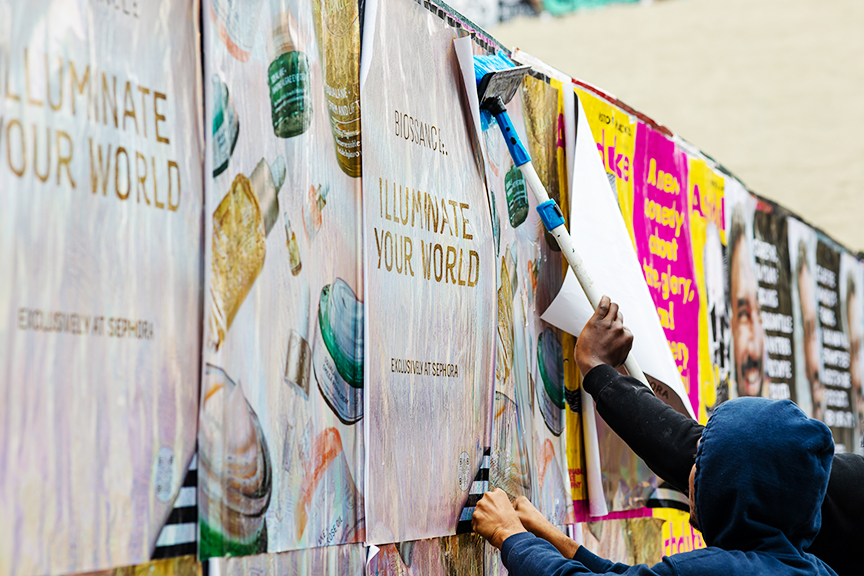
Chicago is the most underrated poster campaign market in the US. Operators who’ve only worked New York and LA consistently underestimate what’s available in the Midwest’s biggest city — the wall inventory, the surface quality, the foot traffic in the right neighborhoods, and the cultural density of communities that engage with poster campaigns and street-level advertising in ways that directly translate to campaign performance.
Chicago’s building stock is one of the best for wheatpaste campaigns of any US city. The city’s architectural character — dense mixed-use corridors of pre-war brick and limestone commercial buildings, large-face industrial warehouses in transitional neighborhoods, and extensive painted concrete in the inner-ring neighborhoods — creates a surface ecosystem that works exceptionally well for large-format poster campaigns. Add in the city’s genuinely distinct neighborhood identities and strong creative-community concentration in specific areas, and you have a market that rewards operators who bother to learn it.
This guide covers Chicago’s primary poster campaign neighborhoods from the ground up — what makes each area work, what to look for during a scout, and what audience profiles each neighborhood delivers.
The Chicago Market: What Makes It Distinctive
A few things about Chicago that affect scouting decisions and campaign strategy:
First, Chicago’s neighborhoods have more distinct identities than those of LA and arguably more than NYC. The difference between Wicker Park and Logan Square is real and specific — demographic differences, cultural differences, foot traffic pattern differences. Audience alignment decisions need to be made at the neighborhood level, not just the city level.
Second, Chicago’s weather makes surface selection decisions more consequential than in warmer markets. A wheatpaste campaign running from October through December in Chicago faces freeze-thaw cycles that degrade adhesion significantly faster than the same campaign in LA. Surface orientation, moisture exposure, and material quality decisions that are relatively forgiving in mild climates become high-stakes in Chicago.
Third, Chicago is a city where the L rail system creates transit-adjacent foot traffic concentrations at stations throughout the city. Proximity to L stops is a meaningful variable in Chicago scouting in a way that doesn’t translate directly to other markets.
Wicker Park and Bucktown: The Established Creative Core
The Milwaukee-Damen-North six corners intersection in Wicker Park is Chicago’s most recognizable street-level advertising hub. The intersection and the blocks radiating from it along Milwaukee Avenue, Damen Avenue, and North Avenue have been the center of Chicago’s independent music, arts, and creative industry community for decades. That community has changed — gentrification has pushed out much of the working-artist population — but the commercial infrastructure remains, and the foot traffic from creative-professional residents and visitors to the neighborhood’s bars, restaurants, boutiques, and venues continues to make this one of Chicago’s strongest poster campaign markets.
Scouting the Wicker Park Corridor
The primary scouting route runs along Milwaukee Avenue from the Division Street intersection north to about Paulina Street. This stretch has a mix of commercial building faces and side walls that range from excellent to marginal. The best surfaces tend to be on the buildings facing side streets off Milwaukee rather than the avenue-facing frontages, which are more often covered by commercial signage and active retail activity.
Damen Avenue between North Avenue and Division Street is a secondary scouting target with strong foot traffic from the neighborhood’s restaurant and shopping corridor. The surface quality on Damen’s building side walls is generally good — consistent painted brick and commercial-grade concrete from mid-century construction.
Bucktown, immediately north of Wicker Park, has a quieter character but overlapping demographics. The Western Avenue corridor and the residential side streets between Western and Damen have lower foot traffic than the Wicker Park core but better campaign longevity due to lower surface competition. For campaigns where frequency with a specific residential audience matters more than raw reach, Bucktown placements can outperform Wicker Park placements on a per-impression basis.
The Milwaukee-Damen-North intersection generates some of the highest pedestrian traffic counts of any non-downtown intersection in Chicago, with weekend foot traffic estimated at 15,000-20,000+ pedestrian passes per day in good weather. Weekday traffic is significantly lower — typically 4,000-7,000 passes depending on time of day.
Logan Square: The Younger Alternative
Logan Square has emerged over the past decade as Chicago’s most pattern creative neighborhood — younger than Wicker Park, with a larger working-artist and musician population that hasn’t been fully displaced by gentrification yet, and with a Latino cultural identity that gives the neighborhood a distinct character that the more homogeneously gentrified Wicker Park has lost.
Why Logan Square Works for Campaigns
For campaigns targeting the 21-32 demographic in Chicago’s arts and music scene, Logan Square often outperforms Wicker Park despite slightly lower aggregate foot traffic. The neighborhood’s audience has stronger engagement with street-level cultural content — they slow down and look at what’s on the walls rather than moving through as functional urban commuters.
The primary scouting corridor runs along Milwaukee Avenue from the Logan Square roundabout (California/Logan/Milwaukee) south to about Kedzie. The blocks immediately surrounding the Logan Square Blue Line stop are the highest foot traffic zone. The side streets north and south of Milwaukee through the core neighborhood have good surface inventory and strong residential foot traffic from repeat-exposure audiences.
Logan Square Surface Notes
Logan Square has a high density of painted building walls that make good wheatpaste surfaces. The neighborhood’s commercial buildings are slightly older on average than Wicker Park’s, with some rougher brick that requires surface assessment before committing. Scout individual surfaces carefully here — the difference between a great surface and a problematic one can be subtle and isn’t always visible from across the street.
Pilsen: The Arts District Standard
Pilsen is Chicago’s most culturally specific neighborhood for poster campaigns targeting Latino communities, arts audiences, and culturally engaged consumers interested in genuine community-level marketing. The neighborhood on the Near South Side has a long history as a center of Mexican-American cultural life in Chicago, with a significant arts community — including numerous working artists and galleries — that has made it one of the most active mural and street art neighborhoods in the Midwest.
Scouting Pilsen
The 18th Street commercial corridor is the neighborhood’s main artery. Scout the full stretch from Halsted to Western, evaluating both the avenue-facing building sides and the side street walls. Pilsen has some of the largest available poster surfaces in Chicago — side walls of two- and three-story commercial buildings that can accommodate very large format campaigns without multi-wall assembly.
The area around the National Museum of Mexican Art at 1852 West 19th Street is a cultural hub with consistent foot traffic from the museum, surrounding galleries, and neighborhood residents. Walls in proximity to this area reach a culturally engaged audience that responds well to thoughtfully executed campaigns.
The side streets between 18th and Cermak in the neighborhood’s interior have residential character with strong repeat-exposure foot traffic. These locations are less visible to outsiders visiting the neighborhood but reach the actual resident community with high frequency.
Bridgeport: Underused, Worth Knowing
Bridgeport, adjacent to Pilsen and anchored by the US Cellular Field (Guaranteed Rate Field) area, is underused by most poster campaign operators and offers specific opportunities for campaigns targeting sports fans, South Side Chicago audiences, and community-level events. The foot traffic patterns here are event-driven rather than organic neighborhood-level — the right campaign at the right time (around game schedules, neighborhood events) can achieve strong results; a campaign running in off-event weeks reaches a smaller, more residential audience.
Weather and Seasonal Scouting in Chicago
Chicago campaigns require more weather-aware scouting than any other major US market. Surface selection decisions that are straightforward in LA or even NYC become complex in Chicago’s climate.
For spring campaigns (March-May), surfaces that accumulated moisture over the winter need to be evaluated after a dry period — paste adhesion on still-wet surfaces fails quickly. Scout after at least 3-5 days of dry weather. For summer campaigns (June-August), south-facing walls in direct sun can cure paste exceptionally well but may fade lighter colors faster than expected. For fall campaigns (September-November), understand that any campaign extending past mid-November faces freeze-thaw risk that will compromise adhesion. For winter campaigns — which can work in Chicago but require specific material and installation approach decisions — surfaces need to be assessed for their freeze-cycle behavior, which requires market-specific knowledge to evaluate accurately.
Transit-Adjacent Scouting in Chicago
Chicago’s L system creates specific scouting opportunities. Stations in high-foot-traffic areas accumulate significant pedestrian volume on the approach blocks — people walking to and from the station on a fixed route multiple times per week. These corridors have high repeat exposure that builds frequency effectively for campaigns targeting the neighborhood’s transit-riding population.
Key L stops worth scouting adjacency in the creative neighborhoods: Damen Blue Line (Wicker Park/Bucktown boundary), Logan Square Blue Line, California Blue Line (Logan Square interior). The approach blocks within 2-3 minutes’ walk of these stations tend to have strong weekday commuter foot traffic that supplements the weekend/evening bar-and-restaurant traffic that dominates most neighborhood scouting assessments.
What Makes Chicago Different to Scout vs. Other Markets
AGM’s scouts have worked Chicago extensively — Wicker Park, Logan Square, Pilsen, Bridgeport, and the transit corridors connecting them. Chicago has specific operational characteristics that distinguish it from NYC and LA in ways that affect how you plan, execute, and budget a Chicago scout.
Weather Is the Dominant Variable
No other major US market has weather variation that affects campaign planning as dramatically as Chicago’s. Winter campaigns (November through March) face genuine installation challenges: paste adhesion requires temperatures above about 40°F, which rules out many winter installation windows, and campaign lifespan is compressed by freeze-thaw cycles that degrade paper faster than in any other US market. Summer campaigns face afternoon thunderstorms that can appear rapidly. Spring and fall are the most reliable campaign windows — May through June and September through October offer the best combination of installation-friendly conditions and campaign lifespan.
During a Chicago scout, document sun orientation more carefully than in LA or NYC. A south or west-facing wall in a Chicago winter gets significantly more sun and stays drier than a north or east-facing wall — which translates directly to longer campaign lifespan in winter months. Wall orientation is a more important selection variable in Chicago than in markets with more moderate climates.
Surface Quality: The Wicker Park Standard
Milwaukee Avenue in Wicker Park between Division Street and North Avenue is Chicago’s benchmark wheatpaste corridor. The surface quality along this stretch is consistently high — painted concrete and brick with decades of campaign activity, well-selected by the neighborhood’s character. AGM’s scouts have documented 40+ confirmed locations in this corridor alone, covering both sides of Milwaukee and the perpendicular blocks toward Damen and Ashland. What we consistently find in the field: the east-facing walls on the west side of Milwaukee Avenue get strong afternoon light and are the best-performing surfaces for campaigns running into evening hours.
Logan Square’s Logan Boulevard has developed significantly as a campaign corridor over the past five years. The surfaces along Logan between Milwaukee Avenue and the Logan Square monument at the boulevard’s east end are now well-established for poster campaign activity, with property owners on the commercial blocks increasingly familiar with campaign requests. The foot traffic at this corridor — anchored by the Logan Square Blue Line station — runs 300-500 pedestrians per hour on weekday commute windows and higher on weekend evenings when the restaurant and bar scene generates significant pedestrian activity.
Neighborhood-by-Neighborhood Wall Quality Summary
Wicker Park (Milwaukee Ave, Division St): Highest wall quality in the market, most established campaign ecosystem. Strong on weekdays and weekends. Best for campaigns targeting 22-38 creative professional demographic.
Logan Square (Logan Blvd, Milwaukee Ave): Strong and growing. Younger demographic than Wicker Park. Better for campaigns targeting 20-32 audience. Surface quality improving as the corridor matures.
Pilsen (18th St, Blue Island, Halsted): Best option for campaigns targeting Latino communities and arts-adjacent audiences. 18th Street’s surface ecosystem is excellent but more seasonally affected by rain than northern neighborhood corridors. Strong community character that responds well to campaigns with genuine cultural alignment.
Bridgeport (Halsted St, 35th-37th blocks): Underused with good surfaces. Lower foot traffic than the primary creative corridors but very low competition. Best for campaigns where clean visual territory matters more than volume.
Chicago campaign surface quality data from AGM field experience: Milwaukee Avenue (Wicker Park, Division to North Ave) — 40+ confirmed locations, highest average wall quality in the market, 400-600 pedestrian/hour peak traffic at Damen station approach. Logan Boulevard (Logan Square) — 20+ confirmed locations, strong and improving surface quality, 300-450 pedestrian/hour peak. 18th Street (Pilsen) — excellent surface quality, 300-400 pedestrian/hour peak, strong cultural character for aligned campaign categories.
The practical Chicago campaign recommendation: run Wicker Park as the primary market for most campaign categories — it delivers the best combination of foot traffic, surface quality, and established campaign ecosystem in the city. Add Logan Square for additional geographic distribution and younger demographic skew. Add Pilsen if your campaign has cultural alignment with the arts and Latino community that makes it authentic in that context rather than out of place. Skip any Chicago market in January through February unless you have exceptional weather-proofing production and can accept compressed campaign lifespan — the freeze-thaw cycles that month will damage even well-installed placements in ways that other markets don’t experience.
Why Some Busy Areas Still Underperform
Traffic review should answer more than whether a street feels busy. For scouting chicago wheatpaste campaigns, the stronger question is whether the audience has a reason to notice the surface at the exact moment the poster is in view. Some blocks are full of movement but almost no attention because people are crossing fast, turning corners, or focusing on transit timing rather than the wall. Other blocks have slightly less volume but better pause points, clearer sightlines, and more repeat exposure, which often makes them the better buy.
That is why scouts who measure route quality usually note queue lines, corner turns, station exits, bike flow, late-night spillout, and how the wall reads from both directions of travel. Those details make the recommendation more credible because they explain not just where the people are, but why the placement should actually work.
Final Route Review Before the Campaign Goes Live
Before a team locks scouting chicago wheatpaste campaigns, the final review should force every recommended location to answer the same set of questions. Does the audience fit the campaign goal, does the wall read clearly from the direction people actually travel, does the timing window match when the crowd is there, and does the route still make sense once crew movement and documentation time are accounted for? That last review is where weak locations usually fall away. It is also where stronger routes become easier to defend because every stop has a specific reason for being there.
That review should also account for what happens after installation. Some locations look strong on scout day but create unnecessary maintenance, replacement, or reporting friction once the campaign is active. Others are easier to service, easier to document, and more likely to stay visually clean for the full run. When those operational details are weighed alongside visibility, the final plan gets better. It stops being a list of interesting walls and becomes a route that the client can approve with confidence and the field team can execute without improvising half the job in real time.
Frequently Asked Questions
Which Chicago neighborhoods are best for wheatpaste campaigns?
Wicker Park, Logan Square, and Pilsen are Chicago’s strongest wheatpaste markets. Bucktown works as an extension of Wicker Park for campaigns needing broader geographic distribution. Bridgeport and Pilsen are best for campaigns targeting Latino communities and arts audiences in the South Side corridor.
How does Chicago’s weather affect wheatpaste campaign scouting?
Chicago’s weather has a significant impact on scouting decisions. Surface orientation matters more here than in warmer climates — south-facing walls dry faster and maintain better in winter. Autumn campaigns before freeze need to account for adhesion degradation in cold temps. Spring campaigns face moisture challenges as snow melts.
What are the best surface types for Chicago wheatpaste?
Chicago has excellent brick building stock with good paint layers on many commercial buildings. The Wicker Park and Logan Square corridors have consistent smooth brick and painted concrete surfaces. Pilsen has excellent large mural walls and some of the best large-format surface inventory in the Midwest.
Is Wicker Park still a strong wheatpaste market?
Yes, though it has gentrified significantly. The core Milwaukee-Damen-North six corners area still generates strong foot traffic from a creative-professional demographic with high engagement. Logan Square has become a stronger complementary market for campaigns needing a younger or more underground audience profile.
Does AGM run campaigns in Chicago?
Yes. AGM has run campaigns in Chicago across multiple neighborhoods and has established scouting knowledge across Wicker Park, Logan Square, Pilsen, Bucktown, and the River North and South Loop areas. Our Chicago location database covers 80+ confirmed locations with surface quality ratings, GPS coordinates, foot traffic assessments, and campaign performance history. The database includes seasonal condition notes from winter and summer campaigns that inform our recommendations on which locations to prioritize for different campaign windows. Contact us for Chicago-specific campaign planning and to learn which currently active locations in our database best match your campaign’s audience and timing requirements.