
November 24, 2026
San Jose Projection Advertising: Permits and Corridors
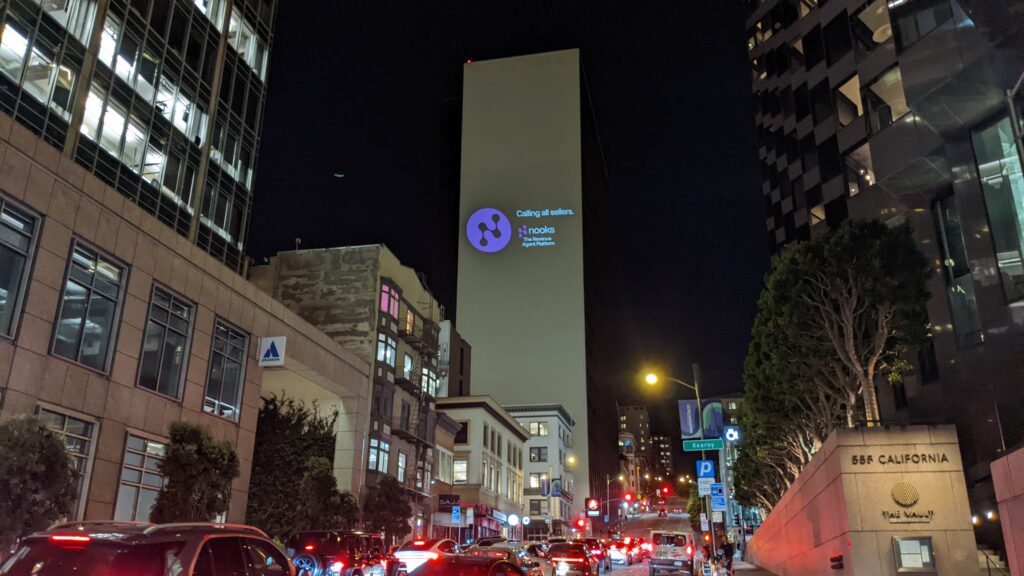
Projection is the only format we run that cannot be stockpiled. A poster goes up and keeps working whether or not anybody is standing there. A projection exists for the hours the crew is running it, onto a surface somebody has agreed to lend, in darkness, and then it is gone.
That makes the scheduling question the whole question, and San Jose has a scheduling quirk that catches almost every buyer out.
The weather here is excellent for projection. Long runs of clear, dry, cloudless nights, stable atmospheric conditions, very little haze to scatter the beam. Downtown’s ambient light is lower than a denser city’s, which helps contrast meaningfully. On paper San Jose should be one of the easiest projection markets in the country.
The catch is that the best weather and the best audience hours do not overlap.
Through the long dry season, darkness arrives late. A summer projection in San Jose cannot start until well into the evening, and downtown nightlife crowds here thin earlier than in larger coastal cities. The usable window gets squeezed from both ends. In December the opposite is true: darkness arrives while downtown is still full, and foot traffic is unusually heavy because of the holiday programming, but you are working inside the wet season.
Most of the planning work on a San Jose projection campaign is resolving that tension honestly. This page covers how we do it, which walls in this city can actually take a beam, how the permission picture works when you are borrowing somebody’s building with light, and what I talk clients out of here.
Finding a wall: the specific San Jose problem
Projection needs a large, unbroken, light-coloured, reasonably smooth, reasonably flat surface, and a place to stand far enough back from it.
San Jose’s walkable core is the SoFA District, San Pedro Square and the blocks between. That is the only area where a projection will be seen by enough people on foot to be worth running. The suburban remainder of the city is car-dependent, widely spaced and not somewhere a projected image earns its night.
Inside that small core, the limiting factor is finding large unbroken wall faces, and SoFA presents a problem that is almost funny once you have walked it.
SoFA is the arts district. Galleries within walking distance of each other, craft breweries, coffee shops with poetry readings, cutting-edge theatres, a bar scene, and buildings covered in original murals.
Those murals are exactly what makes SoFA the right audience and exactly what makes SoFA the wrong wall.
A mural is a terrible projection surface. It is busy, saturated and already carrying a composition. Project onto it and you get two images fighting each other, with the underlying artwork showing through every light area of yours. There is no fixing that with brightness. The more lumens you throw at a painted wall, the more of the painting you light up. Clients see photographs of the district, see all that wall area, and assume the surfaces are available. In practice the mural density subtracts from the projectable inventory rather than adding to it.
So the surface hunt in SoFA is for the walls the muralists skipped: plain side elevations, blank gable ends, pale rendered faces, and the flat faces of construction hoarding when a development is active. Those exist, but there are not many, and they are the reason a San Jose projection campaign is scoped around a handful of specific positions rather than a route.
San Pedro Square, centred on San Pedro Street, has the opposite profile. More food and drink frontage, pints and bites along the street, venues including Five Points Bar, and a dense standing audience on patios in the evening. The audience there is excellent for projection because people are stationary and facing outward. The constraint is street width. A narrow street limits how far back the projector can sit, which limits image size regardless of how capable the equipment is. Throw distance is geometry, not budget, and on the tighter downtown blocks the geometry decides the size of the image before anything else does.
The western edge around SAP Center at 525 West Santa Clara Street has more open space and larger building faces, and the arena draws predictable evening crowds on foot for Sharks and Barracuda games and for concerts through the year. Open approaches mean longer throw distances are available. The trade-off is that event nights bring serious congestion before and after, which is a crew access problem I will come back to.
Santana Row comes up on most calls. It is the significant retail destination in the city, and it is a privately managed environment with its own management and formal approvals process. A projection there is a managed-property submission, not a street campaign.
The vantage point is half the booking, and people forget it
Here is the part of projection that buyers consistently underestimate, and it is worse in San Jose than in most places.
You do not just need permission for the wall. You need a place to put the projector, with a clear sightline, stable ground, power or a generator, and somebody’s agreement to let you occupy that spot for several hours after dark.
In a dense city there are usually several options across the street. In downtown San Jose, with its narrow blocks and its limited number of suitable walls, the vantage point often turns out to be the binding constraint. A perfect blank wall with nowhere to stand opposite it is not a projection site, it is a photograph of a wall.
The vantage points that tend to work here are private: a parking structure deck with the right sightline, a private lot, a forecourt, an upper level with a clear line to the target face. Downtown San Jose has structure parking available and parking is comparatively easier here than in San Francisco, which genuinely helps, because a structure deck is often the most practical elevated position in the core.
Every one of those needs its own permission, separate from the wall permission. Two conversations, two agreements, both documented, both carried by the crew on the night. When clients ask why a projection booking takes longer to lock than a poster flight, this is why.
Power is the other half. A long static projection needs clean, consistent power for hours. In a small, well-observed downtown where the same business owners walk the same block every day, a generator running outside a bar at eleven at night is noticeable. Mains power from a cooperating property is always the better answer here, and it is another reason the relationship with the vantage point owner matters as much as the one with the wall owner.
Permission and enforcement character, as a grey area
This is a grey area and I will frame it as nothing else.
Projection sits in a genuinely unsettled space. You are placing an image on a surface without touching it, which is different from affixing material, and municipalities vary widely in how they treat that. California cities differ in their approach to signage and to use of public infrastructure, and the practical answer is local rather than statewide.
UNVERIFIED: the specific current text and enforcement posture of San Jose’s sign provisions as they relate to projected images. Confirm directly with the City of San Jose before running a campaign. I will not cite a code section I have not read in its current form, and I would not trust an operator who quotes one casually.
What is more useful is the character of the place.
Downtown San Jose is small, managed and visible. The same business owners and the same city staff see the same blocks daily. It has a settled, local rhythm rather than a tourist one, and the people filling the bars are residents and tech workers rather than visitors. A large projected image on a known building in a core that compact is a conspicuous event. It will be noticed within minutes, and it will be noticed by somebody who recognises the building.
In a format that is already ambiguous, conspicuousness means the posture has to be unambiguous. We run projection in San Jose with written permission from the owner of the surface being projected onto, written permission for the vantage point, documentation carried on site, and a crew that can answer a question from a building manager or a passer-by with a name and a piece of paper rather than a shrug.
SoFA helps here in the same way it helps vertical work. There is an established tradition of commissioned and permitted wall art in that district, and the owners are accustomed to being approached about what appears on their buildings. The conversation about a temporary authorised image is a familiar one, even if the technology is less familiar than paint.
Removal is the one commitment projection makes easily. When the equipment goes, the surface is exactly as it was. That is a genuine advantage in conversations with cautious owners and it is worth leading with.
Night conditions: what the San Jose sky actually gives you
San Jose has a Mediterranean climate: long, warm, arid and mostly clear summers, short cool wet winters. Temperatures typically range from about 43°F to 82°F across the year, rarely below 35°F or above 92°F. Rain is sparse from May through October, with NOAA’s San Jose climate summary recording June, July and August normally totalling only around 0.20 inches combined. The dry season effectively runs April to November.
For projection, that long run of clear, dry, cloudless nights is a real advantage. Stable atmospheric conditions mean the beam travels cleanly with little haze scattering it, image contrast holds up, and the schedule is predictable. In a humid eastern market I plan around nights lost to haze and storms. Here, through the dry season, scheduled nights happen.
Downtown ambient light being lower than in a denser city is the second advantage, and an underrated one. Projection competes against whatever light is already hitting the wall. A core with moderate ambient levels gives better contrast at a given output than a brighter downtown would, which means a cleaner image without chasing brightness.
Temperature is a non-issue for equipment here in a way it is not in cold or extreme markets. No freeze, overnight lows in a workable range year-round, so the crew is not fighting condensation on optics or cold-start problems.
The wet season from roughly November through April is the limiting period. Rain cancels, and the marine influence on the far western and northern edges of the metro is greater than downtown sees, though the core is inland enough at the south end of San Francisco Bay to be less affected than a true coastal location. Winter bookings need a contingency night written into the schedule as standard.
And then there is darkness timing, which in this city is the real planner.
Summer gives perfect conditions and a late start. The image cannot run until it is properly dark, and by the time it is, downtown’s crowds, which thin earlier here than in larger coastal cities, are already starting to go home. The productive overlap between full darkness and a full street is narrower in a San Jose July than most people assume.
Winter gives early darkness and a wet-weather risk. Downtown is busy while it is already dark, which is exactly what the format wants, but the nights you can run are fewer and less certain.
December is the sharpest version of this. Christmas in the Park transforms Plaza de César Chávez into a lights, trees and live performance display that is free to walk through, draws large crowds, and makes December downtown traffic much heavier than a typical US downtown’s winter baseline. That is the biggest early-dark pedestrian audience in the San Jose year.
It is also, quite literally, a lighting installation. A projection sited near the plaza is competing with a purpose-built display, both for attention and for contrast on the wall. The answer is to work a block or two off the plaza, on the approach routes rather than inside the lights, catching people walking to and from it in darkness. That is a specific siting decision and it only makes sense if you know what December in this particular downtown looks like.
Crew and calendar
A projection crew is small and stationary, which is the opposite of the walking pattern that suits the other formats here. Two or three people, one position, a long set-up, a long run, a pack-down.
Because the position is fixed, scouting carries disproportionate weight. The sightline, the throw distance, the ambient light on the target face, the power source and the pedestrian flow past the viewing position all have to be confirmed in person, after dark, before anything is booked. A daytime site visit tells you very little about a projection site. I will not quote a position I have not seen at night.
San Jose is car-dependent overall, so the crew drives in, but once parked in the core the sites are close together. Downtown parking is comparatively easier than in San Francisco, with structure parking available, which matters more for this format than any other because the vehicle usually stays with the kit all night.
Access constraints are event-driven. SAP Center event nights congest West Santa Clara Street and the arena approaches before and after, and clearing takes longer than expected, so a position on that side of downtown needs to be set and running well before the crowd or scheduled for a dark night. Christmas in the Park evenings fill Plaza de César Chávez and surrounding blocks through December.
On the calendar side, First Fridays in the SoFA District are the strongest recurring opportunity for this format in San Jose. They run on the first Friday of most months, bringing gallery openings, street performers and pop-up vendors, and the audience is arts-literate, walking, and receptive to exactly this kind of work. A projection during a First Friday reads as part of the evening rather than as an advertisement interrupting it, which is the best reception this format gets anywhere.
San José State University sits directly inside the downtown core, which is unusual and useful, since the student population is already inside the walkable area rather than on a detached campus. Term dates shape downtown’s weekday evening energy substantially. UNVERIFIED: specific current term dates. Check the university’s published academic calendar before planning a student-facing night.
What I talk San Jose clients out of
Projecting onto a mural. The most common SoFA request and the one that never works. The underlying artwork shows through every light part of the image and more brightness only lights the painting up further. We find the plain elevations instead.
Assuming summer is the right season because the weather is good. The weather is excellent, but the darkness arrives late and this downtown empties earlier than bigger coastal cities. A perfect July night can deliver a short productive overlap. I would rather run a shoulder-season or winter date with a contingency night and reach a full street in darkness.
Siting next to Christmas in the Park. The instinct is to go where the December crowd is. The plaza is a lighting display, and a projection sited inside it competes with purpose-built illumination. Work the approaches instead.
Booking the wall before the vantage point. It happens constantly. Somebody falls in love with a building face, and then we discover there is nowhere to stand with a clear sightline and stable power. The two permissions get pursued together or the booking is not real.
Expecting a big image on a narrow street. Throw distance is geometry. On the tighter downtown blocks the available standoff caps the image size, and no amount of equipment changes that. Better to pick a position with the room for the size you need than to over-specify a projector that still cannot back up far enough.
Treating projection as a standalone campaign. This is the structural one. Projection only exists while the crew is running it. A few nights of projection in a city where the core audience walks the same blocks every week is a sharp spike with nothing holding the ground between spikes.
Giving the campaign something that works in daylight
That last point deserves its own answer, because it comes up on every projection brief in this city.
Downtown San Jose has a settled, local rhythm. The people in the core are residents, tech workers and students who walk the same blocks repeatedly. Repetition is what moves them, and projection, by its nature, cannot provide repetition. It runs for a few hours on a few nights.
Pairing projection with Snipe Advertising is usually the right structure here. The small permitted printed panels hold the corridor through the daytime and on every night the projector is not running, building the frequency the audience responds to, and the projection nights become the high-attention moments on top of that persistent base. The same short loop carries both, which suits a city where the walkable core is small and the same people cross it repeatedly.
A campaign built that way gets a lot more out of San Jose’s limited core than a projection booking that burns bright for three nights and leaves nothing behind.
Frequently asked questions
Do you need a permit for projection advertising in San Jose?
It is a grey area. Projection places an image without affixing anything, which municipalities treat inconsistently, and the practical answer is local rather than statewide. We work from written permission for the projected surface and separate written permission for the vantage point, with documentation carried on site. Confirm current requirements with the City of San Jose directly. We do not give legal advice.
Which San Jose walls actually work for projection?
Plain, large, pale, reasonably flat elevations with a usable standoff opposite them. In the SoFA District that means the faces the muralists skipped, since painted walls make poor projection surfaces. San Pedro Square has excellent standing audiences but narrow streets that cap image size. The western edge near SAP Center offers more open space and longer throw distances.
What time of year is best for projection in San Jose?
There is a genuine trade-off. The dry season from April to November gives clear, stable, cloudless nights and very few cancellations, but darkness arrives late and downtown crowds thin earlier here than in larger coastal cities. Winter brings early darkness while the core is still busy, at the cost of rain risk and a required contingency night.
Can you project during Christmas in the Park?
We can run in December, but not beside the plaza. Christmas in the Park is itself a lights, trees and live performance display, so a projection sited within it competes with purpose-built illumination for both attention and contrast. The better approach is working the approach routes a block or two away, reaching people walking to and from the display in darkness.
How bright does the projector need to be?
Brightness is less decisive here than elsewhere, because downtown San Jose carries lower ambient light than a denser city, which helps contrast at a given output. The bigger determinants are the throw distance the street geometry allows and the colour and texture of the target surface. A pale, plain wall at a good standoff beats raw output every time.
How far in advance should a San Jose projection night be booked?
Longer than a print flight, because each position needs two separate permissions, for the surface and for the vantage point, plus a night-time site visit to confirm sightline, ambient light and power. We do not quote a position we have not seen after dark. Winter bookings also need a contingency night held in the schedule for rain.
Request a campaign quote
If you are planning projection work in San Jose, bring me the dates and the audience and I will walk the core after dark and tell you what is genuinely available. The surfaces in this city are fewer than the photographs suggest, and the honest version of that conversation is worth more than an optimistic one.
We handle site scouting after dark, surface and vantage point permission, equipment specification for the throw distance available, and crewed operation on the night. Request a campaign quote and tell me what you are trying to reach.

Ready to Run Your Campaign?
Call us or email us. We’ll tell you exactly what we can do in your market and what it costs.
Related Service
Explore similar advertising solutions offered by American Guerrilla Marketing.
American Guerrilla Marketing — Los Angeles
Street-level campaigns in Los Angeles and nationwide. Wheatpasting, LED trucks, street teams, and more.
(646) 776-2770
Related Articles
-
Cincinnati Projection Advertising: Permits and Corridors
November 25, 2026
-
Projection Advertising in Long Beach, California
November 25, 2026
-
Experiential Marketing Agency Jobs vs the Alternatives
November 25, 2026
-
Richmond Projection Advertising: Permits and Corridors
November 25, 2026
-
Experiential Event Companies: How It Actually Works
November 25, 2026