
November 25, 2026
Richmond Projection Advertising: Permits and Corridors
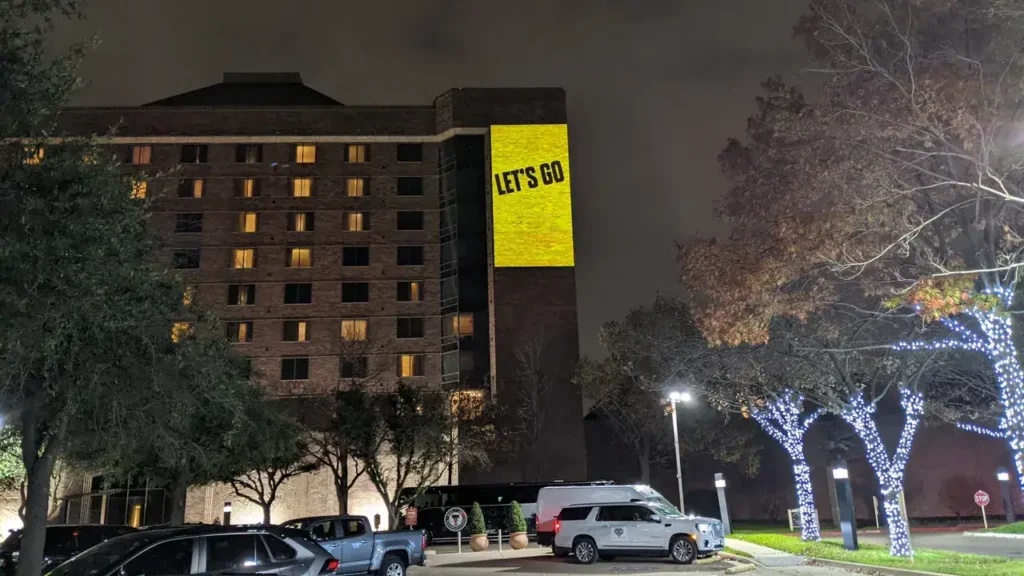
Projection is the only format we run where the city’s air is a material you have to work with.
Everything else on our list is a contact problem. Paste against brick, adhesive against paving, vinyl against a hoarding. You win or lose on surface preparation. Projection is an optical problem: a beam of light travelling through whatever is suspended in the atmosphere between the lens and the wall, landing on a surface whose colour and texture you did not choose.
Richmond is humid subtropical, and on a sticky August night the air between your projector and your target wall is full of suspended moisture. That moisture scatters the beam. Scattering does two things, both bad. It bleeds light out of the image before it arrives, and it lifts the black level, which flattens contrast. The result is a picture that is technically present and visually weak.
So the first conversation we have about Richmond projection is not about corridors or permissions. It is about how much brightness we need and how short we can make the throw, because shortening the throw is the most reliable way to beat atmospheric scattering and the one that depends least on equipment.
The second conversation is about what we are projecting onto, and in Richmond that question has an unusual answer.
The third is about the time of year, and here the seasonal logic runs opposite to every other format we offer in this city. For posters and decals, autumn is the answer and winter is the problem. For projection, a cold clear Richmond night in January is better optically than anything summer will give you, and the nights are longer. That single inversion reshapes the whole plan.
Richmond’s mural inventory is also its projection inventory, and that is a conflict
This is the thing nobody expects.
A good projection surface is large, flat, light-toned, matte and unobstructed. That is a short list of requirements, and Richmond has an unusual amount of exactly that kind of wall: big industrial brick flanks in Scott’s Addition, side elevations along Broad Street, blank masonry in Old Town Manchester.
The problem is that Richmond spent more than a decade filling those walls with paint. The Richmond Mural Project and the RVA Street Art Festival both started in 2012, and the mural project alone has put well over a hundred large painted works onto buildings across the city. Carytown’s side roads and alleys hold plenty more beyond the main stretch.
A mural is close to the worst projection surface there is. It is dark in places and light in others, it is highly saturated, and the existing image competes directly with yours. Project onto a mural and you get a blend of two pictures, with the painted one winning wherever it is darker than your beam.
So in Richmond, the best-looking walls in the city and the best projection walls in the city are largely different sets, and the overlap keeps shrinking as more walls get painted. Finding projection surfaces here means hunting for the walls nobody chose to paint, which is a different survey from the one you would run for paste.
What we actually look for: unpainted or single-tone masonry, preferably light, with no fire escape, downpipe, signage or window array breaking the field. Blank side elevations on Scott’s Addition industrial stock are the richest source. Plain upper storeys above active ground-floor retail work in some Broad Street locations because the clutter sits below the projection field. Freshly erected construction hoarding in Scott’s Addition, where the district’s sustained conversion work keeps producing it, is a genuinely good projection surface while it is still clean: flat, continuous and uniform in tone.
Dark brick is workable but costs you brightness. Red brick shifts colour, so artwork with large areas of pale or neutral tone will not hold its intended colour on it. We design for the wall we have rather than correcting after the fact on site.
Where the throw distances exist in this city
Projection needs standoff. You cannot light a four-storey wall from twenty feet away without a very short throw lens and severe keystone distortion. The question in any city is where you can physically stand far enough back, and Richmond answers that unevenly.
Scott’s Addition is the best projection district in Richmond and it is not close. It was an industrial district, so the streets are wide, the kerbside is often available, residential density is low and the buildings carry large unbroken flanks. Width is throw distance. Low residential density means you are not throwing stray light into bedrooms. Available kerbside means the vehicle carrying the equipment can park where the shot needs it rather than two blocks away. The district’s evening activity also runs latest in the city because of the breweries and distilleries, which means there is still an audience at the hours when projection actually looks good.
Broad Street through the Arts District has the audience and the corridor width, and it has two working problems. Street lighting along a main corridor raises ambient levels and eats contrast. Traffic headlights sweep across the projection field. Both are manageable by choosing a wall set back from the carriageway and angling to avoid the sweep, but they narrow the candidate list considerably.
Carytown is a short-throw environment only. The main Cary Street stretch is narrow and the alleys behind it are narrower. You can light a one or two storey face from across an alley, and the intimacy of that can work well for the browsing pace of the district, but anything large-format is not happening there.
The Fan is out. Dense, historic, residential, no standoff and light spilling into people’s windows. We do not propose projection in The Fan.
Old Town Manchester and the riverside are the interesting unknown. The James River gives unobstructed sightlines in principle, and Manchester sits across the water from the downtown core. UNVERIFIED: we have not confirmed specific usable vantage points, sightlines or access permissions for cross-river projection in Richmond, and we would survey that on the ground before proposing it to anybody. There is also a real constraint down there: the James widens into an estuary downstream and heavy rain can flood low riverside ground around Shockoe Bottom and the Canal Walk. Equipment does not belong on ground that floods, and we do not commit to riverside positions while a tropical system is tracking up the coast.
Shockoe Bottom and the Canal Walk are compact, tourist-facing and supervised. Permission-first, and often the realistic outcome is a venue-arranged placement rather than a street-facing throw.
Permission when you are not attaching anything
Projection sits in a grey area in Richmond, the same as other street-level formats, but the shape of the ambiguity is different and worth explaining properly.
Nothing is being attached. No adhesive, no residue, no mark on the building. When the projector switches off, the wall is exactly as it was. That genuinely changes the risk profile compared with paste, and it is the honest reason some clients choose this format.
It does not mean permission is irrelevant. There are two permission questions, not one, and most buyers only think of the first.
The receiving wall. You are putting an image on somebody’s building. We get the building owner’s agreement in writing, the same as we would for paste, and we record who gave it and when. Richmond makes this easier than most markets, because a city that has run a mural project and a street art festival since 2012 has property owners who are used to being approached about their walls. The ask is familiar here. Scott’s Addition owners in particular, with identifiable commercial occupancy and large blank brick, are the most straightforward conversation in the city.
The standing position. This is the one people forget. The projector and its power have to physically occupy a position, usually for a few hours, usually at night. That position is either on private ground, in which case we need the ground owner’s permission, or in a vehicle on the street, which brings its own set of considerations around parking, obstruction and current municipal requirements.
Beyond those two, current City of Richmond sign and right-of-way requirements apply and should be confirmed directly with the municipality before each campaign. Enforcement attention here is inconsistent and district-specific, and tolerance in one quarter predicts nothing about the next one over. The managed riverside and the ground near state government buildings sit at the monitored end of the spectrum and we treat them accordingly. We do not characterise any of this in terms of what is or is not permitted, and we never cite an ordinance number we have not verified.
What we do is narrow the ambiguity: documented owner permission for the wall, documented permission for the standing position, a crew that can explain itself clearly to anyone who asks, and a format that leaves nothing behind.
The seasonal inversion: why Richmond winter suits projection
For every other format we run here, autumn is the answer. For projection, the calculation changes.
Summer is the hardest season for projection in Richmond and there are three reasons stacked on top of each other.
Humid night air scatters the beam and flattens contrast, as described above. The nights are short, so full darkness arrives late and the usable window is compressed into fewer hours. And the summer rain pattern is thunderstorms rather than drizzle, which means a large volume of water arriving fast, often driven sideways by wind. Projection equipment and driven rain are a poor combination, and a storm cell can end a shoot with no notice. We check radar before committing a crew rather than reading the day’s forecast.
The hot season here is longer than the calendar implies. Late May is often already fully hot and the first half of September frequently still is, so the difficult window runs roughly late May to mid-September rather than June to August.
Winter is optically the best projection season in Richmond. Cold air holds less suspended moisture, so scattering drops and blacks sit deeper. Darkness arrives early, which stretches the usable window across more hours and lets a campaign reach people during an evening rather than only late at night. Richmond winters oscillate around the freezing point rather than locking into hard cold, so crew conditions stay workable.
The trade is audience. Fewer people are out on foot in a Richmond January, so the projection has to be placed where people still are: Scott’s Addition on a Friday evening when the brewery and distillery traffic is moving between venues, or Broad Street on a First Friday.
Autumn is the balanced answer and usually what we recommend. Calmer and more settled than spring, which is the wetter and more erratic shoulder season, with nights lengthening, humidity dropping and the city’s heaviest pedestrian volume of the year.
Timing a projection campaign to Richmond’s calendar
Because projection only exists while the machine is running, timing matters more here than in any other format. A poster works on a Tuesday afternoon when nobody is looking. A projection does not.
October is the peak. The Richmond Folk Festival is described as the largest folk festival in the country and draws over two hundred thousand attendees across three days of free programming, and it lands in the calmest, clearest weather of the year. For a format that needs people physically present at a specific hour, that concentration is the most valuable window Richmond offers. Note that Folk Festival weekend brings street closures, crowd volume and parking saturation across the central districts, which affects where a vehicle carrying equipment can realistically position. Plan positions around that rather than assuming normal access.
First Fridays on Broad Street is the natural recurring anchor. It runs every month, it is one of the region’s most popular art events, and unlike poster work, where we install the night before, projection should run on the First Friday evening itself. The audience being there at that moment is the entire point.
Broad Appetit closes a four-block stretch of Broad Street beside the campus for a dense food event. A closed street removes headlight sweep and gives you standoff on a corridor that normally has neither, which for projection is a genuinely unusual opportunity.
The rest of the year carries the Richmond Jazz Festival in a city that calls itself a jazz capital, the Riverrock outdoor sports and music festival on the river, the RVA Street Art Festival, and community events including the Indian Festival, the Church Hill Irish Festival and the Original Italian Street Festival.
VCU sits directly on Broad Street, so term dates materially change evening foot traffic on the city’s main cultural corridor. UNVERIFIED: current VCU term dates and exact festival dates for the coming year were not confirmed here. Confirm both before fixing a projection schedule, because an empty corridor is a wasted night.
Crew, power and what goes wrong on a Richmond projection night
A projection night runs with two to three people. One on the projector, alignment and content. One on power, cabling and the vehicle. One on documentation and on talking to anybody who comes over to ask what is happening, which somebody always does.
Power is the constraint people underestimate. Either we draw from a cooperating building, which has to be arranged with the same owner conversation as the wall, or we run from the vehicle. The vehicle option is what makes Scott’s Addition so workable, because you can park close enough to the shot to keep cable runs short.
Setup is longer than clients expect. Finding the exact standing position, getting alignment right on a wall that is rarely perfectly perpendicular, correcting keystone and focusing at distance takes real time before anything looks right. We scout the position in daylight and again after dark on a separate night before a campaign evening, because a wall that looks blank at two in the afternoon can turn out to be washed by a security light at eleven.
Here is what actually goes wrong in Richmond.
Ambient light you did not survey for. Security lighting, a newly installed fixture, an illuminated sign switching on at a set hour. This is why we scout after dark.
Summer haze killing contrast. The image is there, it is just weak. The fix is a shorter throw and a brighter unit, decided in planning rather than discovered on site.
A storm cell arriving mid-run. Summer only, and the reason we read radar rather than forecasts.
The wall turning out to be painted. More common in Richmond than anywhere else we work, for the mural reasons above. Survey catches it. Assuming from a map does not.
Headlight sweep on Broad Street. Mitigated by wall choice and angle, not by equipment.
An audience that is not there. The hardest failure, because the projection worked perfectly. A flawless image on a Tuesday in February on an empty Carytown alley reaches nobody.
That last one is the thing we talk clients out of most often. Projection is a moment, not a presence. If a brand needs to be visible across a run of weeks in Richmond rather than for three hours on one evening, projection is the wrong primary tool and we will say so. The usual answer is to pair a projection night at a known moment, a First Friday or the Folk Festival run, with a poster campaign holding the same districts across the weeks around it. The projection makes the event, the paste holds the ground.
We also push back on cross-river ambition before anyone has surveyed it, on riverside positions during wet tropical weather, on The Fan entirely, and on booking a mid-July evening because that is when the client’s launch happens to fall.
Frequently asked questions
Why is projection harder in Richmond in summer?
Humid night air scatters the beam, which bleeds light out of the image and lifts the black level so contrast flattens. Summer nights are also short, compressing the usable window, and the rain arrives as thunderstorms rather than drizzle, which can end a run with little warning. We read radar before committing a crew.
Which Richmond district is best for projection?
Scott’s Addition, clearly. Wide industrial streets give you throw distance, kerbside parking lets the equipment vehicle sit close to the shot, residential density is low so stray light is less of an issue, and the buildings carry large unbroken flanks. Its brewery and distillery evenings also run latest, so there is still an audience at good projection hours.
Does Richmond’s street art make projection easier or harder?
Harder, which surprises people. A projection surface wants to be flat, light-toned and blank. Richmond has put well over a hundred commissioned murals onto exactly the kind of large walls projection wants, and a painted mural competes directly with the projected image. Finding projection walls here means hunting for the unpainted ones.
Do you need permission to project onto a building in Richmond?
Projection attaches nothing and leaves no residue, which changes the risk profile, but permission still matters in two places: the owner of the wall receiving the image, and the owner of the ground where the projector stands. We document both in writing. Current municipal requirements apply and enforcement here is inconsistent, so this remains a grey area.
What time of year should a Richmond projection campaign run?
Autumn is the balanced answer: settled weather, lengthening nights, falling humidity and the year’s heaviest foot traffic including the Folk Festival in October. Winter is optically the best, with drier air and early darkness, but fewer people are out. Summer is the hardest season on every axis and we steer campaigns away from it.
How big is the crew and how long is setup?
Two to three people. One on the projector and content, one on power and the vehicle, one documenting and handling anyone who asks questions. Setup takes longer than clients expect, because finding the standing position, correcting keystone on a wall that is never perfectly perpendicular and focusing at distance all take time before the image looks right.
Request a campaign quote
The useful first conversation about Richmond projection is about which evening you need to own and who will be standing there. Projection is a moment, so the date and the hour carry more weight than the district does.
Tell us whether you are aiming at a First Friday on Broad, the Folk Festival run in October, a Scott’s Addition evening while the brewery traffic is moving, or a winter night where the air is clear and the darkness comes early. We will scout the walls, tell you which ones are already painted, and be straight about whether the audience will be there.
If what you actually need is sustained visibility across weeks rather than one strong night, we will tell you that too, and propose the format that does it.
Request a campaign quote and tell us the evening you are building toward.

Ready to Run Your Campaign?
Call us or email us. We’ll tell you exactly what we can do in your market and what it costs.
Related Service
Explore similar advertising solutions offered by American Guerrilla Marketing.
American Guerrilla Marketing — Los Angeles
Street-level campaigns in Los Angeles and nationwide. Wheatpasting, LED trucks, street teams, and more.
(646) 776-2770
Related Articles
-
Experiential Event Companies: How It Actually Works
November 25, 2026
-
Guerilla Marketing Firms: How It Actually Works
November 24, 2026
-
Best Experiential Campaigns: How It Actually Works
November 24, 2026
-
Measuring an Experiential Marketing Agency in Atlanta
November 24, 2026
-
Best Guerilla Campaigns: How It Actually Works
November 24, 2026