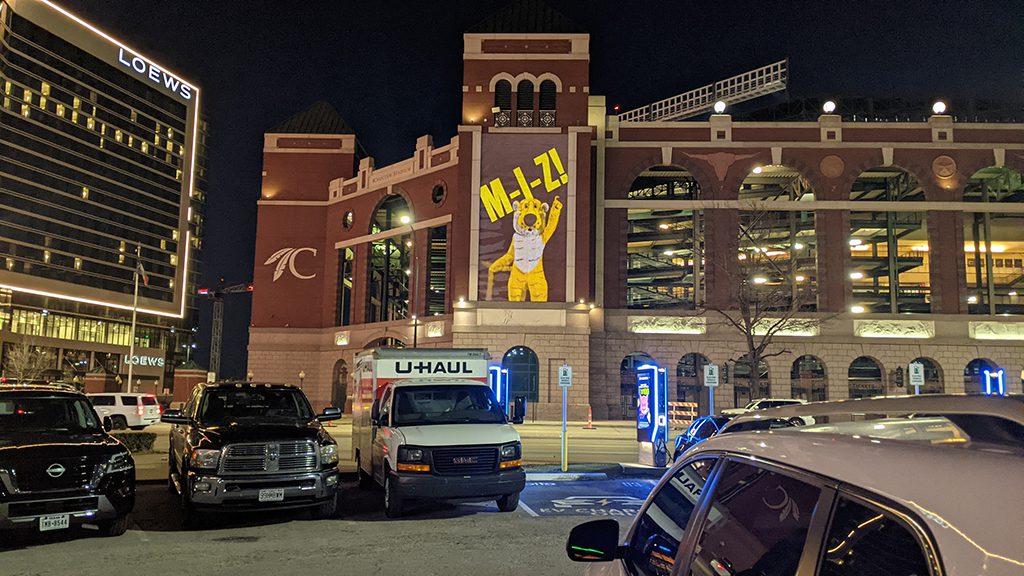
Projection of Buildings: Brand Campaigns on Urban Facades
Projecting onto buildings transforms architecture into advertising at the scale the city itself operates. We have used this format for brands across music, fashion, tech, and entertainment. Here is the full operational picture.
The projection of buildings describes the use of high-powered commercial projectors to display visual content on the exterior surfaces of architecture. It is a practice that sits at the intersection of advertising, installation art, and urban spectacle, but in the context of guerrilla marketing campaigns, it is fundamentally an advertising format: a way of placing a brand’s visual identity in the physical environment at a scale and with a drama that standard advertising structures cannot achieve.
We plan and execute the projection of buildings for brand campaigns across the United States. The format requires specific equipment, specific location conditions, specific content preparation, and operational expertise that can only be built through actually running these campaigns in real urban environments with all the variables that entails. This guide covers the full operational picture of how the projection of buildings works for advertising purposes: what equipment is involved, how building surfaces are evaluated, how locations are chosen, how content must be prepared, what the execution process looks like, and how the format fits within a broader campaign strategy.
The projection of buildings uses commercial laser projectors with lumen outputs typically ranging from 20,000 to 60,000 or higher to throw light and content onto building facades at distances that range from 50 to 250 feet or more. The projector is positioned across the street, in a vehicle, on an adjacent rooftop, or at another location with an unobstructed sightline to the target building surface. A media server connected to the projector plays the brand content, which can be a static graphic, an animated loop, a full video, or a sequence of content assets. A generator provides power at locations where building electrical access is not available, which is the typical situation for street-level projector positions.
The result is a brand visual that occupies the building facade at whatever scale the throw distance and lens configuration allow. A projector positioned 100 feet from a four-story building can fill the majority of that facade with the brand image. At 200 feet with a wider-angle lens and higher output projector, the same equipment can cover a ten-story surface. The practical scale of the projection depends on the specific site conditions confirmed through a site survey, not on generic estimates.
The projection runs from dusk through a window of four to six hours per night, which is the period when ambient light conditions are sufficient for the projected content to achieve its intended visual contrast and brightness relative to the surrounding environment. Setup requires two to three hours before the projection window opens. Breakdown follows at the close of the session. Two technicians manage the entire process from initial equipment positioning through final breakdown.
Evaluating Buildings for Projection
Not all buildings are equally good projection surfaces, and the evaluation of a building’s suitability for projection is one of the most important steps in any projection campaign planning process. We evaluate buildings along several dimensions simultaneously, because a building that excels on one dimension but fails on another is not a suitable projection surface regardless of how good it looks on a single metric.
Surface Material and Color
The material and color of a building’s exterior surface determine how well it reflects projected light. Light-colored smooth surfaces are the gold standard for projection. White or cream-colored concrete and smooth stucco reflect projection light with high fidelity, produce accurate color representation, and require the least projector output to achieve strong image brightness. Painted brick in light neutral colors works well at the distances typical of urban projection campaigns. The brick texture adds a subtle grain to the projected image that is visible in close-up photography but does not significantly affect the visual experience from street level.
Dark-colored surfaces absorb rather than reflect projected light and require substantially more projector output to achieve comparable brightness. A dark gray or charcoal brick building at 100 feet may require twice the projector output of a white concrete building at the same distance to achieve the same projected image brightness. The higher equipment output requirement affects campaign cost and is factored into our equipment recommendations after the site survey confirms the surface characteristics.
Surface Geometry
Flat or gently curved surfaces are ideal for projection. Projecting onto a flat facade produces a predictable image with even brightness and consistent geometry. Projecting onto a curved or angled surface introduces geometric distortion that requires either content design compensation or projection mapping techniques to correct. For standard guerrilla projection campaigns, we select surfaces with minimal curvature and architectural complexity to ensure the content reads as intended without requiring geometric correction in post-processing or on-site software adjustment.
Fenestration Ratio
The ratio of window glass to solid wall surface affects the visual continuity of the projected image. Buildings with high fenestration ratios, meaning large windows occupying most of the facade area, break up the projection surface and create visual gaps in the content where the transparent glass does not reflect projected light effectively. For most brand campaigns, we prefer buildings with low-to-moderate fenestration ratios where solid wall surface dominates and the projection image reads as a continuous visual rather than a fragmented composition interrupted by windows.
Building Characteristic
Ideal Condition
Challenging Condition
Surface color
White to light gray or cream
Dark gray, brown, or black
Surface material
Concrete, stucco, painted brick
Dark-stained wood, metal cladding
Surface geometry
Flat or gently curved
Sharply angled, heavily recessed
Fenestration ratio
Low (solid wall dominant)
High (glass curtain wall)
Available throw distance
50+ feet from projector position
Less than 40 feet from any position
Ambient light competition
Low surrounding commercial signage
Dense neon, adjacent LED displays
The Role of Architecture in Brand Projection Campaigns
Architecture is not just a surface for projection campaigns. It is a context and a signal. The building chosen for a brand projection carries the identity of the neighborhood it inhabits, the associations of its architectural style, and the visual authority of its physical scale. A brand that projects onto a significant building in a significant neighborhood is making a statement about its relationship to both that building and that neighborhood. Those contextual signals are part of what the projection communicates, independent of the content that is displayed.
This is why location scouting for building projection campaigns is as much a strategic exercise as a technical one. A technically ideal surface in a culturally irrelevant neighborhood produces a technically functional projection that serves no strategic purpose. A less technically ideal surface in exactly the right neighborhood for the brand’s audience and positioning may outperform the technically superior surface on every meaningful campaign metric because the strategic context is right.
We work with brands to identify neighborhoods that carry the right strategic context for their campaign objectives and then find the best available technical surface within those neighborhoods. The intersection of strategic relevance and technical suitability is where the strongest building projection campaigns live, and reaching that intersection requires thinking about the campaign from both dimensions simultaneously rather than optimizing one at the expense of the other.
AGM Field Note: One of the most memorable reactions we have seen from street audiences at building projections is the moment when a large projection first appears on a building that the audience knows, that they pass every day, that is part of their familiar urban environment. The transformation of a familiar building into a brand canvas creates a stronger attention response than projecting onto a building the audience has never noticed before. When we have the opportunity to choose between two technically equivalent surfaces where one is a neighborhood landmark and one is not, we recommend the landmark every time for exactly this reason.
Projection of Buildings as Social Media Content Generation
A major portion of the value generated by the projection of buildings in brand campaigns is not the live audience experience but the social media content that live audience generates. People who encounter a large building projection photograph and video it as a visually noteworthy event. When the projection creative is strong, the location is in a socially active neighborhood, and the timing aligns with the brand’s own social media content calendar, those organic photos and videos travel through social networks far beyond the people who were physically present at the location.
We have seen projection campaigns generate social media documentation that reached audiences many times larger than the entire population of the street within the projection’s sightline. The amplification comes from individual social media users with large networks sharing their documentation, from press and entertainment media outlets picking up the coverage, and from the brand’s own coordinated social content publishing during the projection window. Each of these amplification channels is accessible to any well-planned projection campaign, and capturing them requires coordination rather than additional cost.
The coordination that matters most is timing: the brand’s social media team should have content queued to publish at the same time as the projection, creating a bridge between the physical event and the brand’s digital presence. When a follower sees the brand post about a live projection and then finds user-generated content from people at the location, the combination of branded and organic content creates a social presence around the event that a single official post alone cannot generate.
AGM Field Note: Professional documentation photography is one of the highest-return investments in any building projection campaign, and it is consistently underbudgeted by clients planning their first projection. A professional photographer with the right night photography equipment produces images that serve as press assets, case study documentation, client presentations, and brand marketing content for months or years after the projection night. We strongly recommend allocating for professional photography in every campaign budget, not as an add-on but as a core component of the campaign plan.
Pricing for Projection of Buildings Campaigns
Our building projection campaigns in New York City are priced at $6,500 per projector per night. For markets outside New York City, the rate is $7,500 per projector per night. Each package includes a 20,000-lumen laser projector, generator, full electronics bundle, mobility unit, and two technicians covering setup, operation throughout the campaign window, and breakdown at the session close. Projections begin at dusk with a typical run time of four to six hours. Multi-night campaigns are available at the same per-night rate.
Campaign scale grows with the number of projectors and the number of nights. A single projector, single night New York City campaign starts at $6,500. A campaign with three projectors across two cities for three nights scales accordingly at the per-projector, per-night, per-market rate. We provide fully itemized proposals for every campaign before any commitment is made.
Projection of Buildings Campaign Execution Checklist
Every building projection campaign we execute follows the same core planning checklist. We share it here because campaigns that skip items on this checklist encounter problems on campaign night that are preventable with proper planning.
Site survey completed at campaign operating hours in target neighborhood
Building surface evaluated for color, material, geometry, and fenestration ratio
Throw distance confirmed for required image scale and projector output selection
Ambient light at site confirmed for equipment configuration decision
Primary and backup locations identified and documented
Content specifications delivered to content team after site survey
Content received and reviewed at least one week before campaign date
Content aspect ratio confirmed matching confirmed building surface dimensions
Equipment configuration finalized and crew assigned
Weather check completed with contingency date identified
Professional photographer engaged if applicable
Brand social media content calendar aligned with projection window
Post-campaign documentation delivery plan confirmed
Case Uses: When Projection of Buildings Delivers Maximum Value
The projection of buildings is a versatile format, but it delivers its strongest return in specific campaign contexts where the format’s qualities align precisely with what the campaign needs to achieve. Understanding which contexts generate maximum value helps brands allocate projection spending to the moments where it will be most impactful.
Global Artist Releases in Key Cities
Major music releases for artists with significant fan bases in specific cities generate extraordinary social documentation when the release campaign includes building projections in those cities on release night. The combination of a highly anticipated release, a passionate fan community active on social media, and a physical brand presence in the city in the form of a large-scale building projection creates a feedback loop between the digital announcement and the physical presence that amplifies both. Fans who are already searching for content about the release encounter the projection in their physical environment and document it, creating a flow of organic content that reinforces the digital campaign from the real world into the social media environment.
Premiere Week Campaign Anchors
Film and television premiere weeks benefit from building projection as a campaign anchor in the primary markets where the production has its most engaged audience. A premiere week building projection in New York on opening night and in Los Angeles on the following night creates a two-city physical presence that generates documentation from both markets simultaneously. The documentation from both cities appears on social media within hours of each other, creating the appearance of a national brand moment from two geographically distributed pieces of content.
Brand Entry into a New Market
When a brand is entering a new geographic market or attempting to claim a cultural position in a specific city for the first time, building projection in a strategically chosen neighborhood communicates market entry with a physical authority that a digital campaign targeting the same geography does not carry. A building projection in a new market is a physical statement that the brand has arrived, is taking up space, and is serious about its presence in that community. That statement is understood by the audience without requiring any explanation, and it generates a different quality of cultural response than the announcement alone.
Working with Property Owners and Venue Partnerships
The projection of buildings is most commonly executed as a guerrilla-style campaign where the brand positions equipment in a public space, typically across the street or in an adjacent position, and projects onto a building surface without a formal agreement with the building’s owner. This is the standard approach for guerrilla projection campaigns, and being stopped is rare but possible. We recommend identifying one primary location and one backup for each projector unit as standard practice for every campaign.
For brands that want the certainty of a confirmed location with the full support of the property, wall rental arrangements are available at some venues, hotels, and building owners who have made their exterior walls available for projection or advertising purposes. These arrangements provide the assurance of an agreed-upon surface and in some cases provide access to premium architectural surfaces, rooftop lighting accommodations, or electrical access that guerrilla placements cannot offer. The tradeoff is that wall rental requires advance coordination, typically involves a cost beyond the projection campaign itself, and limits location options to buildings whose owners have agreed to participate. We can explore wall rental options as part of our site scouting process for clients who prefer the certainty of a confirmed arrangement over the flexibility of guerrilla placement.
Frequently Asked Questions
What is projection of buildings?
Projection of buildings refers to the use of high-lumen commercial projectors to display visual content on the exterior surfaces of buildings at night. The building facade serves as a display canvas for brand content at a scale that no portable or standard advertising structure can match, creating a temporary brand presence in the physical environment of the city.
What types of buildings are best suited for projection?
Buildings with flat or gently curved facades in light colors are best suited for projection. Concrete, stucco, and painted brick surfaces in white, cream, or light gray reflect projection light evenly and produce clear image quality. Large continuous wall surfaces with minimal window interruption provide the cleanest canvas for projected brand content.
How far away does the projector need to be from the building?
Throw distance typically ranges from 50 to 250 or more feet depending on the required image size and the lens configuration in use. We confirm the appropriate throw distance through a site survey conducted at campaign operating hours, not through estimates from photographs or remote research.
What lumen output is needed for building projection?
A 20,000-lumen projector handles the majority of building projection campaigns on light-colored surfaces at standard throw distances in typical city ambient light environments. High-ambient-light locations or darker building surfaces require 30,000 to 60,000 or higher lumen output. We confirm the correct equipment spec through the site survey before finalizing the campaign configuration.
How much does building projection cost?
Building projection in NYC runs $6,500 per projector per night. Outside NYC the rate is $7,500 per projector per night. Each includes a 20,000-lumen projector, generator, electronics bundle, mobility unit, and two technicians for setup, operation throughout the campaign window, and breakdown at the session close.
How long does building projection run per night?
Projections begin at dusk and typically run four to six hours per night. Multi-night campaigns are available at the same per-night rate. Setup takes two to three hours before the projection window opens and breakdown follows at the close of each session.
Can projection of buildings run in multiple cities on the same night?
Yes. We coordinate simultaneous multi-city building projection campaigns with field teams in each market. Campaigns running in New York, Los Angeles, Chicago, and other cities simultaneously are a common structure for national brand launches requiring coordinated physical presence in multiple markets on the same date.
What content works best for projection of buildings?
High-contrast graphics with bold colors and minimal fine detail perform best in city ambient light conditions. Motion elements significantly increase the projection’s ability to attract attention from distance. Content must be designed at the specific aspect ratio of the confirmed building surface, not at standard screen ratios, and delivered in MP4 or high-resolution PNG format before campaign night.
How do I start a building projection campaign with AGM?
Email [email protected] or call (646) 776-2770 with your campaign brief, target city and neighborhood, and preferred campaign dates. We will provide location options, equipment specifications, and a detailed itemized proposal within a few business days of our initial conversation.