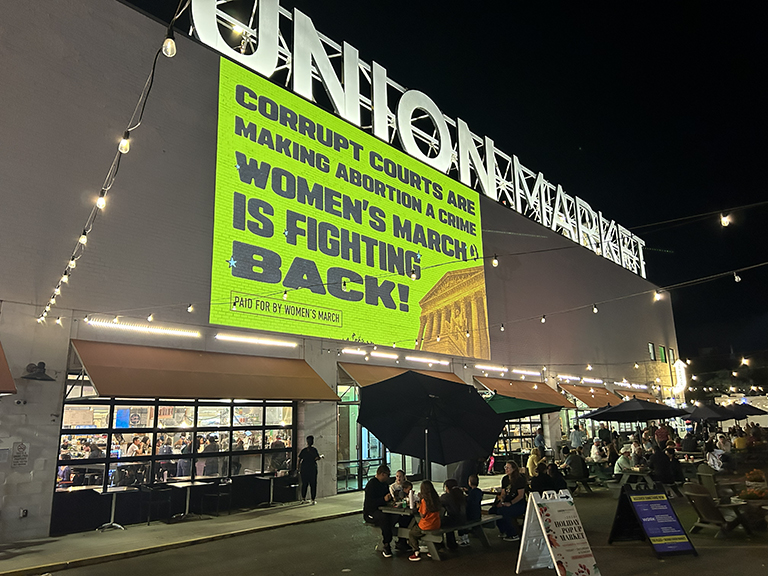
Building Projections for Brand Campaigns: A Field Guide
We have run building projections on six-story facades in SoHo, on parking structures in the Arts District, on warehouse walls in Wynwood. The format rewards careful planning and punishes guesswork. Here is the full playbook.
Building projections are what they sound like: projectors pointed at buildings, throwing light and content onto facades at a scale that turns architecture into a display surface. The format has been used for public art, civic events, and brand activations for decades, but the equipment available today, laser projectors with 20,000 to 60,000 lumens of output, has made building projections significantly more accessible and more visually commanding than anything that was possible even ten years ago.
We use building projections as a core guerrilla marketing tool for brand campaigns across the United States. The format is operationally demanding, technically specific, and rewards the kind of field experience that can only be accumulated by actually running these campaigns in real cities, in real weather, with real street audiences. This guide covers the full operational picture: what equipment is needed, how locations are selected, how content must be prepared, what the campaign execution timeline looks like, and how building projections fit within a larger brand campaign structure.
We will also cover the differences between building projections and projection mapping, since these terms are often used interchangeably but describe meaningfully different approaches that have different equipment requirements, content requirements, and strategic applications. Understanding the distinction helps brands choose the right approach for their campaign objectives from the beginning rather than discovering the difference mid-production.
The distinction between building projections and projection mapping matters for campaign planning because the two approaches have significantly different production requirements, cost structures, and appropriate use cases.
A standard building projection displays content on a flat or near-flat building surface. The content is designed at the aspect ratio of the surface and thrown onto the facade without geometric correction. The building is essentially a blank canvas, and the projection displays on it as it would on any flat screen. This is the approach we use for the vast majority of guerrilla brand campaigns because it is operationally efficient, produces strong visual results with the right surface selection, and does not require the extensive pre-production geometry measurement and software work that projection mapping requires.
Projection mapping uses specialized software to measure the geometry of a building’s architectural features, including windows, cornices, projecting elements, and three-dimensional relief, and then warps the content to align precisely with those features. The result is a projection that responds to the building’s actual architecture, making windows appear to open and close, walls appear to crack and rebuild, or ornamental details appear to animate in coordination with the content. Projection mapping creates a more spectacular and architecturally integrated visual result but requires significantly more pre-production work, more setup time on site, and more complex content production. We offer both approaches; the choice between them is driven by the campaign’s creative ambition and budget.
AGM Field Note: For the majority of brand campaigns, standard building projection produces better results than projection mapping for the budget invested. Projection mapping is extraordinary when the building’s architecture is genuinely interesting and the content is designed to interact with it. For campaigns where the goal is brand presence at scale rather than architectural spectacle, standard projection on a well-selected flat surface typically outperforms projection mapping on a complex surface because the brand imagery reads more clearly and the campaign is easier to execute at the quality level the brand requires.
Equipment: What Makes a Building Projection Work
The equipment for a building projection campaign is more complex than most clients initially expect. A projector alone is not sufficient. A complete building projection setup includes the projector, a media server for content playback and management, a generator for power independence, cabling and signal distribution equipment, positioning and mounting hardware, and a mobility unit for transporting the full equipment load to the site and positioning it correctly relative to the target building. The crew that operates this equipment needs to know not just how to set it up but how to troubleshoot the entire signal chain under field conditions.
Projector Selection
Projector selection is driven by the site conditions confirmed in the site survey. The three primary variables are lumen output, throw distance, and lens ratio. Lumen output determines how bright the projection appears on the target surface at the target distance. Throw distance is the space between the projector position and the building surface, and it determines how large the projected image can be at a given lumen output. Lens ratio determines how wide or narrow the projected beam is at a given distance, which controls image scale at the confirmed throw distance.
Our standard equipment is a 20,000-lumen laser projector. For campaigns involving larger surfaces, longer throw distances, or sites with high ambient light competition, we use 30,000 to 60,000-lumen units. The equipment configuration is confirmed after the site survey, not in advance of it, because guessing the right equipment from photographs or street view imagery produces equipment mismatches that reduce projection quality on campaign night.
Generator and Power
Most street-level projector positions do not have access to building electrical circuits, which means generator power is required. Our generator units are sized to handle the full electrical load of the projector and all supporting electronics with overhead capacity for fluctuation. A generator that is spec’d exactly to projector load without overhead is a point of failure risk. We size generators with margin built in so that power fluctuations during the campaign window do not affect projection quality.
Equipment Component
Specification
Purpose
Projector
20,000 to 60,000+ lumens (laser)
Primary image delivery at building scale
Media server
Redundant content storage, high-output GPU
Content playback management and backup
Generator
Sized to projector load plus 30% overhead
Power independence from building grid
Signal cabling
HDMI or DisplayPort with active extension
Clean signal from server to projector at distance
Mobility unit
Transport vehicle with equipment staging
Site access and equipment positioning
Positioning hardware
Tripod, heavy-duty projector mount
Stable alignment throughout campaign window
Location Scouting Process
Location scouting for building projections is not a task that can be completed remotely or from street view imagery with any reliability. The variables that determine whether a location will work, surface color and texture, available throw distance, ambient light at operating hours, ground surface conditions for equipment positioning, foot traffic patterns at night, and surrounding structures that could interfere with the throw path, all require physical evaluation at the time of day and conditions matching the campaign.
We conduct site surveys at campaign operating hours. A location that looks ideal in daytime may have a streetlight positioned exactly where the projector needs to go, or a bright neon sign on the adjacent storefront that competes directly with the projection surface, or a pedestrian barrier that prevents positioning the projector at the required distance. These conditions only become visible in the ambient light environment of the actual operating hour.
For every campaign, we identify a primary location and a backup. The backup is not a fallback for poor planning. It is a standard operational practice that protects the campaign against conditions that cannot be fully anticipated regardless of how thorough the site survey is: a delivery truck parked at the projector position on campaign night, a private event that has closed the street, or weather conditions that make positioning at the primary site impractical. Having a confirmed backup means the campaign runs regardless of what happens at the primary location.
Content Preparation for Building Projections
Content for building projections is prepared differently than content for any other advertising format, and the differences are specific enough that content produced without knowledge of them reliably underperforms on campaign night. The two most common content errors are wrong aspect ratio and insufficient contrast.
Aspect Ratio
Every building wall has a specific aspect ratio determined by the width and height of the projectable area. That ratio is almost never a standard media ratio like 16:9 or 4:3. Designing and rendering content at a standard ratio and then projecting it onto a building surface with a different ratio produces a stretched, compressed, or letter-boxed result that was not part of the intended design. We provide confirmed surface dimensions to content teams after the site survey, and content should not be finalized until those dimensions are in hand.
Contrast and Color
In city ambient light conditions, projection competes with streetlights, lit windows, neon signage, and reflected light from surrounding surfaces. Content that relies on subtle tonal gradients or medium-contrast compositions loses impact in these conditions and reads as dim or washed out from street level. High-contrast graphics, saturated colors, and strong silhouettes maintain their visual impact in ambient light. We review content before the campaign date and flag elements that we assess as high-risk for ambient light interference.
AGM Field Note: One of the most common requests we receive after a campaign is to reproduce the projection at a future date. This is easy to do when the content files are archived in the correct format and at the correct spec for the original surface. We recommend that clients keep their projection content files archived after every campaign, along with the surface dimensions and equipment configuration notes from the original run, so that re-running or extending the campaign requires only scheduling and logistics rather than a full new production cycle.
Campaign Execution and Documentation
On campaign night, our crew arrives two to three hours before the projection window opens to set up equipment, test the signal chain, align the projector to the target surface, review the content playlist, and confirm power stability. We do not rush setup. Every extra minute spent confirming alignment and signal stability before the window opens is insurance against a technical issue disrupting the campaign mid-run.
During the campaign window, at least one technician monitors the projection continuously. Equipment issues, content playback anomalies, and power fluctuations can occur during any campaign night, and a technician on-site can address them without interrupting the projection for more than a few minutes. We stay on-site for the full campaign window rather than setting up and leaving.
Documentation is part of our standard campaign execution. Our crew captures field photos throughout the campaign window for client use. For campaigns where documentation quality is a priority, we strongly recommend engaging a professional photographer. The difference in image quality between phone camera photos from the street and professional night photography with the right equipment is significant, and professional campaign documentation has ongoing value in press materials, case studies, and brand marketing assets long after the projection night.
Pricing for Building Projections
Our building projection campaigns in New York City are priced at $6,500 per projector per night. For all markets outside New York City, the rate is $7,500 per projector per night. Each package includes a 20,000-lumen laser projector, generator, full electronics bundle, mobility unit, and two technicians for setup, operation throughout the campaign window, and breakdown at the session close. Projections begin at dusk with a typical run time of four to six hours. Multi-night campaigns are available at the same per-night rate.
The rate covers all equipment and crew. Content production is a separate line item handled either by the client’s agency or by AGM’s content team based on the campaign brief. Site photography is also separate and is strongly recommended for all campaigns. We provide fully itemized proposals for every campaign before any commitment is made.
Multi-Night Building Projection Campaigns
Single-night building projections are effective for specific campaign moments where one high-impact night serves the objective. Multi-night campaigns serve different objectives and require different planning considerations. Understanding when a multi-night campaign is the right approach, and how to plan one, is part of getting the most out of the format’s strategic capabilities.
When Multi-Night Campaigns Make Sense
Multi-night building projection campaigns make sense when the campaign objective requires sustained presence rather than a single event moment. Album release weeks are a common example: projecting the album cover for three consecutive nights at the start of release week creates a presence that builds over the week rather than peaking on a single night and disappearing. Film release campaigns that run a projection for the opening weekend, covering Friday, Saturday, and Sunday nights, create sustained presence during the period when the film needs its strongest physical market visibility. Fashion campaigns that run projections for the duration of a major market week, whether New York Fashion Week, Miami Art Basel, or another high-concentration event period, sustain brand presence throughout the event rather than creating a single-night impression.
Location Flexibility Across Multiple Nights
Multi-night campaigns do not have to run at the same location every night. We have planned campaigns where the projection moves to a different neighborhood, and even a different city, on each night of a multi-night run. A three-night campaign might project in Brooklyn on night one, SoHo on night two, and the Meatpacking District on night three, reaching distinct neighborhood audiences on each night while generating cumulative social media documentation that builds across all three nights. This moving campaign structure requires more logistical coordination than a fixed-location multi-night run, but it extends the campaign’s geographic reach within a market substantially.
Creative Sequencing for Multi-Night Campaigns
Multi-night campaigns offer the opportunity for creative sequencing, where the content shown each night advances a narrative rather than simply repeating the same visual. A campaign that teases a single visual element on night one, expands to the full creative on night two, and adds motion or additional elements on night three creates a reason for people who saw the campaign on night one to look for it again on night two and night three. Creative sequencing is more resource-intensive on the content production side but generates stronger total documentation across the campaign’s run than a static single-content approach.
Building Projections and Weather Planning
Weather is a variable in every outdoor campaign, and building projections are no exception. Rain, fog, high wind, and extreme cold each affect the campaign differently, and planning for weather is part of every projection campaign we execute, not an afterthought that gets addressed when the forecast looks uncertain.
Rain presents two primary concerns for building projections. The first is equipment. Commercial projection equipment is not weatherproof, and running projectors in rain without appropriate protection risks equipment damage that is both costly and campaign-disrupting. We take protective measures for light rain but have operational thresholds below which we will not run equipment in precipitation regardless of the campaign schedule. The second concern is projection quality. Light rain creates atmospheric moisture that can slightly scatter projected light, reducing image clarity at distance. Heavy rain creates a visual interference layer between the projector and the surface that significantly degrades image quality. For this reason, we maintain contingency campaign dates for every projection booking and confirm weather forecasts 48 to 72 hours before each campaign night.
Fog is a less common but more severe condition for projection quality than rain. Dense fog between the projector and the building surface causes significant light scattering that can reduce image visibility to the point where the campaign cannot effectively run. Fog is localized and difficult to predict more than 24 hours in advance in most markets, which is why we check conditions both 48 hours before and on the morning of every campaign night and maintain flexibility to shift the campaign to the contingency date when conditions require it.
High wind affects equipment stability. Projectors must remain stationary and precisely aligned throughout the campaign window. Strong wind loads on projection equipment, particularly roof-mounted or elevated positions, can cause vibration that disrupts image alignment. We assess wind risk for every campaign position and use heavy-duty mounting and stability equipment for any position exposed to elevated wind conditions.
Cold weather in northern markets during winter months is operationally manageable but requires generator management attention, as generators are somewhat less efficient in extreme cold. We factor seasonal conditions into equipment selection and crew briefing for winter campaigns in northern markets. Campaigns in New York or Chicago in January or February require cold-weather protocols that summer campaigns in the same markets do not.
Frequently Asked Questions
What are building projections?
Building projections use high-lumen commercial projectors to display visual content on the exterior surfaces of buildings at night. The building facade becomes a temporary display canvas visible to street audiences from significant distances. We run projections using 20,000-lumen and higher laser projectors that can cover surfaces six stories or taller with clarity in city ambient light conditions.
What equipment is needed for building projections?
A 20,000-lumen or higher laser projector, a media server for content playback, a generator for power independence, signal cabling and distribution equipment, positioning hardware, and a mobility unit for transport and site positioning are all required for a standard building projection campaign. Our crew of two technicians manages the full equipment load from setup through breakdown.
How are building projections different from projection mapping?
Projection mapping uses software to geometrically align content with a building’s specific architectural features, creating an integrated visual experience that responds to the building’s three-dimensional form. Standard building projections display content on a flat surface without geometric correction. Projection mapping requires more pre-production, setup time, and content production complexity. For most brand campaigns, standard building projection produces stronger results per dollar invested.
How much do building projections cost?
Building projections in NYC run $6,500 per projector per night. Outside NYC the rate is $7,500 per projector per night. Each package includes a 20,000-lumen projector, generator, electronics bundle, mobility unit, and two technicians for setup, operation, and breakdown.
How far away can a projector be from the building?
Throw distance typically ranges from 50 to 250 or more feet depending on the lens ratio in use and the required image size. We confirm the appropriate throw distance and equipment configuration through a site survey conducted at campaign operating hours before locking the campaign plan.
What is the best building color for projection?
Light-colored surfaces ranging from white to cream to light gray provide the best projection results. They reflect light evenly, produce accurate color representation, and require less projector output to achieve strong brightness on the facade. Dark surfaces absorb more light and require significantly higher lumen output to compensate, which increases equipment cost.
Can building projections run on consecutive nights?
Yes. Multi-night runs are available at the same per-night rate. We recommend identifying one primary and one backup location for each projector unit to allow for operational flexibility if conditions at the primary location change between nights.
Do building projections require any permits?
Permit requirements vary by city, neighborhood, and specific site. We assess operational feasibility on a campaign-by-campaign basis as part of our site scouting process based on field experience in each market. Being stopped is possible but rare in practice for guerrilla-style placements.
How do I book building projections with AGM?
Email [email protected] or call (646) 776-2770 with your campaign brief, target city and neighborhood, and preferred dates. We will provide location options, equipment configuration, and a detailed itemized proposal within a few business days of our initial conversation.