
November 19, 2026
Projection Advertising in Denver: How It Actually Works
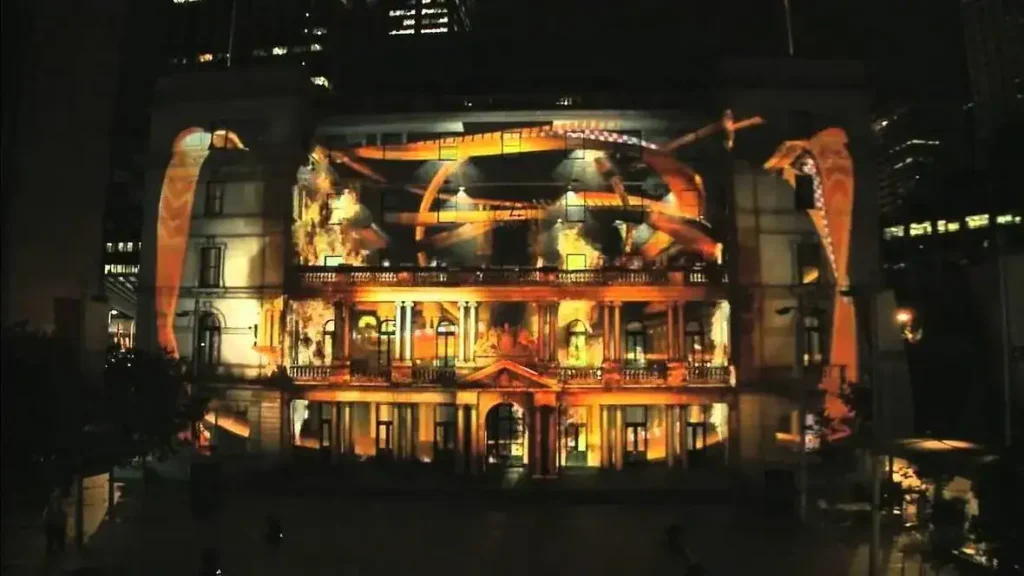
Denver is one of the best projection cities in the country and almost nobody books it that way. Clients come to us wanting projection in Los Angeles or New York because that is where they have seen it, and then we explain what thin dry air at a mile of altitude does to a beam, and the conversation changes.
Projection Advertising is a temporary light installation. A high-output projector throws an image onto a building face, a wall plane or a structure for a defined window of time, usually a few hours on a given night. Nothing is attached. Nothing is left behind. When the generator goes off, the surface is exactly as it was.
That last point is why the format exists, and it is why the permission conversation is genuinely different from every other thing we do. But different is not the same as absent, and the biggest misconception I correct in Denver briefings is the idea that because light leaves no residue, nobody’s permission is needed.
This page covers how projection actually runs in Denver. Which walls work, what altitude does to image quality, the ambient light problem by district, the permission reality, crew logistics, calendar timing, and the things we tell Denver clients to stop asking for.
On rules: this is a grey area. Requirements vary by municipality, enforcement is inconsistent, and what matters in practice is the surface owner, the position you are projecting from, and whether you have documented permission for both. We do not give legal advice.
Why altitude makes Denver unusually good for this
Most projection problems are atmospheric. Humid air holds moisture that scatters light, haze eats contrast, and a beam that looks crisp at the projector arrives at the wall soft and washed out. In a humid coastal market we are constantly fighting that, and the fix is more output, which means bigger units, more power and more truck.
Denver does not have that problem. The city is semi-arid, Köppen BSk, with very low humidity and around 3,100 hours of sunshine a year. The air at a mile up is thin and dry. For projection that is close to ideal: minimal haze, crisp beam definition and good throw distance. An image lands on a Denver wall with edge definition that would need noticeably more output to achieve on the Gulf coast.
The practical consequence is that Denver gives you options other cities do not. Longer throws from further back, which matters enormously when the only legal and practical position for your rig is across a street or in a lot behind you. Bigger images at the same output. Cleaner fine detail, which means type can be smaller and still read.
What altitude does not solve is ambient light, and that is the real constraint here, as it is everywhere. Projection contrast is a competition between your beam and everything else illuminating that wall. Street lighting, building lighting, signage, headlights and spill from neighbouring frontage all subtract from your image. No amount of dry air fixes a wall that is already lit.
That single fact determines district selection in Denver, and it does so very cleanly.
Corridors and walls: where projection works in Denver
Denver is a layered set of districts rather than one dominant core, and for projection the differences between them are decisive.
The River North Art District, RiNo, is the best projection environment in the city and it is not close. It sits just north of downtown, Larimer Street and Brighton Boulevard are its spines, and it is formally organised as an art district with an identity built on street-art alleys, beer gardens and warehouse venues. Three things make it work for this format.
The building stock is warehouse. That means large unbroken wall faces, which is the single rarest and most valuable thing in projection. Most urban facades are broken up by windows, fire escapes, signage, downpipes and changes of material, all of which fragment an image. A blank warehouse flank is a screen.
The ambient light levels are lower than downtown’s. Fewer towers, less illuminated frontage, less overhead glare. Your contrast ratio is simply better.
And the owners are permission-literate. RiNo’s established mural and street-art culture means property owners there are used to being approached about their walls and understand the value exchange. That is not true in most American neighbourhoods and it transforms the tone of the first phone call.
Historic Five Points adjoins RiNo and shares much of that character.
LoDo, Lower Downtown, is the older brick warehouse district closer to the centre, with Larimer Street running through it as a dining and bar corridor. It draws a broader, more mainstream evening crowd than RiNo. The audience is bigger. The projection conditions are worse. Tighter streets mean shorter available throws and fewer positions to set up from, heavier evening crowds mean more obstruction and more crowd management, and downtown spill light is far more aggressive. LoDo can work, but it needs a carefully chosen wall and a position that is genuinely available.
The Art District on Santa Fe runs a gallery-driven rhythm south-west of downtown. Smaller scale, but the audience is culturally primed and the monthly walk gives you a predictable evening with people actually on foot.
Colfax Avenue is the long east-west spine with a music-venue and dive-bar identity. For projection it is a tricky proposition: it is a corridor rather than a concentrated district, so a single projection position reaches a fraction of the people a client imagines, and the corridor’s lighting is uneven. If the message genuinely belongs to Colfax culture, we would usually pick one strong wall on it rather than trying to cover it.
The honest summary: RiNo for image quality and surface, LoDo for audience volume if you accept harder conditions, Santa Fe for gallery nights, Colfax for a single anchored site rather than coverage.
Surfaces: what actually takes an image
Not every big wall is a good wall, and in Denver there are specific things to check.
Colour and tone matter most. A light, neutral, matte wall gives you the brightest and most accurate image. Dark brick swallows light. Glossy or recently sealed surfaces produce hot spots and reflections. Painted murals, which RiNo has a lot of, are beautiful and completely unusable as projection surfaces, because the existing artwork shows through everything you put on it. That catches people out, because the walls that look most exciting in a district survey are often the ones you cannot use.
Texture matters second. Heavy brick relief, deep mortar courses and corrugated metal all break up an image. Some texture is tolerable and even looks good with bold simple artwork. Fine detail dies on it.
Flatness matters third. Angled projection onto a non-perpendicular wall produces keystone distortion, which can be corrected optically and digitally up to a point and then cannot. The further off-axis you are forced to set up, the more image quality you give away.
In Denver there is also a masonry caveat worth raising even though projection touches nothing. Front Range freeze-thaw is severe. Daytime highs near 50 with overnight lows near 10 are routine, and water penetrating a porous surface and freezing expands by roughly nine percent, which is the pressure that flakes brick faces and crumbles mortar. LoDo and RiNo are built substantially of older brick and warehouse masonry, and those faces are often more friable than they look. For projection that is not a damage risk, but it is an image risk: a spalling, patched, repointed wall is a visually noisy wall, and it will show.
Permission, position and the Denver reality
Grey area, and projection has two permission questions where other formats have one.
The first is the surface. Even though light leaves nothing behind, projecting onto a building you have no relationship with is not something we do. It exposes the client, it exposes the crew, and in a city like Denver it burns relationships in districts we want to keep working in. We get the wall owner’s written agreement, and in RiNo that conversation is usually straightforward because the district is organised and owners expect to be asked.
The second is the position. A projector and its power source have to physically stand somewhere, and that somewhere is a lot, a forecourt, a sidewalk or a street. Standing a rig and a generator on private property with the owner’s permission is clean. Occupying public right-of-way is a different question entirely, and Denver maintains ordinance articles covering encumbrances of the right-of-way and temporary occupancy of the public right-of-way. That is the part of the planning that takes the longest and the part clients never budget time for.
UNVERIFIED: the specific current Denver provisions that would apply to a temporary projection installation and to occupying right-of-way for one, and their enforcement posture. We review the current code and speak to the city before a Denver projection night rather than relying on general description, and we recommend clients take their own advice.
Denver’s wider enforcement character is worth understanding even though it concerns physical media rather than light. The City and County of Denver runs Denver Partners Against Graffiti, providing free graffiti removal assistance on business and residential properties through a property owner authorisation form, and business owners may designate their property as a graffiti-free zone. What that tells you is that this is a city with an organised, owner-centred view of what happens to building faces. Owners here think about their facades deliberately. That is good for a permissioned projection conversation and bad for anyone hoping to go unnoticed.
The posture that works in Denver: secure the wall in writing, secure the standing position in writing, talk to the district organisation where one exists, and have a named contact on site on the night.
Crew and night logistics in Denver
A projection night is a smaller crew than a posting night but a more technical one. Typically two or three people: an operator running the unit and content, a technician handling power, cabling and sightlines, and on more complex sites a third managing the position, the public and the client contact.
The night runs in three parts. Setup and alignment, which needs darkness and takes longer than clients expect because final focus and keystone correction can only be judged on the actual wall. The run itself, which is the hours the client is buying. Then strike, which is fast.
Denver specifics shape all three.
Darkness timing swings hard with the season. Summer evenings here stay light late, which pushes a useful start well into the night and compresses the run window. Winter gives you darkness from late afternoon, which is genuinely useful, and it is one of the few formats where a Denver winter is an advantage rather than a problem. Nothing is being glued to anything, so the freeze-thaw and cure issues that dominate our posting schedules simply do not apply. Cold affects the crew and the equipment, not the medium.
Access and parking vary sharply by district. RiNo is the most crew-friendly place in the city for this: warehouse-scale blocks, wider streets, more loading space and real room to position a vehicle and a rig. LoDo is the hardest, with tighter streets, heavier evening crowds and parking that gets considerably worse on Rockies home nights. We check the ballpark schedule before committing a LoDo date.
Nightlife timing matters for audience rather than for access. RiNo and LoDo run late at weekends, so a projection window that ends too early misses the crowd it was bought for. Midweek is quieter in both districts, which is good for setup and bad for reach.
Altitude affects visiting crews. Expect reduced stamina for the first day or two at a mile up, plan a lighter first night, and keep people hydrated, because the very low humidity dehydrates faster than anyone expects.
Weather is the live risk. The format tolerates cold well and tolerates precipitation badly, both for equipment safety and because falling snow or rain scatters the beam. Denver’s rapid swings mean a forecast three days out is less reliable here than in a steadier climate, so we build a contingency night into every projection booking rather than treating it as optional.
Timing against the Denver calendar
Denver publishes a comprehensive Denver365 events calendar, which is the practical planning tool. For projection, the value is in finding nights when the right people are already on foot in the right district.
The Broncos, Rockies, Nuggets, Avalanche and Rapids all play in or around the city, so there is an event-night surge somewhere most weeks of the year. Rockies games drive LoDo foot traffic hard through spring and summer, which is an audience argument for LoDo and a logistics argument against it on the same night.
The National Western Stock Show is the January fixture and brings substantial out-of-town traffic in the depth of winter, when most northern cities are quiet. For projection specifically, January is attractive: early darkness, a real visiting audience, and none of the adhesive constraints that make January difficult for physical formats. It is probably the most underrated projection month in the Denver year.
The Great American Beer Festival is the other signature event, with the published 2026 edition running October 10 to 11 at Levitt Pavilion, having moved outdoors. It draws a national craft-beer audience that pairs naturally with the RiNo and LoDo brewery scene. Confirm dates with the organiser before fixing anything.
Monthly gallery-walk rhythms operate in the Art District on Santa Fe and in RiNo. For projection these are the best recurring opportunities in the city, because they put a culturally receptive audience on foot in exactly the districts where the walls are. Confirm current schedules with each district organisation.
What we talk Denver clients out of
Projecting onto a mural. It comes up constantly in RiNo because the murals are what makes the district visually exciting. Existing artwork shows through a projected image and ruins both. We survey for blank walls.
Downtown core sites chosen for prestige. Clients want a recognisable downtown building and then we measure the ambient light and the available throw position and the answer is no. RiNo will give them a better-looking image to a more receptive audience, and the photographs will be better.
Summer evening starts. In a Denver June, useful darkness arrives late. Clients plan an early evening window because that is when people are out, and then half the booked hours are unusable. We either move the window later or move the booking to a darker month.
Fine detail and small type. Even with Denver’s excellent air clarity, a projected image on a textured brick or warehouse wall is not a print medium. Bold, simple, high-contrast artwork works. Dense layouts do not survive the wall.
Single-night bookings with no contingency. Front Range weather swings fast enough that a one-night booking with no fallback is a coin toss. We build the contingency in.
Treating projection as a substitute for duration. A projection night is a few hours of intense attention. It is not a campaign on its own, which brings me to the thing it should be paired with.
What goes wrong
Position loss is the most common. The lot you surveyed is gated on the night, or a vehicle is parked in the only clean throw line. We survey the position as carefully as the wall and we carry an alternate.
Ambient light underestimated. A wall surveyed at nine in the evening looks very different at eleven when a neighbouring business switches its frontage lighting, or worse, in the other direction. We survey at the actual hour the campaign will run.
Weather. Covered above. Contingency nights.
Power problems. Generator placement, noise and cable runs have to be agreed with the property owner in advance, not negotiated at eleven at night.
Audience mistiming. The image runs beautifully to an empty street because the window ended before the district filled up. We set the hours against how that specific district actually behaves, not against a generic evening.
Pairing projection with poster work across a RiNo flight
Projection is a spike, not a campaign. It produces a concentrated night of attention and a lot of photographs, and then it is gone. Used alone, it is an event rather than a media buy.
The pairing that works in Denver is a Wheatpasting and Poster Campaigns flight running across RiNo and LoDo over several weeks, building frequency with the same audience, with one or two projection nights timed to a gallery walk or an event weekend. The posters do the repetition and the duration. The projection creates the moment worth sharing, and it gives the whole flight a peak that people remember.
Denver supports that combination unusually well, because the same district that gives you the best projection walls also gives you the best permissioned poster surfaces and the owners most willing to discuss both in one conversation.
Frequently asked questions
Do you need a permit for projection advertising in Denver?
It is a grey area and it depends on two separate things: the wall and the standing position. We always secure written permission from the surface owner. Occupying public right-of-way to position a rig raises separate questions, and Denver maintains ordinance articles covering right-of-way encumbrance and temporary occupancy. We check the current code with the city before every Denver booking.
Why is Denver good for projection?
Altitude and dry air. The city is semi-arid with very low humidity, so there is minimal atmospheric haze to scatter the beam. That gives crisp edge definition, good contrast and longer usable throw distances than a humid market allows. Combined with RiNo’s large blank warehouse walls and lower ambient light, it is one of the better projection environments anywhere.
Which Denver walls work best?
Large, flat, light-toned, matte and unlit. RiNo’s warehouse stock is the strongest inventory in the city for exactly that reason. Avoid dark brick, which absorbs light, glossy or sealed surfaces, which produce hot spots, heavily textured faces, which break up detail, and existing murals, which show through any projected image.
Can you project in a Denver winter?
Yes, and winter is genuinely good for it. Darkness arrives early, which widens the usable window, and because nothing is being adhered to anything, the freeze-thaw and cure problems that limit physical formats here do not apply. Cold affects crew and equipment rather than the medium. Precipitation is the real constraint, so we book contingency nights.
How long does a projection night run?
Typically a few hours of live run time, bracketed by setup and alignment beforehand and a fast strike afterwards. The hours are set against how the chosen district actually behaves. RiNo and LoDo run late at weekends, so a window that closes too early misses the crowd. Midweek is quieter and easier operationally.
Is projection a campaign on its own?
Rarely. It delivers a concentrated night of attention and strong imagery, then it is gone. It works best as the peak of a longer flight, paired with poster or snipe work that builds frequency across the same districts over weeks. Used alone, treat it as an event activation rather than as sustained media.
Request a campaign quote
The useful Denver projection conversation starts with the wall, the month and the audience, in that order. Which district your people are actually in, whether you can run in a dark month, and what the artwork needs to do at scale on a textured surface. Those decide far more than output specification does.
Tell us the message and the window. We will come back with surveyed wall candidates, a standing position plan, a permission approach for both the surface and the site, a realistic run window for that district, and a contingency night. If projection is the wrong format for what you are trying to achieve, we will say so before you spend anything.
Request a campaign quote and we will start there.

Ready to Run Your Campaign?
Call us or email us. We’ll tell you exactly what we can do in your market and what it costs.
Related Service
Explore similar advertising solutions offered by American Guerrilla Marketing.
American Guerrilla Marketing — Los Angeles
Street-level campaigns in Los Angeles and nationwide. Wheatpasting, LED trucks, street teams, and more.
(646) 776-2770
Related Articles
-
Guerrilla marketing meaning: How It Actually Works
November 20, 2026
-
Boulder Projection Advertising: Corridors, Permissions and
November 20, 2026
-
Combining Guerrilla and Traditional OOH Campaigns
November 20, 2026
-
Guerrilla Marketing Campaign: A Field Guide From the Crew
November 20, 2026
-
Guerrilla Marketing Ideas: How It Actually Works
November 20, 2026