Postering NYC: Street Advertising That Hits Every Corner in 2026
We’ve walked these streets a thousand times. Bedford Avenue at midnight with a bucket and a stack of posters. Graham Avenue on a Tuesday before dawn. The stretch of Delancey Street just east of Essex where the foot traffic never really stops. Postering is the work we know best, and after years of running campaigns across every borough, we understand exactly how to make a poster placement perform.
American Guerrilla Marketing is a New York City-based street marketing agency. Our crews execute postering campaigns for brands that want real-world visibility in the neighborhoods where their audiences actually live, eat, commute, and go out. This isn’t broadcast advertising. It’s neighborhood-level, block-by-block placement that puts your brand directly in the path of the people you’re trying to reach.
This guide covers everything about postering: how the format works, where we place, how we execute, what it costs, and what you can expect to see when the campaign wraps. If you’re thinking about postering for your brand, read through. By the end, you’ll know exactly what a postering campaign looks like in practice.
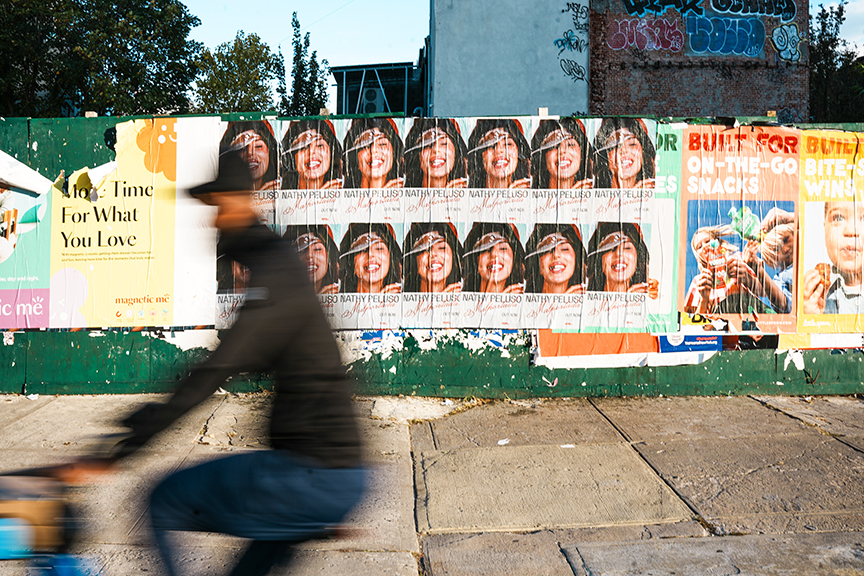
Postering is the practice of placing printed posters on street-level surfaces across high-traffic urban corridors. Our crews affix posters to construction barriers, plywood fencing, utility poles, scaffolding columns, newsstands, and other surfaces throughout the city. We go on foot, block by block, working routes we’ve walked dozens of times. We know which corner on Orchard Street draws the longest dwell time. We know which stretch of Nostrand Avenue sees the most pedestrian crossings on a Friday evening. That knowledge is baked into every campaign we run.
The format is direct and immediate. A poster doesn’t require a click, a download, or an internet connection. It’s physical. It occupies real space in the real world, and it sits in that space for days or weeks at a time. A person walking down Flatbush Avenue on a Monday morning sees your poster. They walk past it again on Thursday. By the end of the week, the image is lodged in their memory in a way no banner ad ever achieves.
Posters have driven street-level advertising for over a century. The medium has survived radio, television, and the full rise of digital advertising because it does something none of those formats can replicate. It meets people where they are, physically, in the neighborhoods they move through every day.
Why Postering Cuts Through in Saturated Markets
New York City is the most media-saturated environment in the country. Digital ads follow people from phone to laptop to tablet. Streaming platforms run pre-rolls. Social feeds serve sponsored content between every few organic posts. The volume of advertising exposures a typical New Yorker absorbs in a single day is staggering, and most of it washes off immediately because the brain has learned to filter it.
A well-placed poster on Second Avenue doesn’t get filtered. There’s no algorithm surfacing it to the wrong audience. There’s no skip button. There’s no competing notification pulling attention away at the critical moment. The poster is simply there, anchored to the physical world, in the path of real foot traffic.
When our crews work a dense corridor like the blocks around 125th Street or the retail stretch along Atlantic Avenue near Barclays, they’re placing posters in front of thousands of pedestrians who pass those surfaces daily. Repeat exposure builds recognition. Recognition builds recall. Recall drives action, and action is what our clients are paying for.
We’ve watched postering campaigns generate social media circulation without any digital spend attached. Someone photographs the poster on their way to the train. They post it. Their followers see it. The poster, placed on a single wall on Essex Street, suddenly reaches an audience far beyond that block. That’s the organic amplification postering generates when the creative is strong and the placement is right.
Where We Run Postering Campaigns in NYC
Manhattan Corridors and Transit Adjacencies
Our Manhattan routes are built around density and demographics. The Lower East Side is one of our most active territories. We work Orchard Street from Broome down to Delancey, Essex Street through the market blocks, and Delancey Street east toward the Williamsburg Bridge. These corridors carry heavy mixed foot traffic from morning through late evening. The audience skews young and culturally engaged, which makes them ideal for entertainment, fashion, food and beverage, and lifestyle campaigns.
We connect Lower East Side runs with the transit adjacencies around the F, J, M, and Z train stops, placing along the surface streets that commuters use to enter and exit the stations. A poster placed near the Essex Street station entrance sees that same cluster of riders pass it multiple times per week.
In Harlem, 125th Street is our primary corridor. We run it from Frederick Douglass Boulevard east through Adam Clayton Powell Jr. Boulevard and on toward Lexington Avenue. The foot traffic on 125th is among the heaviest in any NYC neighborhood, and the commercial density means there are always surfaces available for placement. We extend north and south off the main corridor to hit secondary blocks that catch overflow foot traffic from the main strip.
The East Village gives us Avenue A and the cross streets running through Alphabet City. We run these blocks for clients targeting the arts, music, nightlife, and fashion communities. The audience there has a strong affinity for street-level aesthetics, and posters get genuine attention in that environment. We complement East Village runs with placements along Second Avenue to catch the restaurant and bar corridor that activates heavily Thursday through Saturday.
In Midtown and Chelsea, we work the corridors between Penn Station and the Highline area for clients targeting transit commuters and the arts crowd. Eighth Avenue and Tenth Avenue give us different demographic slices of the same geography, and we route accordingly based on the campaign target.
Brooklyn and Queens Routes We Know by Heart
Brooklyn is where we’ve logged the most hours. Bedford Avenue from Metropolitan Avenue south through the heart of Williamsburg is our most-requested corridor, and for good reason. The mix of foot traffic on that stretch, young professionals, creative workers, out-of-neighborhood visitors, and longtime residents, covers a wide consumer band. The commercial density keeps surfaces available and eyes moving.
We run Graham Avenue east from the L train into East Williamsburg and through the blocks that connect to Bushwick. This corridor has a slightly grittier character than the Bedford Avenue stretch, and it performs exceptionally well for music, art, and underground culture campaigns. The audience there responds to street creative that feels authentic to the environment.
Myrtle Avenue from Bushwick into Bed-Stuy is another route we hit regularly. We’ve run campaigns on Myrtle for clients in fitness, food, entertainment, and apparel. The foot traffic is consistent and the neighborhood is in an active period of commercial growth, which means new businesses, new residents, and new eyes on street placements.
On Flatbush Avenue and Nostrand Avenue in Crown Heights and Flatbush, we’ve executed campaigns for clients targeting the diverse, working-class, and young professional demographics that define these neighborhoods. The transit connections at Nostrand Avenue station and the commercial density along both corridors make these routes high-yield for impression volume.
We connect Atlantic Avenue runs with the blocks around Barclays Center to catch event traffic. When there’s a concert or game, the foot traffic on Atlantic between Fourth Avenue and Flatbush spikes dramatically. Timing postering refreshes around event dates on that corridor is a tactic we use regularly to maximize visibility during high-traffic windows.
In Queens, our primary routes cover Long Island City and Astoria. Northern Boulevard, Steinway Street, and the blocks surrounding the Queensboro Plaza station give us access to the dense, mixed residential and commercial neighborhoods on the western Queens waterfront. We’ve run campaigns there for clients targeting the large South Asian, Greek, and young professional communities that anchor those neighborhoods.
Poster Formats and Print Specs
Standard Sizes and Materials
Our standard postering formats are 11″x17″, 18″x24″, and 24″x36″. Each size has a different application profile based on the surface type and viewing distance we’re targeting.
The 11″x17″ format is our workhorse for pole placements and tight cluster applications. It’s fast to place, efficient on material cost, and works well in locations where surface space is limited. We use this size heavily on Fordham Road in the Bronx, where pole placements along the commercial corridor create a consistent repetition effect across the length of the street.
The 18″x24″ format hits harder on flat surfaces. Construction barriers along Delancey Street, plywood fencing around development sites in Bed-Stuy, scaffolding panels in Midtown. This size has enough visual real estate to carry detailed imagery or typographic creative while still fitting cleanly on a wide range of surfaces. It’s our most commonly specified format for balanced campaigns.
The 24″x36″ format is for impact. When a client needs to own a wall, this is the size that does it. We place these on larger scaffolding panels, long plywood runs, and broad construction barriers where the scale reads from across the street. On high-traffic corridors like 125th Street or Atlantic Avenue, this format commands attention.
Our standard substrate is 100 lb. matte coated stock. It holds color accurately, takes adhesive cleanly, and lies flat without buckling on most surfaces. For campaigns that need extended run time or are scheduled during summer months with high humidity, we print on 130 lb. stock with a UV coating layer. The added weight and coating improve weather resistance and durability through light rain and extended sun exposure.
Full-Color vs. Single-Color and Cost Trade-Offs
Full-color printing is the standard for the majority of campaigns we run. The per-unit cost is higher than single-color, but the visual return on investment on a busy street is clear. A full-color poster with strong photography or bold graphic treatment catches peripheral attention in a way that a limited-color design often doesn’t. When you’re competing with the visual noise of a New York City block, color is an asset.
Single-color printing makes sense in specific contexts. High-volume campaigns where saturation is the primary goal benefit from the lower cost per unit that single-color provides. Instead of placing 200 full-color posters, a client might place 500 single-color units across a wider geography, trading polish for density. For certain creative aesthetics, especially in music, underground culture, and DIY consumer brands, single-color printing on neon stock or uncoated natural paper actually performs better than full-color because it reads as authentic to the environment.
We help clients make this call during the planning phase. Print budget and placement budget need to balance. Spending the majority of a campaign budget on premium print while leaving little for placement volume is a common mistake. We walk clients through the unit economics so the final plan allocates resources in a way that maximizes actual street presence.
We handle print coordination in-house for all packages. Clients provide final print-ready files in the appropriate format, and we manage the rest. Turnaround from file to street is typically five to seven business days depending on volume and schedule.
How We Execute a Postering Campaign
Route Planning and Team Deployment
Every campaign starts with a route planning session. Our team maps the target neighborhoods against the client’s audience profile, identifies the highest-value corridors and surface clusters, and builds a deployment plan that covers the geography efficiently. We don’t send crews out to wander. Routes are pre-built with specific placements marked, surface types noted, and timing windows mapped.
Client targeting drives the routing decisions from the start. A record label pushing a new release to the Brooklyn hip-hop audience gets a different route than a fitness brand targeting the Astoria and Long Island City professional demographic. A fashion label launching in SoHo and the East Village needs different corridors than a food brand building presence in Crown Heights and Flatbush. We build those distinctions into the map before the first poster goes up.
Crews deploy in teams of two. Two-person crews can cover a full neighborhood route in a single overnight run. One person applies adhesive, one places and smooths the poster. They move fast and maintain quality throughout the run. We assign experienced crew leads to every deployment, and those leads are responsible for confirming placements are executed to spec and documenting locations as they go.
For multi-borough campaigns, we deploy multiple crews across zones on the same night. A campaign that needs to cover Williamsburg, the Lower East Side, and Harlem in the same window runs three crews, each working their own zone at the same time. Each crew has their assigned route. They report back when complete, and we compile the documentation the same day.
Night Runs, Morning Refreshes, and Duration
Most placements happen at night. Our crews go out after 10 PM and work through the early morning hours, typically wrapping by 4 or 5 AM. Working at night keeps crews clear of peak pedestrian congestion and allows faster movement through routes. By the time morning commuters are on the street, the campaign is already up and running.
Morning refresh runs keep campaigns active over multi-week durations. High-traffic corridors see more competition for wall space. A poster placed on Delancey Street on a Monday might be partially covered by a competing placement by the following weekend. Refresh runs go back to the route, replace any compromised placements, and keep the campaign at full density for the scheduled duration.
Duration planning is part of every campaign conversation. For a single event with a specific date, a one-week run with one refresh is usually the right structure. The posters go up seven to ten days before the event and stay active through the date. For brand campaigns without a single activation date, two to four weeks is our most common duration. Longer campaigns up to eight weeks use rotating zone coverage, hitting different neighborhood clusters in different weeks to extend geographic reach without dramatically increasing the weekly placement count.
We confirm the complete route documentation with clients at the end of each run. Every campaign ends with a photo report delivered within 48 hours of the final placement date.
Postering Pricing and Packages
What Affects Your Quote
Postering pricing is driven by three variables: volume, geography, and duration. Understanding how each one affects the overall cost helps clients plan campaigns that fit their budget without sacrificing the elements that make the campaign work.
Volume is the biggest cost driver. Labor per unit decreases as volume increases. The crew time required to place 500 posters is not five times the crew time required to place 100 posters, because the movement and logistics of the run are largely fixed costs. Print economies of scale apply as well. A 1,000-unit print run has a meaningfully lower per-unit cost than a 100-unit run. This means volume campaigns are more efficient per placement, and clients who can commit to higher volume get more out of each dollar spent.
Geography affects crew time and logistics complexity. A campaign concentrated in one Brooklyn neighborhood is faster and cheaper to execute than one spread across four boroughs. Multi-borough campaigns require more crew hours, more coordination between teams, and more route management overhead. That added complexity is real cost, and it’s reflected honestly in the quote.
Duration adds cost through refresh runs. A single overnight placement is the most economical structure. Adding one or two refresh visits multiplies the crew hours deployed. Clients who want a four-week active campaign with weekly refreshes are investing in sustained presence, which requires sustained crew engagement. We structure multi-run campaigns so each refresh is efficient, but the cumulative labor is priced accordingly.
Print is included in all our packages. Clients provide print-ready files, and we handle production and delivery to the crew. There are no hidden print markups. What you see in the package is what the campaign costs.
Postering Package Comparison
Package
Posters Placed
Coverage Area
Duration
Refresh Runs
Print Included
Photo Report
Starter
100
1 neighborhood
1 week
None
Yes
Yes
Launch
250
2 to 3 neighborhoods
2 weeks
1 refresh
Yes
Yes
Borough
500
1 full borough
3 weeks
2 refreshes
Yes
Yes, after each run
City-Wide
1,000+
Multi-borough
4 weeks
Weekly
Yes
Yes, after each run
All packages include route mapping, crew deployment, adhesive and materials, and a photo documentation report delivered after each run. Custom packages are available for campaigns with specific geographic or scheduling requirements. Call us and we’ll build a quote around your actual campaign goals.
Combining Postering with Other Street Marketing
Wheatpaste Plus Postering
Postering pairs naturally with wheatpaste campaigns, and combining them in the same activation is one of the most effective things we do for clients running larger street marketing pushes. Wheatpaste applications go up on large flat walls, long construction barriers, and broad plywood panels where the adhesive bonds the print directly to the surface. The result is a piece that sits flush with the wall and reads at a much larger scale than a standard poster placement.
When we run wheatpaste and postering together, we structure the two formats to cover different surface types and different viewing distances. The wheatpaste applications anchor the campaign on the major walls along the route, reading from across the street or from half a block away. The postering fills in the pole placements, scaffolding panels, and smaller surfaces throughout the same corridor, delivering the campaign image at closer range and to pedestrians moving through the blocks.
A client launching a product in Brooklyn might get wheatpaste applications on the signature walls along Bedford Avenue and the long plywood stretches on Graham Avenue, with postering covering the poles and smaller surfaces throughout the same zone. A pedestrian walking that route encounters the campaign multiple times in multiple formats. The combined presence reads as a campaign, not a single placement, and that sense of scale drives stronger brand recall than either format could achieve in isolation.
We coordinate wheatpaste and postering crews to execute on the same schedule so both elements go up together. The campaign launches at full density on the first night.
Street teams and postering work together as a push-pull combination that addresses two different audience behaviors. Postering builds ambient presence. People encounter the brand through their daily movement through a neighborhood. The poster doesn’t demand action in the moment. It accumulates exposures over time. A street team works the opposite end of that dynamic, creating direct contact with people in the same geography at the same time.
When we run both together, the postering crew goes out the night before and gets the campaign up across the target corridor. The street team deploys the following day into the same geography, working the sidewalks while the posters are live on the walls behind them. The brand is visible in the environment, and the team is reinforcing that presence through direct conversation, sampling, or material distribution.
We’ve run this combination on Orchard Street for retail clients, on 125th Street for entertainment clients, along Atlantic Avenue for food and beverage brands, and on Nostrand Avenue for health and wellness companies. The dynamic works in every neighborhood because the logic is consistent. A person who has already seen your poster on the block is warmer to the street team than someone who has no prior brand exposure. The postering does priming work. The team does conversion work.
For event campaigns specifically, this combination delivers clear results. The posters drive awareness in the days leading up to an activation. The street team drives attendance and engagement on the event day itself. We schedule both elements as part of a single integrated campaign plan so timing and geography are fully coordinated.
What Clients See After a Postering Campaign
Impression Data and Coverage Maps
Every campaign ends with a documentation report delivered within 48 hours of the final placement run. Our crews photograph placements throughout each night’s work, capturing the poster in context: the surface, the surrounding environment, and the placement quality. We compile those images into a report organized by location so clients can see exactly where each placement went up.
For multi-neighborhood and multi-borough campaigns, we build a coverage map overlaid on a geographic view of the city. You can see the density of placements in each zone, verify that the route executed as planned, and identify which corridors received the highest concentration of placements. Coverage maps are a useful internal document for campaign reporting and for communicating street marketing impact to decision-makers who weren’t on the ground during the run.
Impression estimates are calculated from foot traffic data for the corridors we covered. We cross-reference our placement locations with pedestrian traffic counts from publicly available urban mobility data. The resulting impression ranges give clients a directional sense of campaign reach based on realistic daily foot traffic past each placement surface. These are estimates, not panel-certified numbers, but they’re grounded in actual pedestrian movement data and are directionally accurate for planning and reporting purposes.
We keep our reporting honest. We won’t inflate impression numbers to justify a campaign. We tell you what we placed, where we placed it, and what kind of foot traffic moves past those locations based on available data. You can evaluate that against your own goals and make informed decisions about future campaigns.
Brand Recall and Social Capture
Physical postering creates social media circulation that’s genuinely difficult to plan for but consistently happens when the creative is strong and the placement is in a high-attention neighborhood. Someone sees your poster on Bedford Avenue. They photograph it. They post it with a tag or a mention. Their followers see it. The reach of that single poster extends past the physical surface it’s on and into a digital audience that was never part of the original placement geography.
We’ve watched this happen for music clients, fashion brands, film campaigns, and product launches. A 200-poster run in Williamsburg and Bushwick generates a social footprint that appears in our clients’ analytics as a spike in brand searches, profile visits, and direct mentions in the 72 hours following placement. That organic amplification is a real return on the campaign investment, and it’s one of the reasons street postering continues to perform for brands that have already tried and exhausted digital-only strategies.
Brand recall from repeated physical exposure works differently than recall from digital. A person walking down Second Avenue passes the same poster on Monday, Wednesday, and Friday. Each pass reinforces the brand image in a real-world context. That repetition, anchored to a physical place they move through regularly, creates memory encoding that a single digital impression can’t replicate. By the end of a two-week campaign, people in that neighborhood have a clear mental image of your brand even if they never consciously stopped to read the poster. That’s street presence working as it’s designed to.
Frequently Asked Questions
What is postering in marketing?
Postering is the placement of printed posters in public spaces to build brand awareness, promote events, or drive local market presence. Formats range from small flyposted sheets to large-format outdoor prints on construction hoardings.
What poster sizes work best for street campaigns?
24×36 and 27×40 are common street postering sizes. Larger formats like 4-sheet (48×72) and 8-sheet (96×72) work for high-visibility wall placements. Format choice depends on location, viewing distance, and campaign goals.
How does AGM handle postering campaigns?
AGM manages the full postering workflow: creative review, print production, site scouting, permits where required, installation by field crews, and photo documentation of every placement.
AGM runs postering programs in major US markets including New York, Los Angeles, Chicago, Houston, Atlanta, Austin, Philadelphia, and dozens of secondary markets. Call (646) 776-2770 to discuss your target cities.