How to Get Ahead in Advertising: 12 Strategies That Move the Needle
Every brand in your category is fighting for the same eyeballs on the same platforms using the same playbook. They’re all buying Google keywords, running Meta retargeting, posting three times a week on Instagram, and wondering why their cost-per-acquisition keeps climbing. Getting ahead in advertising means doing something they’re not doing, in a way that builds real brand momentum. This guide lays out how.
We run street-level advertising campaigns in New York City and across the country for brands that have figured out that the crowded platforms aren’t going to give them the edge they need. Our crews paste posters on the walls of Williamsburg, run street teams outside Penn Station during morning rush, project brand imagery onto building facades in the Meatpacking District. We’ve watched what works and what doesn’t for over a decade. The strategies in this guide come from that direct experience.
Some of what follows will reinforce things you already know. Some of it will challenge your current approach. All of it is designed to help you think more clearly about where your advertising dollars are actually building something durable and where they’re just renting attention that disappears the moment the billing stops.
Most brands treat physical advertising as an afterthought. Something they consider when digital underperforms, or when there’s a launch event that needs local support. That’s backwards. Physical presence, whether through street posters, ambient installations, vehicle wraps, or street team activations, builds brand recognition in a way that compounds over time and doesn’t reset to zero every time you pause your ad spend.
Why Physical Presence Compounds
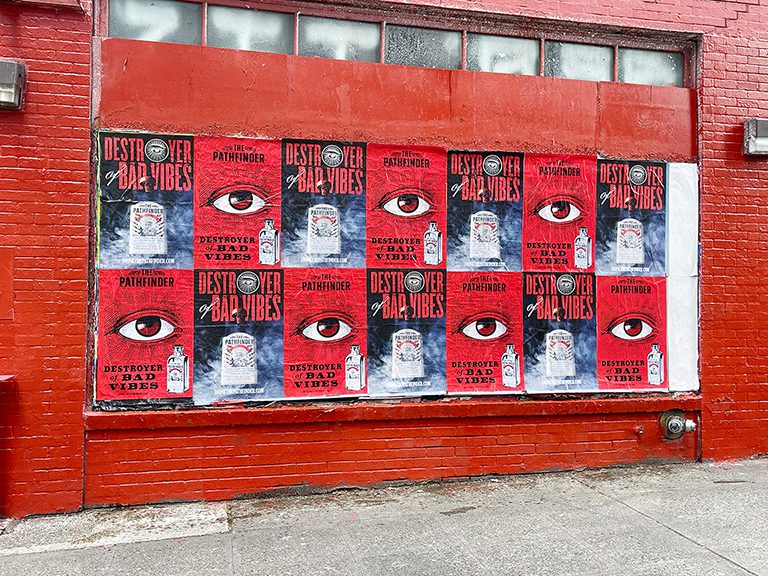
When we run a wheat paste poster campaign for a client in Williamsburg and they come back six months later for a second run, we consistently find that the second campaign performs better than the first. Not because the posters are in new locations, but because the audience has already been introduced to the brand. The second wave of street presence lands on people who have a prior mental association with the brand, even if it’s faint. Recognition builds. Familiarity builds trust. Trust drives conversion.
A brand that maintains a consistent physical presence in its core markets, even at modest scale, is building brand equity that brands spending exclusively on digital are not. When you’re on the walls of the neighborhood your audience walks through every week, you become part of the environment. That’s worth more than most marketers calculate.
How to Start Small and Build
You don’t need a massive budget to start building physical presence. A focused wheat paste campaign of 75 to 100 posters in one or two target neighborhoods costs $2,000 to $4,000. Do that quarterly in your core market for a year, and you’ve spent $8,000 to $16,000 building consistent neighborhood-level brand recognition that supports everything else you’re doing. That’s less than most brands spend on a single month of paid social, and it doesn’t disappear when the billing stops.
2. Stop Competing on the Same Platforms as Everyone Else
If all of your advertising is happening on Meta, Google, and TikTok, you’re in the most crowded rooms in the history of commerce. The platforms benefit from the congestion because it drives up bid prices. You pay more for each impression every year, and you’re competing against every other brand targeting your audience, including your direct competitors who are using the same targeting tools with the same signals.
Find the Uncrowded Channels
The channels with the lowest competition are almost always the physical and experiential ones. Your competitor isn’t running street teams outside the transit hub where your audience commutes. They’re not pasting posters in the neighborhood where your customers live. They’re not projecting their brand onto the wall of the building near the bar where your customers go on Friday night. That uncrowded space is where you can build recognition without fighting a bidding war.
We’ve run campaigns in neighborhoods where the only advertising on the walls was our client’s. No competition. No noise. Just your brand in the visual field of your exact target audience, at a cost that’s a fraction of what you’d pay to reach the same number of people on a saturated digital platform.
Physical Advertising Generates Digital Results
The other reason to move budget toward physical channels is that they feed back into digital. When your street campaign generates organic social content, when people photograph your installation on Bedford Avenue and post it to Instagram, when press covers your activation outside Barclays Center, you’re getting digital distribution without paying a platform for it. A great physical campaign doesn’t just reach people in the street. It generates earned media that extends that reach enormously.
3. Concentrate Before You Expand
One of the most common mistakes we see brands make is trying to be everywhere at once with insufficient budget. They spread a modest campaign across twelve neighborhoods, two cities, and four formats, and end up with too little presence in any single zone to make an impact. A thin presence everywhere is worth less than a concentrated presence somewhere.
The Saturation Principle
When we run a concentrated campaign in Williamsburg, Bushwick, and Greenpoint in a single week, our client’s brand becomes unavoidable in those neighborhoods. Someone living on South 4th Street and working near Graham Avenue walks past our client’s campaign four to six times a day for three weeks. That’s not advertising. That’s brand immersion. It creates a sense of ubiquity that feels far larger than the actual spend.
Concentrate your budget in your highest-value markets before expanding. Dominate two blocks before you try to cover twenty. Build genuine recognition in one neighborhood before going borough-wide. The brands that feel biggest in street presence aren’t always spending the most money. They’re spending it in the most concentrated way.
Stacking Formats for Maximum Impact
Concentration applies to formats as well as geography. Stacking a wheat paste poster campaign with a street team activation in the same zone in the same week creates a compounding effect. The posters prime people to recognize the brand. The street team creates a direct human interaction with people who have already seen the campaign. The combination works better than either format alone because the audience is meeting your brand in multiple modes over a short time window.
4. Use Competitor Proximity Strategically
Your competitor’s location is one of your most valuable advertising sites. The people walking into your competitor’s store, restaurant, gym, or office are exactly the people you want to reach, and they’re concentrated in a predictable location at predictable times.
How to Work the Perimeter
We don’t place campaigns inside competitor spaces, and we don’t interfere with their materials. We cover the three to five block radius around competitor locations with our client’s brand. If someone is deciding between two fitness studios in the Upper West Side and they walk past our client’s campaign on the way to and from the competitor’s studio, the competitor’s foot traffic is doing some of our client’s marketing work for us.
This applies to any brand with identifiable competitor locations. Restaurants near competing restaurants. Retailers near competing retailers. Professional services near competing firms. We’ve run conquesting campaigns for a downtown law firm around the offices of two competing firms in the Financial District, covering the entry points, nearby coffee shops, and transit exits that served both firms’ client and employee populations. The firm’s name recognition in that zone climbed measurably in the quarter after the campaign.
5. Time Your Campaigns to Cultural Moments
Advertising that runs at a moment of heightened cultural attention performs better than the same advertising run on a random Tuesday in February. The moment amplifies the message. A campaign timed to align with a major cultural event, a seasonal transition, a sporting moment, or a neighborhood event is swimming with the current instead of against it.
NYC’s Calendar of Amplification Moments
We build a campaign calendar every year around the moments in New York City that create heightened audience attention. New York Fashion Week in September brings an extraordinary concentration of media, influencers, and brand-aware consumers into specific Manhattan neighborhoods for ten days. The weeks surrounding major concerts at Madison Square Garden and Barclays Center bring large, definable audiences to predictable locations. The summer Saturdays on the High Line draw a specific demographic every weekend from May through September.
Back-to-school season in late August and early September transforms every corridor near NYU, Fordham, Columbia, Brooklyn College, and the other major campuses in the city. A brand targeting a college or young professional audience that runs street campaigns in those corridors during the first two weeks of September reaches an audience that is newly arrived, highly impression-able, and actively establishing the local brand relationships that will define their spending patterns for the next several years.
6. Build for Share, more than Reach
Advertising that gets shared extends its own reach without additional cost. Every piece of organic content that someone creates because they photographed your campaign installation is earned media. It reaches their followers, many of whom are part of your target audience, at zero marginal cost to you. Building campaigns that are inherently shareable is one of the highest-use moves in modern advertising.
What Makes Street Campaigns Shareable
Shareable street campaigns have three characteristics. They’re visually interesting enough to photograph well. They’re in a location that people already photograph. They have some element that makes the person who shared it look good by association, whether it’s humor, beauty, cultural relevance, or insider knowledge.
We’ve run installations that generated thousands of organic social posts from a single night’s work. A projection campaign on the facade of a building near Houston and Bowery, timed to run during a weekend evening when that intersection is dense with people, can generate more organic Instagram content than a focused influencer campaign at a fraction of the cost. The key is that the installation is worth posting. That’s a creative question, not a budget question.
Designing for the Camera
We now think about every campaign from the perspective of someone photographing it on their phone. Does it read well in a 4:3 crop? Does the text resolve clearly at phone camera range? Is there a natural framing that an amateur photographer would gravitate toward? Campaigns designed with these questions in mind generate more organic content than ones designed purely for in-person viewing. The two are usually compatible, but it requires intentional design.
7. Maintain Presence, more than Peaks
Campaign thinking is episodic. Brands run big pushes for launches, holidays, and events, then go dark in between. Brand-building thinking is continuous. Brands that maintain a consistent presence in their markets, even at modest scale between major campaign moments, build recognition faster and more durably than brands that spike and disappear.
The Sustained Campaign Model
We have clients who run monthly wheat paste refresh campaigns in their core neighborhoods. The budget per run is modest. The cumulative effect over a year is significant. By the end of the year, their brand has been part of the visual environment of their target neighborhoods for twelve consecutive months. People who moved into those neighborhoods mid-year already know the brand by the time they’ve been residents for three months. That depth of local recognition is very difficult to achieve with episodic campaigns no matter how large the individual spend.
8. Know Your Audience’s Physical Geography
Most brands know their digital audience well. They know the demographic profile, the interest categories, the devices and platforms. Fewer brands know where that audience physically exists in the city, which blocks they live on, which transit lines they ride, which neighborhoods they frequent on weekends, where they eat and work out and buy groceries.
Mapping the Physical Audience
We start every campaign brief with questions about the physical geography of the target audience. Where in New York do they live? What transit lines do they rely on? What’s their work commute look like? Where do they go on weekends? What cultural institutions do they patronize? The answers to these questions determine campaign geography. And campaign geography determines who actually sees the work.
A brand whose target audience lives primarily in Park Slope, Prospect Heights, and Crown Heights and works in Downtown Brooklyn or Midtown should be advertising along the 2/3 train corridor, along Flatbush Avenue, along Atlantic Avenue, and at the transit connections between those neighborhoods and Midtown. That geography is specific and it’s knowable. We know it because we’ve walked it.
Advertising Format Comparison: Channels and What They Deliver
Here’s an honest comparison of the major advertising formats available to brands in New York City, based on our experience across hundreds of campaigns.
CPM estimates for physical formats are based on foot traffic data for typical New York City placement locations. Actual numbers vary significantly by specific location and campaign design.
9. Create Urgency Without Desperation
Urgency drives action. Desperation drives away. The difference is context and confidence. An ad that creates urgency does so by making an offer genuinely time-sensitive, by connecting to a cultural moment that has a natural end, or by communicating scarcity that’s real. An ad that feels desperate does so by over-explaining, over-discounting, or begging for attention through volume rather than quality.
In street advertising, urgency looks like a campaign that’s clearly tied to an event or moment. A poster for an album dropping on Friday. A campaign covering the blocks around a new restaurant that opens next week. An installation timed to coincide with a cultural event that will draw the target audience to a specific location. The temporal connection between the campaign and the moment creates natural urgency without requiring a countdown timer or SALE banner.
10. Measure What You Can, Accept What You Can’t
Digital advertising’s great promise was perfect measurement. That promise has turned out to be significantly overstated. Attribution models are broken, iOS privacy changes have gutted signal quality, and last-click models misrepresent the actual customer process. Meanwhile, street advertising gets dismissed because it can’t produce a click-through report.
The truth is more nuanced. Street advertising can be measured, not with the same precision as digital, but meaningfully. We track foot traffic-based impression estimates for every placement location. We monitor organic social content generated by campaigns. We look at spikes in branded search volume that correlate with campaign timing. We count direct interactions in street team activations. Combined, these give a clear enough picture to make investment decisions, and they often show results that purely digital attribution would never capture because the customer touchpoints happened in physical space.
11. Keep the Creative Ruthlessly Simple
In physical advertising environments, you have about half a second to register before the audience moves on. Complex messaging, multiple calls to action, and design that requires effort to parse are all waste. The strongest street campaigns communicate one thing, clearly, with a visual that stops the eye before the brain has caught up.
We’ve seen clients send us artwork that looks exceptional in a PowerPoint presentation and falls completely flat at 24×36 inches on a wall. A poster is not a brochure. It’s not a landing page. It’s a signal that has to complete its job before someone takes their next step. One message. One brand mark. One visual. Get those three things right and everything else follows.
12. Work With People Who Know the Street
The tactics in this guide sound straightforward. They require real expertise to execute. Knowing which surfaces hold paste through a rain week. Knowing which block in Crown Heights sees five times the foot traffic of the block next to it. Knowing how to position a street team at the corner of 14th and 8th versus 14th and 7th based on pedestrian flow patterns. Knowing which projection surfaces in Lower Manhattan have line-of-sight from the longest approach angle. These things are learned in the field over years, not in an agency conference room.
When you’re investing in street-level advertising, you need operators who have done it thousands of times, who know the city, and who treat execution quality as a professional standard. Shortcuts in this format show. Bad paste jobs peel in two days. Street teams that don’t know the brand create awkward interactions. Projections pointed at the wrong surface are invisible from thirty feet. The details matter.
Frequently Asked Questions
What skills matter most for a career in advertising?
Strategic thinking, clear writing, an understanding of consumer behavior, and the ability to connect creative ideas to measurable outcomes are the skills that move advertising careers forward fastest.
Is guerrilla and street-level advertising a growing career path?
Yes. Brands increasingly allocate budget to non-traditional, street-level formats as digital ad costs rise and attention fragmentation increases. Field marketing, experiential, and OOH execution roles are in demand.
How does working at an independent agency differ from a large network agency?
Independent agencies typically run leaner, move faster, and give junior team members more direct client exposure. Network agencies offer more structure, resources, and formal training tracks.
What does AGM look for when building campaign teams?
AGM values operators who think clearly under pressure, communicate in plain language, and understand what it takes to execute in real-world conditions — not just what looks good in a deck.