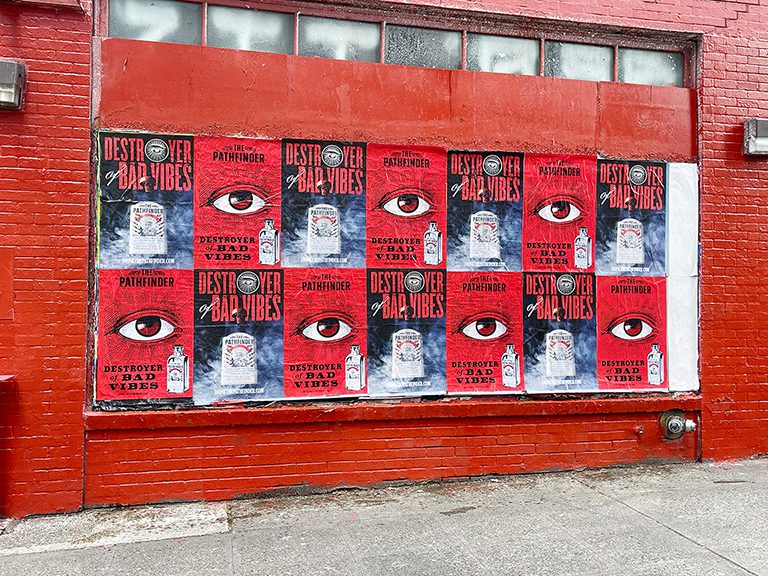
Poster size in inches is the practical starting point for every print marketing campaign. Before design, before printing, before placement, you need to know what size your poster is. The answer determines your file setup, your print cost, your placement options, and the visual impact your campaign will have in the real world.
We produce and place poster campaigns across New York City and major markets every week. These are the poster sizes in inches that we work with, the ones that matter, and the guidance on using each one effectively.
The smallest sizes that qualify as posters rather than flyers or documents start around 11 x 14 and 11 x 17 inches. Below 11 x 14, you are working in standard paper territory, and the line between a flyer and a poster blurs. Above 11 x 14, the format starts to read as a poster in its own right.
The 11 x 14 is primarily used for photo prints and framed retail displays. It is not a marketing standard in the same way that 11 x 17 is. The 11 x 17 is tabloid size, the smallest truly standard poster used in promotional contexts. It works for bulletin board campaigns, small venue distribution, and supporting elements in larger multi-size campaigns.
Mid-Range Poster Sizes in Inches
The 18 x 24 inch range is where poster sizes start to earn genuine marketing presence. An 18 x 24 poster is visible from across a retail floor, reads clearly in a bar or restaurant window, and commands a meaningful portion of an interior wall.
This size is the workhorse of retail promotional campaigns. Product launches, seasonal promotions, event announcements. The 18 x 24 fits most retail display hardware, is affordable to print in volume, and works across indoor environments without the logistical challenges of larger formats.
For campaigns that need both indoor and outdoor elements, 18 x 24 typically handles the indoor placements while 24 x 36 handles the outdoor ones. This pairing is one of the most common multi-size campaign structures in the industry.
The 18 x 24 Sweet Spot
In our experience, 18 x 24 is the most versatile size for campaigns with mixed indoor and outdoor placement needs. It is small enough to fit most indoor display locations but large enough to attract attention in those spaces. It is also a reasonable outdoor size in environments where wall space is limited.
The Primary Street Marketing Poster Size in Inches
Twenty-four by thirty-six. If you do one thing after reading this article, memorize this size. It is the backbone of street-level marketing poster campaigns in the United States. Every practitioner knows it. Every print shop produces it. Every street campaign defaults to it when no other constraint is present.
Why 24 x 36? Because it is large enough to read from 20 feet away. Because it fits standard frames. Because print shops have optimized their equipment and processes around it over decades. Because the frame market is built around it. Because it has become the default through a decades-long feedback loop of supply and demand.
On a construction wall in Williamsburg or a retail exterior in the Meatpacking District, a well-designed 24 x 36 poster commands attention. You can build an entire campaign around a single size if that size is 24 x 36. It is not the only answer, but it is always a valid one.
Entertainment Industry Poster Sizes in Inches
The entertainment industry has two specific standard poster sizes that differ from general marketing standards. Understanding these matters if you work with entertainment clients or want your campaign to speak the visual language of the entertainment world.
The one-sheet is 27 x 40 inches. This has been the US movie poster standard since the mid-20th century. It is the size that theater lobbies were built around. Its cultural resonance is substantial. A 27 x 40 poster signals “major release” in the collective visual memory of the American public.
The quad sheet is 30 x 40 inches. It was used in wider-format theater lobbies and transit environments. It has a slightly different aspect ratio than the one-sheet, giving it a more expansive horizontal feel. Less common in general marketing, but standard in certain transit and venue contexts.
Large Format Poster Sizes in Inches
The 36 x 48 inch format sits at the boundary between traditional poster printing and wide-format printing. At 3 feet by 4 feet, it requires wide-format printing equipment, more careful handling, and usually more lead time than smaller standard sizes.
For street campaigns, 36 x 48 is a premium format. It creates a visual takeover impression on a construction wall. A cluster of 36 x 48 posters covering a large wall section is genuinely impressive. For flagship campaign moments, brand launches, and high-profile events, the scale justifies the additional cost and production complexity.
The 48 x 72 inch format is the largest commonly produced standard poster size. At 4 feet by 6 feet, it reads from a full block away in an urban environment. Production at this scale involves wide-format inkjet equipment, specialized paper or substrate, and multi-person installation. The investment is significant. When the campaign moment justifies it, the result is extraordinary.
When to Go Large Format
Go large format when: you have one high-visibility location that will generate thousands of daily exposures, your creative is bold enough to fill the scale, and your budget allows for the premium production and placement costs. Large format is about quality of placement, not quantity. One perfectly placed 48 x 72 can outperform 50 smaller posters in the wrong locations.
Poster Sizes in Inches vs. Centimeters
The US works in inches. Most of the rest of the world works in centimeters or uses the ISO A-series system. If you are working with international vendors, here is a quick conversion reference:
US Size (inches)
Width (cm)
Height (cm)
Nearest ISO Size
11 x 17
27.94
43.18
A3 (29.7 x 42 cm)
18 x 24
45.72
60.96
A2 (42 x 59.4 cm)
24 x 36
60.96
91.44
A1 (59.4 x 84.1 cm)
36 x 48
91.44
121.92
A0 (84.1 x 118.9 cm)
Choosing the Right Poster Size in Inches for Your Campaign
Your poster size in inches should be determined by your campaign’s placement environment, not by habit or convenience. Here is the decision process:
Start with your placement locations. Survey them before you design or print. Measure the available wall space. Note the viewing distances from the typical audience position. Identify any physical size constraints (door frames, display hardware, landlord restrictions).
Match size to viewing distance. For every 10 feet of viewing distance, you generally need to increase your poster size by roughly 6 to 8 inches in each dimension to maintain legibility. A 24 x 36 works at 15 to 20 feet. For 30-foot viewing distances, consider 36 x 48 or larger.
Consider your print quantity relative to your budget. More per unit for larger sizes. Fewer units means less coverage. Decide whether coverage or impact matters more for this specific campaign moment.
Paper and Substrate Options for Poster Printing
The physical material your poster is printed on affects how it looks, how long it lasts, and how much it costs to produce. Understanding your substrate options is part of making an informed decision about your campaign.
Matte paper. The standard substrate for most marketing poster production. It absorbs ink well, renders colors accurately, and does not produce glare in indoor environments. Matte is the right choice for most indoor campaigns: venue posters, retail displays, and bar and coffee shop placements. It is not weather-resistant and will degrade quickly when exposed to moisture.
Satin or semi-gloss paper. A middle option between fully matte and high-gloss. Satin papers produce slightly more vibrant colors than matte while avoiding the harsh glare of high-gloss in lit indoor environments. Many clients use satin for high-quality retail and gallery placements where visual quality is a priority.
Gloss paper. High-gloss finishes produce the most vivid color and sharpest image reproduction. They work well in low-light environments or in any setting where the poster will be viewed at close range. In brightly lit retail environments, gloss can create reflections that reduce legibility from certain angles.
Vinyl banner material. The standard substrate for outdoor poster placements. Vinyl resists moisture, UV light, and the physical abrasion of outdoor environments. It is heavier than paper and more expensive per square foot, but for campaigns that need outdoor durability, it is the correct choice. Most street campaign wheat-paste posters use a coated paper rather than vinyl because the paste process is not compatible with vinyl, but vinyl works well for framed outdoor placements and billboard-style installations.
Synthetic or polypropylene paper. Waterproof synthetic papers offer the look and feel of paper with significantly improved water resistance. They are more expensive than standard paper but less expensive than vinyl, making them a good middle option for outdoor placements in lower-weather-risk environments or for transit-adjacent placements where some moisture exposure is likely but full outdoor weatherproofing is not required.
Fabric tension systems. For trade show and event use, fabric prints stretched over aluminum frames are increasingly common. Fabric prints look premium at close range, pack compactly for transport, and install quickly compared to rigid substrates. They are not appropriate for street placement but are excellent for indoor activation displays and event backgrounds.
Print File Setup: Getting Your Specs Right at Every Size
Every poster size in inches requires a specific file setup to print correctly. Getting this wrong is one of the most expensive mistakes in print production, because a file that is too small in pixel dimensions will print with visible pixelation. By the time you discover it, the printing cost is already spent.
The rule is: multiply each dimension in inches by your target DPI to get the required pixel dimension. For close-viewing indoor placements, we recommend 150 to 200 DPI. For standard outdoor viewing distances, 100 to 150 DPI is generally sufficient. For posters that will be viewed from ten feet or more, 100 DPI is adequate. Here are the pixel dimensions for the most common poster sizes at key DPI values.
For 11 x 17 at 150 DPI: 1,650 x 2,550 pixels. For 18 x 24 at 150 DPI: 2,700 x 3,600 pixels. For 24 x 36 at 150 DPI: 3,600 x 5,400 pixels. For 27 x 40 at 150 DPI: 4,050 x 6,000 pixels. For 36 x 48 at 100 DPI: 3,600 x 4,800 pixels.
Always include bleed. A standard bleed of 0.125 inches on all sides adds a small margin of safe printing area around the edge of your design. Without bleed, any slight misalignment in the cutting process will result in a white edge on one or more sides of the finished poster. Set your document with bleed and keep essential content inside the safe zone, which is typically 0.25 inches from the trim edge on all sides.
Submit print files in PDF format using the PDF/X-1a or PDF/X-4 standard for maximum compatibility. Embed all fonts. Convert all colors to CMYK before export. RGB files will be converted by the printer, and the color shift between RGB and CMYK can be significant for saturated colors. What looks vibrant on your monitor in RGB may look dull in CMYK. Proof your colors in CMYK mode before finalizing.
How Poster Size Affects Visual Impact on Different Surfaces
The same poster design produces very different visual impact depending on the surface it is placed on. Understanding how size interacts with surface type is critical for campaigns where the wall is part of the statement.
On a clean white interior wall in a retail environment, a 24 x 36 inch poster dominates the space and commands attention at 15 to 20 feet of viewing distance. The same 24 x 36 poster on a cluttered construction wall on Canal Street in New York competes against a dozen other visual elements and needs bold, simple creative to cut through that competition. The surface context changes what the poster needs to do at a given size.
Brick walls in neighborhoods like Williamsburg, Wicker Park, and Shoreditch are some of the most photographed poster placements because the texture of exposed brick behind and around a well-designed poster creates a visual depth that flat surfaces can’t replicate. For these placements, larger formats, 24 x 36 or bigger, typically benefit more from the textured context than smaller sizes, which can look lost against the visual complexity of old brick.
Smooth-surface construction walls and scaffolding in dense urban environments support the highest-volume poster concentrations. These surfaces accept multiple sizes in a single campaign. A 48 x 72 as the centerpiece flanked by a row of 24 x 36 posters creates a hierarchy that feels like a real campaign presence rather than a single isolated placement. Knowing that you can mix sizes on the same surface, and planning for it from the start, produces stronger visual impact than using only one size throughout.
For venue exterior campaigns, size selection should be driven by the architecture of the building. A venue with large flat exterior panels, like a converted warehouse or a building with a solid painted face, supports large format placements that turn the entire building into a brand statement. A venue with irregular masonry or lots of windows requires smaller size placements concentrated on the available smooth surfaces. Scout before you spec. The surface is as important as the design when deciding poster size in inches.
What finish should I specify for an outdoor poster in inches?
For outdoor placements, specify a UV-resistant print on coated paper or vinyl substrate depending on how it will be mounted. Matte lamination resists fingerprints and minor moisture better than unlaminated surfaces. For street paste campaigns, a coated stock with no lamination is standard because the paste process requires paper that absorbs the adhesive. For framed outdoor placements, weatherproof substrates or UV laminated prints are the right call.
Frequently Asked Questions
What is the standard poster size in inches?
The most commonly cited standard poster size in inches is 24 x 36. Other widely used standards include 11 x 17, 18 x 24, and 27 x 40. The right standard depends on your use case.
What poster size in inches is best for street campaigns?
24 x 36 inches is the standard for street campaign posters. It provides sufficient scale for pedestrian and near-traffic visibility while remaining cost-effective to produce in volume.
What is a 27×40 poster in other units?
27 x 40 inches is 68.58 x 101.6 centimeters, or 685.8 x 10¹⁶ millimeters. The area is 1,080 square inches.
How many pixels wide is a 24×36 poster at 150 DPI?
At 150 DPI, a 24 x 36 poster is 3,600 pixels wide by 5,400 pixels tall. At 300 DPI (recommended for closer viewing), it would be 7,200 x 10,800 pixels.
What poster size in inches works for a retail window?
18 x 24 is the most common retail window poster size. For larger storefront windows at flagship locations, 24 x 36 is appropriate. The right choice depends on your window dimensions and the viewing distance from the sidewalk.
Are poster sizes measured width by height or height by width?
In the US, poster sizes are typically listed width first, then height. So 24 x 36 means 24 inches wide by 36 inches tall. Some vendors list differently, so always confirm orientation when ordering.
What is the smallest effective marketing poster size in inches?
11 x 17 is the smallest size typically used for marketing posters. Below this, the format is generally considered a flyer rather than a poster. The 11 x 17 is effective for close-range indoor placements but not for outdoor street campaigns.