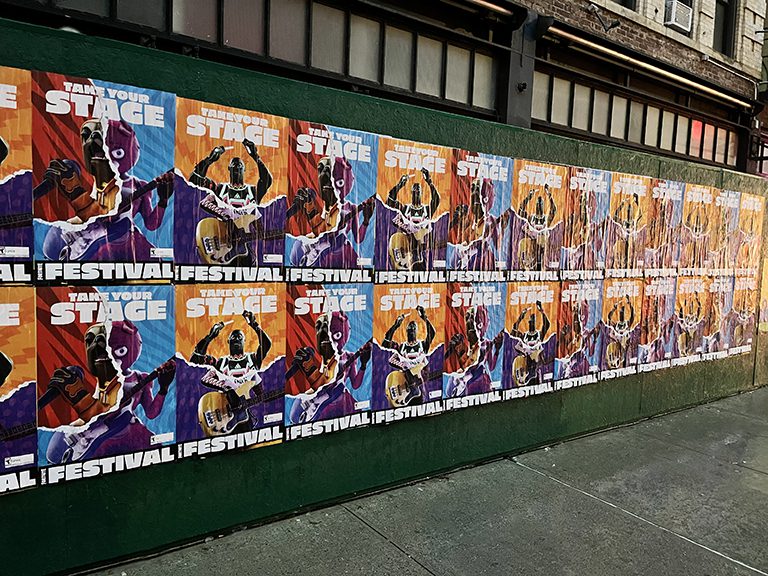
Standard poster dimensions exist because the print industry, the advertising industry, the film industry, and the academic community have each independently settled on formats that work well for their specific applications and equipment constraints. The result is a set of recognized standard dimensions that designers, print buyers, and campaign managers can rely on across thousands of different projects and vendors. Knowing these standards — and understanding why each one exists and what it is optimized for — makes every poster production decision faster and more confident.
At American Guerrilla Marketing, we execute wheatpaste poster campaigns across more than 50 North American markets and specify poster dimensions for production on a weekly basis. We work with print shops, design teams, and field crews who all need to speak the same dimensional language. This guide is the complete reference we wish existed when we started — every standard poster dimension, its aspect ratio, its typical application, and the production specifications that matter for getting professional results.
All dimensions are given in inches (width x height) for portrait orientation unless otherwise noted. Bleed dimensions are listed separately from finished poster dimensions. DPI recommendations are for the finished print size, not for scaled working files in design software.
The Standard Poster Dimension Reference Table
Here are the core standard poster dimensions used across US print and advertising production, organized from smallest to largest with key specifications for each.
11 x 17 inches — Tabloid / Mini-Poster
Aspect Ratio: 0.647:1 (approximately 2:3)
Surface Area: 187 square inches
Recommended DPI: 300
With Bleed: 11.25 x 17.25 inches
Primary Applications: Small venue event promotion, bulletin boards, office environments, high-density distribution campaigns
Notes: Prints on standard tabloid/ledger paper; lowest cost per poster of all standard sizes
18 x 24 inches — Small Standard / Event Poster
Aspect Ratio: 0.75:1 (3:4 portrait, or 3:2 ratio with width as shorter dimension)
Surface Area: 432 square inches
Recommended DPI: 300
With Bleed: 18.25 x 24.25 inches
Primary Applications: Concert/event promotion, venue interior display, bar and retail wall posting, bulletin board campaigns
Notes: Most economical standard outdoor poster size; the format that fills a bulletin board section cleanly
24 x 36 inches — Full Standard / The Default
Aspect Ratio: 0.667:1 (2:3 portrait)
Surface Area: 864 square inches
Recommended DPI: 300 (close viewing), 150 (outdoor viewing)
With Bleed: 24.25 x 36.25 inches
Primary Applications: Movie promotion retail, event/concert premium, street campaign standard, retail display, home art display
Notes: The most universally applicable poster format; twice the area of 18×24; AGM’s street campaign standard
27 x 40 inches — US Movie One-Sheet
Aspect Ratio: 0.675:1
Surface Area: 1,080 square inches
Recommended DPI: 300 (close viewing), 150 (standard viewing)
With Bleed: 27.25 x 40.25 inches
Primary Applications: Theatrical movie lobby display, film industry promotion, premium art print
Notes: Film industry standard since early 20th century; approximately 25% larger area than 24×36; requires non-standard frame
27 x 41 inches — International Movie One-Sheet
Aspect Ratio: 0.659:1
Surface Area: 1,107 square inches
Recommended DPI: 300 (close viewing), 150 (standard viewing)
With Bleed: 27.25 x 41.25 inches
Primary Applications: International theatrical movie distribution; European film promotion
Notes: One inch taller than US one-sheet; used for international film distribution supply chains
36 x 48 inches — Large Format Standard
Aspect Ratio: 0.75:1 (3:4 portrait)
Surface Area: 1,728 square inches
Recommended DPI: 150 (standard viewing), 100 (large venue)
With Bleed: 36.25 x 48.25 inches
Primary Applications: Academic/scientific conference posters, trade show displays, premium retail, major event promotion
Notes: Four times the area of 18×24; twice the area of 24×36; the large format standard
Landscape Format Standard Dimensions
The landscape (horizontal) equivalents of the core poster sizes follow the same dimensional logic with width and height inverted. Here are the standard landscape dimensions.
17 x 11 inches — Tabloid Landscape
Surface Area: 187 square inches
Applications: Informational displays, counter cards, bus interior car cards
24 x 18 inches — Landscape Event Poster
Surface Area: 432 square inches
Applications: Horizontal venue display, retail window (landscape), horizontal event promotion
36 x 24 inches — Landscape Standard
Surface Area: 864 square inches
Applications: Conference posters (landscape), horizontal wall advertising, outdoor landscape placements
48 x 36 inches — Large Landscape
Surface Area: 1,728 square inches
Applications: Scientific conference posters (landscape), trade show horizontal display, retail large format
Outdoor Advertising Standard Dimensions
Outdoor advertising has its own standardized dimension system that extends beyond promotional poster sizes into large-scale formats. These are the recognized standards for US outdoor advertising.
Bus Shelter One-Sheet: 40 x 60 inches
The 40×60 inch bus shelter poster is the standard for transit shelter advertising panels. At 3.3 feet wide and 5 feet tall, it is visible to both pedestrians and passing vehicles. This format is managed by outdoor advertising companies with bus shelter concession agreements — it is not a self-produced format. Campaign design for bus shelter one-sheets needs to account for the standard bus shelter display hardware, which typically includes a frame margin that reduces the visible image area.
8-Sheet Bulletin: 72 x 48 inches
The 8-sheet outdoor bulletin is 72 inches (6 feet) wide and 48 inches (4 feet) tall. This format is the smallest traditional outdoor advertising bulletin, found at pedestrian-level locations, transit stations, and retail centers. It has a 3:2 landscape aspect ratio. Production for 8-sheet bulletins is typically done by outdoor advertising companies on vinyl with UV printing rather than on paper like standard promotional posters.
30-Sheet Billboard: 144 x 252 inches
The 30-sheet billboard is 12 feet tall (144 inches) and 21 feet wide (252 inches). This is the North American standard for large roadside billboard advertising. The format is specifically designed for vehicle-speed viewing and is not part of street-level campaign strategy. Production is on printed vinyl installed on fixed billboard structures operated by outdoor advertising companies.
Production Specifications for Standard Poster Dimensions
Understanding standard dimensions is only the beginning. Professional poster production requires correct file setup to avoid problems at the print stage. Here are the key production specifications for each standard category.
Resolution by Viewing Distance
The appropriate print resolution depends on the typical viewing distance, not on the format size itself. Here is the practical guide our team uses for production decisions.
Close viewing (under 3 feet, typical for bulletin boards, counter display, interior venue walls): 300 DPI at full print size. This is the standard for 11×17 and 18×24 in interior applications and for 24×36 when the poster may be viewed closely.
Standard viewing (3 to 10 feet, typical for most retail and event display): 150 to 300 DPI. At 300 DPI, the file will be very large for 24×36 and above. 150 DPI at full print size is the practical minimum for this distance range and produces visually indistinguishable results from 300 DPI when viewed from 5 feet or more.
Outdoor viewing (10 to 30 feet, typical for street-level campaign placements): 100 to 150 DPI. A 24×36 poster at 150 DPI is 3600×5400 pixels — a large file, but manageable. At outdoor viewing distances, the additional resolution of 300 DPI adds file size without adding visible quality.
Long-distance outdoor viewing (30 feet and above, billboard and large outdoor): 72 to 100 DPI. Large-format prints at billboard scale are often designed and viewed at low DPI because the viewing distance makes higher resolution visually irrelevant.
Bleed Setup
All standard poster formats require 0.125 inch (1/8 inch) bleed on all four sides. This means the design file document size is 0.25 inches wider and 0.25 inches taller than the finished poster dimension. For a 24×36 finished poster, the document is 24.25 x 36.25 inches. Design content that should reach the edge of the finished poster must extend into the bleed area. Design content that must not be cut off (text, logos, critical image elements) should be at least 0.25 inches inside the trim edge, creating a safe area of 23.5 x 35.5 inches for a 24×36 poster.
Color Mode
Professional poster printing uses CMYK color mode, not RGB. Design files prepared in RGB need to be converted to CMYK before delivery to the print shop. The color shift between RGB and CMYK can be significant for saturated colors — vivid blues and greens in RGB often shift noticeably when converted to CMYK. Always proof the CMYK conversion before approving final files for printing.
File Format
PDF/X-1a or PDF/X-4 are the preferred file formats for professional poster printing. These PDF profiles embed all fonts and images and confirm color settings appropriate for print output. High-resolution TIFF files are accepted by most print shops as an alternative. JPEG files compress image data in ways that become visible in large-format output — avoid JPEG for professional poster production.
International Poster Dimensions: ISO A-Series Comparison
For projects that involve international print production or that need to align with non-US format standards, here is how the standard US inch-based poster dimensions compare to the international ISO A-series metric dimensions.
A0 (841 x 1189 mm, approximately 33.1 x 46.8 inches): The largest standard A-series format, equivalent to approximately a large-format US poster between 36×48 and a custom oversize. Used for large exhibition and conference display in European markets.
A1 (594 x 841 mm, approximately 23.4 x 33.1 inches): The European equivalent of 24×36. Slightly smaller in both dimensions than a 24×36, with the same approximate aspect ratio. Most European print shops handle A1 as their primary promotional poster format.
A2 (420 x 594 mm, approximately 16.5 x 23.4 inches): The European equivalent of 18×24. Slightly smaller than an 18×24 in both dimensions. Standard for European event promotion and venue display.
A3 (297 x 420 mm, approximately 11.7 x 16.5 inches): Between US tabloid (11×17) and small standard — not a direct US equivalent. Used for smaller European promotional materials.
When working with print shops in Europe or Canada on campaigns that include both US and international markets, confirm whether the shop produces to US inch-based standards or ISO metric standards and adjust file specifications accordingly. A file prepared as 24×36 inches at 300 DPI will not print to exactly A1 dimensions without resizing.
How AGM Uses Standard Dimensions in Campaign Production
In our campaign work, standard poster dimensions simplify production and reduce error. Here is how our team applies these standards in practice.
We specify 24×36 as the campaign standard across all US street campaigns unless site-specific conditions require a different format. This single format specification simplifies the print production process — one template, one file specification, one production run that covers the entire campaign’s needs. Exceptions are made for specific premium locations that warrant a larger format (36×48 or tiled 24×36) or for high-density coverage campaigns where the quantity economics favor 18×24.
For clients producing poster campaigns alongside other marketing materials — social media assets, digital ads, email graphics — we coordinate to ensure the poster creative is developed at print-appropriate resolution and file format from the beginning, not scaled up from lower-resolution digital assets. A 1080×1620 pixel social media image set at 72 DPI cannot be scaled to 24×36 at 300 DPI without quality loss. Starting with a 7200×10800 pixel master file at 300 DPI allows derivation of both print and digital assets from a single high-quality source.
We provide clients with a poster production specification document at the beginning of each campaign that includes the exact finished dimensions, bleed dimensions, safe area dimensions, required DPI, color mode, and preferred file format. This specification eliminates the most common production errors — incorrect bleed, wrong color mode, insufficient resolution — before they occur and ensures that files from the creative team are print-ready on first delivery.
Frequently Asked Questions
What are the standard poster dimensions?
The standard poster dimensions in the US are: 11×17 inches (tabloid/mini-poster), 18×24 inches (small standard/event poster), 24×36 inches (full standard, the most widely used format), 27×40 inches (US movie one-sheet), and 36×48 inches (large format/conference standard). These five formats cover the majority of professional poster production across advertising, event promotion, academic, and retail applications.
What is the standard poster dimension for printing?
For printing purposes, the standard poster dimension is 24×36 inches. Most large-format print shops optimize their equipment and pricing around this format because it is the highest-volume poster size in the US market. Design files should be set up at 24×36 inches at 300 DPI with 0.125 inch bleed on all sides for professional print output.
What is the standard poster dimension ratio?
The most common standard poster dimension ratio is 2:3 (width to height). Both 18×24 and 24×36 use the 2:3 ratio. The movie one-sheet (27×40) uses an approximately 0.675:1 ratio, slightly wider than 2:3. The large format 36×48 uses a 3:4 ratio. For landscape orientation, these ratios are reversed.
Do standard poster dimensions work for digital display as well as print?
Standard print poster dimensions do not directly translate to digital display because digital screens use pixel-based resolution. For digital applications, posters are sized in pixels at a specific DPI — a 24×36 poster at 300 DPI is 7200×10800 pixels. For social media or screen display, use the platform’s native resolution specifications rather than print poster dimensions.
What is the standard dimension for a street advertising poster?
The standard dimension for street advertising posters (wheatpaste campaigns, guerrilla marketing) is 24×36 inches. This format provides adequate visibility at typical outdoor viewing distances of 15 to 25 feet and is cost-effective for the large quantities needed for city-scale campaigns. AGM uses 24×36 as the standard across all US market street campaigns.
What are the standard poster dimensions for trade shows?
Trade show poster and display dimensions vary by booth format, but common standards include: 24×36 for promotional posters mounted on display boards, 36×48 for standing display panels, 24×80 for pull-up banner stands, and 8×10 feet for full booth backdrop graphics. Confirm dimensions with the specific trade show venue and booth size before production.
Are poster dimensions the same in the US and internationally?
For more on this, explore our experiential marketing.
For more on this, explore our street team activations.
No. The US uses inch-based poster dimensions (18×24, 24×36, 27×40). International markets, particularly in Europe, use ISO A-series metric dimensions (A0: 841x1189mm, A1: 594x841mm, A2: 420x594mm). A1 is roughly equivalent to 24×36, and A2 is roughly equivalent to 18×24. Always confirm the format system when working with international print partners.