
November 11, 2026
Planning LED Trucks & Mobile Billboards in Spokane
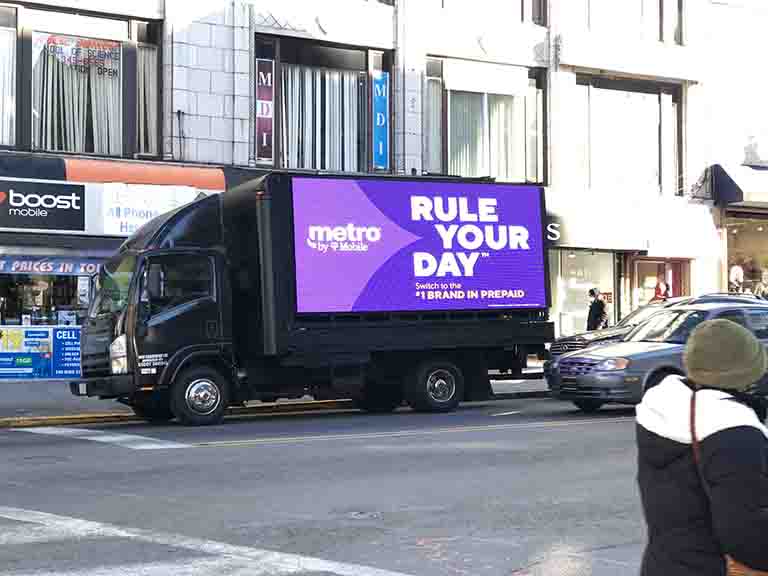
Every other format we run in Spokane fights the same problem. This city is multi-node and car-dependent between its nodes, so the distance between the places worth reaching is dead space. A poster cannot cross it. A decal cannot cross it. A projection unit crosses it slowly and expensively.
A truck crosses it with the screen on.
That is the honest case for Mobile Billboards in Spokane, and it is a better case here than in a lot of larger cities. In a dense grid, a mobile unit is competing with an enormous amount of static inventory and a pedestrian who already has plenty to look at. In Spokane, the drive between Garland and South Perry, or between downtown and the Gonzaga area, is a stretch of time where a real share of the local audience is sitting in a car with nothing to read.
The flip side is that a vehicle format inherits every vehicle problem this city has. Snow. Ploughing. And one week in June when the downtown street grid simply is not available to drive.
This page is about how to plan a Spokane mobile campaign around those facts rather than into them.
Spokane's geography is the argument for this format
Start with how the city is actually shaped, because it drives everything else.
Downtown Spokane wraps around Riverfront Park and the Spokane River. It is compact and genuinely walkable, and it holds the retail, hotel and office density. That is one node.
Then there is a ring of small, strongly defined commercial strips, each walkable inside itself and separated from the others by driving distance. The Garland District north of downtown, a short dense strip anchored by the Garland Theater with galleries and antique shops along it. South Perry, a near-South Hill neighbourhood strip led by independent food and drink. Browne's Addition immediately west of downtown, historic residential, home to the Northwest Museum of Arts and Culture. Kendall Yards on the north bank just west of downtown, now one of the city's strongest food, drink and small-retail corridors. And the Gonzaga University area northeast along the river, around E Boone Ave and E Desmet Ave, where the campus sits adjacent to the Centennial Trail and student foot traffic overlaps with park foot traffic.
Every one of those is a destination people drive to. That is the key planning fact.
In a city where the population walks between districts, a mobile unit is a slow-moving duplicate of static media. In a city where the population drives between districts, the mobile unit is in the same space as the audience for the entire journey, not just at the endpoints.
So the Spokane route design I keep coming back to is not a loop. It is a chain. Hit the arrival and departure flow of one node, run the connecting road while the screen is working on drivers, arrive at the next node during its own busy window, repeat. The time between stops is not transit overhead here. It is inventory.
Kendall Yards is the easiest node to chain with downtown because it sits immediately across the river. Garland and South Perry are separate legs with real driving time attached, and that time is worth something rather than being wasted.
Hoopfest is the one week a truck cannot work downtown
This is the single most important scheduling fact for a vehicle format in Spokane, and it is the one out-of-town planners never see coming.
Hoopfest is an outdoor 3-on-3 basketball tournament held in the final week of June. It spreads roughly 450 courts across around 45 downtown city blocks. It is the largest street-level event in the Spokane year, and it does not sit inside a venue. It occupies the street grid itself.
For a pedestrian format that is the best week of the year. For a vehicle format it is the worst.
Vehicle access across those roughly 45 blocks is not reliable during the tournament. A mobile billboard route planned through the downtown core that week will not run to schedule, and a route that cannot keep to schedule in a time-bound format is not a campaign, it is a truck sitting in traffic.
I will talk clients out of downtown mobile work during Hoopfest week every time, and the reason is not caution. It is that the thing they are buying cannot be delivered.
What does work that week, if Hoopfest is genuinely your audience:
Work the approach and departure routes rather than the core. People are driving into the city for the tournament and driving home afterwards, and those journeys happen on roads that are not given over to courts. The audience is the same audience. You reach them on the way in rather than in the middle.
Shift to the other nodes. Kendall Yards, Garland and South Perry are still operating normally that week, and a downtown that is full of visitors tends to push some spillover activity outward.
Or move the downtown element of the campaign to a different week entirely and let a static format cover the tournament, since a poster placed the week before does not care that the street has become a basketball court.
Bloomsday creates a smaller version of the same problem. It is a major annual spring road race drawing a very large participant and spectator field through the city, and a road race is by definition a road closure. Same rule. Plan around the route, not through it.
Winter is this format's best season in Spokane, and its hardest
Spokane's winter is where mobile billboards earn their place in the mix, for a reason that has nothing to do with the trucks and everything to do with what stops working.
Spokane runs a humid continental climate with very cold, snowy, mostly cloudy winters. December lows sit near 22 °F. In a sustained freeze, paste will not cure properly, and ground media cannot bond to a slab that is frozen, salted and being ploughed. The static formats are either out of season or compromised.
A vehicle-mounted screen does not care about substrate temperature. It also benefits from two specific Spokane winter conditions.
Long nights. An illuminated screen is at its strongest against a dark background, and a northern winter gives a long dark evening that starts early. The screen is doing its best work during the hours people are still driving home, running errands and going out.
Mostly cloudy skies. Overcast conditions bring usable darkness forward and cut the long bright dusk that reduces screen contrast in clearer climates. The practical result is a longer high-impact display window than you get in a Spokane July, where late sunsets and mostly clear skies mean the screen is competing with daylight until the evening is well advanced.
There is also a genuine winter audience here, and it is specific. Spokane's festival density runs spring through fall, and winter's reliable draws are indoor and arena-based rather than street-based. Gonzaga basketball drives recurring winter evening crowds to the campus area through the season, anchored by the McCarthey Athletic Center at 801 N Cincinnati St.
That is a vehicle audience almost by definition. People arriving at an arena on a cold night arrive by car, park, walk a short distance, and leave the same way. The approach and departure routes around the campus area on a game night are the clearest example in the Spokane calendar of a format and an audience lining up exactly.
Now the hard part, because it is equally real.
Winter driving is the main seasonal logistics constraint in this city. Snow reduces night access to unploughed side streets, and ploughing after a snowfall changes which streets are usable on a given night. A route drawn in October does not survive February without revision. We plan winter Spokane routes with alternates built in and with the assumption that side-street access is not guaranteed.
Snow and plough spray also load the lower portion of any vehicle working a ploughed corridor, which is a maintenance reality rather than a campaign one, but it affects how a unit looks by the end of a week and that matters for something whose whole job is to be looked at.
Where a route actually earns attention in this city
A mobile billboard is only working when it is in front of people who are stopped or slow. That narrows the useful parts of any route and it is worth being specific about where those are in Spokane.
Downtown core. Compact, walkable, and surrounded by the arrival traffic of a small-business district. The value here is the combination of pedestrians on the sidewalk and drivers at intersections. Because the core is small, a unit can cover it quickly, which cuts both ways. You get efficient coverage, and you also exhaust the audience faster than in a big grid. More on that below.
Kendall Yards. Its recurring night market pulls a walking crowd into the district on a predictable schedule, and a scheduled crowd is a schedulable route. Being immediately across the river from downtown, it is the natural second leg of a single shift.
The Gonzaga area. As above, the winter game-night play, plus the general overlap of campus and Centennial Trail foot traffic along the river.
Riverfront Park events. The park is the city's central event ground and the anchor for most large downtown crowds. Event traffic means slow traffic and a lot of people walking between parking and the park. Pig Out in the Park, a multi-day food and free-concert festival held there, is a strong candidate, though sources disagree on its timing, with one placing it on Labor Day weekend and another in late July or early August. Treat it as a late summer window and confirm the current year's dates directly rather than taking a date from me. The Fourth of July celebration is another Riverfront Park draw.
Garland and South Perry. Worth visiting, but understand what you are buying. These are short strips with concentrated pedestrians, and a vehicle passes through them in moments. They are arrival-and-dwell stops rather than drive-through inventory. If these strips are central to your audience, a static format on owner-granted frontage will serve you better and the truck is the supporting act.
Browne's Addition I generally leave alone for this format. It is historic residential, and running an illuminated commercial vehicle repeatedly through a residential neighbourhood is a good way to generate complaints rather than customers.
Permission, idling and the grey area for a moving format
Mobile billboards change the permission conversation because the unit is on a public road rather than attached to someone's property, but the change is not as clean as people assume.
The framing stays the same as everything else we do. This is a grey area. I will not tell you that mobile billboard advertising is legal or illegal in Spokane. It varies by municipality, enforcement is inconsistent, and what applies depends on local ordinance, where the vehicle is and what it is doing. I am not a lawyer and this is not legal advice.
What I can tell you is where the risk concentrates for this format, which is not in driving. It is in stopping.
A vehicle in motion on a public road is doing a fairly ordinary thing. A vehicle parked for an extended period with an illuminated advertising screen running, on a particular block, near a particular venue, is a much more visible and much more questionable proposition. That is where complaints come from and that is where enforcement attention lands.
So the operating discipline we apply in Spokane, as everywhere, is to treat the format as a moving one. Routes rather than parking positions. Where a dwell is genuinely needed, the sensible version is a private lot with the property owner's permission rather than a public curb, which puts you back into the same owner-permission model that works so well in this city.
That model is worth spelling out, because Spokane suits it. The high-value frontage here is overwhelmingly privately owned small-business frontage in owner-operator districts with business associations and strong neighbourhood identity. Permission conversations happen with individual owners, and they are more productive than they are in markets where everything runs through a leasing office.
Two specifics. Riverfront Park and the programmed downtown core around it are managed public space with municipal event management attached, so anything tied to an event there should be assumed to sit under event and parks permissions. And Gonzaga's campus is private institutional property with its own posted rules and its own patrol presence. The university states that its parking regulations are enforced year-round with heavier patrol during the academic year, which is a clear signal that a vehicle sitting on campus ground is going to be noticed. We keep this format on public approach routes and off-campus streets, which is where the game-night audience is anyway.
I should also flag an honest gap. Downtown metered-parking hours and overnight parking rules in Spokane I did not confirm in research. UNVERIFIED. For a format that involves a vehicle in a downtown core, that gets checked locally before a route is finalised rather than assumed from another city's pattern.
What goes wrong, and what I argue against here
Circling a small downtown for hours. This is the most common mistake in Spokane specifically, and it comes from applying a big-city playbook. Spokane's downtown core is compact. A unit looping it repeatedly is showing the same message to the same people over and over, well past the point of diminishing returns, and in a small district the repetition becomes conspicuous in a way that is not flattering. I would rather chain nodes than loop one.
Buying hours instead of moments. Mobile billboard briefs often arrive specified as a number of hours on the road. In a city with sharp activity peaks and quiet stretches between them, hours is close to meaningless. What matters is whether the unit is at the Gonzaga area as a game lets out, or at Kendall Yards during the night market, or on a Riverfront Park event approach. Two well-timed hours beat six badly timed ones.
Running the route during Hoopfest. Covered above. The format cannot be delivered in the downtown core that week.
Treating Garland and South Perry as drive-through inventory. Short strips, quick passes, pedestrians who are browsing shopfronts rather than watching the road. These districts reward static placement on owner-granted frontage far more than they reward a vehicle passing through.
Residential routes. An illuminated commercial vehicle repeating through a residential area generates friction and very little value. I will push back on routes that lean on residential streets to connect nodes, even when the map says it is the fastest line.
Assuming summer is the strong season. Clear skies and late sunsets mean a Spokane summer screen is working against daylight until quite late in the evening. Summer still works, particularly around events, but the pure illuminated-impact argument is a winter argument in this city.
Pairing a mobile unit with something that holds the ground
The format I most often pair with mobile work in Spokane is wheatpasting and Poster Campaigns, and the logic is geographic rather than seasonal.
The truck owns the connective tissue. It reaches people during the drive between nodes, which is exactly the part of Spokane that static media cannot touch. What it cannot do is hold a position inside a walkable strip, because the people in Garland or South Perry are looking at shopfronts, not at the road.
Posters on owner-granted frontage own the inside of those strips. They are there when the pedestrian slows down, and they stay there across weeks rather than seconds.
Run together, you get coverage of both halves of how this city actually moves. The driver sees the brand on the way to the district and the pedestrian sees it once they have arrived and parked. In autumn, when paste still cures properly, that combination is straightforward to build. Through a sustained winter freeze, the poster half becomes unreliable and the mobile unit carries more of the load, which is the seasonal shape I described earlier.
Scope on mobile work is driven by how many nodes you want chained, how many separate shifts that needs, which hours you are targeting, how far apart the legs are, and whether the season adds winter routing constraints. Spokane's node spacing and its winter driving conditions push hardest on the shift count.
Frequently asked questions
Why do mobile billboards suit Spokane specifically?
Because Spokane is multi-node and car-dependent between nodes. Downtown, Kendall Yards, Garland, South Perry and the Gonzaga area are each walkable internally but separated by driving distance, so a large share of the local audience spends real time in a car between them. That connective travel is exactly the space static formats cannot reach.
Can an LED truck run downtown during Hoopfest?
No, and I will talk you out of it. Hoopfest spreads roughly 450 courts across around 45 downtown blocks in the final week of June, and vehicle access across that footprint is not reliable. Work the approach and departure routes instead, shift to other districts, or cover the tournament with a static format placed beforehand.
Is winter a bad time for mobile billboards in Spokane?
The opposite, in display terms. Long nights and mostly cloudy winter skies give an illuminated screen a long high-impact window starting early in the evening, while paste and ground media are out of season. The real winter constraint is driving, since snow and ploughing reduce access to side streets and routes need alternates planned in.
Where should a Spokane route actually stop or slow down?
Where people are slow or stopped. The compact downtown core, Kendall Yards during its recurring night market, Riverfront Park event approaches, and the Gonzaga area around the McCarthey Athletic Center on winter game nights. Garland and South Perry are better served by static placement, since a vehicle passes through those short strips in moments.
Do you need permission to run a mobile billboard in Spokane?
It is a grey area and I will not call it legal or illegal, since it depends on local ordinance, location and what the vehicle is doing. Risk concentrates in stopping rather than driving, so we treat this as a moving format. Where a dwell is needed, we use a private lot with the owner’s permission.
How long should a Spokane mobile campaign run?
Think in well-chosen windows rather than total hours. Spokane has sharp activity peaks, a market evening in Kendall Yards, an event letting out at Riverfront Park, a game night near campus, with quiet stretches between them. Matching the unit to those peaks across several shifts beats a long continuous run through empty hours.
Request a campaign quote
If you are planning mobile billboard work in Spokane, tell me which districts matter and which nights your audience is actually out. Those two answers let us chain the route properly instead of looping a small downtown until the message wears out.
We will build around the city's real driving geography, keep the format moving, use owner-permitted private ground where a dwell is genuinely needed, and plan winter routes with alternates for the nights when ploughing changes what is passable.
Request a campaign quote and we will scope it as a chain of timed legs rather than a block of hours.

Ready to Run Your Campaign?
Call us or email us. We’ll tell you exactly what we can do in your market and what it costs.
Related Services
Explore similar advertising solutions offered by American Guerrilla Marketing.
American Guerrilla Marketing — Los Angeles
Street-level campaigns in Los Angeles and nationwide. Wheatpasting, LED trucks, street teams, and more.
(646) 776-2770
Related Articles
-
LED Truck Advertising Creative Specs: A Field Guide
November 12, 2026
-
Mobile Billboard Companies: How It Actually Works
November 12, 2026
-
LED Trucks & Mobile Billboards in Cincinnati, Ohio
November 12, 2026
-
Planning LED Trucks & Mobile Billboards in Jacksonville
November 11, 2026
-
Mobile Billboard Route Planning, Start to Finish
November 11, 2026