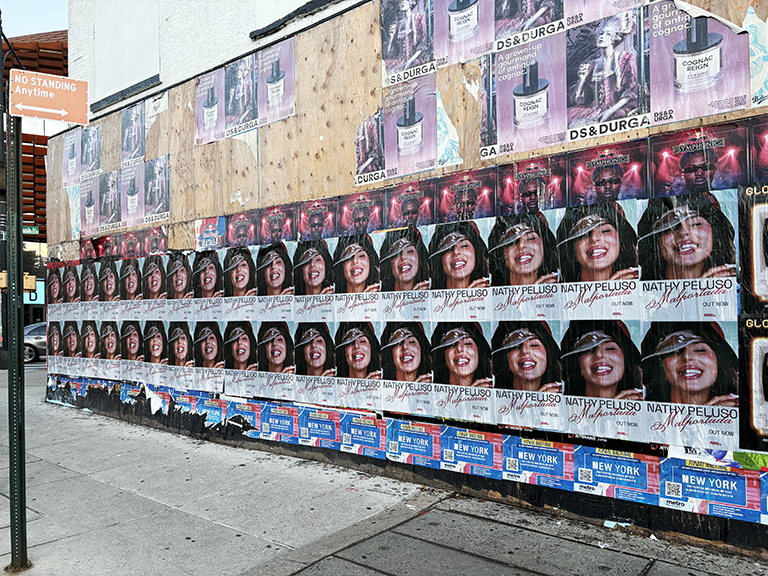
Running a wheatpaste campaign in one city is a production challenge. Running the same campaign simultaneously in three, four, or six cities across different countries is a different category of problem entirely. The logistics multiply, the time zones fight each other, and every market has its own printing standards, installation windows, and documentation expectations. Most brand teams don’t find out how complicated this is until they’re already in the middle of it.
We’ve been doing this for over a decade. American Guerrilla Marketing field operators have placed posters in New York, London, Mexico City, Tokyo, Paris, and a growing list of other markets. We’ve walked the neighborhoods, built the operator relationships, and run the multi-city coordination from our New York office. This guide covers the actual production logic — what you need to know before you book anything, and how to structure a multi-city international wheatpaste launch so it doesn’t fall apart three days before go-live.
Why Multi-City Street Campaigns Fail
The failure mode is almost always the same. A brand team has a strong creative concept, a firm launch date, and a confident vendor relationship in their home market. They assume international execution is roughly the same process, just with different zip codes. It isn’t. The printing standards are different. The installation windows are different. The proof-of-posting formats are different. The time to brief a local operator, get location approvals, confirm print specs, and turn artwork is longer than domestic timelines by anywhere from three to seven days depending on the market.
When a brand tries to run a three-city international campaign with a two-week lead time because that’s what they’re used to doing in New York, something breaks. Usually it’s the international legs. The US placement goes up. London is delayed. Mexico City never gets confirmed. The social media launch moment the team planned shows photos from one city, and the “global street campaign” narrative doesn’t hold.
The fix is front-loading. You need a master brief that travels across markets, city-specific briefs built from it, and production timelines built backward from your street date — not forward from when artwork gets approved.
The Master Brief: What It Is and What It Has to Contain
The master brief is the single document that governs the entire campaign regardless of which market is executing. It is not a creative deck. It is not a mood board. It is an operational document that tells every operator in every city exactly what the campaign must deliver and what they cannot change without approval.
A well-built master brief covers:
- Campaign intent: What the brand is trying to achieve. What the poster needs to communicate. What success looks like.
- Core visual assets: The approved artwork files with bleed specifications, color profiles, and any market-specific variations that are pre-approved vs. those that require sign-off.
- Format specifications by market: This is where most briefs fail. A 24×36 inch format used in New York becomes an A1 in the UK. A poster sized for a US transit surround doesn’t translate directly to European surface dimensions. Format conversion has to be addressed in the master brief, not left for the local operator to figure out.
- Placement targeting: The type of neighborhoods, the type of walls, the density of coverage, and any specific location requirements (or exclusions). This should be directional — not a GPS coordinate list, because those can only be confirmed on the ground.
- Documentation standards: What constitutes acceptable proof-of-posting. GPS-tagged photography. Video walkthroughs. The reporting format every market delivers back to you. This matters because if you don’t standardize it, you get three different documentation formats and no way to build a single consolidated report.
- Quality thresholds: Minimum acceptable paste quality. What happens if a placement is damaged. Whether replacement placements are required and who authorizes them.
- Timeline and go-live date: The hard street date and what “live” means — does every market need to be up on the same calendar date, or is there a window?
The master brief is the document you brief every market from. It’s also the document you use to hold every market accountable. If it’s vague on documentation standards, you’ll get vague documentation. If it’s specific on format requirements, every market delivers the right spec.
City-Specific Briefs: Translation Without Drift
Once the master brief is locked, you build a city-specific brief for each market. The city-specific brief takes the master document and translates it into local reality. It doesn’t change the campaign — it operationalizes it for a specific place.
A city-specific brief covers:
- Local format specifications: Confirmed print sizes, paper weights, and local print house requirements.
- Target neighborhoods and walls: The actual areas where the campaign runs. In London, this might mean Shoreditch, Brick Lane, and Hackney. In Mexico City, it might mean Roma Norte, Condesa, and Insurgentes. These are confirmed by the local operator based on the targeting parameters in the master brief.
- Installation timing: The specific windows when installation happens in that market. Installation timing is driven by local enforcement patterns and operator experience — it’s not something a US-based team should specify without operator input.
- Local approvals status: Which placements are on permissioned surfaces. Documentation from property owners where applicable.
- Creative adaptations: Any approved localization decisions for this market — translated taglines, adjusted color treatments, locally relevant imagery. Only changes pre-approved in the master brief or separately authorized.
- Contact chain: Who the operator contacts if something changes during installation, and who signs off on any last-minute decisions.
The discipline here is keeping city-specific briefs within the bounds of the master brief. The danger is drift — each local operator making small adjustments that feel locally reasonable but collectively dilute the campaign’s visual consistency. The city-specific brief should feel like an execution document, not a creative license.
Production Timelines Per Market: Building Backward from Street Date
Here’s the timeline reality for a three-city launch across New York, London, and Mexico City:
| Market |
Standard Production |
Rush Production |
What Drives the Timeline |
| New York, USA |
5–7 days |
48–72 hours |
Local print, direct operator coordination |
| London, UK |
7–10 days |
5–7 days |
Format conversion, UK print lead times |
| Mexico City, MX |
7–10 days |
5–7 days |
Print coordination, customs if shipping from US |
The safest approach is to use the longest market timeline as your planning baseline and work back from there. If Mexico City and London both need 10 days, you need artwork approved at least 10 days before your street date. That means client-side approvals need to close before that 10-day window opens. Most campaigns need two to three rounds of internal approval on artwork. Build those into the schedule too.
A realistic master timeline for a simultaneous three-city launch looks like this:
- Week 1: Kickoff, master brief drafted, artwork concept presented
- Week 2: Artwork revisions, city-specific briefs drafted, operator briefings initiated in each market
- Week 3: Final artwork approved, production files delivered to each market, print orders placed
- Week 4: Printing and pre-installation logistics in each market, location confirmation from local operators
- Week 5: Installation across all markets, proof-of-posting consolidation, campaign live
Five weeks is tight. Six weeks is comfortable. Anything under four weeks for a three-market international launch means you’re accepting real risk of at least one market either running late or running with reduced coverage.
Staggered Launch vs. Same-Day Simultaneous
The choice between a staggered launch and a same-day simultaneous launch is more of a marketing decision than a logistics one, but logistics constrain what’s possible.
A same-day simultaneous launch — every city live on the same calendar date — is achievable with sufficient lead time. The production complexity is real, but it’s manageable if the master brief is tight and the city-specific briefs are built early. The advantage is narrative. A brand that can say “overnight, our posters hit the streets of New York, London, and Mexico City” has a story. It’s the kind of thing that generates organic social coverage because people in each city photograph and post what they see, and collectively it looks like a coordinated movement.
A staggered launch — market by market, typically 24 to 72 hours apart — reduces production pressure and allows each market to get maximum attention in sequence. The tradeoff is that it requires longer total campaign duration and can feel less like an event. For product launches where the goal is a single news moment, staggered usually doesn’t serve the intent as well.
One practical note on same-day simultaneous: because of time zones, “same day” in practice means installations happen at different local times. Mexico City might go up at 2am local time, London at 4am, and New York the following evening. They’re all on the same calendar date. This is standard, and it works. What matters is that when the brand publishes launch content, every market has documentation ready.
Proof-of-Posting Consolidation Across Markets
This is the part that brand teams don’t think about until they need it for a press release or an agency debrief, and by then it’s too late to fix a fragmented documentation process.
Our standard: every American Guerrilla Marketing field operator delivers GPS-tagged photography with location metadata intact, video walkthrough documentation of each placement, and a location log that maps every installation address to the photographic record. For international markets we coordinate, the same standard applies — we require it in the operator brief, and we don’t accept documentation that doesn’t meet it.
The consolidation step — taking documentation from three operators in three countries and building a single campaign report — takes time. If you plan for it, it happens the day after installation. If you don’t plan for it, you spend a week chasing operators for formatted photos in a consistent file structure.
Build proof-of-posting consolidation into your campaign timeline as a discrete step. Assign someone to own it. Define the output format in your master brief so every operator delivers documentation that assembles cleanly into the final report.
Budget Allocation by Market: Relative Logic
We won’t name numbers here because market costs vary and cost structures change. But the relative allocation logic for a three-city international wheatpaste campaign holds across most scenarios.
New York typically requires the largest share of budget — not because it’s the most expensive market per placement, but because the density of coverage needed to generate real street presence in a competitive media market like NYC is high. Shoreditch in London is more concentrated — a smaller geographic area where a high density of placements creates strong presence. Roma Norte and Condesa in Mexico City work similarly.
A rough relative allocation for a launch campaign aiming for strong presence in all three markets might weight New York at roughly 40–45% of total budget, London at 30–35%, and Mexico City at 20–25%. This reflects coverage density requirements and market costs, not relative campaign importance. All three markets matter equally — the budget split reflects what it costs to achieve equivalent visibility in each one.
Coordination and consolidation costs — the overhead of managing a multi-city international campaign from a single New York contact — are real and should be built into the budget. The value of that coordination is that you don’t pay for the mistakes that come from managing three independent operators without a central brief. Over time, brands that run international campaigns through a single coordinating partner spend less total than brands that piece together local operators market by market.
Creative Localization: What to Adapt and What to Hold Constant
The default for a brand running its first international street campaign is to use identical creative in every market. This is usually wrong. It’s also not always wrong. The decision depends on the specific campaign, the specific markets, and what the creative is doing.
What typically needs localization:
- Language: English works in London without adaptation. It does not work the same way in Mexico City. A campaign running in Roma Norte and Condesa should be in Spanish. Direct translation is the floor — the messaging often needs cultural adaptation, not just word substitution.
- Cultural references: Imagery or copy that reads clearly in New York may not read the same way in London or Mexico City. References that feel current and relevant in one market can feel imported or generic in another.
- Format and size: As covered above — format standards are different by country, and artwork sized for US standard formats may need adjustment for UK or Mexican print specs.
What typically should stay constant:
- Core visual identity: The brand’s color palette, typography, and logo treatment should be identical across markets. This is what makes it a recognizable global campaign rather than three separate local ones.
- Structural design: The layout and hierarchy of the poster should be consistent. Local operators will sometimes suggest visual adjustments to “fit the market better” — most of the time, this isn’t a request worth honoring unless there’s a specific cultural reason.
- Campaign intent: The thing the poster is trying to communicate should be the same in every market. Localization is about how you say it, not what you say.
On campaigns where we’ve managed creative localization across three or more markets, the most common mistake is over-localizing. Brands that approve too many market-specific variations end up with three different posters that don’t read as a single campaign. The sweet spot is one core design with approved language and format variants — not separate concepts per market.
Case Study: Streaming Platform Launch Across NYC, London, and Mexico City
Here’s how a multi-city international wheatpaste campaign actually runs in practice. The scenario: a streaming platform is launching in three markets simultaneously. They want street presence in New York, London, and Mexico City on the same calendar date. The campaign goal is to generate organic social coverage, drive sign-up intent in each market, and signal that this is a serious global launch — not a US platform expanding internationally, but a platform arriving in all three cities at once.
Week 1: Kickoff and Master Brief
We start with a kickoff call covering all three markets. The master brief is drafted that week and covers campaign intent, format specs for each market (24×36 for New York, A1 for London, local standard for Mexico City), approved targeting neighborhoods, documentation standards, and the go-live date. Creative is already in development on the client side.
Operator briefings are initiated in London and Mexico City simultaneously. The US execution is managed directly by American Guerrilla Marketing field operators — no separate vendor relationship needed. For London, we brief our UK partner with the targeting parameters: Shoreditch, Brick Lane, and select locations in Hackney. For Mexico City, the targeting focuses on Roma Norte, Condesa, and sections of Insurgentes Sur where the audience demographic concentrates.
Week 2: Creative Approval and City-Specific Briefs
Artwork is presented in English. The New York version is approved. The London version is the same creative — the streaming platform’s target audience in the UK is English-speaking, and the messaging translates without adaptation. The Mexico City version requires translation and light copy adaptation. The brand’s internal team manages the translation; we flag two phrases that don’t convert cleanly, and the client’s Spanish-speaking marketing lead revises them.
City-specific briefs are finalized. London confirms wall availability in Shoreditch and Brick Lane. Mexico City confirms locations in Roma Norte and Condesa. New York locations are confirmed across lower Manhattan, Williamsburg, and the West Village — neighborhoods where the platform’s likely early adopter audience concentrates.
Print specs are delivered to each market: US files go to the New York print house, UK files go to the London print partner, Mexico City files go to the local printer. Format conversion for London and Mexico City adds one working day to production prep.
Week 3: Production and Pre-Installation
Printing runs in all three markets. London and Mexico City print locally — shipping posters internationally would add cost and customs risk without meaningful quality advantage. The New York print run finishes in 48 hours. London runs five days including format review. Mexico City runs six days including a reprint of one artwork file that arrived with the wrong color profile — caught in pre-press, not on the wall.
Installation timing is confirmed per market. New York installations are scheduled for Wednesday night, starting at midnight. London installations are scheduled for Thursday morning, between 4am and 8am local time — Thursday is a day ahead of New York due to the time zone difference, so London actually goes up before New York on the calendar, but both hit the brand’s Thursday launch date in their respective local news cycles. Mexico City goes up Wednesday night local time, which is Thursday morning EST.
Week 4: Installation Week
New York installations run Wednesday night. American Guerrilla Marketing field operators place posters across the confirmed locations — certified and licensed placement on permissioned surfaces. GPS-tagged photography is captured at each installation, with timestamps confirming the night-before go-live timing. We walked the entire New York footprint to confirm location quality before installation — no satellite-view approval process, actual on-the-ground assessment.
London installations complete Thursday morning local time. Brick Lane goes up first, then Shoreditch, then the Hackney locations. Our UK operator delivers GPS-tagged photography that morning. Proof-of-posting arrives in the shared documentation folder by 10am London time — 5am New York time, before the US team is at their desks.
Mexico City installs Thursday morning local time. Roma Norte goes up in the pre-dawn window. Condesa and Insurgentes locations are completed by 7am. Documentation is delivered to the shared folder by midday Thursday local time.
Campaign Live and Consolidation
By Thursday afternoon New York time, all three markets are documented and live. The consolidated proof-of-posting report is assembled that afternoon — a single document covering every placement in all three cities, with GPS coordinates, installation timestamps, and photography for each location.
The brand publishes its launch content Thursday afternoon. Organic social posts start coming in from people who spotted the posters in Shoreditch, Roma Norte, and the West Village. The campaign reads as genuinely simultaneous. It is.
How AGM Manages Multi-City International Campaigns from New York
The core value proposition is single-point coordination. Brand teams working with American Guerrilla Marketing don’t manage separate relationships in each country. They work from one New York contact who owns the master brief, briefs every local operator, consolidates documentation, and is accountable for the full campaign — not just the US portion.
We’ve built this over a decade of running campaigns domestically and internationally. Our nationwide portfolio of US media markets gives us the operational infrastructure and documentation standards that translate directly to international execution. Our operators — domestic and international partners — work to the same proof-of-posting standards, the same GPS-tagged documentation requirements, and the same quality thresholds.
For brands running their first multi-city international wheatpaste campaign, the biggest risk is underestimating coordination complexity. Our job is to absorb that complexity and deliver a campaign that looks, from the outside, like it ran without friction. Inside the operation, it takes real planning. We’re set up to do that planning so you don’t have to figure it out on the fly.
We’ve run enough of these campaigns to have firsthand knowledge of what breaks, when it breaks, and what you do about it. That’s not something you build from a single campaign — it comes from years of on-the-ground experience across multiple markets, multiple formats, and multiple types of launches. Multi-city international wheatpaste is a specific operational discipline. We guarantee the results because we’ve done the work to know what reliable results require.
Frequently Asked Questions
How far in advance should we start planning a multi-city international wheatpaste campaign?
For a simultaneous three-city launch covering the US, UK, and Mexico, plan on a minimum of five weeks from kickoff to street. Artwork approval alone can consume the first two weeks when multiple stakeholders are involved. Production, shipping, and installation in each market add another two to three weeks. Rush campaigns are possible but cost significantly more and compress the margin for error.
What is the difference between a master brief and a city-specific brief?
The master brief defines the campaign’s intent, core visual identity, approved messaging, documentation standards, and quality thresholds. It’s the non-negotiable document every market works from. The city-specific brief translates that into local reality — it specifies the exact neighborhoods, wall formats, installation timing, and any creative adaptations approved for that market. A strong master brief makes city-specific briefs faster to build and easier to enforce.
Does American Guerrilla Marketing handle both the US leg and the international coordination?
Yes. AGM manages US execution directly through its own certified and licensed field operators, and coordinates international markets through vetted local partners. Your brand team works from a single New York contact rather than managing separate vendors in each country. This keeps documentation standards, timeline accountability, and proof-of-posting consistent across every market.
What happens when cities hit the street at different times due to time zones?
For a same-day launch, most brands coordinate on a calendar date rather than a single moment. Mexico City installations go up the night before in local time, London goes up early morning, and New York follows in the evening. This is standard for global campaigns — what matters is that every market is live on the agreed date, not that they’re posted at the identical hour.
How does proof-of-posting work across three different countries?
Each market delivers GPS-tagged photography and video documentation to a shared reporting format established in the master brief. American Guerrilla Marketing compiles these into a single consolidated proof-of-posting report — location data, photo timestamps, and installation notes for every placement across all markets. Your team receives one document covering the full campaign rather than three separate operator reports in different formats.