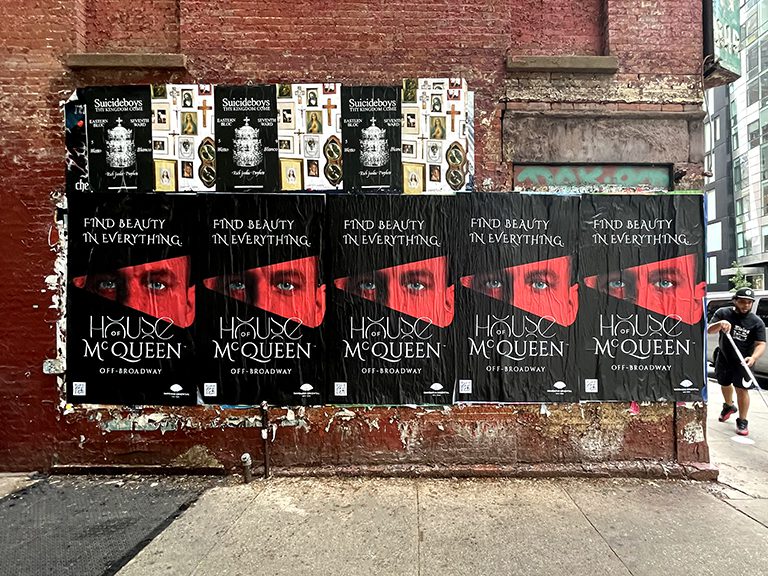
Film has always used the street. The history of movie marketing is inseparable from the history of poster culture — the hand-applied broadside, the theater lobby card, the hand-painted wall advertisement. What has changed is the sophistication of execution, the precision of geographic targeting, and the integration of physical street campaigns with the digital programs that now anchor most studio marketing plans. We execute film street marketing campaigns for studios, distributors, and independent producers across 50+ U.S. markets, and the format remains one of the most effective tools available for reaching the movie-going audience in the physical environment they actually inhabit.
This guide covers how film street marketing campaigns are structured, what formats perform at each stage of the campaign timeline, how independent and studio campaigns differ in approach, and what the operational picture looks like from first brief to opening weekend documentation.
Why Street Marketing Still Works for Film
Film audiences are not found in the same place as general consumer audiences. Movie-goers skew toward urban neighborhoods with dense walkable entertainment infrastructure. The audience that accounts for the majority of opening weekend attendance in any major market lives in, works in, or regularly visits exactly the neighborhoods where street-level campaigns operate — Williamsburg in Brooklyn, Silver Lake in Los Angeles, Wicker Park in Chicago, Capitol Hill in Seattle, and Cambridge in Boston.
These audiences are also among the most resistant to digital advertising in their categories. Ad blocking rates are high. Social feeds are curated. But a well-produced wheatpaste campaign on a Williamsburg building wall is not blockable. It is not skippable. It appears in the physical world of an audience that is already predisposed to notice and engage with visual culture.
Street campaigns create social amplification that digital buys alone do not generate. A striking wheatpaste panel becomes a photographable moment — audiences post it to Instagram, tweet about it, show it to friends. That organic social amplification multiplies the reach of the physical campaign into networks that the studio’s paid social would never penetrate at the same cost. For films that have earned it, a striking street campaign can become part of the cultural conversation around the release.
The Campaign Timeline: Teaser, Full Push, and Opening
Effective film street campaigns operate in phases that map to the pre-release marketing build. The teaser phase runs two to three weeks before opening. The full campaign push runs in the final seven to ten days. Opening weekend itself is the culmination — campaigns that have been building for two to three weeks create an environment of maximum visual saturation when the film opens.
The teaser phase uses minimal information for maximum curiosity. We deploy key art with the film title, a striking image, and the release date — nothing more. No review quotes (they do not exist yet), no tagline in most cases, no cast listing. The goal is to place the film’s visual identity in the market two to three weeks before the audience needs to make an attendance decision, establishing recognition before the campaign’s message needs to sell anything.
The full push phase deploys complete key art with tagline, review quotes as they emerge, and the full cast. By this point, the audience has already seen the teaser campaign and has recognition for the visual identity. The full campaign lands on familiar ground. We concentrate full push deployments in the final week before opening, ensuring maximum freshness going into the weekend when attendance decisions are made.
Wheatpaste Poster Campaigns for Film
Wheatpaste is the foundational format for film street marketing. Large-scale poster panels applied to building walls at eye level create the kind of visual dominance in a neighborhood that no other street format matches. A well-placed panel on a high-foot-traffic wall in Williamsburg, Silver Lake, or Wicker Park generates thousands of impressions per day from the audience most likely to attend the film.
Our wheatpaste poster campaigns for film clients use high-quality print materials sized to match the surface dimensions at each placement location. For major releases, we produce multiple size variants — a full-wall overlay for large building surfaces, a standard single-panel for utility boxes and hoarding, and a smaller format for secondary placements. The size mix allows us to make use of the full range of available surfaces in each market rather than limiting coverage to locations that accommodate only one panel size.
Surface selection is the most important variable in a film wheatpaste campaign. We know which walls in each market consistently produce high impression rates, which surfaces hold best in weather, and which locations are most likely to attract social photography. The goal is not just to place the poster — it is to place it where the audience will find it, see it, and share it.
Street Team Activations for Film Campaigns
Street team programs for film campaigns concentrate at the highest-leverage audience contact points: the exits of high-traffic cinemas (the audience there has just self-identified as a moviegoer), the entrances to entertainment districts on Thursday and Friday evenings (when weekend attendance decisions are being made), and university campus zones for films targeting younger audiences.
Our brand ambassador agency briefs film campaign teams on the specific film — the genre, the talent, the release date, the audience it is designed for — before every deployment. A team handing out postcards for a horror film needs to engage differently than a team distributing materials for a romantic comedy. The audience at a multiplex on a Friday night is not a single demographic; it is multiple distinct audience clusters making different entertainment choices. Briefed teams calibrate their approach accordingly.
Theater approach deployments are the highest-conversion street team application for film marketing. Audiences leaving a comparable film are the most qualified leads in the market — they are active moviegoers, they are in the entertainment frame of mind, and they have just demonstrated their willingness to spend money on a movie ticket. A well-executed postcard distribution at the exit of the theater playing a comparable genre film reaches this audience at maximum receptivity.
Campus Campaigns for College Demographic Films
University campuses are distinct campaign environments that require specific formats and approaches. For films targeting audiences in the 18-to-25 range — genre films, independent releases, animated features, and films with a clear college-audience demographic — campus campaigns in major university markets significantly extend reach into the core audience.
Campus wheatpaste campaigns in the neighborhoods surrounding major university campuses (Allston/Cambridge in Boston, Hyde Park in Chicago, Berkeley in the Bay Area, Wicker Park in Chicago, and similar zones in each major market) reach the off-campus student residential audience. On-campus distribution programs using handbills and table tents reach the residential hall and dining commons audience directly.
For SXSW-adjacent releases targeting the indie film demographic, Austin’s campus corridor and the surrounding East Austin neighborhoods create a particularly receptive campaign environment during the festival week when the audience’s attention is already elevated around film culture.
Market Priority for Film Street Campaigns
New York and Los Angeles are mandatory first-tier markets for any national film campaign. These cities account for a disproportionate share of opening weekend box office for limited releases, house the entertainment press and industry audience whose reviews and social posts drive national conversation, and contain the densest concentration of the core film-going demographic.
For wide releases targeting mass audiences, we extend the campaign into 10 to 20 additional markets covering the Southeast, Midwest, and Southwest. The specific market selection depends on where the film’s target demographic is concentrated geographically and where the distributor’s exhibition relationships are strongest.
For independent and arthouse releases, a focused six to eight city campaign concentrating resources in the highest-return markets is often more effective than spreading a limited budget across 15+ cities. A strong campaign in New York, Los Angeles, Chicago, San Francisco, and Seattle will drive more aggregate opening weekend performance than a thin campaign across 15 markets at the same budget.
Integration with Digital Film Marketing
Street campaigns for film work best when they are coordinated with the film’s digital campaign — same key art, same visual identity, same release date messaging. When an audience member sees the film’s key art on a building wall in their neighborhood and then sees the same image in a social feed ad, the physical encounter creates a recognition and credibility signal that the digital impression alone cannot generate.
For campaigns with a social amplification objective, we can position wheatpaste placements specifically at locations known to generate social photography — striking wall backgrounds, landmark adjacencies, or locations that create interesting compositional frames for Instagram images. These placements are not just impression vehicles; they are content creation moments that extend the campaign’s reach into earned media.
Our sidewalk stencil programs near major theater locations create ground-level impressions that complement the eye-level poster campaigns. A stencil at the pedestrian approach to a multiplex — “Now Showing” or “[Film Title] Opens [Date]” — reinforces the campaign message at the decision point, when the audience is literally walking toward the box office.
LED Trucks for Film Opening Weekend
LED billboard truck routes through entertainment districts on Thursday and Friday evenings before opening weekend create a moving campaign layer that complements static placements. The truck route covers the full entertainment geography of the market — restaurant blocks, bar districts, theater corridors — reaching the audience in the evening hours when they are making the weekend plans that include or exclude going to the movies.
Our LED billboard trucks can display video trailers, animated key art, and rotating messages — including a countdown to opening night that creates urgency in the final days before the film opens. For films with a strong trailer that has driven strong digital engagement, displaying that trailer content on an LED truck in a high-traffic entertainment zone extends the trailer’s reach into the physical environment where the audience lives.
Campaign Documentation and Reporting
All film street campaigns are documented with geo-tagged photography at each placement location, a written placement log with surface descriptions and timestamps, and crew activity reports for street team deployments. Reports are delivered within 48 hours of campaign completion.
For campaigns running across multiple markets, we deliver a unified report covering all markets in a single document with market-by-market sections and a consolidated summary. Studios and distributors with press and publicity teams often want campaign photography for earned media and social use — we can provide high-resolution placement photography suitable for social sharing as part of the post-campaign deliverable package.
Budget Ranges for Film Street Marketing
Independent film campaigns in two key markets (New York and Los Angeles) with wheatpaste poster campaigns and targeted street team programs run $12,000 to $25,000 including print production. A six-city independent campaign covering New York, Los Angeles, Chicago, San Francisco, Seattle, and Austin runs $35,000 to $65,000 depending on campaign duration and format mix.
Studio campaigns for wide releases across 10 to 15 markets with combined format deployments (wheatpaste, street teams, LED trucks) run $80,000 to $200,000 depending on market count, campaign duration, and format scope. We provide detailed line-item proposals within 48 hours of receiving a brief that specifies market list, release date, and format preferences.
International Film Distribution and Street Campaigns
For foreign-language films releasing in North American markets and for domestic films releasing internationally, street campaign strategy requires additional market-specific creative decisions. A Korean-language film releasing in New York and Los Angeles needs to reach Korean-American community audiences in specific neighborhoods — Flushing and parts of Queens in New York, Koreatown in Los Angeles — as well as the broader arthouse audience that will attend with subtitles in the city’s dedicated arthouse theaters.
International distributors launching domestic productions in major European markets use street campaigns in culturally specific ways. A Hollywood studio launching a tent-pole release in London, Paris, and Madrid needs neighborhood-specific creative strategies in each city that reflect local entertainment culture rather than transporting the U.S. campaign approach unchanged into a different cultural context.
We coordinate international film street campaigns through our European operator network, applying the same creative consistency standards and documentation requirements as domestic programs. For distributors launching globally in the same window, we can coordinate simultaneous deployments across North American and European markets from our unified operations center, delivering a consolidated campaign report covering all markets.
Streaming Platform Film and Series Marketing
Streaming platforms promoting original films and series use street campaigns in ways that differ from theatrical release marketing. The objective is not opening weekend attendance but sustained awareness that drives subscription and viewing in the weeks following the release or premiere date. Campaign timing for streaming launches is typically two weeks before the release date through one week after, with a street campaign intensity peak in the final week before the premiere that mirrors the theatrical opening weekend push.
Our wheatpaste poster campaigns for streaming platform titles use key art from the platform’s official creative materials and include the platform logo, the release date, and a simple awareness message rather than the complex review-quote-and-cast-listing format of theatrical campaigns. Streaming campaigns are awareness programs, not ticket-sell programs, which changes the message hierarchy and creative requirements at street scale.
Timing the Street Campaign to the Trailer Release
For film campaigns with a theatrical trailer that has strong audience traction, the optimal timing for the first street deployment is in the two weeks following the trailer’s initial release. The trailer has established the film’s visual identity in the audience’s digital environment; the street campaign then places that same identity in the audience’s physical environment while the digital impression is still fresh. The cross-channel recognition effect — seeing the same key art on a building wall that they have already seen in their social feed — accelerates the transition from awareness to consideration.
For films releasing before a strong trailer exists — teaser trailers, or cases where the full trailer releases close to the opening date — the street campaign carries more of the initial awareness burden. In these cases, the teaser campaign two to three weeks before opening creates awareness in the absence of robust digital impressions, and the full campaign in the final week before opening reinforces and completes the message.
Frequently Asked Questions
How far in advance should a film begin street marketing?
Teaser wheatpaste campaigns typically launch two to three weeks before the release date to establish visual presence and curiosity before the full marketing push. Full campaign deployments run in the final seven to ten days before opening weekend. For major wide releases, we recommend starting the first street deployment four weeks before opening to build awareness through multiple campaign phases.
What street marketing formats work best for film campaigns?
Wheatpaste poster campaigns are the most effective street-level format for film marketing because they allow large-scale key art deployment at eye level in high-foot-traffic neighborhoods. Street team programs at high-traffic cinemas and entertainment districts provide direct audience contact. Sidewalk stencils near theater entrances and LED trucks on entertainment corridors complete the architecture.
Which cities matter most for film street marketing?
New York and Los Angeles are the anchor markets for any national film street campaign. Chicago, San Francisco, Seattle, Boston, and Austin are the next tier for independent and arthouse releases. For wide releases targeting broad national audiences, we extend into 15 to 25 additional markets.
Do independent films use guerrilla marketing?
Yes, and guerrilla marketing is particularly well-suited to independent film campaigns because the cost efficiency of wheatpaste and street team programs allows limited marketing budgets to achieve visible market presence in key cities. We execute independent film campaigns with budgets starting around $15,000 for targeted two-city executions.
What does a film street marketing campaign cost?
A two-city wheatpaste campaign for an independent film starts around $12,000 to $18,000 including print production. A national 10-city campaign for a studio release runs $60,000 to $150,000 depending on format mix, campaign duration, and market selection. We provide detailed proposals within 48 hours.
Can street marketing help expand an arthouse film’s audience?
Yes. Arthouse and independent films benefit significantly from street-level campaigns because the key art of most quality independent films performs strongly in the urban neighborhood environments where their core audience lives. A well-placed wheatpaste campaign in Williamsburg, Silver Lake, or Capitol Hill creates the visual presence that drives word-of-mouth and theater attendance.
How does the studio or distributor provide artwork for street campaigns?
We work from the client’s approved key art files. We handle all print production, sizing the key art to our standard wheatpaste panel dimensions. The studio or distributor approves the mock-up before production begins. We can size the same artwork for sidewalk stencil templates, street team handout materials, and LED truck creative.