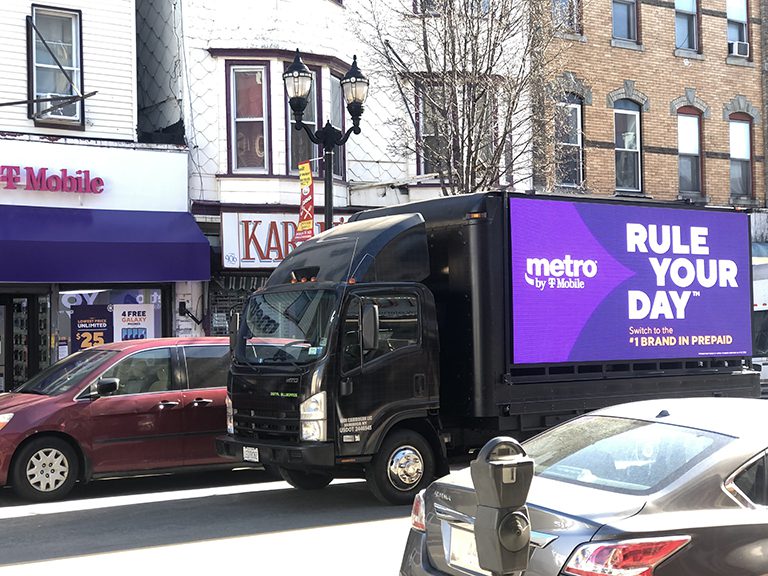
Mobile brand activations go where consumers are instead of waiting for consumers to come to them. Here is how to plan and execute tours that actually cover markets and drive results.
Mobile brand activations move. That is the fundamental point. Instead of building a single activation in one location and hoping your audience finds it, mobile activations bring the brand directly to consumers in the neighborhoods, at the events, and in the daily environments where those consumers actually spend time. A branded vehicle drives through Brooklyn, parks in Williamsburg for two hours, rolls to Crown Heights, and wraps up in Bushwick. Three neighborhoods. One day. Three completely different consumer segments reached.
We run mobile brand activations at American Guerrilla Marketing. This is not a theoretical service; it is operational work that we execute regularly across dozens of markets. This guide covers the formats, the strategy behind mobile activation planning, how to route a tour, what goes wrong, and how to document and measure what you did.
The core advantage of mobile brand activations is that they remove the attendance barrier. A stationary activation, a pop-up in a fixed location, depends on consumers discovering and choosing to visit it. The marketing effort required to drive foot traffic to a stationary activation adds cost and complexity and often results in a mismatch between the audience that shows up and the audience the brand actually needs to reach.
Mobile activations go to where the target consumer already is. If the target consumer is a fitness-oriented professional who lives in Williamsburg and works in Midtown, a mobile activation can reach them at their gym exit in the morning, near their office at lunch, and in their neighborhood on a weekend afternoon. The brand reaches three separate moments of potential relevance without requiring the consumer to take any deliberate action to engage with it.
This is especially valuable for new brands and brands entering new markets. Without established retail presence or strong word-of-mouth, new brands cannot rely on consumers seeking them out. Mobile activations allow the brand to establish direct consumer contact proactively, seeding trial and awareness in markets where the brand has no existing footprint.
Types of Mobile Brand Activation Vehicles
The vehicle is the most visible element of a mobile brand activation, and the choice of vehicle communicates something about the brand before the consumer even interacts with it. Understanding the options helps brands select the right format for their identity and objectives.
Branded Sprinter Vans and Step Vans
Sprinter vans and step vans are the workhorses of mobile brand activation. They are large enough to carry significant product inventory and sampling equipment, nimble enough to navigate urban streets and park in standard commercial loading zones, and can be fully wrapped in brand graphics that create a high-visibility presence wherever they park. Step vans, with their walk-in cargo area, allow staff to work efficiently from inside the vehicle, which is particularly useful in variable weather conditions.
For most sampling and street-level activation programs, a branded sprinter or step van is the practical choice. It provides the operational capacity needed to run a full activation day while maintaining the visibility and brand presence that makes the vehicle itself a media asset.
Airstream Trailers
Airstream trailers have become a popular choice for premium brand activations because the vehicle itself carries an immediate aesthetic and cultural cachet that reinforces certain brand identities. For lifestyle brands, premium food and beverage, and brands associated with craft and quality, an Airstream provides a visual shorthand that communicates brand values before a single conversation happens.
The practical limitations of Airstreams include the need for a tow vehicle and additional setup time, as well as restrictions on where they can be deployed in dense urban environments. They work best in more open settings: markets, festivals, outdoor events, and suburban or semi-urban locations where parking and setup space is available.
Custom Trailer Builds
For brands that want a mobile activation unit built specifically for their product and experience, a custom trailer build is the premium option. Custom builds can include built-in display systems, climate control, integrated technology, serving counters, and brand environments that create the full experiential impact of a pop-up while retaining the mobility of a vehicle-based activation.
Custom builds require a longer lead time and significantly higher upfront investment than renting a standard vehicle. For brands planning extended national tours or looking to use a mobile unit over multiple campaign cycles, the investment can be justified. For shorter or one-off activations, renting a configured vehicle through an experienced agency is more practical.
Standard Vans and Smaller Vehicles
For purely operational mobile programs, simple branded vans are often sufficient. A sampling program that deploys street teams from a central vehicle does not need the vehicle to be a branded spectacle; it needs the vehicle to carry product, equipment, and staff efficiently. For street team sampling programs and logistical support roles, standard vans with basic brand graphics are the practical and cost-effective choice.
The vehicle is a brand statement. Choose one that communicates what you want the brand to say before anyone opens their mouth. An Airstream says something different than a step van, and both say something different than a standard cargo van wrapped in brand graphics.
Building a Mobile Tour Strategy
A mobile activation tour is not a vehicle driving randomly through markets. It is a precisely designed market coverage strategy that uses the mobility advantage to reach the right consumers in the right contexts across multiple locations and cities.
Market Selection
Which cities? This is the first strategic decision, and it should be driven by data, not by which markets seem exciting or which brand leaders live in. Relevant data includes retail distribution, consumer demographic concentration, competitive presence, and the cost of activation in each market. AGM helps brands prioritize markets based on where mobile activation investment will produce the greatest return.
For a national CPG brand, this might mean prioritizing the twenty markets with the highest concentration of the target demographic and the strongest existing retail distribution, so that the sampling and trial generated by the mobile tour can convert into shelf purchases at accessible retail accounts. For a brand entering a new market, it might mean prioritizing the two or three markets where the brand has the strongest pre-existing word of mouth and the best retail partner relationships.
Stop-Level Location Planning
Within each market, the tour needs a specific location plan: which neighborhoods, which venues, which events, which specific street corners or parking locations create the best consumer contact for the brand. This requires genuine market knowledge, not just general awareness that a city has a dense downtown area.
AGM’s location planning in New York, for example, distinguishes between Williamsburg and Bushwick, between SoHo and the Meatpacking District, between the Upper East Side and the Upper West Side, because each neighborhood has a distinct consumer profile that may or may not match the brand’s target. Getting this granular is the difference between an activation that reaches the right consumers and one that generates foot traffic from whoever happens to be nearby.
Timing and Schedule
When you are in each location matters as much as where you are. A weekend morning in a residential neighborhood reaches a very different consumer than a weekday afternoon in a commercial district. Events create temporary concentrations of specific consumer profiles that may be worth routing around. Seasonal and weather considerations affect both consumer behavior and operational feasibility.
Mobile tour scheduling should build in contingency time. Vehicles break down. Locations do not perform as expected and need to be changed. Rain drives consumer traffic indoors and may require a shift to covered locations. Tours that are scheduled with no flexibility have no ability to adapt, and activations in the field always require adaptation.
Staffing the Tour
Mobile tour staffing has unique requirements compared to stationary activations. Staff need to be comfortable working out of a vehicle, managing the physical setup and breakdown that each stop requires, adapting quickly to different location types and consumer contexts, and maintaining energy and brand enthusiasm across multiple stops in a single day.
Tour staff also need to handle logistics that are not part of a stationary activation: vehicle maintenance awareness, navigation, parking management, and the operational tasks that keep the tour moving. AGM selects and trains mobile tour staff specifically for these requirements, not just for the consumer-facing brand ambassador role.
Vehicle Type
Best Use
Urban Parking
Brand Impact
Relative Cost
Branded Sprinter Van
Sampling, street team support
Excellent
Moderate
Low
Step Van / Box Truck
Sampling + display
Good
Good
Low-Moderate
Airstream Trailer
Premium experiential
Limited
High
Moderate
Custom Trailer Build
National tours, brand flagship
Moderate
Very High
High
Double-Decker Bus
High-visibility urban
Difficult
Very High
High
Executing a Mobile Brand Activation Day
The mechanics of running a mobile activation day require more operational discipline than a stationary activation. The team is managing multiple locations, variable setup times, varying consumer traffic patterns, and the logistical reality of operating out of a vehicle in urban environments.
Pre-Day Preparation
Every activation day starts with a briefing that confirms locations, timing, consumer approach protocols, documentation requirements, and contingency plans. The vehicle is checked: product inventory is correct, equipment is functional, brand graphics are clean and undamaged. Staff know their specific roles and responsibilities at each stop, including who handles setup, who leads consumer interactions, who manages documentation, and who serves as the point of contact for field management.
Stop Management
At each stop, the team needs to set up quickly and efficiently, engage consumers with the right approach for that specific location and time, document the activation thoroughly, and manage the transition to the next stop without losing activation time to slow teardown. Good mobile tour staff develop routines that make each stop efficient, while remaining flexible enough to extend a high-performing stop when consumer traffic warrants it.
Adapting in the Field
Every mobile activation day produces surprises. A planned stop location is blocked by construction. Consumer traffic at a specific location is lower than expected. An unexpected event in a nearby location creates a density of the right consumer that was not in the original plan. Strong field management means having the authority and judgment to make real-time adjustments that capture these opportunities and avoid wasted time at underperforming locations.
End-of-Day Documentation
At the end of each activation day, the team completes full documentation: photos from each stop, GPS-verified location records, product distribution counts, consumer contact summaries, and field notes on what worked and what did not. This documentation feeds into the ongoing reporting cycle and provides the brand with a day-by-day record of tour performance.
We tell our tour teams: if it did not get documented, it did not happen. The documentation is the proof of performance, the basis for any reporting to leadership, and the raw material for planning the next tour smarter than this one.
Multi-City Mobile Tour Management
Managing a mobile activation tour across multiple cities adds layers of operational complexity that require strong systems and experienced management.
Vehicle Logistics
Moving a branded vehicle from market to market requires planning around drive times, overnight parking and storage, maintenance schedules, and fuel costs. For tours covering large geographic areas, multiple vehicles operating regionally may be more practical than a single national vehicle covering the entire route. AGM’s logistics planning accounts for all of these variables and builds them into the tour budget and schedule.
Market-Level Staffing
For tours covering many markets, it is often more practical to staff each market locally, using the tour vehicle as the central asset while recruiting and briefing staff in each city. This approach reduces travel costs and ensures that local staff have the neighborhood knowledge and cultural context that makes activations in their own city more effective. It also requires strong remote briefing and training systems to ensure consistent brand representation across all markets.
Product Supply Chain
Ensuring adequate product supply at each stop on a mobile tour requires coordination with the brand’s logistics and operations teams. Product needs to be staged appropriately ahead of the vehicle’s arrival in each market, with sufficient inventory for the planned activation volume plus contingency stock. Cold chain requirements for food and beverage products add additional complexity that needs to be built into the logistics plan.
Centralized Reporting
For multi-city tours, centralized reporting systems allow field teams in different markets to submit documentation and data to a single platform, which AGM synthesizes into ongoing tour performance reports for the brand. This gives brand leadership real-time visibility into tour performance across all markets without requiring them to manage communication with multiple field teams directly.
What Can Go Wrong on Mobile Tours
Mobile activations have a specific set of risks that brands and agencies need to plan around explicitly.
Vehicle Mechanical Failures
The activation vehicle is the single point of failure for the entire tour. A breakdown that is not managed quickly can take an entire activation day offline and create cascading schedule problems. AGM builds vehicle maintenance protocols into every mobile tour plan, including pre-tour inspections, mid-tour checkpoints, and relationships with breakdown response services in each market on the tour route.
Location Performance Variability
Pre-planned stop locations sometimes underperform. The foot traffic is lower than expected, the consumer profile at that location is wrong, or conditions have changed since the location was scouted. Field managers need both the authority to redirect the tour to more productive locations and the market knowledge to know where to redirect it. This is why AGM insists on field managers with deep market knowledge rather than managers who are simply good at following a script.
Weather and Seasonal Factors
Outdoor mobile activations are weather-dependent. A cold rain on an activation day can reduce consumer engagement dramatically, particularly for formats that require consumers to stop and engage rather than receive a quick sample in passing. Tour planning should include weather contingency stops such as covered markets, indoor retail adjacencies, or sheltered urban locations, so that inclement weather does not eliminate the activation day entirely.
Staff Performance Consistency
On multi-week tours with market-by-market staffing, maintaining consistent staff quality and brand representation across all markets requires active monitoring and management. Field managers need to evaluate staff performance at each stop and provide coaching or replacement where needed. The brand ambassador program should include clear performance standards and a process for addressing underperformance quickly, before it accumulates into a pattern of poor brand representation across multiple markets.
Integrating Mobile Brand Activations with Retail Strategy
The highest-ROI mobile brand activations are those that run in coordination with the brand’s retail distribution. A consumer who receives a product sample from a mobile unit on a Saturday morning is meaningfully more likely to purchase that product when they encounter it at their grocery store Saturday afternoon than a consumer who has only seen an ad. The mobile activation bridges the gap between digital awareness and physical purchase by inserting a direct product trial in the consumer’s path.
This retail coordination requires some planning. The mobile tour route should prioritize markets where the brand has active retail distribution, so that the trial generated by the mobile activation can convert to purchase at accessible points. The timing of the mobile activation should ideally align with retail resets or new product introductions in each market, so that the consumer who tried the product from the mobile unit finds it on shelves in their usual stores within the same week.
For brands launching in new retail accounts, a mobile activation in the same market during the same period as the retail launch creates a pull-through effect that accelerates sell-through and demonstrates consumer demand to the retailer. This kind of coordinated activation and retail execution is one of the highest-use uses of mobile brand activation investment available.
Mobile Brand Activation for Market Testing
Mobile brand activations also serve a research function that many brands underutilize. A mobile tour through five markets provides direct consumer feedback on product, messaging, and brand positioning across a range of geographic and demographic contexts. Field teams observe consumer reactions in real time: which products draw the most interest, which messages resonate, which demographic segments engage most readily, which locations produce the highest quality consumer interactions.
This qualitative market intelligence is not available from digital campaigns. A click-through rate tells you that a consumer responded to an ad. A field team observing fifty consumer interactions with your product in a specific neighborhood tells you which aspects of the product experience drive the most genuine interest and what questions or objections consumers raise most frequently. That intelligence directly informs product positioning, marketing messaging, and retail strategy in ways that digital data alone cannot.
AGM provides structured field intelligence reporting as part of mobile brand activation programs. Field managers are trained to observe and document consumer response patterns, product-specific reactions, and competitive observations from the activation environment. This reporting becomes part of the post-campaign deliverable alongside the standard photo documentation and deployment data.
Seasonal Mobile Brand Activation Strategy
For many brands, mobile activation investment is most efficient when concentrated in the seasons and occasions most relevant to the product. A cold brew coffee brand activates most productively in the spring and summer. A holiday gift brand activates most productively in November and December. A sunscreen brand makes its most compelling case to consumers in the weeks before peak outdoor season begins.
Building a seasonal mobile activation strategy requires mapping the consumer purchase cycle against the brand’s product relevance calendar. Peak activation seasons should be planned well in advance: vehicle booking, staff recruitment, event calendar research, and location scouting all require lead time that gets longer as the program scale increases. Brands that plan seasonal programs six months out have access to better event opportunities, better staffing options, and better overall execution than brands that plan six weeks out.
Frequently Asked Questions
What are mobile brand activations?
Mobile brand activations are marketing executions that use branded vehicles, touring units, or roaming field teams to bring the brand directly to consumers in their neighborhoods, at events, and in the environments where they spend time. Rather than waiting for consumers to find the brand, mobile activations go to them.
What types of vehicles are used in mobile brand activations?
Common vehicle types include branded step vans and delivery trucks, sprinter vans configured for sampling or demo, food trucks repurposed for non-food brand activations, double-decker buses for high-visibility campaigns, Airstream trailers for premium brand presentations, and custom-built trailer units designed specifically for a brand’s activation requirements.
How many cities can a mobile brand activation cover?
A single mobile activation unit can cover five to fifteen cities over a four to twelve week tour, depending on routing, pacing, and activation day requirements in each market. AGM has managed mobile tours covering twenty or more markets using multiple units operating simultaneously in different regions.
How much does a mobile brand activation tour cost?
A single-city mobile activation day runs $5,000 to $15,000 including vehicle, staff, and product. A multi-city tour of eight to twelve cities typically ranges from $60,000 to $200,000 depending on tour duration, vehicle type, staffing requirements, and activation complexity. AGM builds detailed cost estimates based on your specific tour scope.
What documentation does AGM provide for mobile activation tours?
AGM provides photo documentation from each activation stop, GPS-verified deployment logs showing locations and durations, consumer contact summaries, daily field reports, and a comprehensive post-tour summary report covering all markets. This documentation gives brands a full record of where the tour ran and what it accomplished.