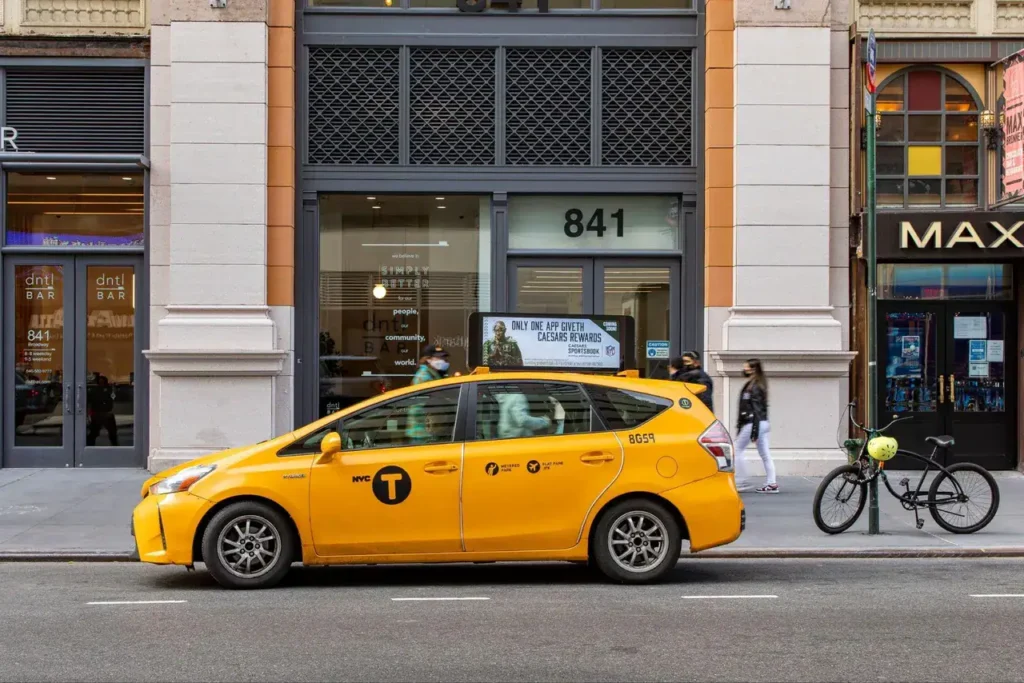
Every major city has a fleet of vehicles that moves through every neighborhood, every traffic corridor, and every commercial district continuously throughout the day and night. Taxi cabs don’t stay in one place — they’re in constant motion across the full geographic footprint of the city, covering transit hubs, residential neighborhoods, business districts, entertainment corridors, and everything in between. That geographic mobility is what makes taxi trunk advertising a uniquely powerful format for brands seeking broad urban market coverage without the constraint of fixed placement locations.
At American Guerrilla Marketing, we understand mobile advertising formats because we deploy LED billboard trucks across major U.S. markets — bringing brand messages into the environments where fixed placements can’t reach. Taxi trunk advertising operates on the same principle: your brand travels to where the audience is, rather than waiting for the audience to come to it. The result is a format that generates impressions in a remarkable diversity of contexts throughout a single campaign day.
This guide covers what taxi trunk advertising is, why it generates exceptional market reach, how to structure a campaign, and how it fits within a broader urban out-of-home strategy.
What Is Taxi Trunk Advertising?
Taxi trunk advertising places branded display panels on the rear trunk lid of taxi cabs and for-hire vehicles. These panels — typically backlit or printed vinyl graphics — are positioned to be visible to the vehicle immediately following the cab in traffic, pedestrians on adjacent sidewalks, and anyone with a sightline to the rear of the vehicle.
The Trunk Panel Format
Trunk panels are one of several taxi advertising formats available in major markets. Roof toppers — illuminated signs on the roof of the cab — are visible above the traffic flow to pedestrians. Interior advertising appears on screen systems inside the passenger compartment. Trunk panels occupy a distinct position in this ecosystem: they face outward, toward the street and the vehicles behind the cab, delivering impressions to the traffic environment rather than to passengers.
This outward-facing orientation means trunk advertising is fundamentally different in audience and impression context from interior taxi advertising. Where interior advertising reaches the passenger — a receptive, captive audience in close proximity — trunk advertising reaches the broader urban environment: the following car in traffic, the pedestrian on the sidewalk, the bystander at the corner waiting to cross the street. Scale and breadth are the trunk format’s primary advantages.
Static and Digital Trunk Formats
Trunk panels are available in both static vinyl and digital LED formats in selected markets. Static trunk panels are more common and more widely available — they’re printed vinyl graphics mounted in standardized frames on cab trunks, replaced periodically with new creative. Digital trunk panels are illuminated LED displays that cycle through creative content, allowing for multiple brand messages, daypart targeting, and content updates without physical replacement. Digital trunk advertising is available in limited markets and at premium costs relative to static placements.
Why Taxi Trunk Advertising Generates Exceptional Reach
The geographic mobility of taxi advertising is its defining advantage. Understanding why that mobility translates to exceptional reach requires understanding how taxi fleets move through cities.
The Coverage Geography of a Taxi Fleet
A single taxi cab operating a full shift in New York City may traverse every borough, navigate dozens of distinct neighborhoods, serve airport trips that reach JFK, LaGuardia, and Newark, and stop at hundreds of traffic signals and taxi stands throughout its shift. Over a 12-hour day, that single vehicle delivers brand impressions in contexts ranging from Wall Street to Harlem, from the Lincoln Tunnel approach to the airport terminal. No fixed OOH placement replicates that geographic breadth.
Multiply that single cab across a fleet of 100 or 1,000 vehicles with trunk panels, and the coverage becomes comprehensive across the full urban geography. Every major traffic corridor, every commercial district, every transit hub receives multiple daily exposures. The impression volume from a well-executed taxi fleet campaign is substantial — estimated at 30,000 to 100,000 impressions per vehicle per day in dense urban markets.
Traffic Dwell Time at Eye Level
Urban traffic creates extended exposure windows for following vehicles. A car following a taxi through midtown Manhattan in peak traffic may be within 10 to 30 feet of that cab’s trunk for minutes at a time — repeatedly. In slow-moving urban traffic, trunk panel dwell time is significantly longer than billboard or transit advertising dwell time, and the viewing angle is constant: directly facing the creative at eye level. This combination of proximity, duration, and angle creates impression quality that static billboards viewed at high speed from the roadway can’t replicate.
Pedestrian Sightline Reach
Beyond the following vehicle, cab trunk panels are visible to pedestrians along the entire route the vehicle travels. In dense urban environments where taxis frequently pull over, idle at lights, wait in taxi queues at hotels and venues, or travel at slow speeds through commercial districts, the pedestrian audience is substantial. A cab queuing at the taxi stand outside Penn Station in New York delivers trunk panel impressions to the thousands of pedestrians passing through that corridor daily.
New York City and the Taxi Trunk Advertising Market
New York City is the center of gravity for taxi trunk advertising in the United States. The NYC yellow cab fleet — regulated by the Taxi and Limousine Commission (TLC) — is the largest metered taxi fleet in the country and one of the largest urban taxi fleets in the world. Our team based at Industry City, Brooklyn operates across the New York market and has extensive experience with the full spectrum of New York transit and OOH advertising formats, including taxi placement programs.
The NYC Yellow Cab Advantage
Yellow cabs in New York operate 24 hours a day, seven days a week, across all five boroughs and into the tri-state area for airport and charter runs. The fleet’s around-the-clock operation means trunk advertising generates impressions at all hours — morning commutes, lunchtime midtown traffic, evening entertainment district congestion, and late-night runs to outer borough residential neighborhoods. No other fixed OOH format delivers this temporal breadth alongside geographic coverage.
Contact our team at (646) 776-2770 to discuss New York City taxi trunk advertising as part of a broader urban campaign strategy.
Regulatory Considerations
Taxi advertising in regulated markets like New York is subject to TLC rules regarding advertising placement, panel dimensions, and content restrictions. Working with licensed taxi advertising vendors who understand TLC compliance prevents campaign delays and regulatory problems. Our network of OOH partners in New York includes vendors with established TLC relationships and compliant installation processes.
Integrating Taxi Trunk Advertising with Broader OOH Campaigns
Taxi trunk advertising performs best as part of a multi-format urban out-of-home campaign that combines the geographic mobility of vehicle advertising with the fixed presence of street-level placements and the high-impact energy of guerrilla marketing activations.
Fixed OOH Plus Mobile Fleet Coverage
Fixed OOH placements — bus shelters, subway stations, billboards, kiosks — establish brand presence at specific high-traffic locations where the audience reliably appears. Mobile taxi fleet coverage fills the geographic gaps, reaching neighborhoods, corridors, and contexts that fixed placements don’t cover. The combination creates a citywide presence that makes a brand feel genuinely ubiquitous — everywhere the target audience goes, in vehicles and at fixed locations alike.
Taxi Plus Guerrilla Activation
For product launches and campaign moments that require maximum awareness compression — getting the whole market to know about something in a short window — combining taxi trunk advertising with poster campaigns, sidewalk stencil activations, and brand ambassador programs creates the saturation effect that makes individual campaigns memorable. The taxi fleet delivers the broad reach; the guerrilla elements deliver the memorable moments that earn social sharing and word-of-mouth amplification.
LED Billboard Trucks for Event Amplification
For high-impact campaign moments, combining taxi fleet advertising with LED billboard trucks creates mobile advertising presence that can be concentrated in specific geographic zones at specific times — around event venues, at transit hubs, or in specific neighborhoods during peak hours. While taxi cabs cover the city continuously, LED trucks can be deployed with precision targeting that fixed and fleet formats can’t achieve. Together, they build both broad awareness and targeted high-impact moments within the same campaign geography.
Measuring Taxi Trunk Advertising Performance
Taxi advertising measurement relies on fleet tracking and audience modeling rather than the precise digital measurement tools available in online advertising. Understanding measurement methodology helps set appropriate expectations and design supplementary measurement approaches.
Fleet Tracking and Impression Modeling
Modern taxi fleets are GPS-tracked, enabling vendors to provide route data showing where panel-equipped cabs traveled during a campaign period. Audience impression models estimate the number of people exposed to the panels based on traffic volume data, pedestrian count data, and time-of-day factors for each route segment. While this methodology is modeled rather than observed, it’s consistent with the Geopath standards used across the OOH industry and provides defensible impression estimates for campaign reporting.
Supplementary Digital Attribution
For campaigns that include a digital call-to-action — a URL, QR code, or trackable phone number — digital attribution data can supplement impression modeling with direct conversion measurement. A QR code scan from a stopped taxi’s trunk panel is as traceable as any digital click. Integrating direct response elements into taxi trunk creative creates the measurement bridge between OOH impression volume and digital conversion activity.
Frequently Asked Questions About Taxi Trunk Advertising
What is taxi trunk advertising?
Taxi trunk advertising places branded display panels on the rear trunks of taxi cabs and rideshare vehicles. These panels are visible to the vehicles immediately behind the cab in traffic, pedestrians on sidewalks, and anyone in the sightline of a stopped or slow-moving cab in traffic or at taxi stands.
How many impressions does taxi trunk advertising generate?
A single taxi operating in a major urban market can generate 30,000 to 100,000 impressions per day depending on route density and hours of operation. A fleet of 100 taxis with trunk panels can generate millions of impressions per week across the city’s traffic grid.
What cities have the strongest taxi advertising markets?
New York City leads taxi advertising with its large yellow cab fleet operating under TLC regulations. Chicago, Boston, Washington D.C., Miami, and Los Angeles also have significant taxi and for-hire vehicle advertising markets. NYC taxi advertising is particularly valuable due to the city’s density and heavy pedestrian and vehicular traffic.
How is taxi trunk advertising different from roof top advertising?
Taxi roof advertising is visible to pedestrians on sidewalks and above ground level. Trunk advertising is visible at eye level to the vehicle immediately behind the cab in traffic, making it particularly effective in dense traffic conditions where following vehicles maintain proximity for extended periods. Both formats are often combined in comprehensive taxi advertising campaigns.
What creative specifications are required for taxi trunk advertising?
Taxi trunk panels typically require vinyl graphics sized to fit standard cab trunk dimensions — usually around 12 to 18 inches tall and 24 to 36 inches wide depending on the vehicle fleet. Creative must be legible at following-vehicle distance (10 to 30 feet) and comply with TLC or local for-hire vehicle regulations regarding advertising placement.
Is taxi advertising still relevant with the rise of rideshare?
Yes. While rideshare has reduced the total taxi fleet in many cities, the remaining taxi fleet is highly concentrated in urban cores, airports, and high-traffic commercial zones that are difficult to reach through other OOH formats. Rideshare vehicles themselves now carry advertising in some markets, expanding the mobile vehicle advertising opportunity.
How do you buy taxi trunk advertising?
Taxi advertising is purchased through specialized transit media companies that have contracts with taxi fleets and medallion holders. In New York, vendors like Verifone Media (now NMS) and others have historically managed yellow cab advertising inventory. Campaign planning should include lead time for production, installation, and fleet distribution.
Frequently Asked Questions
What is maximizing market reach the power of taxi trunk advertising?
American Guerrilla Marketing provides maximizing market reach the power of taxi trunk advertising services across 50+ U.S. markets. Every campaign is planned, scouted, executed, and GPS-documented by our field teams. We work with regional brands and Fortune 500 companies on campaigns that require real street-level execution and documented proof of performance.
How does AGM approach trunk advertising?
Our process starts with a market consultation to understand your goals, target audience, and budget. We then scout locations, handle any required permissions or permits, coordinate production and installation with our local crews, and provide a full GPS-tagged photo report after the campaign runs.
What markets does American Guerrilla Marketing cover for trunk advertising?
We operate in 50+ U.S. markets including New York, Los Angeles, Chicago, Miami, Houston, Atlanta, Seattle, Denver, Boston, and dozens of secondary markets. Contact us to confirm availability and pricing for your specific market.
How much does a trunk advertising campaign cost?
Campaign pricing depends on market, format, quantity, and duration. We work with budgets ranging from targeted single-market runs to national rollouts across multiple cities. Use our RFP Builder or contact us directly for a custom quote based on your specific campaign requirements.
How do I get started with trunk advertising through AGM?
The fastest way to get started is to submit your campaign details through our RFP Builder at americanguerrillamarketing.com, or contact us directly at [email protected] or (646) 776-2770. Our team typically responds within one business day with availability and initial pricing.