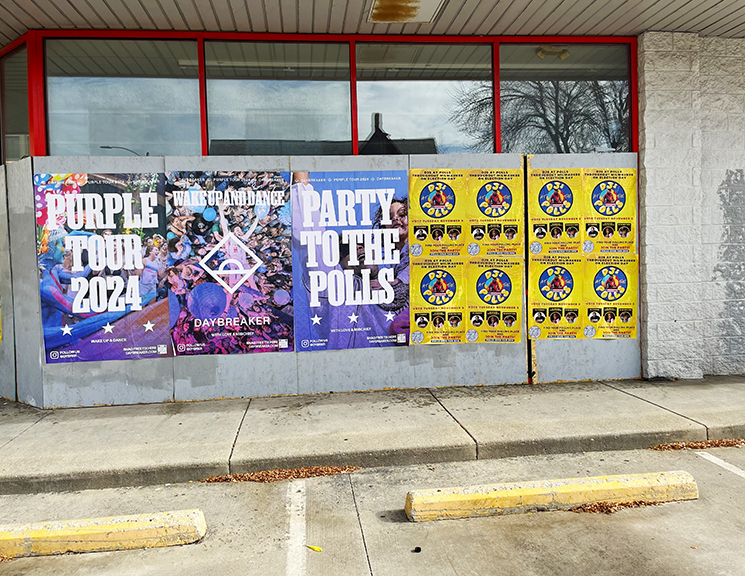
Wisconsin’s advertising landscape looks like a lot of Midwestern states at first glance: dominated by local TV spots, radio, and digital display. But the brands generating the most buzz in Milwaukee, Madison, Green Bay, and Appleton are not the ones with the biggest media buys. They are the ones showing up where their audience actually lives and moves, on the streets, in the neighborhoods, and along the daily commute routes that define how people experience a city.
Local advertising wisconsin means getting your message into the physical environment of your target market. It means sidewalk stencils on Brady Street. LED billboard trucks circling the Fiserv Forum before a game. Wheatpaste posters on permitted walls in the Third Ward and Bay View. Brand ambassadors engaging people face-to-face at the Farmer’s Market on the Capitol Square. This is how street-level advertising works, and our team at American Guerrilla Marketing has built campaigns exactly like this across Wisconsin for brands of all sizes.
This guide covers the tactics, the markets, and the strategic framework for running effective local advertising in Wisconsin using guerrilla marketing methods.
Why Guerrilla Marketing Is the Most Efficient Form of Local Advertising in Wisconsin
Traditional local advertising in Wisconsin works through reach and frequency. A radio spot reaches the entire metro several times a week. A local TV buy reaches households across a broad DMA. The challenge is that these formats reach everybody, including the vast majority who are not your customer. You pay for the whole audience to reach the fraction that matters.
Guerrilla marketing inverts this logic. Instead of broadcasting to the broadest possible audience and hoping your message filters down to the relevant segment, you identify where your specific audience physically concentrates and place your message there with high frequency and zero wasted impressions. In Milwaukee’s Third Ward, if your audience is design professionals and creative industry workers, you deploy on their commute corridors and lunch routes. In Madison near the UW campus, if your audience is college students and young professionals, you deploy on State Street and the pedestrian paths connecting campus buildings to the commercial strip.
The result is a campaign that achieves higher relevant frequency at lower total cost than any traditional media buy of comparable duration. A well-placed sidewalk stencil in the right Milwaukee neighborhood achieves dozens of impressions with the right individual over the course of a week, at a fraction of the cost of a single broadcast spot.
Sidewalk Stencils and Decals for Wisconsin Local Advertising
Sidewalk stenciling is the most cost-effective entry point for local advertising in Wisconsin’s urban markets. We apply water-soluble, chalk-based stencils to concrete surfaces in high-traffic pedestrian zones, creating high-contrast brand impressions that achieve repeat exposure with the specific audiences concentrated in each deployment zone.
In Milwaukee, the highest-value stencil zones are determined by your audience profile. The Third Ward’s public market approaches and pedestrian plaza surfaces reach design, food, and creative industry audiences. Brady Street and the surrounding East Side residential corridors reach young professional and lifestyle audiences. The downtown business core along Wisconsin Avenue and Water Street reaches corporate and professional audiences during weekday commute hours.
In Madison, State Street is the single highest-foot-traffic pedestrian corridor in the state outside of a major stadium event. The approach to the State Capitol on Capitol Square, the library mall adjacent to the UW campus, and the residential corridors of Willy Street and Atwood Avenue all offer targeted deployment zones for specific demographic audiences.
We scout every deployment zone in advance to confirm surface quality, foot traffic patterns, and any local restrictions. Every stencil placement is photographed with GPS coordinates and timestamps so you have full documentation of your deployment.
LED Billboard Trucks for Local Advertising in Wisconsin
LED billboard trucks bring the visual impact of digital out-of-home advertising directly to the streets of Wisconsin’s urban markets without the fixed location limitations of static billboard placements. Our trucks carry full-motion, high-resolution displays that run video, animated content, and multiple ad rotations while driving targeted routes through your audience’s geography.
In Milwaukee, LED truck routes can cover the entire Fiserv Forum and Deer District entertainment zone before and after Bucks games, making passes along McKinley Avenue, Vel R. Phillips Avenue, and the surrounding hotel and parking garage approaches. For restaurant and nightlife brands, routes through the Third Ward, Brady Street, and the East Side entertainment corridors during peak evening hours create maximum visibility with the going-out demographic.
In Madison, Capitol Square routes on game day weekends reach the enormous crowd moving between tailgate zones and Camp Randall Stadium via Regent Street and University Avenue. The State Street corridor, while restricted to pedestrian traffic, creates framing opportunities for truck routes along adjacent parallel streets that achieve line-of-sight visibility from the pedestrian zone.
Every LED truck deployment includes GPS route tracking and photo documentation. You see exactly where your truck traveled, the duration of each pass, and the coverage of your target zone.
Wheatpaste and Poster Campaigns in Wisconsin
Large-format wheatpaste poster campaigns create sustained brand presence at scale across the permitted surfaces of Wisconsin’s urban neighborhoods. We place 24×36 to 48×72 inch posters at eye level in the commercial and residential corridors of your target market, creating a visual presence that persists for days or weeks beyond the initial deployment.
Milwaukee’s Third Ward, Riverwest, Walker’s Point, and Bay View neighborhoods all have active permitted posting environments where poster campaigns reach specific lifestyle and professional demographic segments at high frequency. The concentration of bars, restaurants, music venues, and creative businesses in these neighborhoods makes them ideal for brands targeting young professional and entertainment-seeking audiences.
Madison’s near-downtown neighborhoods, from Willy Street to Williamson Street and the Monroe Street corridor, support strong poster campaigns for brands targeting the progressive, educated, and professionally employed demographic that characterizes the Madison market. The university zone along Langdon Street and the State Street commercial district are high-value zones for brands targeting college and young adult audiences.
Brand Ambassador Programs for Wisconsin Local Advertising
Brand ambassador street teams add human engagement to every guerrilla campaign element. We deploy trained ambassadors at events, festivals, farmers markets, transit hubs, and commercial corridors throughout Wisconsin’s urban markets to engage your audience directly, distribute promotional materials, and drive specific conversion actions.
Milwaukee’s summer festival calendar is one of the most active in the country. Summerfest, the largest music festival in the world, draws over 800,000 attendees over eleven days to the lakefront. Ethnic and cultural festivals on the Summerfest grounds through the summer months draw additional hundreds of thousands. Each of these events creates a concentrated, captive audience for brand ambassador activations during entry, exit, and wait-time windows.
Madison’s Dane County Farmers Market on Capitol Square draws 20,000 or more visitors on peak summer Saturdays, creating a highly concentrated, pedestrian-friendly environment for ambassador engagement with the local consumer audience. UW sporting events, the Overture Center cultural event calendar, and the Monroe Street Festival all create additional high-density activation opportunities throughout the year.
Local Advertising in Green Bay and Appleton
Green Bay’s local advertising environment is heavily shaped by the Packers and Lambeau Field’s gravitational pull on the city’s commercial and cultural life. On game days, the Titletown District and the Lambeau neighborhood concentrate enormous crowds along the commercial corridors surrounding the stadium. Our team deploys LED trucks, street teams, and sticker campaigns in this zone for brands targeting the game day audience.
Appleton’s College Avenue commercial corridor and the Fox River waterfront district provide active pedestrian environments for local advertising campaigns serving the Fox Valley market. The concentration of regional retail, dining, and entertainment along College Avenue makes it a natural deployment zone for brands targeting the Fox Cities market’s consumer and professional audiences.
Seasonal Considerations for Local Advertising in Wisconsin
Wisconsin’s climate shapes local advertising strategy in ways that don’t apply to sunbelt markets. Outdoor foot traffic concentrates heavily in the spring, summer, and early fall months, when Milwaukee and Madison’s park systems, festival grounds, lakefront, and outdoor dining districts draw millions of residents and visitors. Summer is peak season for sidewalk stencils, outdoor street team activations, and LED truck deployments in warm-weather zones.
Winter campaigns benefit from interior and transit-adjacent placements, LED truck visibility in dark, early evenings when digital displays achieve maximum contrast against low-light conditions, and targeted digital-physical hybrid approaches. The indoor concentration of the winter Wisconsin audience at malls, sports venues, and restaurant and bar districts creates winter-specific deployment opportunities that summer outdoor campaigns cannot access in the same way.
Measuring Local Advertising ROI in Wisconsin
Every guerrilla advertising campaign we deploy in Wisconsin is built around documentation and accountability. GPS-tagged photo delivery reports confirm what was deployed, where, and when. QR code scan tracking on physical placements provides a digital measurement bridge between street-level impressions and online engagement. LED truck route logs provide complete geographic and temporal coverage data.
We encourage clients to pair guerrilla campaign windows with promotions, offers, or trackable calls to action that allow direct attribution of sales or leads to campaign activity. When a Milwaukee customer mentions the sidewalk stencil they saw on their morning run, or a Madison prospect scans a QR code from a poster on State Street and books a demo, the attribution chain from street-level impression to conversion is complete.
Wisconsin’s University Market: Reaching Students and Faculty
Wisconsin’s university system creates a significant local advertising opportunity that operates differently from the general consumer market. The University of Wisconsin-Madison enrolls over 47,000 students, making it one of the largest universities in the Big Ten and one of the largest concentrations of young adult consumers in the state. The UW-Milwaukee campus, Marquette University, and the Wisconsin system’s comprehensive campuses in Green Bay, Oshkosh, La Crosse, and Stevens Point collectively add another 60,000-plus university students to the Wisconsin local advertising audience.
The university audience has characteristics that make street-level advertising particularly effective. Students walk. They commute by foot, bicycle, and bus rather than car. They concentrate in specific commercial zones adjacent to campus on a highly predictable daily schedule. And they are active social media consumers and content creators who amplify physical advertising they find interesting or shareable at rates that exceed the general population’s organic sharing behavior.
On the UW-Madison campus, the pedestrian corridors along State Street and the library mall connecting the Capitol Square to the Bascom Hill academic zone are the highest-density foot traffic routes in the Wisconsin market during the academic year. A sidewalk stencil campaign on State Street achieves reach with the Madison student and young professional audience that no other advertising format can match at the same cost per impression. Ambassador programs on the library mall during morning class-change periods reach the broadest possible cross-section of the UW student audience in the shortest possible campaign window.
For brands targeting the university market statewide, coordinated deployments across multiple UW system campuses during the same week can achieve market penetration across the entire Wisconsin young adult demographic in a single campaign cycle. We coordinate multi-campus Wisconsin university campaigns with unified creative assets and consolidated reporting that covers every campus deployment in a single performance view.
Strategic Targeting by Wisconsin Audience Segment
Wisconsin’s consumer market is not uniform. Milwaukee and Madison have developed distinct identity-driven consumer cultures that require different creative strategies. Milwaukee’s working-class heritage and its thriving craft and independent business ecosystem respond well to creative advertising that respects authenticity and local relevance. Brands that try to import coastal creative without adapting it to Milwaukee’s specific cultural context often underperform against brands that demonstrate genuine understanding of the market. Direct, benefit-forward messaging with strong visual execution in Milwaukee’s neighborhood vernacular outperforms aspirational lifestyle creative that feels imported.
Madison’s university and state government concentration creates a market that prizes education, sustainability, and progressive brand positioning. Creative that communicates social responsibility, local sourcing, or community benefit resonates with the Madison consumer audience at a level that is unusual for a market of its size. Ambassador programs in Madison perform particularly well when ambassadors can speak credibly to the brand’s values and community engagement, not just its product features.
Green Bay’s market is defined almost entirely by the gravitational pull of the Packers. Brands that can connect their identity to the Packers fan culture, whether through sports-adjacent positioning, community investment, or simply acknowledging the team’s centrality to the local identity, achieve relevance and warmth in the Green Bay market that non-Packers-connected brands struggle to match. This does not require official NFL partnership. It requires cultural intelligence and creative that acknowledges the local context.
Integrating Guerrilla Marketing with Wisconsin Digital Campaigns
Physical guerrilla advertising in Wisconsin markets performs at its highest level when paired with coordinated digital campaigns targeting the same geographic zones. Geo-targeted social media advertising in Milwaukee’s Third Ward during a week-long poster campaign creates a surround-sound brand experience that neither physical nor digital achieves independently. When a consumer sees your wheatpaste poster on their morning run and then sees your Instagram ad on their lunch break in the same neighborhood, the combined impression produces recall levels that single-channel campaigns cannot match.
QR codes on Wisconsin physical placements connect street-level impressions to measurable digital engagement. We recommend landing pages optimized for the specific call to action relevant to each Wisconsin market deployment: a store locator for retail brands, a booking form for service brands, or an exclusive offer for brands running promotional campaigns. The QR scan rate in Wisconsin markets, particularly among the young professional and university-adjacent demographics in Madison, provides a clean measurement bridge between outdoor impressions and digital conversion events.
LED truck deployments in Wisconsin markets can be coordinated with geofencing campaigns that trigger mobile ad delivery to users in the truck’s travel corridor during the deployment window. This mobile-physical synchronization means every person who sees the LED truck on their drive home also receives a companion digital ad on their phone within the same hour, doubling the brand touch without doubling the media budget.
Scaling Local Advertising Campaigns Across Wisconsin
For brands targeting the full Wisconsin market rather than a single city, we build multi-market campaign frameworks that maintain creative consistency while adapting deployment strategy to each city’s specific pedestrian and vehicle infrastructure. A statewide Wisconsin launch campaign might run poster placements in Milwaukee’s Third Ward, stencil campaigns on Madison’s State Street, LED trucks through the Green Bay game day circuit, and ambassador activations at the Fox Valley mall complex in Appleton, all within the same week-long activation window.
Multi-market campaigns benefit from consolidated planning, unified creative assets, coordinated print production runs, and single-contact campaign management. We serve as the central logistics coordinator for all Wisconsin market deployments, managing crew scheduling, material delivery, and documentation across every city in the campaign footprint. You receive a single unified delivery report covering all markets rather than separate reports from separate vendors for each city.
Frequently Asked Questions About Local Advertising in Wisconsin
What types of local advertising work best in Wisconsin?
Street-level tactics including sidewalk stencils, LED billboard trucks, wheatpaste poster campaigns, and brand ambassador activations perform strongly in Wisconsin’s urban markets. Milwaukee’s dense commercial corridors and Madison’s high-foot-traffic campus and State Street zones are particularly well-suited to guerrilla advertising formats.
Can AGM run local advertising campaigns in Milwaukee and Madison simultaneously?
Yes. We coordinate multi-city campaigns across Milwaukee, Madison, Green Bay, and other Wisconsin markets. Each city has dedicated crew deployment, and we provide unified reporting across all markets so you can see the full scope of your campaign performance.
How does guerrilla advertising in Milwaukee differ from traditional local media?
Traditional local media reaches audiences passively. Street-level guerrilla advertising intercepts people physically, creating brand impressions in the environment where they live and move. In Milwaukee’s walkable neighborhoods like the Third Ward, Brady Street, and Bay View, this produces repeated high-frequency impressions that traditional media rarely achieves at comparable cost.
Do you provide proof of performance for Wisconsin local advertising campaigns?
Every placement is GPS-tagged and photographed. You receive a delivery report with location coordinates, timestamps, and crew notes for every element deployed in your Wisconsin campaign.
What does local advertising through guerrilla marketing cost in Wisconsin?
Entry-level campaigns in Wisconsin markets typically start around $2,500 to $4,000 for sidewalk and poster work in a single city. Full multi-tactic campaigns across multiple Wisconsin markets range from $7,000 to $20,000 depending on scope, duration, and tactic mix.
Is guerrilla marketing legal for local advertising in Wisconsin?
When executed correctly, our core tactics are fully compliant. Sidewalk stencils use removable, water-based materials. Poster campaigns use permitted surfaces. LED trucks operate within vehicle advertising regulations. We handle all compliance review so your campaign runs clean.
Frequently Asked Questions
What is local advertising wisconsin?
American Guerrilla Marketing provides local advertising wisconsin services across 50+ U.S. markets. Every campaign is planned, scouted, executed, and GPS-documented by our field teams. We work with regional brands and Fortune 500 companies on campaigns that require real street-level execution and documented proof of performance.
How does AGM approach advertising wisconsin?
Our process starts with a market consultation to understand your goals, target audience, and budget. We then scout locations, handle any required permissions or permits, coordinate production and installation with our local crews, and provide a full GPS-tagged photo report after the campaign runs.
What markets does American Guerrilla Marketing cover for advertising wisconsin?
We operate in 50+ U.S. markets including New York, Los Angeles, Chicago, Miami, Houston, Atlanta, Seattle, Denver, Boston, and dozens of secondary markets. Contact us to confirm availability and pricing for your specific market.
How much does a advertising wisconsin campaign cost?
Campaign pricing depends on market, format, quantity, and duration. We work with budgets ranging from targeted single-market runs to national rollouts across multiple cities. Use our RFP Builder or contact us directly for a custom quote based on your specific campaign requirements.
How do I get started with advertising wisconsin through AGM?
The fastest way to get started is to submit your campaign details through our RFP Builder at americanguerrillamarketing.com, or contact us directly at [email protected] or (646) 776-2770. Our team typically responds within one business day with availability and initial pricing.