
November 13, 2026
LED Trucks & Mobile Billboards in San Jose, California
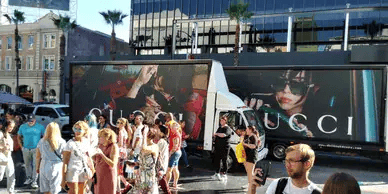
Most of the time, when a client asks me about a mobile billboard, I am talking them down. In a dense walkable city the truck is usually a supplement, something you add after the static campaign is doing the heavy lifting, because the streets already carry enough pedestrian surface to reach people cheaply and repeatedly.
San Jose is the market where I argue the other way.
This is a very large city with one small walkable core. The downtown loop covering the SoFA District, San Pedro Square and the blocks between is a tight, foot-coverable area, and it is effectively the entire street-level static opportunity in the city. Outside it, San Jose is overwhelmingly strip-mall and suburban in form, built around driving, with widely spaced retail nodes and very little continuous pedestrian frontage.
For a static format, that geography is a ceiling. You can run a strong downtown campaign and then you run out of city.
For a mobile format, the same geography is the argument. A car-dependent metro with destinations spread across a wide area and most of the population moving through it inside vehicles is close to the ideal case for a screen that drives itself to the audience. The truck does not need a wall, a pole, a sidewalk or a property owner. It needs roads, and San Jose has a great many of them with a great many people sitting on them.
This page is about how we actually plan that here: which corridors and nodes are worth the hours, what the climate does to screen legibility, how the arena and holiday calendar changes routing, and the places where I tell San Jose clients the truck is the wrong answer.
The routing logic: one dense core plus a lot of spread-out nodes
A mobile billboard campaign is a routing problem. You are buying hours, and the question is where those hours get spent.
In San Jose the route almost always ends up with two distinct components, and they behave completely differently.
The first is the downtown loop. Downtown San Jose has a settled, local rhythm rather than a tourist one. The people filling the bars are residents and tech workers, not visitors. SoFA carries galleries, craft breweries, coffee shops with poetry readings, theatres and a bar scene, with buildings covered in original murals. San Pedro Square, centred on San Pedro Street, concentrates food and drink with venues including Five Points Bar and substantial outdoor patio frontage.
That matters for a truck because patios mean seated, stationary, outward-facing people. A screen passing a full patio run on San Pedro Street at low speed gets a genuinely good look. Downtown is also where a truck can circulate a compact loop repeatedly within an hour, which builds frequency on the same audience rather than single impressions on new ones.
San José State University sits directly inside this core, which is unusual. The student population is in the walkable downtown rather than on a detached campus, so a downtown circuit reaches students without a separate routing leg.
The second component is everything else, and it is a different kind of buy. Outside the core, San Jose is widely spaced strip-mall nodes connected by wide arterials. The truck covers distance between them, and the time cost per node is real. A route that tries to hit six suburban retail nodes in an evening spends most of the evening in transit.
The honest planning framing is that the suburban leg is bought for reach and the downtown leg is bought for frequency, and a route that pretends it is doing both everywhere does neither well.
Santana Row deserves specific mention because it comes up on every San Jose brief regardless of format. It is the significant retail destination in the city and it is a privately managed environment with its own management and its own formal approvals process. For posters, decals or projection that means a formal submission or nothing. For a truck it means something different and genuinely useful: the approach streets and the surrounding public roads carry everyone arriving, and the format reaches that audience from the road without needing the management conversation at all. That is one of the clearest format-specific advantages in this market.
Why SAP Center nights are good for a truck and bad for everything else
Across the other formats we run in San Jose, event nights at SAP Center are a problem. The arena sits at 525 West Santa Clara Street on the western edge of downtown, it is home to the San Jose Sharks and the San Jose Barracuda and hosts concerts through the year, and event nights congest traffic around West Santa Clara Street and the arena approaches both before and after. Clearing takes longer than people expect. For a crew trying to install posters or set up a projection, that congestion is lost time.
For a mobile billboard, congestion is the product.
A screen in slow-moving traffic is a screen being read. Dwell time is the entire value proposition of this format, and the single most reliable source of dwell time in San Jose is the arena approach before a Sharks game and the exit flow afterwards. The audience is captive, facing forward, in vehicles, with nothing else to look at, and they are there on a schedule published in advance.
That makes arena nights the highest-value routing decision available in this city, and it is the opposite of the advice I give for every other format here.
The planning details matter. Arrival flow and departure flow are two different windows with different durations and different traffic directions, and a route that only works one of them leaves half the value on the table. The departure flow in particular stays dense for a sustained period after an event ends.
Check the venue’s own events listing when scheduling. The difference between an arena night and a dark night on those blocks is substantial, and a route built for an event night that runs on a dark night is spending hours on empty approaches.
December adds the other big congestion opportunity. Christmas in the Park transforms Plaza de César Chávez into a lights, trees and live performance display. It is free to walk through, draws large crowds, and makes December downtown traffic much heavier than a typical US downtown’s winter baseline. For static formats that is a crew access headache. For a truck it is weeks of elevated downtown vehicle and pedestrian density, running every evening rather than on scattered event dates.
Climate: legibility, not survival
In a lot of markets the weather conversation about a truck is about whether the campaign can run at all. Snow, ice, storms. In San Jose it is not, and that is worth stating plainly.
San Jose has a Mediterranean climate: long, warm, arid and mostly clear summers, short cool wet winters. Temperatures typically range from about 43°F to 82°F across the year, rarely below 35°F or above 92°F. Rain is sparse from May through October, with NOAA’s San Jose climate summary recording June, July and August normally totalling only around 0.20 inches combined. The dry season effectively runs April to November.
Practically, that means scheduled routes happen. There is no freeze, no ice, no snow closure risk, and for more than half the year almost no rain. A San Jose route plan is one of the more reliable ones we build anywhere, and clients can commit to dates with real confidence.
Temperature is also kind to the equipment. Rarely above 92°F means thermal load on an LED panel is manageable in a way it is not in a desert market, where midday summer screen temperatures become an operational constraint on their own.
The climate issue here is legibility, and it has two sides.
The first is daylight. Mostly clear skies through a long summer mean very high ambient brightness during the day. An LED screen competing with direct California sun needs real output to stay readable, and an underpowered screen in a bright San Jose afternoon is a grey rectangle. This is the single most common disappointment with the format in sunny markets, and it is entirely predictable at the planning stage. Specify for the conditions or route around them.
The second is the darkness timing, which cuts the same way it does for every night-dependent format in this city. LED is at its most striking after dark. Through the dry season darkness arrives late, and downtown nightlife crowds thin earlier here than in larger coastal cities, which compresses the window where a dark sky and a full street coincide. In winter, darkness arrives while downtown is still busy, and December in particular pairs early dark with unusually heavy holiday traffic. That is a genuinely strong combination for this format and it is the reason I do not treat the San Jose winter as off-season for trucks the way I would for paste work.
For a vinyl-panel mobile billboard rather than an LED screen, the relevant issue is ultraviolet load instead. Long sunny seasons fade printed media, reds and magentas first, and a wrap that runs for months of San Jose summer needs UV-stable inks or it will look tired while it is still perfectly intact.
Permission, routing and the grey area
This is a grey area, and the mobile format has its own version of it.
Municipalities across the country treat vehicle-based advertising inconsistently. Some regulate it as signage, some address it through parking and traffic provisions, some do neither clearly, and the practical answer is local rather than statewide. California cities vary in how they approach outdoor signage generally.
UNVERIFIED: the specific current text and enforcement posture of San Jose’s provisions as they apply to Mobile Billboards and vehicle advertising. Confirm directly with the City of San Jose before a campaign. I am not going to cite a code section I have not read in its current form, and I would not give anyone legal advice about it.
What I can describe is how we reduce exposure operationally.
We route on public roads and keep the vehicle moving as a vehicle. The ambiguity in this format tends to concentrate around a truck that stops and functions as a stationary sign for an extended period, which is a different proposition from one that drives a route. Where a client wants a static presence at a node, we look at private property with the owner’s permission rather than parking on street and hoping.
We keep the crew briefed and documented, and the vehicle properly operated and compliant with ordinary road requirements, because the most common problems in this format are mundane traffic and parking ones rather than advertising ones.
We also pay attention to the character of the market, which in San Jose means remembering that the downtown core is small, managed and visible. The same business owners and city staff see the same blocks daily. A truck circulating a compact downtown loop repeatedly for hours is noticed in a way it would not be in a sprawling anonymous grid. Vary the pattern, mix the downtown loop with other legs, and do not grind the same four blocks all night.
UNVERIFIED: freeway and highway restrictions applicable to this format in California. Clients frequently assume a truck can work the regional freeway network, and that assumption needs checking properly before it goes into a route plan rather than being taken on trust.
Crew and the shape of a San Jose route day
A truck campaign is a small crew and a long day. A driver, and depending on the build and the campaign, an operator managing the screen content.
Parking and staging are easier here than in a lot of West Coast markets. Downtown San Jose has structure parking available and parking is comparatively easier than in San Francisco, which is a real operational advantage when a large vehicle needs somewhere to sit between legs.
The route day usually splits across the traffic rhythm rather than running flat. Commuting flows, retail node peaks in the afternoon and early evening, and then the downtown or event circuit later. Flat routing across a whole day burns hours in the quiet middle of the afternoon when the arterials are moving freely and nobody is sitting long enough to read anything.
Distances are the planning discipline. San Jose’s suburban nodes are genuinely spread out, and the time between them is time the screen is on an arterial rather than in front of an audience. That is not wasted exactly, since a moving truck is still seen, but it is lower-value time and the plan should be honest about the ratio. I would rather build a route around three well-chosen nodes with real dwell time than six that look better on a map.
Night work is comfortable here year-round. No freeze, overnight lows in a workable range, and through the dry season very few weather cancellations. Winter needs a contingency allowance for rain, mostly for safety and visibility rather than for equipment.
What goes wrong, and what I talk San Jose clients out of
Buying the truck as a downtown-only campaign. It happens because downtown is the part of San Jose people picture. Circulating a compact loop for hours is conspicuous in a small observed core and it reaches a limited audience very repetitively. The downtown loop is one leg of a good route, not the whole route, and in this city the format’s real advantage is everything outside it.
Running midday in high summer with an underspecified screen. Direct California sun against a weak LED panel produces something nobody reads. Either specify a screen that holds up in bright ambient conditions or weight the route towards late afternoon and evening. Clients who skip this conversation are the ones disappointed with the photographs afterwards.
Assuming freeway coverage is available. This is the most common planning assumption I challenge here, because the regional network looks like an obvious opportunity on a map. Restrictions applicable to this format need confirming properly before any route plan depends on them.
Ignoring the arena schedule. Running a San Jose route on a dark night at SAP Center and skipping an event night is leaving the single best dwell-time opportunity in the city unused. The schedule is published in advance. There is no excuse for routing blind to it.
Parking the truck as a static sign on street. The ambiguity in this format concentrates exactly there. If a client wants a stationary presence at a node, we find private ground with permission instead.
Treating December as off-season. It is off-season for paste work here. It is not for this format. Early darkness plus the sustained crowds and traffic that Christmas in the Park brings to Plaza de César Chávez and the surrounding blocks makes December one of the stronger months for a screen in this city.
Giving the campaign something that stays after the truck leaves
The structural weakness of a mobile billboard is the same everywhere: it leaves. When the route ends, nothing remains on the street carrying the message.
In San Jose that interacts with a specific local fact. Downtown has a settled, local rhythm. The people in the core are residents, tech workers and students walking the same blocks week after week. That audience responds to repetition, and a truck that passes through on a Thursday is a single impression rather than a presence.
So when a client is buying trucks because San Jose’s geography demands reach, I usually push for a small permitted static layer downtown alongside it. Wheatpasting & Poster Campaigns on a handful of owner-permitted surfaces in SoFA and around San Pedro Square holds the core continuously, at the eye level of the people who walk it daily, while the truck handles the suburban nodes, the arena approaches and the retail destinations the sidewalk cannot reach.
That split matches the actual shape of San Jose. A small walkable core that rewards persistent static presence, and a large car-dependent remainder that only a mobile format can serve. Most cities make you choose a primary format. This one genuinely wants both, each doing the job the other cannot.
Frequently asked questions
Why do LED trucks suit San Jose better than most cities?
Because the geography favours them. San Jose is a very large, car-dependent city with one small walkable core around SoFA and San Pedro Square, and widely spaced suburban retail nodes beyond it. Static formats run out of usable street quickly. A mobile screen reaches the large share of the population whose daily routine happens inside a vehicle, without needing walls, poles or property owners.
Should the route cover Sharks games at SAP Center?
Usually yes, and it is the strongest routing decision available in this market. Event nights congest West Santa Clara Street and the arena approaches both before and after, and clearing takes longer than people expect. For installation crews that congestion is a problem. For a screen it is dwell time with a captive forward-facing audience, on a schedule published well in advance.
Will the screen be readable in San Jose daylight?
Only with the right specification. Mostly clear skies through a long summer create very high ambient brightness, and an underpowered panel against direct sun is simply not read. Either specify for those conditions or weight the route towards late afternoon and evening. In winter, darkness arrives early while downtown is still busy, which is excellent for legibility.
Are mobile billboards allowed in San Jose?
It is a grey area. Municipalities treat vehicle advertising inconsistently, sometimes as signage and sometimes through parking and traffic provisions, and the answer is local rather than statewide. We route on public roads, keep the vehicle operating as a vehicle, and use owner-permitted private ground for any stationary presence. Confirm current requirements with the City of San Jose. We do not give legal advice.
Can a truck reach the Santana Row audience?
Yes, and this is a real format advantage here. Santana Row is privately managed with its own formal approvals process, which makes static placement a submission rather than a street campaign. A truck works the surrounding public approach roads that everyone arriving uses, reaching the same audience from the road without requiring that management conversation.
Is December a good month for a San Jose truck campaign?
It is one of the better ones, which surprises people. Christmas in the Park draws large sustained crowds to Plaza de César Chávez and makes December downtown traffic considerably heavier than a typical US downtown’s winter baseline. Darkness also arrives early, so the screen is at its most legible during the busiest hours rather than after the streets have emptied.
Request a campaign quote
If you are weighing a mobile billboard campaign in San Jose, tell me the audience, the dates and what else is running, and I will build a route that is honest about where the hours actually go. The nodes in this city are spread out, the arena calendar matters more than people expect, and a plan that acknowledges both beats one that looks busy on a map.
We handle route planning around the local traffic and event calendar, screen or panel specification for the season, and crewed operation. Request a campaign quote and tell me what you are trying to reach.

Ready to Run Your Campaign?
Call us or email us. We’ll tell you exactly what we can do in your market and what it costs.
Related Services
Explore similar advertising solutions offered by American Guerrilla Marketing.
American Guerrilla Marketing — Los Angeles
Street-level campaigns in Los Angeles and nationwide. Wheatpasting, LED trucks, street teams, and more.
(646) 776-2770
Related Articles
-
LED Advertising Truck Mistakes That Waste a Campaign, and
November 13, 2026
-
Mobile Billboard Truck for Sale: A Field Guide From the Crew
November 13, 2026
-
How Experiential Marketing Agency London Work Actually Gets
November 13, 2026
-
LED Trucks & Mobile Billboards in Tacoma, Washington
November 12, 2026
-
Planning LED Trucks & Mobile Billboards in Grand Rapids
November 12, 2026