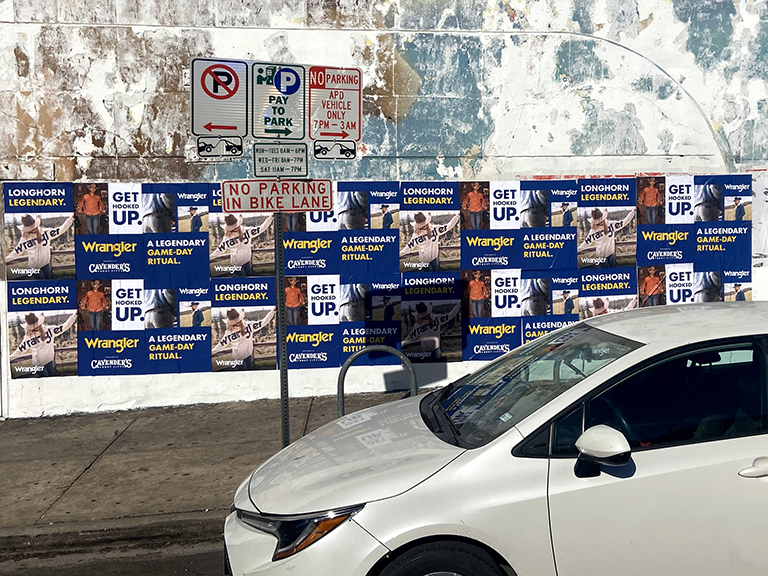
A 24×36 poster is exactly that: 24 inches wide by 36 inches tall. In feet, that is 2 feet wide by 3 feet tall. It is a large poster. It is one of the two most common standard poster sizes used in the United States, and it is the go-to format for outdoor campaigns, high-traffic placements, and any situation where you need your message to be seen from a distance.
We have used 24×36 posters in campaigns across New York City, Los Angeles, Chicago, Miami, Dallas, and beyond. We know exactly how this format performs, what surfaces it fits, and why it works better than smaller formats in the right context. This guide covers everything you need to know about the 24×36 poster size.
Two feet by three feet is easier to visualize in context. Here are some real-world comparisons:
A 24×36 poster is roughly the size of a large bathroom mirror
It is about twice the size of a standard 18×24 poster
It is slightly smaller than a standard classroom whiteboard
Laid flat on a desk, it extends past both edges of a standard office desk (which is typically 24 to 30 inches wide)
Three stacked on top of each other reach 9 feet tall, which is about the height of a standard commercial ceiling
In the field, a 24×36 poster stands out. Walk down a block in Midtown Manhattan or along Melrose Avenue in Los Angeles and you will see them everywhere. They fill a single standard store window cleanly. They cover the glass on a subway entrance door. They command attention on the side of a wooden construction barrier.
Where 24×36 Posters Work Best
This is not a universal format. It excels in specific contexts.
Outdoor Street-Level Placements
The 24×36 was built for the street. At two feet wide and three feet tall, it is big enough to be seen from across a typical urban block. The size gives your designer enough canvas to work with bold typography and graphics that communicate in under two seconds of passing glance. This is the format we recommend for campaigns targeting pedestrians in dense urban neighborhoods like Williamsburg, Brooklyn or Logan Square in Chicago.
Store Windows and Doors
A 24×36 poster fits cleanly in most standard commercial windows. It covers a significant portion of the glass without completely blocking visibility. Glass doors in urban retail environments are often slightly wider than 24 inches, making this format a near-perfect fit. We have run dozens of campaigns where 24×36 posters in storefront windows served as the primary outdoor media.
Construction Fencing and Plywood Barriers
Construction sites in active urban markets are some of the best poster surfaces available. The plywood or metal surfaces are wide, flat, and visible. A 24×36 poster placed on construction fencing reads clearly from street level. Multiple 24×36 posters side by side create a cohesive billboard-scale presence without requiring billboard-scale budgets.
Lobby and Elevator Displays
Office buildings, apartment complexes, and hotels all use lobby and elevator area signage. A 24×36 format is large enough to hold a headline, supporting copy, and visual elements in an elevator lobby without feeling cramped. It fits standard display frames sold for commercial property use.
Music and Entertainment Events
The 24×36 is the large-format choice for concert and event promotions. When an 18×24 is the standard show poster, a 24×36 is used for headlining acts, major festivals, and club events that want to command more visual space. Film festivals, gallery openings, and cultural events frequently use this format for their primary promotional campaign.
24×36 vs. 18×24: When to Upgrade
Use 18×24 for indoor placements, tight spaces, and budget-conscious runs. Use 24×36 when you are outdoors, in high-traffic areas, or competing against visual noise in a dense environment. The 24×36 costs roughly 50 to 100 percent more per unit than the 18×24, but delivers significantly more visual presence. In the right placement, it pays for itself.
24×36 Poster Specs for Printing
Here are the technical specifications you need to print a 24×36 poster correctly:
Specification
Recommended Value
Notes
Canvas size
24 x 36 inches
Add 0.125-inch bleed on all sides for trimming
Color mode
CMYK
RGB files will be converted by the printer, sometimes with color shifts
Resolution
150 DPI (street use) / 300 DPI (close-up)
150 DPI = 3600x5400px; 300 DPI = 7200x10800px
Font size
72 pt minimum for headlines
Body text should be 24 pt or larger for outdoor readability
Safe area
0.25 inch from all edges
Keep all critical content within this zone to avoid trimming loss
File format
PDF (print-ready) or TIFF
High-resolution JPEG is acceptable at most print shops
Paper and Substrate Options for 24×36
The 24×36 format is produced on a variety of substrates. Here is what you will encounter:
100 lb Gloss Text
This is the most common paper stock for 24×36 posters. It is bright white, prints vivid CMYK color, and has a gloss coating that makes images pop. It is lightweight enough to roll or fold for transport and durable enough for short to medium-term indoor use.
Photo Paper or Lustre Paper
For high-end or gallery-quality prints, photo paper delivers superior color depth and sharpness at the 24×36 size. It is heavier and more expensive than standard gloss text but produces the richest print output. Many concert poster collectors seek prints made on photo or lustre paper.
Laminated Poster Stock
A UV laminate applied over a standard 24×36 print adds weather resistance, scuff resistance, and a premium feel. UV matte laminate is popular for a non-reflective, sophisticated finish. Gloss laminate intensifies colors further. Laminate is essential for any outdoor placement where the poster will be exposed to moisture or direct sunlight.
Adhesive Vinyl
For window applications where you want the poster to stick directly to the glass, adhesive vinyl is the substrate of choice. It comes in clear, white, and perforated options. The 24×36 format is a common size for window vinyl graphics in retail and event contexts.
How Much Does a 24×36 Poster Cost to Print?
Cost depends on quantity, stock, and vendor. Here are typical ranges:
Quantity
Per Unit Cost (Standard Stock)
Per Unit Cost (With Laminate)
1
$8 – $18
$14 – $28
10 – 25
$4 – $9
$7 – $16
50 – 100
$2.50 – $5
$4.50 – $9
250 – 500
$1.50 – $3.50
$3 – $6
1,000+
$1 – $2.50
$2 – $4.50
Online print vendors like Canva Print, GotPrint, and PrintingForLess are often the most cost-effective for 24×36 in medium quantities. Local print shops offer faster turnaround and more control over the process, often worth the higher per-unit cost for time-sensitive campaigns.
Minimum Viable Quantity for a Street Campaign
For a neighborhood-scale campaign using 24×36 posters, we typically recommend a minimum of 50 to 100 pieces. That is enough to cover key surfaces in one or two neighborhoods without repetition fatigue. For a city-wide campaign across multiple districts, 300 to 500 posters in the 24×36 format creates meaningful visual saturation.
Framing a 24×36 Poster
Standard 24×36 frames are widely available. IKEA, Target, Walmart, and art supply stores all stock frames in this size. Prices range from $15 for a basic wood or plastic frame to $150 or more for metal gallery-style frames.
For campaigns where you are placing framed posters in venues, lobbies, or retail spaces, the frame adds a professional finish that unframed posters cannot achieve. A 24×36 poster in a black metal frame on a white wall looks like a real display installation. The same poster taped directly to the wall looks temporary.
If you are framing outdoors or in high-humidity environments, use a metal or weatherproof composite frame rather than wood. Wood frames warp and split in wet conditions.
24×36 vs. Other Common Poster Sizes
Size
Compared to 24×36
Best Use Case
11 x 17
21% the area of 24×36
Bulletin boards, tight indoor spaces
18 x 24
50% the area of 24×36
Standard indoor events and venues
24 x 36
Baseline
Outdoor, storefronts, high-traffic placements
27 x 40
125% the area of 24×36
Movie theaters, entertainment venues
36 x 48
200% the area of 24×36
Trade shows, wide outdoor surfaces
Where the 24×36 Poster Shows Up in Real Campaigns
The 24×36 is more than a number. In the field, it defines what a campaign looks like at street level. Here is how this format plays out in specific real campaign environments.
Construction hoarding in Midtown Manhattan
Midtown Manhattan has more linear feet of active construction hoarding than almost any other neighborhood in the country. A 24×36 poster placed at eye level on plywood panels along 5th Avenue or near Herald Square gets seen by thousands of pedestrians per day. Placed in a grid of four or six across the width of a hoarding section, the format creates a repeating visual brand presence that reads like a mini-billboard. We place hundreds of 24×36 posters monthly on Midtown hoarding surfaces.
Bar and venue windows in Chicago
Along Milwaukee Avenue in Wicker Park and on Damen in Bucktown, bar windows are a primary placement surface for 24×36 campaign posters. The format fits most Chicago bar storefront windows without blocking sightlines into the interior. Bar owners in these neighborhoods accept 24×36 posters from brands and promoters regularly, especially when the campaign has cultural relevance to the neighborhood’s audience.
Retail windows in Los Angeles
On Melrose Avenue between Fairfax and La Brea, 24×36 posters in boutique windows are part of the neighborhood’s visual culture. Independent retailers use 24×36 to promote in-store events and product launches. Brands that want window placement in this corridor need to pitch the store with a poster that fits the space and the aesthetic. The 24×36 hits both requirements for most storefronts in this stretch.
Scaffolding panels in New York
New York City scaffolding runs along sidewalks for extended periods during building renovations. The exposed panels on scaffolding structures at pedestrian eye level are among the best poster surfaces in the city. A 24×36 at eye level on scaffolding along a busy commercial block in Soho or Chelsea gets sustained high-frequency exposures from foot traffic that passes the same location multiple times per week.
24×36 Poster Alternatives: When to Size Up or Down
The 24×36 is the right choice in most outdoor contexts, but not in all of them. Here is how to decide when to size up or down.
Size down to 18×24 when:
The available wall space is narrower than 24 inches
The campaign budget requires more coverage locations than a 24×36 allows at the same spend
The placement context is indoor and viewers will be within 6 to 8 feet
The venue or location has a display system built for 18×24
Size down to 11×17 when:
The campaign is primarily telephone pole and community board placement
Very high volume of placements is required at minimum cost per unit
The cultural context of the neighborhood favors small-format authentic posting over large commercial-looking posters
Size up to 27×40 or larger when:
The campaign has the production budget for premium large format
The placement surface is wide enough to justify the larger size
The brand communication requires the extra visual presence to compete in the environment
The campaign is for a major entertainment or cultural event that warrants the prestige of the larger format
How big is a 24×36 poster exactly?
A 24×36 poster is 24 inches wide by 36 inches tall. In feet, that is exactly 2 feet by 3 feet. It is one of the two most common large poster sizes in the United States, along with the 18×24.
Is a 24×36 considered a large poster?
Yes. At two feet by three feet, it is significantly larger than a standard 18×24 poster. It is the most common large poster size in the U.S. market and is widely used for outdoor campaigns, lobbies, and high-visibility placements.
What resolution should a 24×36 poster be?
For outdoor or high-distance viewing (10 feet or more), design at 150 DPI. That is 3,600 by 5,400 pixels. For close-up gallery-quality viewing, use 300 DPI, which requires 7,200 by 10,800 pixels.
How much does it cost to print a 24×36 poster?
Costs range from about $8 to $18 for a single print to $1 to $3 per piece in quantities of 1,000 or more. Stock choice, finish, and vendor all affect price. Online print shops typically offer the lowest per-unit cost at volume.
Is 24×36 the same as A1 paper size?
Not exactly. A1 is 23.4 inches by 33.1 inches (594 x 841 mm). A 24×36 is slightly wider and taller. The proportions are similar but not identical. Files formatted for 24×36 will not print cleanly on A1 paper without minor adjustment.
Can I hang a 24×36 poster without a frame?
Yes. Command strips, binder clips, poster putty, and tape are all common options for hanging unframed 24×36 posters indoors. For outdoor use, use weatherproof tape or staples depending on the surface. Unframed posters look more casual or grassroots. Framed versions look more intentional and professional.
What paper stock is best for a 24×36 outdoor poster?
For outdoor placements, use 100 lb gloss text with a UV laminate. The laminate adds weather resistance and extends the life of the poster from a few days to several weeks depending on conditions. Without laminate, paper posters degrade quickly in rain and direct sunlight.
How does a 24×36 poster compare to an 18×24 poster?
A 24×36 has twice the surface area of an 18×24. It costs roughly 50 to 100 percent more per unit to print. It delivers significantly more visual presence and reads from greater distances. For indoor close-range use, an 18×24 is usually sufficient. For outdoor and high-visibility applications, the 24×36 is the better choice.
How many 24×36 posters do I need for a neighborhood campaign?
For a single neighborhood saturation campaign in a market like New York or Chicago, a typical run is 50 to 150 posters. That quantity covers primary wall surfaces, select bar and shop windows, and key pedestrian intersections throughout a neighborhood. For a multi-neighborhood city campaign, multiply by the number of neighborhoods targeted. We assess specific markets and provide placement recommendations based on the actual surface inventory available.
Can I use 24×36 posters for a trade show booth?
Yes. A 24×36 poster is a versatile size for trade show booth displays. It fits most standard booth panel frames and display hardware. For a 10×10 booth, one or two 24×36 posters mounted on the back wall create a strong visual brand presence without overwhelming the space. Pair them with retractable banners and tabletop displays for a complete booth environment.
Frequently Asked Questions
How big is a 24×36 poster exactly?
A 24×36 poster is 24 inches wide by 36 inches tall. In feet, that is exactly 2 feet by 3 feet. It is one of the two most common large poster sizes in the United States, along with the 18×24.
Is a 24×36 considered a large poster?
Yes. At two feet by three feet, it is significantly larger than a standard 18×24 poster. It is the most common large poster size in the U.S. market and is widely used for outdoor campaigns, lobbies, and high-visibility placements.
What resolution should a 24×36 poster be?
For outdoor or high-distance viewing (10 feet or more), design at 150 DPI. That is 3,600 by 5,400 pixels. For close-up gallery-quality viewing, use 300 DPI, which requires 7,200 by 10,800 pixels.
How much does it cost to print a 24×36 poster?
Costs range from about $8 to $18 for a single print to $1 to $3 per piece in quantities of 1,000 or more. Stock choice, finish, and vendor all affect price. Online print shops typically offer the lowest per-unit cost at volume.
Is 24×36 the same as A1 paper size?
Not exactly. A1 is 23.4 inches by 33.1 inches (594 x 841 mm). A 24×36 is slightly wider and taller. The proportions are similar but not identical. Files formatted for 24×36 will not print cleanly on A1 paper without minor adjustment.
Can I hang a 24×36 poster without a frame?
Yes. Command strips, binder clips, poster putty, and tape are all common options for hanging unframed 24×36 posters indoors. For outdoor use, use weatherproof tape or staples depending on the surface. Unframed posters look more casual or grassroots. Framed versions look more intentional and professional.
What paper stock is best for a 24×36 outdoor poster?
For outdoor placements, use 100 lb gloss text with a UV laminate. The laminate adds weather resistance and extends the life of the poster from a few days to several weeks depending on conditions. Without laminate, paper posters degrade quickly in rain and direct sunlight.