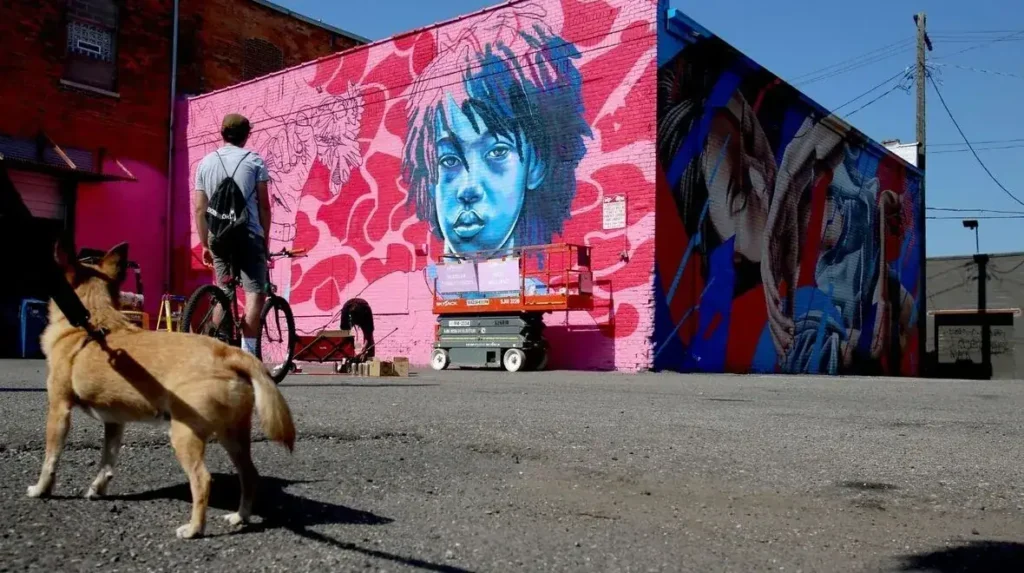
Hiring a mural artist for brand marketing creates something that no billboard, digital ad, or poster campaign can: a permanent or semi-permanent piece of art in public space that consumers seek out, photograph, and share on their own initiative, without any paid promotion. AGM has managed mural advertising campaigns across dozens of markets, and the single biggest driver of a mural’s marketing value isn’t the painting, it’s the wall. This guide covers everything brands need to know about hiring a mural artist effectively: wall selection, artist sourcing, realistic costs, permit requirements, and how to turn your mural into a continuous UGC engine.
How to Commission a Brand Mural: The Process Step-by-Step
Commissioning a mural for marketing purposes is not the same as commissioning public art. The process has commercial requirements that most artists don’t handle by default, and skipping them creates problems mid-project.
Step 1: Secure the wall before hiring the artist
Wall negotiation comes first. The location determines everything: audience size, foot traffic, social media background value, and whether the mural will be visible to passing vehicles or only to pedestrians. Negotiate a minimum 12-month agreement with the property owner. Shorter terms mean the mural may disappear before you get full marketing value from it. AGM’s guide on wall selection for outdoor campaigns covers the key location variables.
Step 2: Write a creative brief for the artist
The brief should include: brand colors and logos with exact specifications, what the mural should communicate to someone who sees it for 5 seconds, any text that must appear, any imagery that cannot appear, and the target audience. Give the artist creative latitude within those constraints. Micro-managing mural artists produces stiff, corporate-looking results that don’t photograph well and don’t attract organic social sharing.
Step 3: Clarify usage rights upfront
Your contract with the mural artist should specify that the brand owns full rights to photograph and use images of the mural in any commercial context. Without explicit language, you may find that the artist retains rights to the imagery. This becomes a problem the first time you want to use the mural in an ad, a press release, or a social campaign. Address it in writing before work begins.
Step 4: Plan the documentation shoot
A professional photography session within 48 hours of completion captures the mural at its freshest. Photograph it in morning light, midday, and at dusk. Capture close-ups of key design elements. Get an aerial or improved angle if possible. The photos you take on completion day will be used in press pitches, social content, and brand decks for months. Budget for a proper shoot, not a phone photo.
Why Mural Marketing Works in 2026
Murals have become one of the most powerful guerrilla marketing formats precisely because they don’t feel like advertising to consumers. A compelling mural on a building facade in a high-foot-traffic neighborhood functions as a neighborhood landmark, people orient by it, meet friends there, and photograph it as a representation of the neighborhood’s character. When a brand’s visual identity is integrated into that landmark, the brand earns community association that no amount of paid media can buy.
The social media ROI of a well-placed mural is extraordinary. Documented examples from AGM campaigns: a 40’×60′ brand mural in a high-Instagram neighborhood generates 800–4,000+ organic tags per month from consumer photos, with an estimated social reach of 300,000–2,000,000 monthly impressions from unpaid UGC. For a mural with a 3-year commercial lease, the annual cost per organic social impression can drop below $0.001, making it one of the most efficient media placements in existence.
The Most Important Decision: Wall Selection
The wall selection decision is the most important creative and strategic decision in the entire mural project. A well-placed mural wall is a long-term brand asset. A poorly placed wall is expensive painted square footage that no one photographs, no one passes, and no one talks about.
What Makes a Great Mural Wall
Foot traffic volume: The wall must face genuine pedestrian flow, people walking on the sidewalk in front of it, not just vehicles passing at 30mph. Vehicle-only visibility is partial value; pedestrian visibility is primary. The best mural walls are in commercial neighborhoods with active sidewalk culture.
Sight lines: The wall should be visible without obstruction from at least 15–20 meters away. Trees, parked vehicles, utility infrastructure, and adjacent signage all reduce effective visibility. AGM scouts sight lines at multiple times of day, what’s clear at 8am may be blocked by parked delivery trucks at noon.
Photography angle: The wall needs to allow consumers to photograph it while standing on the sidewalk in front of it. A wall set back 2 meters from the street’s edge in a narrow alley is hard to photograph. A wall facing directly onto a wide pedestrian plaza is perfect. We evaluate photography angle explicitly in every mural site scout.
Neighborhood identity: The mural should be in a neighborhood that aligns with the brand’s target consumer. A health brand’s mural in a fitness-oriented neighborhood earns organic engagement from exactly the right audience. The same mural in a neighborhood with no brand-demographic alignment generates impressions from irrelevant consumers.
How AGM Finds Mural Walls
AGM identifies available exterior walls in the target market through a combination of physical scouting, property owner outreach, and our network of existing property relationships in markets where we operate regularly. In major cities like New York, Los Angeles, Chicago, and Miami, we maintain active relationships with building owners who have pre-approved walls available for brand murals, which dramatically reduces lead time for wall acquisition.
For markets outside our primary network, the wall scouting and property negotiation process takes 3–6 weeks. Property owners typically negotiate either a flat licensing fee for the wall surface ($200–$2,000/month depending on market and visibility) or a revenue share on any commercial fees generated by the mural content.
Hiring the Right Mural Artist
Artist Style vs. Brand Identity
The most common mistake brands make in mural artist selection is hiring based on portfolio prominence rather than style alignment. A highly acclaimed muralist with an abstract expressionist style is the wrong choice for a brand that needs clean, typographic, immediately legible brand communication. Artist selection should start with brand objectives, what do we need this mural to communicate in 3 seconds or less?, and work backward to artists whose visual language aligns with that objective.
For brand murals that need to be photographed and legible in social media crops, clean graphic style with strong color contrast consistently outperforms complex illustrative work. For murals designed to establish neighborhood art credibility and generate organic cultural sharing, more complex, narrative-rich illustration styles earn more organic community engagement.
Local vs. National Artists
Local artists have a built-in advantage for brand murals: they’re embedded in the neighborhood’s social network, they’ll share the completed work to their own local following, and they’re perceived as authentic by the community in a way that imported “name” artists aren’t always. AGM recommends local artists for brands prioritizing community integration and organic neighborhood sharing. We recommend nationally recognized artists for brands where the artist’s own audience is a meaningful part of the marketing equation.
Working with Artists: What Brands Need to Prepare
Artists need from the brand: brand guidelines (color palette, logo usage rules, approved imagery), key message or concept brief, size and surface specifications, timeline, and clear agreement on artistic vs. brand control balance. Brands that over-specify creative direction get technically compliant murals with no artistic energy, the murals that generate organic sharing are the ones where the artist brought genuine creative contribution within brand guardrails, not just executed a brand mockup in paint.
Mural Cost Breakdown: What to Budget
Artist Fees
Mural artist day rates in the US market: $500–$2,500/day depending on artist experience, market, and mural complexity. A 20’×30′ exterior mural typically requires 3–7 days of painting time depending on complexity. Total artist fee for a standard brand mural: $2,500–$15,000. For nationally recognized muralists with significant followings, artist fees can reach $25,000–$75,000 for large-format works.
Materials
Exterior-grade aerosol paint (Ironlak, Montana Cans) or brush-applied exterior latex: $600–$2,500 for a 600–800 sq ft mural depending on color count and paint density. Surface preparation (cleaning, priming): $300–$800. UV-resistant sealer coat for longevity: $200–$600. Total materials for a standard 600 sq ft mural: $1,100–$3,900.
Wall Licensing
Wall licensing fees vary enormously by market and visibility. In high-foot-traffic neighborhoods of Manhattan or LA, wall licensing for a prime mural surface can run $1,500–$5,000/month. In secondary markets and less premium locations, $200–$800/month is standard. Annual licensing for a single mural wall: $2,400–$60,000 in premium markets, $2,400–$9,600 in secondary markets.
Permits
Most US cities require a sign permit or mural permit for commercial murals on building exteriors. Permit costs range from $50–$500 depending on municipality and mural size. Processing time: 1–4 weeks. In some cities (New York, LA, Chicago), murals on private property are generally permitted without public-space sign permits. AGM handles permit research and application for all mural projects.
Complete Mural Campaign Budget Example
A 600 sq ft brand mural on a permission-secured wall in a high-traffic neighborhood in Chicago:
- Artist fee (experienced local muralist, 5 days): $5,000
- Materials: $1,800
- Wall licensing (12 months): $6,000
- Permit: $150
- AGM project management: $2,500
- Total: $15,450 for 12 months of continuous brand presence
- Cost per month: $1,288
For comparison: a standard static billboard in a comparable Chicago location runs $2,000–$6,000/month with no social amplification value and no permanence. The mural earns comparable visual impressions at lower monthly cost, plus ongoing organic social reach that compounds over the mural’s lifetime.
Turning Your Mural Into a UGC Engine
The mural is the anchor. The UGC strategy is what multiplies its reach. AGM recommends three tactics for maximizing the organic social amplification of a brand mural:
Embed a social prompt: Include a subtle but visible @handle or hashtag in the mural design, small enough to not feel promotional, clear enough for a photographer to capture it in their frame. A mural with an embedded handle generates 3–5x more tagged social posts than a mural without one.
Seed the launch: On the day the mural is completed, brief 5–10 local creators or community members to photograph it and post to their feeds. The first wave of organic social content conditions Instagram’s algorithm to serve the location-tagged content to similar users, creating a self-reinforcing discovery loop.
Run a geotag activation: Instagram and Snapchat location stories for the mural’s address generate ongoing discovery. Create a location-specific Snapchat filter for the mural address (cost: $5–$20/day for a sponsored filter) during the first 2–4 weeks to accelerate geotag association.
Frequently Asked Questions
Hire a Mural Artist: A high-impact Marketing Tactic That Builds Lasting Brand Presence generates better results when placement, timing, creative, and local execution all work together. These questions cover the details brands usually need before launch, during rollout, and while evaluating performance.
For mural, the strongest campaigns usually come from tight geographic targeting, message discipline, and enough repetition to be remembered. Market conditions, neighborhood flow, event calendars, commuter behavior, and production logistics all change how the tactic performs, so the planning details matter as much as the idea.
How long does a brand mural last?
Exterior murals painted on properly prepared and sealed surfaces last 3–7 years before requiring touch-up or refresh, depending on sun exposure, weather severity, and surface substrate. AGM uses UV-resistant paints and exterior-grade sealer on all mural projects to maximize longevity. Annual touch-up costs run $200–$800 for minor maintenance on a well-executed mural.
Can I commission a mural without AGM’s involvement?
Yes, artists can be commissioned directly. Where AGM adds value: wall scouting and property negotiation (we have existing relationships that accelerate this significantly), artist vetting for brand-fit not just portfolio quality, permit handling, and UGC strategy development. For brands that want to manage the artist relationship directly, AGM offers wall sourcing and permit management as standalone services.
What’s the timeline from brief to completed mural?
Wall sourcing and property negotiation: 3–6 weeks (less in markets with existing AGM property relationships). Permit processing: 1–4 weeks (may overlap with wall sourcing). Artist selection and creative development: 2–3 weeks. Painting execution: 3–7 days. Total: 6–13 weeks from brief to completed mural. In markets where AGM has pre-approved wall inventory, this compresses to 4–8 weeks.
Do murals require maintenance?
Yes. Exterior murals in high-pedestrian zones are subject to graffiti overlay and weathering. AGM recommends budgeting $500–$1,500 annually for graffiti removal (clear anti-graffiti coating applied during initial sealing makes removal significantly easier) and minor touch-up work. Murals that are clearly loved by the community, visually distinctive, photographed frequently, tagged by local influencers, experience much less graffiti overlay than murals that blend into the background.
What neighborhoods are best for brand murals?
How do I know if this topic is worth turning into a real campaign?
Start with audience location, not creative ideas. If you can name the blocks, venues, campus gates, stations, or event windows where attention is concentrated, the campaign can usually be built into something measurable. If the audience is vague, the spend drifts and results get fuzzy fast.
What usually makes a street campaign feel too small?
The most common issue is spread. Brands buy a handful of placements across too many neighborhoods instead of owning one route. A tighter footprint with stronger repetition beats a scattered footprint almost every time, especially for event promotion, launches, and local service awareness.
Should the message focus on awareness or action?
That depends on the traffic environment. Fast moving traffic calls for a short awareness message with one visual anchor. Slow pedestrian traffic can support a QR code, a stronger offer, and more direct response copy. The format should match the pace of the audience, not the other way around.
How long should a campaign stay up?
For event driven pushes, the best window is often the 7 to 14 days before the date. For evergreen brand building, two to four weeks works better because repetition does the heavy lifting. Weather, removals, and local conditions still matter, so timing should always be part of the plan.
What should be tracked besides impressions?
Use QR scans, coupon redemptions, landing page traffic, geofenced audience lift, survey responses, and direct field photos. Street work is easier to defend when the campaign is built with proof from day one instead of trying to backfill measurement after the fact.
Related Pages and Articles