National brands entering Providence face the same challenge: the market doesn’t know them yet, and digital advertising alone doesn’t build the local credibility that drives first-purchase conversions. Guerrilla marketing accelerates that local authority-building by putting your brand visibly into Providence’s commercial environment before competitors stake the same claim. American Guerrilla Marketing specializes in Providence market-entry guerrilla marketing campaigns designed for exactly this objective.
Brand memory, the kind that drives actual purchase behavior, isn’t built through a single impression. It’s built through repeated, contextually relevant encounters that accumulate over time. Guerrilla marketing campaigns in Providence create that repetition structurally: the same audience encounters the same creative across multiple touchpoints in their daily geography. Neuroscience research on memory formation consistently shows that physical, in-environment exposure generates stronger recall than screen-based advertising because it engages spatial memory pathways that screen advertising cannot access. In a market like Providence, where design-forward market where creative quality is actively noticed by consumers trained by years of RISD influence on the local visual culture, that recall advantage compounds.
Use this page as a planning reference for guerrilla marketing in Providence. The sections below cover neighborhood and corridor selection, format options and their relative ROI in this market, how American Guerrilla Marketing structures field execution across Providence’s commercial environment, what campaign documentation looks like, and how budget scales to results. The final sections include an FAQ and direct contacts for getting a campaign started.
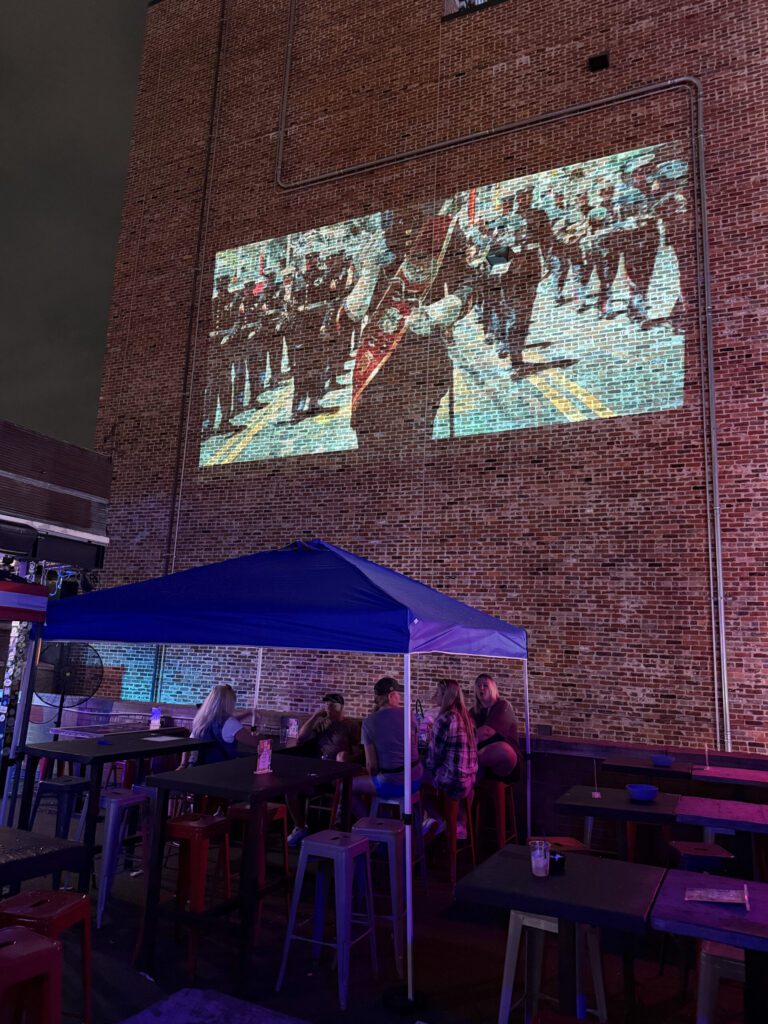
Why Rhode Island Is Built for Guerrilla Projections
Rhode Island is a small state, but that is exactly what makes projection campaigns so efficient. The market is tight enough that a smart operator can focus attention instead of scattering budget. You are not trying to cover an endless metro footprint. You are choosing a handful of highly strategic visibility zones where audience concentration, nighttime movement, and social energy all overlap.
Providence leads that conversation. Downtown blocks around Kennedy Plaza, Westminster Street, Dorrance Street, the Providence River corridor, and the edges of College Hill create the kind of evening movement that projections thrive on. Office workers leave, dinner crowds arrive, students circulate between campus and nightlife, and event attendees layer on top depending on the calendar. When WaterFire is running, when major shows hit the Providence Performing Arts Center, or when downtown calendars are full, the same compact geography becomes even more powerful.
Rhode Island also benefits from audience familiarity. People revisit the same social corridors again and again. That means a projection campaign is not just a one-night stunt if the schedule is planned correctly. Repeated exposure across a few nights in the right zones can build real memory because the audience is physically moving through the same nightlife ecosystem on a regular basis.
Then there is the visual fit. Providence is an especially good projection city because it has texture: historic facades, industrial edges, civic buildings, parking structures, warehouse surfaces, and river-adjacent architecture that all create opportunities for strong light-based creative. A projection that looks generic in an overscaled metro can feel sharp and memorable in Providence because the urban frame is intimate enough for the audience to actually absorb it.
Providence: The Anchor Market for Rhode Island Projections
If a brand asks where to begin with guerrilla projections in Rhode Island, the answer is almost always Providence. That is where the state’s concentration of arts audiences, student audiences, downtown workers, hospitality traffic, and nighttime foot movement becomes most usable for a street-level campaign.
Kennedy Plaza matters because it is not just transit infrastructure. It is one of the clearest circulation points in the city, where different audiences cross paths throughout the day and into the evening. Nearby downtown corridors keep that movement alive with restaurants, bars, venues, office buildings, and event traffic. A projection strategy built around that ecosystem can capture both passerby visibility and social documentation, especially when the creative is simple enough to photograph well.
College Hill and the surrounding university footprint add another layer. Brown University, RISD, and nearby student-heavy zones produce an audience that is visually literate, socially active, and naturally responsive to bold environmental media. That does not mean the creative should try to be clever for cleverness’ sake. It means the campaign should respect the audience. Good projection work in Providence feels deliberate, culturally aware, and clean. Bad projection work feels like noise.
Thayer Street, the edges of campus circulation, and the route between downtown and the hill all matter when a campaign wants younger, highly social audiences. Westminster Street and the downtown arts corridor matter when the brand needs design-aware consumers, restaurant-goers, and nightlife circulation. Federal Hill matters when dinner traffic and destination dining are part of the objective. Near the river, event nights create visibility that can expand fast because people arrive early, stay out later, and spend more time looking around than they do in a normal commuter environment.
Providence works especially well for campaigns that need to feel current. Album launches, nightlife promotions, ticketed events, streaming releases, fashion drops, beverage rollouts, and cause-driven messaging all benefit from the city’s mix of walkability and social chatter. If the activation is visually strong, the market does some of the distribution work on its own because people talk, text, and post about what they encounter.
Beyond Providence: Newport, Warwick, Pawtucket, and Coastal Reach
Providence is the anchor, but Rhode Island projection strategy gets better when brands understand where the supporting markets fit. Newport is the obvious seasonal standout. In the warmer months and during destination-heavy weekends, Newport delivers affluent visitors, tourism traffic, hospitality density, and a built environment that gives campaigns a very different tone than Providence. Messaging there should usually feel more improved, more selective, and more tuned to dining, hospitality, culture, or event positioning rather than broad mass awareness.
Warwick matters in a different way. It is not the first place most people imagine for a projection campaign, but it becomes strategically relevant when a brand wants to intercept airport-area movement, suburban consumers, retail traffic, or audiences moving between Providence and southern Rhode Island. A projection-led plan can use Warwick as a support market rather than a hero market, especially for regional campaigns that need a broader footprint without losing control of spend.
Pawtucket has its own value when campaigns want industrial texture, neighborhood authenticity, or adjacency to Providence without fully relying on Providence’s core blocks. As the city continues to evolve around arts, redevelopment, and event energy, it offers surfaces and audience patterns that can support brands aiming for a more local, culture-linked feel.
Then there is the Rhode Island coast more broadly. Depending on season and objective, South County-adjacent activity, beach-route traffic, and hospitality-driven evening movement can become relevant to campaign planning. Not every projection campaign should chase summer tourism, but for the right categories, such as beverage, apparel, travel, nightlife, and entertainment, Rhode Island’s summer pattern creates a real opportunity. The key is resisting the urge to generalize the whole state. Different places in Rhode Island behave differently at night, and the campaign has to match that reality.
Who Should Use Projection Campaigns in Rhode Island
Guerrilla projections are not for every brand, and that is a good thing. They work best when the brand has something timely to say and a reason to be seen in public. In Rhode Island, the strongest use cases usually fall into a few categories.
Entertainment and culture are obvious fits. Concert promoters, nightlife venues, film releases, music projects, festivals, art events, and touring experiences benefit because projection media already feels event-driven. It belongs in the nighttime city. It creates anticipation instead of just repetition.
Consumer brands with a visual identity also perform well. Streetwear, beverages, beauty launches, apps with local growth targets, hospitality concepts, and lifestyle products can all use projections to create a perception of momentum. In a market like Providence, that momentum matters because people notice when something starts showing up in their environment.
Universities, student-facing services, and youth-oriented campaigns can use projections effectively when the work is designed around the academic and social rhythms of the city. Orientation windows, recruiting pushes, event weeks, and campus-adjacent activations all become more memorable with after-dark visibility.
Cause campaigns and civic messaging can also work well when the execution is strategic and respectful. Rhode Island audiences tend to be responsive to culture, community, and place-based messaging, but only when it feels rooted in the moment. Generic issue language underperforms. Specific, emotionally clear messaging performs far better.
Local business launches and challenger brands may get the biggest relative upside. In a compact market, a projection campaign can make a smaller brand feel suddenly larger. The right nighttime activation can create the impression that the brand is everywhere, even if the actual media footprint is disciplined and selective.
What Creative Works Best After Dark in Rhode Island
Projection creative has to do two jobs at once. It has to read instantly from a distance, and it has to hold up when somebody stops, stares, and lifts a phone. That means the best creative is usually simpler than clients first expect. A projection is not a website. It is not a brochure. It is a high-impact frame in a live environment.
Start with one dominant idea. In Rhode Island, audiences are often seeing the work in motion, in conversation, or while walking to the next place. If the concept takes too long to decode, the moment is gone. Strong projections typically rely on bold typography, sharp contrast, minimal copy, and one memorable visual hook. If the brand needs more explanation, that is where companion tactics come in.
Color and brightness matter because the environment changes block by block. A downtown corridor with ambient storefront lighting needs different creative handling than a darker warehouse edge or a more open river-facing zone. What looks dramatic on a laptop mockup can disappear in the field if contrast is weak or the design is too detailed. AGM plans creative with the actual visibility environment in mind, not just the presentation deck.
Photography value matters too. In Providence especially, a lot of campaign amplification comes from people documenting what they saw. If the projection looks weak in a phone photo, the campaign loses secondary reach. The best projection creative in Rhode Island is built to be seen live and to travel well in a captured image. That usually means clean layouts, confident messaging, and restrained design rather than overloaded composition.
Timing, Sequencing, and Event Windows
Rhode Island projection campaigns live or die on timing. The market is not large enough to forgive lazy scheduling. A brand has to know whether it wants commuter adjacency, nightlife energy, student movement, destination dining traffic, or event spillover, because those audiences show up at different hours and in different moods.
WaterFire weekends are an obvious example of timing use in Providence. When the river corridor is activated and downtown is fuller than usual, the city becomes an audience engine. But that does not mean every campaign should run on a WaterFire night. In some cases, a quieter but still active evening creates better visibility because there is less event clutter and more room for the brand to own the visual moment.
The academic calendar matters too. Early fall, spring social season, and specific campus windows can change how Providence behaves at night. The restaurant calendar matters. Venue schedules matter. Tourism patterns matter in Newport. Weather matters more than clients like to admit. Great Rhode Island street campaigns are usually built around audience behavior first and media deployment second.
Sequencing across nights can also create stronger results than a one-off splash. A single projection can create novelty, but a carefully repeated run across a tight schedule can create recall. If the same audience sees the work Thursday, Friday, and Saturday in related zones, the campaign starts to feel bigger than it is. That is one of the smartest ways to use Rhode Island’s compact footprint.
How AGM Stacks Projections With Other Street Tactics
Projection campaigns get stronger when they are not forced to carry the whole load alone. AGM often builds Rhode Island programs where projections are the headline moment, but other street-level tactics do the reinforcement work that makes the campaign last longer and travel farther.
Wheat Paste Posting is one of the best companions because it extends visibility into daytime hours and gives the campaign a static citywide layer. A projection creates urgency. Posters create repetition. Together they turn a short nighttime encounter into a multi-touch campaign.
Brand ambassadors add explanation and direct engagement when the campaign needs conversation, sampling, or guided participation. If the projection gets attention, trained field staff can turn that attention into leads, social follows, RSVP growth, or product trial.
Street teams, flyer handoffs, QR-linked landing pages, and short-form social capture also matter. A lot of brands make the mistake of treating projections like a standalone art piece. AGM treats them like a force multiplier. The projection is often the most visible part of the campaign, but the surrounding layers are what create measurement, recall, and follow-through.
That matters even more in Rhode Island because the market is so relationship-driven. Audiences respond when a campaign feels integrated with the street, the timing, and the city’s rhythm. When all the pieces reinforce each other, the brand stops looking like a visitor and starts looking present.
Campaign Strategy & Market Considerations
Campaign strategy in Rhode Island starts with geographic honesty. Brands often say they want statewide reach when what they actually need is influence in the handful of places where attention concentrates. For most projection campaigns, that means prioritizing Providence, deciding whether Newport or Warwick meaningfully support the objective, and then building the schedule around live movement instead of map coverage.
The second consideration is message fit. Projections are high-attention media, but they are not forgiving. Weak messaging looks weaker when it is enlarged on a building. Rhode Island is a market where audiences notice tone. If the creative feels generic, late, or disconnected from the local mood, it underperforms. If it feels sharp, current, and visually confident, it can punch well above the size of the state.
The third consideration is layering. Because the state is compact, repeated audience exposure matters more than sheer impression volume. Instead of trying to hit every possible pocket once, better campaigns hit the right audience several times through a mix of visibility zones, nights, and supporting tactics. That is how a projection campaign turns from an interesting moment into an actual market presence.
AGM plans Rhode Island campaigns with that practical lens. Where is the real nighttime audience? What does the district feel like at the hour of deployment? What other street conditions will help or hurt the work? What social behaviors can the campaign piggyback on? Good projection strategy is less about raw spectacle than about using spectacle with discipline.
How to Measure Projection Performance
Brands sometimes assume projections are hard to measure because they are physical and temporary. In practice, Rhode Island campaigns can be measured well if the response path is designed before launch. QR codes, custom URLs, branded search monitoring, promo tie-ins, event RSVPs, and social listening all create useful signals. Field documentation fills in the rest.
For local businesses, the most important indicators are usually direct response and foot-traffic lift. For entertainment campaigns, ticketing activity, RSVP velocity, and social mentions tend to matter more. For challenger brands, the clearest signs are often branded search lift, local market conversation, and retail or web traffic from the targeted area during the run.
AGM also documents the campaign visually so the client has proof of execution and a usable content asset library after the activation. That matters because projection work often keeps producing value after the live nights end. The captured visuals can fuel recap content, sales decks, internal reporting, investor updates, and follow-on media.
In a market like Rhode Island, measurement should not chase false precision. It should answer the practical questions. Did the campaign own the right moments? Did the target audience actually encounter it? Did people respond, search, share, attend, or show up differently because of it? Those are the answers that matter.
Find American Guerrilla Marketing on Google: View American Guerrilla Marketing’s Google Business Profile for Rhode Island campaign reviews, installation documentation, and service details.