Guerrilla Marketing Agency NYC | American Guerrilla
New York City is the most visually competitive advertising environment on earth. Running a guerrilla campaign here that actually registers requires local knowledge that takes years to build. We have been building ours since we opened in this city.
New York City is the most visually competitive advertising environment on earth. Every surface is contested. Every intersection is cluttered. Every neighborhood has its own culture, demographics, and street dynamics. Running a guerrilla marketing campaign in New York that actually registers requires more than a concept and a budget. It requires local knowledge that takes years to build. We have been building ours since we opened in this city more than a decade ago.
This guide covers everything you need to know about working with a guerrilla marketing agency in NYC. What guerrilla marketing actually means in this city. What formats we run. How we approach neighborhoods. How we build multi-format campaigns that create real cultural presence. And what the process looks like from brief to documentation.
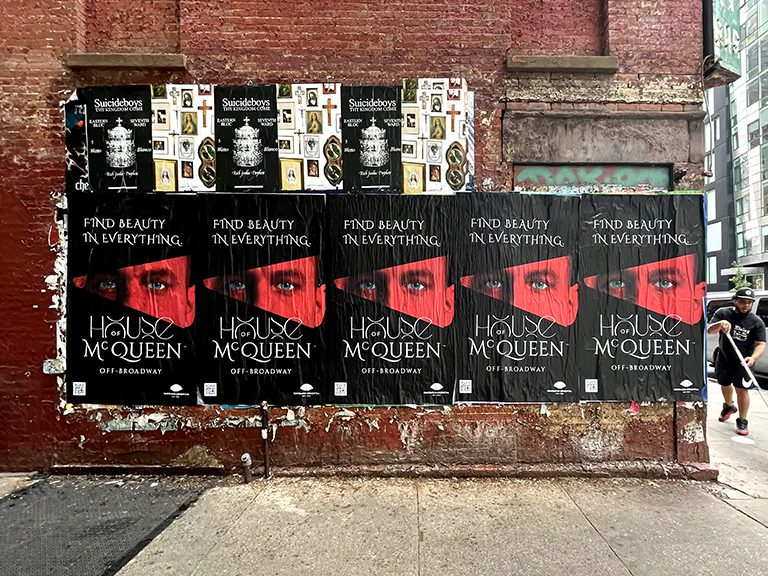
In New York City, guerrilla marketing takes several forms. Poster campaigns cover construction barriers and building facades in specific neighborhoods. Street teams engage people directly in high-traffic corridors. Pop-up installations appear in unexpected locations. Projection campaigns turn building facades into enormous moving brand statements. Mobile vehicles drive through neighborhoods carrying brand messages. Murals appear on building walls across Brooklyn, the Bronx, and Manhattan.
What all of these formats share is direct, physical presence in the city’s most culturally active zones. They show up where people are, in the real world, on the streets where the brand’s target audience lives and moves every day. And in New York, where the target audience for most brands is dense, diverse, and moving on foot, the street-level presence has a concentrated impact that few cities can match.
New York City guerrilla marketing requires local expertise that goes beyond general knowledge of street advertising. Our team knows which blocks in Williamsburg have the best available surfaces for poster campaigns, which intersections in SoHo get the most pedestrian dwell time, which corridors in Harlem reach which specific cultural communities, and which neighborhoods are emerging as the next cultural destination before the broader market figures it out. That knowledge is the product of years of running campaigns in this city and cannot be replicated by an agency reading foot traffic data from a dashboard.
New York City Neighborhoods: Our Street-Level Knowledge
Williamsburg, Brooklyn
Williamsburg is our most active market. The corridor from Bedford Avenue east through Graham Avenue along the L Train remains the densest concentration of creative professionals in the outer boroughs. The construction barriers lining this corridor, particularly the large plywood barriers around development sites on Wythe Avenue and North 7th Street, are some of the highest-value poster placement surfaces in the city. The audience is 25-40, creative-industry, high social sharing activity, and culturally influential far beyond its geographic size. A campaign that lands in Williamsburg generates social content that travels nationally.
Lower East Side, Manhattan
The Lower East Side runs from Houston Street south to Delancey and from the Bowery east to Clinton Street. Our most active corridors here are Orchard Street, Ludlow Street, and Rivington Street. This neighborhood has the cultural heritage of immigrant communities, punk rock, hip-hop, and contemporary art layered on top of each other. The current demographic is 22-40, art-adjacent, and culturally active. Poster campaigns in the LES regularly generate earned media and social sharing because the audience treats the neighborhood’s visual environment as content.
SoHo and NoLita, Manhattan
SoHo runs from Houston Street south to Canal Street, between Sixth Avenue and Lafayette. Broadway through SoHo is our primary corridor, particularly the stretch from Prince Street to Spring Street. This area captures a mix of affluent locals, creative professionals, and high-spending visitors. It is one of the most photographed retail corridors in the world. A campaign that appears here gets more secondary social exposure than any other neighborhood in the city. The trade-off is that surface availability is more competitive and the visual environment is already intense.
Harlem, Manhattan
The primary Harlem corridor for guerrilla marketing is 125th Street, from Morningside Avenue east to Lexington Avenue. The intersection of 125th and Lenox Avenue, near the Apollo Theater, is one of the highest-traffic cultural intersections in the city. The blocks around the Studio Museum in Harlem and the National Black Theatre are key placements for campaigns that require genuine cultural credibility with the African American community. Brands that show up in Harlem without that credibility generate the wrong kind of attention. Brands that earn their presence there build lasting relationships with a community that influences cultural taste nationally.
Bushwick, Brooklyn
Bushwick is New York’s outdoor art capital. The Bushwick Collective, centered on Troutman Street and Wyckoff Avenue, has turned entire blocks into a permanent open-air gallery. Brand campaigns that integrate authentically with this environment can achieve lasting presence alongside some of the most photographed street art in the world. The audience is younger and more diverse than Williamsburg, with a strong arts, music, and nightlife orientation. Summer weekends bring significant visitor foot traffic from across the city and beyond.
Bed-Stuy and Crown Heights, Brooklyn
Bed-Stuy along Fulton Street from Ralph Avenue west to Nostrand Avenue has become one of the fastest-growing cultural destinations in Brooklyn. The neighborhood’s community culture is strong and the audience is not receptive to brands that appear without respect for that community identity. Crown Heights along Nostrand Avenue from Atlantic Avenue south to Eastern Parkway reaches a deeply community-rooted audience with strong Caribbean and African American cultural ties. Campaigns that belong in these neighborhoods earn long-term community goodwill. Campaigns that do not understand the context generate friction.
Hudson Yards and West Chelsea, Manhattan
The corridor along 10th Avenue from West 16th Street through West 40th Street serves the fashion industry, media companies, and tech office clusters that have relocated to the far west side over the past decade. The High Line and the construction surrounding Hudson Yards create significant ongoing poster surface availability. This is the right corridor for B2B brands targeting creative and media industry professionals, and for consumer brands whose target demographic skews fashion and media industry.
The Bronx
The Grand Concourse, running north from Mott Haven through Fordham, is a primary advertising corridor in the Bronx with a large and engaged community. Fordham Road, the busiest shopping street in the Bronx, offers high-traffic placement opportunities. Southern Boulevard through Hunts Point and Longwood reaches a densely concentrated community that is underserved by conventional advertising, which means brands that show up on these streets stand out more clearly against a less cluttered visual environment.
Guerrilla Marketing Formats We Run in NYC
Wheatpasted Poster Campaigns
Poster campaigns are the foundation of most of our NYC guerrilla marketing work. Paper posters adhered to construction barriers, building facades, and storefronts using paste. We run single-neighborhood saturation campaigns, multi-corridor city campaigns, and staggered multi-wave campaigns that build frequency over weeks. Every campaign includes proof-of-posting documentation delivered within 48 hours of installation.
Street Team Activations
A street team is a trained crew of brand ambassadors who engage people directly in high-traffic corridors. We run street teams at subway entrances, in parks, at events, and in corridors surrounding specific venues and retail destinations. Times Square, Union Square, Washington Square Park, the High Line, and the Brooklyn Bridge approaches are our highest-volume street team locations. We also run neighborhood-specific street teams in Williamsburg, Harlem, and Bed-Stuy for campaigns that require deep community engagement rather than broad reach.
Projection Campaigns
We project brand visuals onto building facades using high-lumen projectors positioned from the street or from nearby windows. A projection on a Williamsburg warehouse wall on a summer evening reaches everyone in a two-block radius and generates a wave of social content that travels far beyond those two blocks. Projections are temporary, but the social content they generate is not. We typically run projections during the evening hours of peak activity in the target neighborhood, which varies by neighborhood and season.
Pop-Up Installations
Pop-up retail, experience, or demonstration installations in parks, vacant lots, and permitted street locations. We handle build-out, staffing, and documentation. NYC pop-up locations we have used include Domino Park on the Williamsburg waterfront, the plazas around Madison Square Park, and the pedestrian zones on Broadway at Herald Square.
Mobile Billboards and Branded Vehicles
Vehicles wrapped with brand creative that drive specified routes through target neighborhoods. A mobile billboard driving through SoHo during Fashion Week hits a concentrated audience of industry professionals and high-spending consumers. We route mobile vehicles based on traffic patterns, event schedules, and audience concentration data to maximize relevant exposures per deployment hour.
Mural and Large-Format Street Art
We produce commissioned murals and large-format wheatpasted installations on walls across the city. In Bushwick, we work alongside the existing outdoor art network to place brand-adjacent murals that read as genuine cultural contributions. On walls across Williamsburg and the Lower East Side, our large-format installations create lasting physical brand presence. The best murals we have placed in New York have been generating social media content and brand exposures for three or more years after installation.
Campaign Process: From Brief to Results
Phase
What Happens
Timeline
Brief and Strategy
Gather audience, geography, goal, and creative direction. Build preliminary location and format strategy.
Week 1
Location Scouting
Scouts evaluate specific surfaces and corridors against audience criteria. Deliver ranked placement report with documentation.
Week 2
Creative Review
Review all creative files against street-scale production specs. Provide feedback before any production spending.
Week 2-3
Production
Print, fabrication, or crew briefing depending on format. Standard print production is 5-7 business days.
Week 3
Installation
Crews execute across all locations. Every placement documented at completion with geotagged photography.
Week 4
Proof-of-Posting
Documentation package delivered to client within 48 hours of campaign execution.
Week 4
Post-Campaign Measurement
Brand recall surveys run in target neighborhoods. Social media monitoring compiled. Site traffic and search data pulled.
Week 6-7
Why Local Knowledge Is Non-Negotiable for NYC Guerrilla Marketing
We have seen brands hire agencies that run guerrilla marketing campaigns in New York City from offices in other cities, treating every neighborhood as interchangeable. The results are predictable. Posters go up in the wrong neighborhoods. Street teams work corridors that the target audience does not use. The campaign spends its budget reaching people who are not the target demographic.
Local knowledge means knowing that the audience for a sneaker brand lives in Williamsburg and Flatbush, not in Murray Hill. It means knowing that a campaign targeting music industry professionals should concentrate on the block between West 28th and West 29th Street on Sixth Avenue, where music industry offices have been concentrated for decades. It means knowing that the construction barriers along the building at the corner of Houston and Broadway change availability from month to month as the project progresses.
It means knowing that a summer evening guerrilla marketing activation in Brooklyn is most effective in the hour between 7 PM and 8 PM when the neighborhood is in the street, and that the same activation in November needs to move its timing two hours earlier to catch the same audience before they go inside. These details accumulate over years of running campaigns in a city. They are not available in a database or on a map. They come from crews on the ground, from location scouts who walk the streets in every season, and from the institutional memory of an agency that has been running campaigns in this city for more than a decade.
AGM Field Note: The block matters. Not just the neighborhood and not just the corridor. The specific block. We have placed campaigns on two walls 200 feet apart on the same street in Williamsburg where one placement generated 40 documented social shares in the first 48 hours and the other generated four. The difference came down to which direction the foot traffic was walking, the natural stopping point created by a crosswalk and a cafe entrance, and the light conditions at the time of day when the target audience walked that section of the block. You learn these things by being on the street, not by looking at a map.
Multi-Format NYC Guerrilla Marketing Campaigns
The strongest campaigns we run in New York City combine multiple formats. A poster run creates ambient awareness across a neighborhood. A street team activation creates direct human interaction at a specific high-traffic point. A projection creates a social-sharing moment that travels far beyond the immediate geographic footprint. A pop-up creates an immersive brand experience. Each format reaches the same target audience through a different physical modality, and the cumulative effect is dramatically stronger than any single format executed in isolation.
We design multi-format campaigns with specific roles for each format in the overall campaign logic. The poster campaign is awareness at scale. The street team is conversion through direct engagement. The projection is the media moment that generates social content. The pop-up is the immersive brand experience that creates the deepest impression. When each format is designed to play its specific role and they are deployed in a coordinated sequence rather than simultaneously, the campaign creates a brand encounter progression that moves the target consumer from awareness through engagement to genuine brand relationship over the campaign window.
New York City Campaign Documentation and Proof of Performance
Documentation is how a guerrilla marketing campaign in New York City becomes accountable. Every placement we install gets photographed at installation time with geotag and timestamp. We return for daylight follow-up photography for every campaign because the photos taken at 3 AM during installation rarely capture the campaign as it actually appears to a pedestrian walking past at noon on a Tuesday. The daylight documentation is what goes in client reports, what gets used in case studies, and what provides the visual record that allows the client to verify, at the level of individual placements, that the campaign ran exactly as planned.
We organize documentation by neighborhood and provide it to clients within 48 hours of campaign completion. For multi-wave campaigns, we document each wave on the same schedule. Clients should not have to wait a week for proof of posting documentation. We treat the 48-hour delivery as a service commitment, not a target.
New York City’s guerrilla marketing calendar has seasonal dynamics that affect campaign planning in ways that matter significantly for execution quality and audience reach. Understanding these dynamics is part of the local knowledge that makes campaign planning in New York different from campaign planning in a city with less dramatic seasonal variation.
Winter campaigns in New York require specific material and adhesive specifications. Below-freezing temperatures affect paste viscosity, paper behavior on cold surfaces, and the crew’s operational speed. We calibrate every winter campaign for the expected temperature range during the installation window and use materials and formulas that perform at those temperatures. A paste campaign installed at 15 degrees in January looks the same in the morning as a paste campaign installed at 55 degrees in April only if the materials and application technique are calibrated for the cold. Ours always are.
Summer campaigns benefit from the outdoor lifestyle of New York neighborhoods, with foot traffic in parks, streets, and outdoor dining areas that winter suppresses. Summer Saturday afternoons in Williamsburg, Prospect Park, and along the High Line represent some of the densest foot traffic windows of the year in New York. Campaigns timed to those windows reach maximum audiences per placement. The trade-off is that summer heat affects adhesive performance and UV exposure affects ink longevity. We plan for both.
Fashion Week in February and September represents the highest-concentration creative industry audience window in New York’s annual calendar. Brands that need to reach the fashion, media, and luxury goods industry community in New York should consider coordinating campaigns with the Fashion Week windows in their target neighborhoods, particularly SoHo, the Meatpacking District, and the blocks around Spring Studios in Tribeca where shows often concentrate.
NYC Campaign Case Studies: How Campaigns Have Performed
Without naming specific clients, here are representative examples of how our NYC campaigns have performed across different categories and objectives.
A music label releasing a major artist’s album ran a flash campaign in Williamsburg, the Lower East Side, and Harlem on the release morning. By noon on release day, organic social posts featuring campaign placements had generated reach across the artist’s audience on Instagram and Twitter. Three placements in Williamsburg were shared by influencer accounts with combined followings in the hundreds of thousands. The campaign’s organic social reach significantly exceeded the paid digital media spend allocated to the New York market launch window.
A fashion brand entering the New York market for the first time ran a six-week saturation campaign in SoHo, NoLita, and the Lower East Side, combined with a street team presence at the brand’s pop-up opening in SoHo. Brand recall surveys in the target neighborhoods two weeks after the campaign ended showed a 34 percentage point lift in aided brand awareness among the target demographic compared to pre-campaign baseline. The campaign’s physical presence seeded the digital conversation that the brand’s social media team built on throughout the following quarter.
A consumer food brand launching into New York retail distribution ran a poster campaign in the neighborhoods surrounding its initial retail locations, paired with sampling at three high-foot-traffic subway exits in those neighborhoods. Retail velocity in the campaign neighborhoods during and after the campaign window outperformed retail velocity in comparable distribution locations that did not receive street campaign support by a margin that the brand’s sales team attributed directly to the street presence. The campaign became the template for the brand’s subsequent market launches in Chicago and Los Angeles.
Building a Sustained NYC Street Presence Over Time
The brands that win in New York City’s competitive street environment are not the ones that run one strong campaign. They are the ones that run consistently. A brand that maintains street presence in Williamsburg, the Lower East Side, and SoHo across multiple quarters develops a neighborhood familiarity that a single campaign, regardless of its quality, cannot achieve. The people who live and work in these neighborhoods register a brand differently when they have seen it on the streets across changing seasons than when they see it once and then never again.
We design sustained NYC street presence programs for brands that understand the compounding value of consistent physical presence. These programs typically run on a quarterly cadence, with each wave building on the location intelligence and audience response data from the previous wave. The location selection gets more precise over time. The creative calibration improves. The crew familiarity with the brand’s standards produces more consistent execution quality. By the fourth or fifth quarterly campaign, the brand has built the kind of neighborhood recognition that drives both direct consumer loyalty and the word-of-mouth that converts the friends and colleagues of existing fans into new ones.
Sustained programs also allow the campaign strategy to respond to neighborhood dynamics that change over time. Williamsburg in the summer has a different audience composition than Williamsburg in February. A campaign that runs in May and then again in October in the same neighborhood is speaking to slightly different audiences and should be adapted accordingly. We factor these seasonal dynamics into sustained program planning and deliver campaigns that are calibrated to the specific moment in the NYC calendar rather than recycled from the previous wave.
The location intelligence we accumulate across multiple campaign waves in the same NYC neighborhoods is one of the most practical advantages we bring to sustained relationships. We track which specific placements on which specific blocks have generated the strongest organic social content for each brand category. We know which Williamsburg walls photograph best in the afternoon light that reaches them during the peak foot traffic window. We know which Lower East Side surfaces hold paper through a rainy week and which shed it after the first heavy rain. That knowledge is not available in any database. It lives in our operational memory and it compounds in value with every campaign we run for a brand that returns to the same markets across seasons and years.
Frequently Asked Questions
What neighborhoods does AGM focus on in New York City?
Our primary NYC guerrilla marketing zones are Williamsburg, Lower East Side, SoHo and NoLita, Harlem, Bushwick, Bed-Stuy, Crown Heights, Hudson Yards and West Chelsea, and the Grand Concourse in the Bronx. The specific neighborhoods we target depend on your audience: we always start with who we are trying to reach and then identify the specific blocks and corridors where that audience is most concentrated.
How long does a NYC guerrilla marketing campaign take to execute?
From brief to installation typically runs three to four weeks for a standard poster campaign. More complex multi-format campaigns with fabrication, custom installations, or projection elements require six to eight weeks. Multi-city campaigns that include NYC as one of several markets require eight to twelve weeks for the full campaign scope. We assess realistic timelines at the brief stage and flag any constraints before production spending is committed.
How does AGM document NYC campaigns?
Every placement is photographed at installation time with geotagged documentation. We compile the complete proof-of-posting package, organized by neighborhood and location with installation date and time stamps, and deliver it to the client within 48 hours of campaign completion. We also return for daylight follow-up photography for any campaign where nighttime installation documentation does not capture the campaign as it appears to the walking audience during peak hours.
What makes NYC guerrilla marketing different from other cities?
Density and diversity. The foot traffic density in NYC’s target neighborhoods is unmatched by any other US market, which means campaign reach per placement is higher. The neighborhood-to-neighborhood cultural diversity means that a brand cannot apply a single campaign approach across the city. What works in Williamsburg reads wrong in Harlem. What works in SoHo reads wrong in Bushwick. Effective NYC guerrilla marketing requires neighborhood-specific intelligence, not a city-wide template.
Can a brand from outside New York run a NYC guerrilla campaign effectively?
Yes. Most of the brands we work with in NYC are based outside the city. Our local knowledge and crew infrastructure make it possible for brands headquartered anywhere to execute campaigns in New York City at the quality level that the market requires. We manage the complete local execution from location scouting through installation and documentation, and coordinate with the brand’s marketing team remotely throughout the process.
What is the minimum budget for a NYC guerrilla marketing campaign?
Poster campaigns in NYC start at $4,500 for 100 standard posters (24×36) in a two-week run. Multi-neighborhood and multi-format campaigns are priced based on the formats selected and scope. We build campaigns to maximize impact within the available budget.
How does AGM measure campaign performance in NYC?
We track organic social media content generated in target neighborhoods, brand search volume in NYC during and after the campaign period, and for campaigns with a sampling or direct engagement component, lead volume and conversion to store or site visits. For campaigns integrated with digital media, we track lift in direct site traffic from NYC geographies and conversions attributed to the NYC campaign window.
Does AGM work with brands across all industries in NYC?
Yes. Our NYC campaigns span music and entertainment, fashion and streetwear, consumer goods, food and beverage, technology and apps, fitness and wellness, real estate, and financial services. We have experience running campaigns for category leaders and first-time market entrants across every major consumer and B2B category. The approach differs by industry, audience, and objective, but the local knowledge and operational infrastructure apply across all of them.