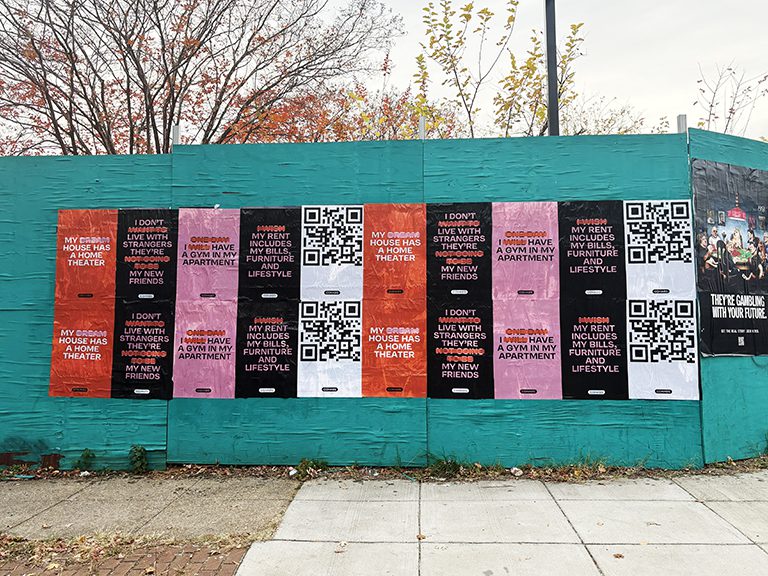
Real estate is a geography business. Guerilla marketing is a geography business. The brands that win in both treat location precision as the primary variable in every campaign decision.
Real estate marketing has a geography problem. Most real estate advertising, whether digital or print, targets prospects wherever they happen to be online at a given moment. But real estate decisions are fundamentally geographic. People buy and rent in specific neighborhoods, on specific streets, near specific amenities, transit lines, and communities. A real estate marketing strategy that does not engage people at the neighborhood level is missing the most important part of the conversation.
Guerilla marketing solves the geography problem. It puts real estate brands, developments, and brokerages in the physical environments where their target buyers and renters actually spend time. A large-format campaign on the main commercial street of the neighborhood where a new development is opening reaches exactly the audience that development was built for. A presence campaign in the adjacent neighborhoods where potential buyers currently live builds awareness among the people most likely to consider a move. This guide covers how guerilla marketing works for real estate and how we approach it for developers, brokerages, and individual agents across our major markets.
Real estate has one of the longest consideration cycles of any purchase category. From first awareness to closing takes months or years. During that consideration period, repeated exposure to a brand builds familiarity and trust that directly affects the final outcome. When a prospect has seen a development’s name and imagery on the streets near their current home for six months before they start seriously looking, they arrive at the inquiry stage already knowing and trusting the brand. That pre-existing familiarity shortens the sales cycle and improves conversion rates measurably.
Real estate also benefits from the scale signals that guerilla marketing provides. A full-building mural or a large-format wall campaign adjacent to a development site makes the project look significant and real, even before construction is complete. The physical presence of the advertising creates an impression of scale and seriousness that digital advertising alone cannot deliver. Buyers making one of the largest financial decisions of their lives are reassured by visible, tangible evidence that the developer is serious and the project is happening. Street presence is that evidence.
The geographic precision of guerilla marketing is particularly valuable for real estate. Digital advertising targets demographics and interests, but it cannot guarantee that the person being reached has any geographic connection to the development. Street advertising in the right neighborhood guarantees geographic relevance by definition. The person who walks past a campaign for a development on the same street where they currently live is the exact prospective buyer the developer needs to reach. That targeting precision is something no digital platform can fully replicate.
Guerilla Marketing Formats That Work Best for Real Estate
Construction Site Advertising
The construction site itself is one of the most underused advertising assets in real estate marketing. Construction hoarding, the barriers that surround an active construction site, creates a continuous advertising surface that runs along the perimeter of the development. We design and install full-perimeter campaigns that turn construction barriers into compelling pre-launch marketing assets. For a development in a high-foot-traffic area, the construction site advertising might be seen by tens of thousands of people per week during the entire construction period, which can run for months or years before sales launch.
Pre-launch site advertising creates anticipation and builds name recognition before sales begin. When the sales office opens and the development becomes available for purchase or lease, the target audience already knows the name, has seen the imagery, and has formed an initial impression of the brand. That pre-sold awareness is enormously valuable in a market where sales velocity in the first weeks after launch directly affects the project’s commercial trajectory. A development that opens to an audience that is already familiar is in a fundamentally stronger position than one opening to a cold market.
Neighborhood Saturation Campaigns
For developments that want to reach prospects in specific surrounding neighborhoods, a street-level print saturation campaign puts the development’s name and imagery on walls, fences, and surfaces throughout the target zone. When a prospect in the adjacent neighborhood encounters the development’s branding at multiple points during their weekly routine, awareness builds quickly and the development occupies mental real estate before it occupies physical real estate.
We execute neighborhood saturation campaigns for real estate clients by identifying the neighborhoods most likely to supply buyers for the specific development type. A luxury residential development in DTLA might target adjacent neighborhoods in Silver Lake and Echo Park where aspirational buyers currently live. A mid-market rental development in Brooklyn might target neighborhoods in Queens where renters are being priced out of their current buildings and are actively considering a move. The location strategy is the primary determinant of campaign efficiency.
Street Team and Direct Outreach Programs
Brand ambassador programs that deploy knowledgeable representatives in target neighborhoods can generate direct leads for real estate developments and brokerage services. A well-briefed street team near a transit hub or a major shopping corridor in a target neighborhood can have direct conversations with potential buyers, collect contact information, distribute high-quality marketing materials, and build a database of qualified leads that the sales team can follow up on directly.
This format requires careful execution. The representatives need to understand the development thoroughly, be comfortable engaging with strangers in a professional and non-intrusive way, and have the right materials to leave with interested prospects. When executed correctly, street team outreach generates leads that would be extremely expensive to acquire through digital channels, and the quality of face-to-face leads typically converts at a higher rate than digital inquiry leads because the conversation has already established the human connection that real estate purchases depend on.
Transit-Adjacent and Commuter Route Campaigns
Commuters who travel to and from work through specific subway stations, bus hubs, and commuter rail platforms are among the most receptive audiences for real estate advertising. The daily commute creates a defined window of time when people are often thinking about their lives, their routines, and their housing situation. Advertising that appears in this context and speaks directly to those considerations lands with unusual relevance.
We place real estate campaigns in transit-adjacent locations across our major markets, with specific attention to the routes most traveled by the demographic profiles that match each development’s target buyer. The daily repeated exposure of a transit-adjacent campaign builds awareness at a depth that single-exposure advertising cannot produce. We have executed commuter corridor campaigns for developments in New York along the G train corridor in Greenpoint and the 7 train corridor in Long Island City, both of which proved to be highly effective for reaching the target buyer profiles those developments were designed for.
Format
Best Timing
Key Audience
Primary Outcome
Site Hoarding Advertising
Pre-launch through construction
Neighborhood foot traffic
Awareness and anticipation
Neighborhood Saturation
Pre-launch and launch period
Residents of adjacent neighborhoods
Lead generation, inquiry volume
Street Team Outreach
Pre-launch sales period
Target demographic in transit zones
Direct leads, contact collection
Transit-Adjacent Campaigns
Throughout sales period
Commuters on target routes
Repeat awareness, brand familiarity
Mural and Large-Format Art
Pre-launch through sales period
Neighborhood community, social media
Long-term presence, cultural credibility
AGM Field Note: The construction site hoarding is routinely the best real estate marketing surface available in any neighborhood and the one most often treated as an afterthought. We have seen developers spend heavily on digital campaigns and event marketing for a launch while the perimeter of the actual construction site runs generic contractor branding or plain plywood. The site itself, wrapped with compelling campaign creative, is visible to every person who walks the block for the entire construction period. That audience is free, already geographically targeted, and enormous over the campaign duration.
Real Estate Guerilla Marketing by Development Type
Luxury Residential Developments
Luxury real estate requires premium execution at every level. A guerilla marketing campaign for a luxury development must look as refined as the product it is promoting. We approach luxury real estate campaigns with elevated design standards, high-quality production materials, and placement in locations that signal the right cultural context. A campaign for a luxury residential tower in Tribeca does not belong in a budget retail corridor. It belongs on the streets where the development’s target buyers already live and spend time.
Brand storytelling matters more in luxury real estate than in almost any other category. Buyers making seven-figure decisions are not only responding to price and square footage. They are responding to a vision of the life the development represents. Guerilla advertising for luxury real estate needs to communicate that vision with the same sophistication as the sales materials and the finished product itself. When the campaign creative looks as good as the sales gallery, the brand story is coherent. When there is a visible quality gap between the campaign creative and the product, the campaign undermines confidence rather than building it.
Mid-Market and Rental Developments
Mid-market and rental real estate guerilla campaigns focus on price-to-value clarity and neighborhood positioning. The buyer evaluating a $650,000 condo or a $3,800 per month apartment wants to understand what they are getting and why this building in this neighborhood is worth the investment. Clear messaging delivered at street level in the neighborhoods where these buyers currently live builds consideration among an audience that is actively thinking about a move.
Speed to awareness is particularly important for rental developments because the sales cycle is shorter than ownership. A renter looking for a new apartment makes decisions on a faster timeline than a buyer looking for a condo. Guerilla campaigns for rental developments need to create awareness quickly and include clear calls to action that move interested prospects toward inquiry and tour scheduling. The creative needs to communicate price range, availability, and distinctive features within the attention window available to someone walking past a wall poster.
Individual Agents and Brokerages
Real estate agents and brokerages can use guerilla marketing to build name recognition in specific neighborhoods where they want to develop their business. A sustained street-level presence in the target neighborhood builds the kind of familiarity that drives referrals and repeat business. When a homeowner in a neighborhood has seen an agent’s name on street-level advertising consistently for six months, that agent is the one they call when they decide to sell. Building that top-of-mind awareness in the target neighborhood is one of the most valuable long-term investments a real estate professional can make, and guerilla marketing is the most efficient way to achieve it at meaningful scale without a multi-million-dollar advertising budget.
Measuring the Impact of Real Estate Guerilla Marketing
Real estate guerilla marketing results are measured through a combination of brand awareness tracking, inquiry volume analysis, and geographic correlation data.
Inquiry volume during and after the campaign period is the most direct commercial signal. When inquiries increase following a street campaign launch in a specific geographic area, the connection between the campaign and the commercial outcome is strong. We track this signal by asking clients to record where inquiries are coming from at the time of first contact and comparing geographic patterns before, during, and after campaigns.
Brand search volume in the target markets is another strong signal. When awareness campaigns are generating genuine interest, people search for the development name to learn more. Tracking branded search volume during the campaign period provides a real-time indication of whether the street presence is driving curiosity and purchase intent that translates to digital follow-through.
For campaigns with a street team component, lead volume and lead quality from direct outreach provides a direct and quantifiable measure of campaign performance that does not require any inference or correlation analysis. The street team generated 47 qualified leads last week is a clear result that every decision-maker can evaluate.
We help real estate clients establish measurement baselines before campaigns launch and structure reporting to capture the signals most relevant to their specific sales process. The measurement framework is built into the campaign plan from the start, not added as an afterthought at the reporting stage.
Real Estate Guerilla Marketing by Market
The specific guerilla marketing approach for a real estate campaign varies by market in ways that matter significantly for campaign performance. The geographic and cultural dynamics of the target city shape every aspect of the campaign from location selection through creative tone.
New York City: The density of NYC’s residential neighborhoods means that neighborhood saturation campaigns can reach enormous impression counts within a small geographic footprint. We have run construction site campaigns for developments in Greenpoint and Long Island City that reached the residents of the adjacent neighborhoods comprehensively within a two-week deployment window. The subway network also provides natural commuter corridor access that is uniquely valuable for reaching prospective buyers along the lines that serve the target development’s catchment area.
Los Angeles: LA’s car-dependent geography requires a different approach to reach commuters and neighborhood residents. We combine vehicle-supported deployment across target corridors with concentrated neighborhood saturation in the walkable zones where the target buyer concentrates. In the Arts District and Culver City, where walkable urban residential development has accelerated over the past decade, traditional poster campaigns work effectively. In other parts of LA, larger-format placements visible to vehicle traffic supplement street-level pedestrian-facing placements.
Miami: Brickell, Edgewater, and Wynwood are the primary guerilla marketing environments for residential real estate campaigns in Miami. The concentration of international buyers in these neighborhoods, combined with the tourism and visitor traffic that cycles through them, creates an audience that is both geographically concentrated and nationally and internationally diverse. Campaign creative for Miami real estate needs to translate well across cultural backgrounds and language groups more than campaigns in most other US markets.
AGM Field Note: We recommend that real estate clients run guerilla campaigns in the neighborhoods where the buyers currently live, not just at the development site. The development site advertising creates awareness among the people who happen to be near the site. The neighborhood campaign in the adjacent residential areas reaches the people who are considering whether to move into the development’s part of the city. Those are different audiences and they require different placements to reach effectively.
Creative Strategy for Real Estate Guerilla Campaigns
Real estate guerilla marketing creative operates under constraints that do not exist for most other brand categories. The product is geographically fixed. The buyer consideration cycle is long. The decision is among the highest-stakes purchases the buyer will make in their lifetime. These realities shape every aspect of how the creative needs to work.
Clarity is the first principle. A real estate poster that fails to communicate the development name, a clear price indication or positioning signal, and a clear action step is a wasted placement regardless of how beautiful the visual is. The consumer who is interested needs to know what this is, whether it is relevant to them, and what to do next. All three pieces of information need to be visible and readable from the natural pedestrian viewing distance within two to three seconds of the consumer’s attention being captured.
Aspiration is the second principle. Real estate decisions are emotional as well as rational. The buyer is not only evaluating price per square foot. They are evaluating whether they can see themselves living in this building, in this neighborhood, in this version of their life. The campaign creative needs to speak to that aspiration directly, communicating the feeling of the development, the life it represents, the community it creates, alongside the factual information that supports the decision.
Neighborhood integration is the third principle. Real estate campaigns that feel disconnected from the neighborhood where the development is located miss an opportunity to communicate that the development belongs there. Creative that references the neighborhood’s character, uses visual language that feels native to the local aesthetic, and treats the location as an asset rather than simply an address earns more community goodwill and generates stronger response from the prospects most likely to actually buy.
The Pre-Launch Timeline: When to Start and What to Run
Real estate developments leave significant awareness-building opportunity on the table by waiting until sales launch to begin marketing. The period from the moment construction barriers go up to the day the sales office opens is an extended, cost-effective advertising window that most developers underuse.
Month one through three of construction: site hoarding advertising goes up immediately when the barriers appear. This advertising is not yet selling specific units or communicating pricing. It is establishing the development name, the brand identity, and the simple fact that something significant is being built here. It is brand awareness at its most fundamental, but in a real estate context where buyers have long consideration cycles, building that awareness as early as possible is directly valuable.
Months four through nine of construction: the neighborhood saturation campaign expands beyond the site perimeter to reach the adjacent neighborhoods where the target buyer currently lives. This phase of the campaign begins communicating more specifically about what the development will be, when it will be ready, and how to register for early information. The audience that registers in this phase becomes the pre-launch pipeline that drives sales velocity in the first weeks after launch opens.
Three months before launch: the street campaign shifts to urgency messaging. Pre-sale registration deadlines, early access opportunities, exclusive preview events. The audience that has been building awareness of the development for months is now the prime target for conversion messaging. This audience already knows the development name, already has a general sense of what it is, and is ready to respond to direct calls to action in a way that a cold audience never is.
Working with Your Sales Team During a Street Campaign
The relationship between the street campaign and the sales team is one of the most important and most underplanned elements of real estate guerilla marketing. The campaign generates awareness and interest. The sales team captures and converts that interest. If the sales team is not briefed on the campaign, does not know where it is running or what it looks like, and is not prepared for the specific inquiries it will generate, the campaign’s commercial value is compromised regardless of how well the street presence performs.
We recommend a campaign brief session with the sales team before every real estate guerilla campaign launches. The session covers the campaign’s geographic footprint, the creative messaging the street presence is communicating, the expected inquiry timeline relative to installation dates, and the specific questions prospects who have encountered the campaign are most likely to ask. A sales team that is pre-briefed on the campaign performs better when prospects arrive because they understand the context in which those prospects first encountered the brand and can build on that initial impression effectively.
Lead attribution is also a sales team conversation. The simplest and most reliable attribution method for guerilla campaigns is asking every inquiry where they first heard about the development. When a significant portion of inquiries in the weeks following a campaign launch cite having seen the brand in the neighborhood, that data provides direct attribution for the campaign’s contribution to the lead pipeline. We work with sales teams to establish this simple attribution process before campaigns launch so the data is available when it matters.
Beyond the Campaign: Sustaining Street Presence Through the Sales Cycle
Real estate sales cycles are long. A development that opens for sales in month six of a campaign and closes out its final units in month eighteen needs a street presence strategy that sustains awareness and drives ongoing inquiry volume for the full duration of the sales period, not just the launch window. Brands that launch with strong street presence and then let it lapse discover that inquiry volume drops in direct correlation with the decline in physical brand visibility.
We recommend building a phased street campaign strategy for any development with a sales cycle exceeding six months. The launch phase concentrates on maximum awareness density in the target geography to establish brand recognition and drive the pre-sales inquiry volume. The mid-sales phase shifts to sustaining awareness in the highest-converting geographic zones while introducing urgency messaging around available units and closing timelines. The final-phase campaign focuses tightly on the specific unit types still available and the specific buyer profiles most likely to be interested in those units.
Frequently Asked Questions
Does guerilla marketing work for residential real estate?
Yes. Street-level campaigns are particularly effective for residential real estate because they reach prospective buyers and renters in the geographic context where they already live, creating brand awareness at exactly the moment and location where real estate consideration is most active. Construction site advertising, neighborhood saturation, and street team programs have all produced measurable inquiry volume increases for our real estate clients.
When in the development lifecycle should we start guerilla marketing?
As early as possible. Pre-launch campaigns that run during the construction period build brand awareness and anticipation before the sales office opens, so that the target audience arrives at the launch already familiar with the development’s name and positioning. This pre-sold familiarity improves sales velocity in the critical early weeks of a launch. We recommend starting site hoarding advertising when construction barriers go up and neighborhood campaigns three to six months before launch.
What neighborhoods should a guerilla marketing campaign target for real estate?
The target neighborhoods depend on the specific development type and the buyer profile. For luxury residential, we target the neighborhoods where the target income demographic currently lives and concentrates. For mid-market residential, we target the adjacent neighborhoods where buyers are priced out and actively considering a move. For rental, we target commuter corridors and transit-adjacent neighborhoods that overlap with the target renter’s workplace geography. Each campaign starts with audience definition and then maps that audience to specific geographies.
Can guerilla marketing generate direct leads for real estate developments?
Yes. Street team programs with properly briefed representatives and clear lead capture protocols generate qualified leads directly. We have executed street team programs for real estate developers that produced several hundred qualified conversations and contact captures over a multi-week deployment. The quality of face-to-face leads is typically higher than digital inquiry leads because the human conversation has already established the relationship context that moves prospects toward tour scheduling and inquiry follow-through.
How do we use the construction site for advertising?
We design and install full-perimeter campaign creative on the hoarding around the construction site, covering the standard plywood barriers with compelling campaign imagery and messaging that reaches every person who walks or drives past the site during the construction period. The design approach, messaging, and visual quality should match the positioning of the final product. We manage the design, production, and installation of site hoarding advertising as a complete service.
Can individual real estate agents use guerilla marketing effectively?
Yes. Sustained neighborhood-level presence through posters, stencils, and direct outreach builds the top-of-mind awareness that drives referrals and listing inquiries over time. An agent who maintains visible street presence in their target neighborhood for six to twelve months consistently becomes the first call when residents decide to transact. The investment is significantly less than conventional real estate advertising channels and the geographic precision is significantly higher.
How much does a real estate guerilla marketing campaign cost?
A focused neighborhood saturation campaign for a single development might run $8,000 to $25,000. A comprehensive multi-format program including site hoarding, neighborhood campaigns, and street team deployment might run $30,000 to $100,000 depending on market, scale, and duration. We provide detailed budgets based on the specific development type, target geography, and campaign objectives. Contact us at (646) 776-2770 to discuss your project.
What markets does AGM execute real estate campaigns in?
We execute real estate guerilla marketing campaigns in New York City, Los Angeles, Miami, Chicago, Boston, Austin, Houston, Atlanta, Seattle, and other major US markets. We have executed campaigns for residential, commercial, and mixed-use developments across all these markets and understand the neighborhood-level dynamics that determine campaign effectiveness in each.