Guerrilla Marketing Campaigns That Work in NYC (2026 Guide)
We’ve been running guerrilla marketing campaigns in New York City for years. We’ve had our crews out on Bedford Avenue at five in the morning before the neighborhood woke up. We’ve covered walls on the Bowery in the dead of winter. We’ve watched commuters freeze mid-stride at Grand Central because something we put up overnight stopped them cold. That’s the work. That’s what this guide is about.
Guerrilla marketing campaigns aren’t a trend. They’re a discipline. When you do them right, people stop, photograph, share, and show up at your doors. When you do them wrong, you waste your budget and leave your brand invisible in one of the most competitive visual environments on the planet.
We’re going to break down everything we know: the types of campaigns, the neighborhoods we target, how we plan and execute, what it costs, and how you can measure results that you can actually show in a meeting. If you’re serious about getting your brand into the city’s DNA, read every word of this.
Guerrilla marketing campaigns are high-impact, attention-grabbing efforts that happen in physical public spaces. They rely on surprise, placement, and creative quality instead of media spend. The name comes from guerrilla warfare: small units, fast movement, unexpected strikes. You don’t buy attention through traditional ad placements. You earn it by showing up somewhere people don’t expect you, with something they can’t ignore.
We’ve run hundreds of these campaigns across all five boroughs. The core idea stays the same every time. Put something remarkable in front of the right people at the right moment. Make it impossible to scroll past, because there’s no scrolling on the street.
The Philosophy Behind the Work
Our team doesn’t treat guerrilla marketing as a shortcut or a cheap substitute for real advertising. It’s a specific channel with specific strengths. It works because it’s physical. You can’t ignore a 20-foot mural staring at you from Houston Street. You can’t block a stencil on the sidewalk outside your morning coffee shop. The city becomes the medium, and the medium is everywhere at once.
Brands that get the most from these campaigns come in with clear goals. They want foot traffic to a new location. They want social amplification in a specific demographic. They want people in a targeted neighborhood to know their name before the product even ships. Those are real, measurable outcomes. We build every campaign around them.
What Separates Guerrilla from Standard Outdoor Advertising
A banner ad on a bus shelter is outdoor advertising. A massive LED board in Times Square is OOH placement. Guerrilla marketing campaigns have a completely different character. They feel discovered. They feel urgent. They feel like someone went out of their way, specifically and intentionally, to put this thing here for you.
That quality of discovery is what we chase. We want someone turning a corner on Canal Street and stopping in their tracks. Eyes wide. Phone out. That moment of genuine surprise is the whole game. When the format achieves it, everything else follows: the photo, the post, the tag, the conversation.
The Brands That Win With This Format
We’ve worked with restaurants, beverage brands, fashion labels, tech startups, music artists, film studios, and consumer goods companies. The common thread isn’t industry. It’s a willingness to be bold and specific. Vague creative in a great location does nothing. Sharp creative in the right location at the right time changes awareness curves.
Our most successful clients come in knowing their customer well. They can describe exactly who walks down Bedford Avenue on a Saturday afternoon. They know if their audience takes the L train or the J train. That customer specificity is what lets us put the campaign exactly where it needs to be.
The NYC Streets Are Our Canvas
New York City is the best environment in the world for guerrilla marketing campaigns. The density of foot traffic, the texture of the built environment, the fierce neighborhood identities, and the sheer diversity of consumers all create conditions that don’t exist anywhere else at this scale. Every borough has a different character. Every block has a different audience. We know these streets because we’ve walked them, scouted them, and worked them across every season.
Lower Manhattan, SoHo, and the Bowery Corridor
The Bowery corridor from Houston Street down toward Canal Street is one of our most-used zones. Old walls, loading dock roll-up gates, the mixed texture of residential lofts above ground-floor galleries and restaurants, all of it creates surfaces that practically beg for placement and artwork. And the foot traffic is serious, even midweek.
SoHo draws shoppers, tourists, and fashion-forward New Yorkers who are already primed to notice and evaluate brands. We’ve run brand ambassador activations on Prince Street, coordinated placements near the Spring Street subway entrance, and executed stencil campaigns on West Broadway between Spring and Broome. The audiences here respond to aesthetic quality. If your creative is clean and considered, SoHo respects it. If it’s sloppy, it gets ignored.
Houston Street itself is a corridor we return to constantly. It cuts across Lower Manhattan connecting the West Side Highway to the East Village, and the mix of people changes block by block. We’ve timed activations near the Whole Foods on Houston, near the NYU buildings between Mercer and Broadway, and along the stretch past the Bowery Hotel heading east. Each pocket delivers a slightly different audience at a slightly different moment in their day.
Brooklyn: Williamsburg, Bushwick, and DUMBO
We spend significant time in Brooklyn. Williamsburg is a primary campaign zone for brands reaching younger consumers, creative professionals, and the cultural influencers who move trends before they reach the mainstream. Bedford Avenue from North 7th Street down to Metropolitan Avenue is a corridor we know deeply. We’ve placed campaigns near the Bedford Avenue L train entrance, run street teams on the Northside blocks, and activated near the Wythe Avenue hotel strip and the stretch around the Brooklyn Brewery.
The Williamsburg Bridge approach on both the Manhattan and Brooklyn sides is a pressure point. Cyclists, pedestrians, and commuters funnel through that corridor on both ends. The foot traffic has a captive quality. People are walking, and they’re looking around. We hit that zone for campaigns that need broad coverage across the bridge community.
Bushwick is the mural district. Myrtle Avenue, Wyckoff Avenue, and the blocks around the Bushwick Collective on Jefferson Street are covered in artwork year-round. Our campaigns placed in Bushwick land in a neighborhood whose residents came specifically to look at things on walls. That’s not an obstacle. That’s a gift. The creative bar is higher because the audience is visually sophisticated, but when you meet it, the reception is extraordinary.
DUMBO, the neighborhood under the Manhattan Bridge on the Brooklyn waterfront, has become a premium address for tech companies, creative agencies, and consumer brands. Washington Street with the iconic bridge framing, the Time Out Market on Front Street, and the DUMBO waterfront park all draw a mix of Brooklyn residents and Manhattan visitors. We’ve activated there for product launches, brand awareness campaigns, and event promotion with consistently strong social media output from organic audience photos.
Midtown, Times Square, and the Grand Central Zone
Midtown is volume. When you need to reach an enormous number of people in a compressed time window, Midtown is the answer. Times Square is the center of that universe, but it comes with a challenge: standing out in an environment already engineered to demand attention at maximum intensity. Our best Times Square work has been unexpected, human-centered activations. Moments that break the commercial noise by feeling genuinely different from what surrounds them. We’ve coordinated street teams at the TKTS steps on 47th Street, along 42nd Street between 7th and 8th Avenues, and on 7th Avenue itself during peak tourist and commuter windows.
Grand Central Terminal is a different animal entirely. The foot traffic is massive but purposeful. People are moving. They have trains to catch. Our campaigns near Grand Central work best in the surrounding blocks where people slow down: 42nd Street approaching Vanderbilt Avenue, Lexington Avenue near the main terminal entrance, Park Avenue heading uptown from 46th Street. These are the pressure points where commuters transition between movement modes and become briefly receptive to what’s around them.
Uptown, Harlem, and the Outer Boroughs
Our campaigns don’t stop at 59th Street. Harlem along 125th Street is one of New York’s great commercial corridors with foot traffic that rivals Midtown in density at peak hours. The audiences there respond to authenticity and genuine community relevance. Brands that approach Harlem activations with quality creative and real respect do extremely well. We’ve run campaigns on 125th between Lenox and Amsterdam Avenues, and we’ve activated near the Apollo Theater for music and entertainment clients with excellent results.
Long Island City along Jackson Avenue and the waterfront has become a tech and creative corridor with a rapidly growing residential population. The Bronx along the Grand Concourse and near Fordham Road has dense foot traffic and underserved brand attention. Queens along Roosevelt Avenue serves one of the most diverse consumer bases in the country. Our crews operate across all five boroughs, and we’ll tell you honestly which geography makes sense for your specific brand and audience.
Types of Guerrilla Marketing Campaigns We Run
Our team has developed and refined a core set of campaign formats through years of street-level work in New York City. Each format has different strengths, different ideal placements, and different cost structures. Most of our larger campaigns combine two or more formats to create layered coverage across a neighborhood or market.
Poster Board and Wheat Paste Placements
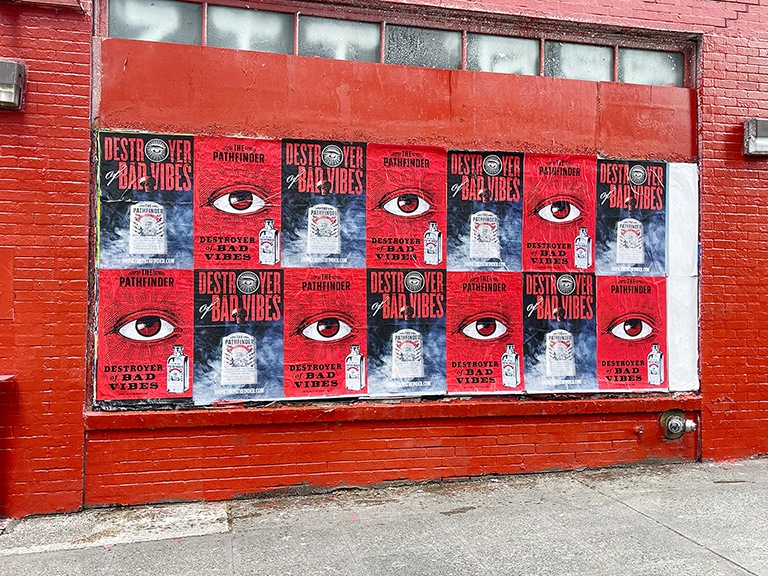
Poster placements are the backbone of street-level brand marketing. The format is direct. Bold visuals placed at eye level on surfaces throughout targeted neighborhoods. We find the right locations, prep the surfaces, and install posters in the volume required to create genuine saturation. Saturation is the word that matters. Seeing a poster once creates mild curiosity. Seeing it six times across a six-block walk creates brand recall.
Creative quality determines everything at this format. A weak poster in a great location accomplishes nothing. Our team reviews creative before any placement goes up. The visual has to stop someone mid-step. It has to communicate the essential brand message in under two seconds. We’ve turned down installation jobs because the creative wasn’t ready, and we’d rather have that conversation early than waste a client’s budget on material that won’t perform.
We typically run poster campaigns in waves. An initial burst establishes presence. A refresh one to two weeks later extends the campaign window as early placements weather and fade. In high-traffic zones like the L train corridor in Williamsburg or the 2 and 5 train stops in the Bronx, a two-wave campaign builds measurable brand recognition that persists weeks after the campaign officially ends.
Stencil Art and Sidewalk Chalk Activations
Stencil work and sidewalk chalk art create a different kind of discovery. They live on the ground. People look down on their walk and find your message. The format works especially well for QR code activations, for directional campaigns routing foot traffic to a nearby opening, and for event marketing where you want an unexpected announcement to reach people in the physical neighborhood where the event is happening.
Our crews have stenciled everything from clean brand marks to complex multi-element installations covering full city blocks. We’ve done chalk art campaigns on the sidewalk outside Madison Square Garden before launch events, stencil runs in SoHo coordinated with retail store openings, and directional campaigns in the Financial District routing lunch-hour foot traffic to new restaurant locations on nearby blocks. The format is fast to install, visually striking, and generates social media content at a rate that consistently surprises clients.
Street Teams and Brand Ambassador Programs
Street teams are human beings. That’s their advantage. A person can look someone in the eye, start a real conversation, answer an honest question, and create a genuine moment of connection between a stranger and a brand. Our brand ambassador programs put trained, high-energy people at the locations and times where your audience is most open to that connection.
We’ve built street teams of over 150 for large-scale launch activations, and we’ve run intimate four-person crews for premium brand experiences that required depth over breadth. The team size depends on geography, goals, and the type of engagement your brand calls for. Handing out product samples at the Columbus Circle farmers market on a Saturday morning requires a completely different team than activating across six subway entrances in Midtown during the morning rush hour.
Our ambassadors receive full briefings on the brand, the message, the product, and the objectives before they hit the street. We don’t send people out with talking points they’ve only skimmed. Our ambassadors know the product and the story well enough to answer real questions and hold real conversations. That’s the quality of human contact that actually drives awareness and trial.
Experiential Pop-Up Activations
Pop-up activations turn a street corner, an empty lot, or a borrowed indoor space into a full brand experience. We’ve built photo-op installations in the Meatpacking District that drew lines stretching down 14th Street. We’ve run sampling and demo activations outside Grand Central with product demonstrations that moved thousands of units in a single afternoon. We’ve created fully branded environments inside partner spaces, from Williamsburg coffee shops and record stores to Chinatown gallery spaces and Lower East Side music venues.
The pop-up format works because it creates urgency. It’s here today. If you miss it, you miss it. That scarcity drives engagement, encourages social sharing, and generates press coverage that scales the campaign’s reach well beyond the direct physical footprint. A well-executed pop-up activation can generate media exposures five to twenty times larger than the immediate foot traffic count suggests.
Projection Mapping and Ambient Campaigns
After dark, New York becomes a different city. Our projection campaigns use the architecture as a screen. We’ve projected brand visuals and product launch messages onto building facades on the Bowery, on warehouse walls in Long Island City along Queens Plaza, and on parking structure exteriors in SoHo during Fashion Week. The combination of scale, surprise, and the darkness that makes the image pop creates a genuinely cinematic brand moment. People stop on sidewalks and watch.
Ambient marketing works on a different principle. Instead of a single concentrated activation, ambient campaigns embed brand messages into the normal texture of a neighborhood’s environment. We’ve placed branded elements in laundromat windows, bodega refrigerator doors, subway platform waiting areas, and coffee shop takeout sleeves throughout targeted ZIP codes. The goal is repeated, low-friction exposure in unexpected contexts. Ambient campaigns build familiarity before a launch. They create the feeling that your brand is already part of the neighborhood before it officially arrives.
How We Plan and Execute a Guerrilla Marketing Campaign
A great campaign starts weeks before anyone steps foot on a street. Our planning process is detailed, methodical, and built on lessons learned through hundreds of executions across New York City and beyond. We don’t improvise the important things.
Discovery and Goal Setting
The first conversation with a new brand is always about goals. What does success look like? Foot traffic to a specific address? Social media exposures in a defined demographic? Brand recognition in a particular neighborhood before a grand opening? Direct product trial? These goals aren’t interchangeable. A campaign optimized for social amplification looks different from a campaign built to drive foot traffic. We need to know which one we’re building before we make a single decision about format or location.
We ask specific questions in discovery. Who is your customer? Where do they spend time in the city? What time of day are they outdoors and moving through neighborhoods where you want visibility? What are they doing in that moment that makes them open to discovering something new? The answers shape the campaign brief, the location list, the format selection, and the creative direction. Discovery is where we earn or lose the trust that makes the rest of the work possible.
Location Scouting: On Foot, Every Time
Our scouts go out on foot. That’s non-negotiable. Google Maps gives you a satellite view. Street-level scouting gives you reality. We walk proposed locations at the exact times of day when the campaign will run. We count foot traffic. We evaluate the quality and density of available surfaces. We note competing visual noise. We observe what’s happening in the immediate environment that we didn’t know about from a distance.
We look for what our crews call pressure points: locations where people naturally slow down, wait, or gather. Subway entrances and exits. Intersection corners with pedestrian countdown signals that hold people in place for 30 to 60 seconds. Coffee shop queues that stretch out onto the sidewalk. Bus stops. Spots outside beloved local businesses where regulars congregate. These are the moments of pause where a campaign lands with force.
We’ve walked away from seemingly excellent locations after scouting revealed conditions we didn’t expect. We’ve discovered incredible spots we never would have found without putting feet on the ground. Scouting is where the real campaign is built. Everything downstream from it is execution.
Creative Development for the Street
Our team works closely with brands on creative for guerrilla marketing campaigns, and the rules here are different from traditional advertising. You don’t have five seconds of attention. You have one second. The visual has to communicate the essential brand message before the viewer has consciously decided to look.
The creative has to be legible from 30 feet. The brand mark has to be instantly recognizable. The message has to be surprising, funny, beautiful, or provokative enough to make someone stop and look again. We push brands toward bolder creative choices than they’re sometimes comfortable with. The street demands it. A timid poster in a busy corridor is invisible. A bold one becomes a landmark.
We’ve learned consistently that copy-heavy creative fails at street level. Big visuals, minimal text, a clear brand mark. That formula outperforms every time. We’ve also learned that seasonally and culturally timely creative outperforms evergreen messaging. A campaign that references something real and current in the neighborhood where it’s placed will always outperform a generic brand message, no matter how well-produced that message is.
Installation, Logistics, and Crew Management
Our crews handle all logistics end to end. Printing and production, material transport and storage, installation scheduling, crew briefings, on-site coordination, and real-time problem-solving. We’ve developed efficient operational systems through years of field execution, and they make a meaningful difference in campaign quality.
We run tight installation windows. Getting into neighborhoods early in the morning, before foot traffic peaks, means we can work efficiently and have the full campaign visible and in place when people start moving. For Midtown activations, we often start before 6 AM. For Brooklyn and Queens neighborhoods, we adjust the timing based on the specific foot traffic rhythms of each block. Our crew leaders communicate in real time during installations. If a location has changed since scouting, we have backup options already identified and ready.
Documentation and Post-Campaign Reporting
Every campaign gets a full documentation package. Our photographers accompany the crews and capture the campaign in context throughout the installation process. We shoot again during peak foot traffic hours to capture audience interaction and the campaign as people actually encounter it. Clients receive a complete photo set along with a detailed post-campaign report.
The documentation package serves multiple purposes. It gives brands strong content for their own social media and internal communications. It’s verifiable proof of execution with timestamps and locations. And it lets our team review the campaign in detail, capture lessons, and improve the next execution. We take post-campaign reporting seriously because the insights from field experience are what make us better at the work over time.
Guerrilla Marketing Campaign Costs and Packages
Pricing for guerrilla marketing campaigns varies based on campaign format, geographic scope, duration, and production requirements. We’re transparent about costs because we’ve found that honest budget conversations early in the process produce better campaigns. Here’s how we break it down.
Major market launches, sustained multi-neighborhood brand presence
What’s Included in Every Campaign
Every campaign we run includes location scouting, creative review and consultation, full installation by our crews, on-site coordination, and a professional photo documentation package delivered within 48 hours of campaign completion. We don’t sell a service and then charge extra for the basics. Documentation, post-campaign reporting, and the debrief conversation are part of the standard package on every job.
For street team programs, we include full brand briefings for every ambassador, all branded materials and handling supplies, real-time field reporting from crew leaders, and an end-of-day summary covering every location worked, approximate contacts made, and notable observations from the field. That last piece has genuine strategic value beyond the campaign itself.
How to Think About Budget Allocation
Brands new to guerrilla marketing sometimes allocate too much budget toward creative production and not enough toward field execution and distribution. In street-level marketing, distribution is the multiplier. A great poster installed in four locations has less impact than a good poster installed in fifty locations. We push clients toward prioritizing distribution volume, because saturation is what creates the neighborhood presence that changes brand awareness.
Our general guidance is to allocate roughly 30 percent of the total campaign budget toward creative production and 70 percent toward field execution, installation, street teams, and distribution. The creative matters enormously. But the streets make the campaign real, and the streets cost money to cover properly.
Measuring Guerrilla Marketing Campaign Results
Traditional advertising metrics don’t map cleanly onto guerrilla marketing campaigns. But that doesn’t mean you can’t measure results. You absolutely can. You just have to measure the right things, using methods appropriate to the format.
Direct Response Tracking
The cleanest measurement comes from campaigns built with direct response mechanisms from the start. A unique QR code on every poster that links to a campaign-specific landing page. A unique URL printed on all brand ambassador materials. A promo code exclusive to the street campaign. When you build tracking in from the brief stage, you can tie street-level exposure directly to digital actions and conversions with clear, auditable data.
We’ve run campaigns where QR code scans started appearing in the client’s analytics within 20 minutes of the first installation going up. We’ve tracked promo code redemption spikes that correlated exactly with our crew’s timing in Williamsburg and the East Village. The data tells a clear and compelling story when the infrastructure is there to capture it.
Social Media Amplification and UGC
User-generated content is one of the most powerful returns on guerrilla marketing investment. When someone photographs our work on their morning walk and posts it to Instagram or TikTok, they’re amplifying the campaign to their entire audience at zero incremental cost to the brand. We track campaign hashtags, location tags, and brand mentions tied to our campaigns throughout the execution window and for several weeks after.
Our best campaigns have generated social media reach five to ten times larger than the direct foot traffic exposure. One pop-up activation we ran in DUMBO for a consumer brand generated over 200 organic Instagram posts in the first 48 hours. The physical activation ran for a single afternoon. The social life of the content extended for three weeks. That multiplier effect is what makes guerrilla marketing campaigns competitive with media buys that cost ten times as much.
Foot Traffic and Sales Lift Analysis
For campaigns tied to a physical retail location, restaurant, or event venue, foot traffic counts and sales data provide direct measurement of campaign impact. We recommend brands establish a clean pre-campaign baseline by counting foot traffic or tracking sales for the two weeks before the campaign launches. We run the campaign. Then we compare post-campaign data to that baseline across a matched time window.
We’ve helped brands document foot traffic lifts of 15 to 40 percent tied to concentrated neighborhood campaigns. The results vary based on creative quality, location targeting accuracy, campaign duration, and how effectively the campaign routes people from the street to the door. But the methodology gives you a real, defensible number that you can show to your team.
Brand Recall and Awareness Surveys
For campaigns focused primarily on brand awareness rather than immediate direct response, structured recall surveys in the target geography give you a measurable outcome you can track over time. We partner with market research firms to run these surveys for clients who need them. You measure aided and unaided brand recall before the campaign launches and again three to four weeks after the campaign completes, in the specific ZIP codes targeted by the activation.
That before-and-after delta is a real number. It reflects actual change in brand familiarity in the exact neighborhoods where your campaign ran. That’s a metric that means something in a strategic planning conversation, and it’s one that media-buy campaigns often struggle to deliver with this level of geographic precision.
Our Best Guerrilla Marketing Campaign Stories From the Field
Theory only goes so far. Here’s what actually happened when our crews hit the streets on some of our most memorable campaigns.
The Houston Street Saturation
A fashion brand came to us for a campaign around a new collection launch. They had a focused budget and a clear goal: make people in Lower Manhattan feel like this brand was everywhere, all at once, all week. We designed a poster saturation campaign centered on a six-block radius around their Houston Street retail location.
Over three consecutive nights, our crews placed over 300 poster boards on surfaces throughout the corridor from the Bowery to Sullivan Street, north to Bleecker and south to Spring. We hit every alley entrance, every loading dock gate, every corner surface that faced foot traffic. By the morning of their launch day, every path leading to the store was covered. People who walked that neighborhood every day stopped the store team to mention they’d been seeing the posters all week. Foot traffic on launch day ran 3.4 times their normal Saturday average. The campaign cost less than a single day of targeted Instagram advertising.
The Bedford Avenue Brand Ambassador Week
A beverage brand hired us for a five-day street team program in Williamsburg built around the launch of a new product line. We placed a crew of eight brand ambassadors at key traffic nodes on and around Bedford Avenue from the L train entrance at North 7th Street down through Metropolitan Avenue.
Our team hit the Driggs Avenue intersection during the morning coffee rush, when the foot traffic is dense and people are in a slow, receptive mood. They worked the McCarren Park entrance at peak afternoon hours on the weekend. They ran the stretch along North 3rd Street near the Rough Trade record store and Radegast Hall. They covered the North 11th Street block during evening hours when dinner crowds moved through. By the end of five days, our ambassadors had made over 12,000 direct consumer contacts and distributed nearly 8,000 product samples. Several food and drink writers who lived in the neighborhood tried the product on the street and mentioned it in their newsletters the following week.
The Grand Central Perimeter Play
A tech company wanted to announce a major B2B product launch to the Midtown professional audience. Instead of trying to activate inside Grand Central Terminal itself, we ran a perimeter campaign around the entire building. Crews worked the entrances on 42nd Street at Vanderbilt, Lexington Avenue at the main entrance, the 45th Street approach, and the Park Avenue viaduct level during the morning rush window from 7:30 to 9:30 AM.
We ran two consecutive mornings, hitting the same commuters twice in 24 hours. The repetition was intentional and critical. First contact creates curiosity. Second contact creates recall. Brand website traffic from New York ZIP codes jumped 34 percent during the campaign window. The company’s LinkedIn product launch post received three times the engagement of their previous product announcement. Two industry newsletters picked up the story based on the street-level buzz they heard from their own readers.
The Bushwick Collective Block Installation
A music streaming platform came to us wanting to connect with Brooklyn’s creative community before a major artist partnership announcement. We proposed an ambient mural installation in Bushwick, coordinated with three independent artists to create original works on Wyckoff Avenue and Jefferson Street that incorporated the platform’s brand language without overwhelming the artists’ creative vision.
The murals went up over a weekend. By Monday, every art account covering the Bushwick Collective had photographed and posted them. The artists tagged the platform in their posts. The platform reshared the organic content. The total earned social media reach from the campaign exceeded 400,000 exposures in the first week, at a fraction of the cost of a paid digital campaign targeting the same demographic. The artists got visibility. The brand got credibility. The neighborhood got artwork. That’s the best version of what guerrilla marketing campaigns can be.
Frequently Asked Questions
What types of brands benefit most from guerrilla marketing campaigns?
Brands with specific geographic audiences get the clearest results. Restaurants, retail stores, event promoters, consumer product companies, and tech companies launching in specific markets all see strong returns. The format works for any brand that needs to reach real people in physical space, and especially for brands whose customers are concentrated in identifiable neighborhoods or daily routin
How much lead time do you need to plan and launch a campaign?
For a standard poster placement or street team campaign, we ask for two to three weeks of lead time. For larger experiential activations, multi-neighborhood poster saturation campaigns, or anything involving custom production, four to six weeks is better planning practice. Rush campaigns are possible and we’ve delivered them in under a week when necessary. Rush timelines cost more and reduce plann
Do campaigns work in winter? What about bad weather?
Absolutely. Winter foot traffic in New York drops from summer peaks but remains enormous by any standard. The upside of winter is that visual noise is lower, competing activations are fewer, and well-placed creative stands out with less competition for attention. Our crews are trained and equipped for cold-weather installations. We’ve run poster campaigns at 15 degrees at 4 AM and brand ambassador
How long do poster and street-level placements typically stay up?
In active New York neighborhoods, placements typically remain visible for one to three weeks before weathering, competing placements, or general wear reduces their impact. We plan campaign windows and refresh schedules based on those realities. For campaigns that need extended presence, we build a refresh wave into the campaign plan and budget from the start. Some placements in more protected loca
Can you target specific demographics through location selection?
Yes, and this is one of the real strengths of the format. New York’s neighborhoods have distinct, well-understood demographic profiles. Williamsburg skews younger and creative. The Financial District skews professional and high-income. Astoria skews diverse, family-oriented, and community-connected. Harlem draws a mix of long-term residents and new arrivals. We select locations based on the audien
Do you work outside New York City?
Our deepest expertise is in New York, but we’ve planned and executed campaigns in Los Angeles, Chicago, Miami, Philadelphia, Boston, and Atlanta. We have running crew relationships in most major markets. If you’re planning a multi-city launch, contact us and we’ll tell you honestly what we can deliver at quality in each market, and where we’d want to partner with strong local operators.
What’s the minimum budget for a campaign that will actually produce results?
For a focused single-neighborhood campaign with meaningful saturation, results start at around $3,000 to $5,000 all-in. Below that threshold, the distribution is too thin to create the density of exposure that moves brand awareness. We’d rather have that honest conversation early than accept a budget we know won’t produce the outcome you’re looking for. Some clients start with a smaller pilot camp